
Malus domestica
Growing apples in Scotland comes down to which rootstockThe root system and lower stem a fruit tree is grafted onto, chosen to control the tree's eventual size rather than for its own fruit. Full definition → actually controls the size of the tree, how pollination groups work, and two varieties genuinely suited to a "northerly, colder rainfall" garden.
James Grieve and Egremont Russet both carry that regional fit as a stated trait, not something inferred from where or when they were bred.
Choosing a rootstock
An apple tree is a graftJoining a chosen fruiting variety onto a separate rootstock, so the tree grows the fruit of one plant on the roots of another. Full definition →: a chosen variety grown on a rootstock that controls its eventual size, not the variety itself and not how old the tree is. There are six standard rootstocks, from most to least dwarfing:
- M27: extremely dwarfingHow much a fruit tree's rootstock limits or allows its eventual size, from extremely dwarfing (smallest) through to very vigorous (largest). Full definition →, 1.2-1.8m. Dwarf pyramids, spindlebush or stepovers, for small gardens with fertile soil.
- M9: dwarfing, 1.8-2.4m. Bush, pyramid, spindlebush or cordonsA fruit tree or bush trained as a single main stem with short fruiting side-spurs, usually grown at an angle against a wall, fence or wire. Full definition →; an excellent choice for small gardens.
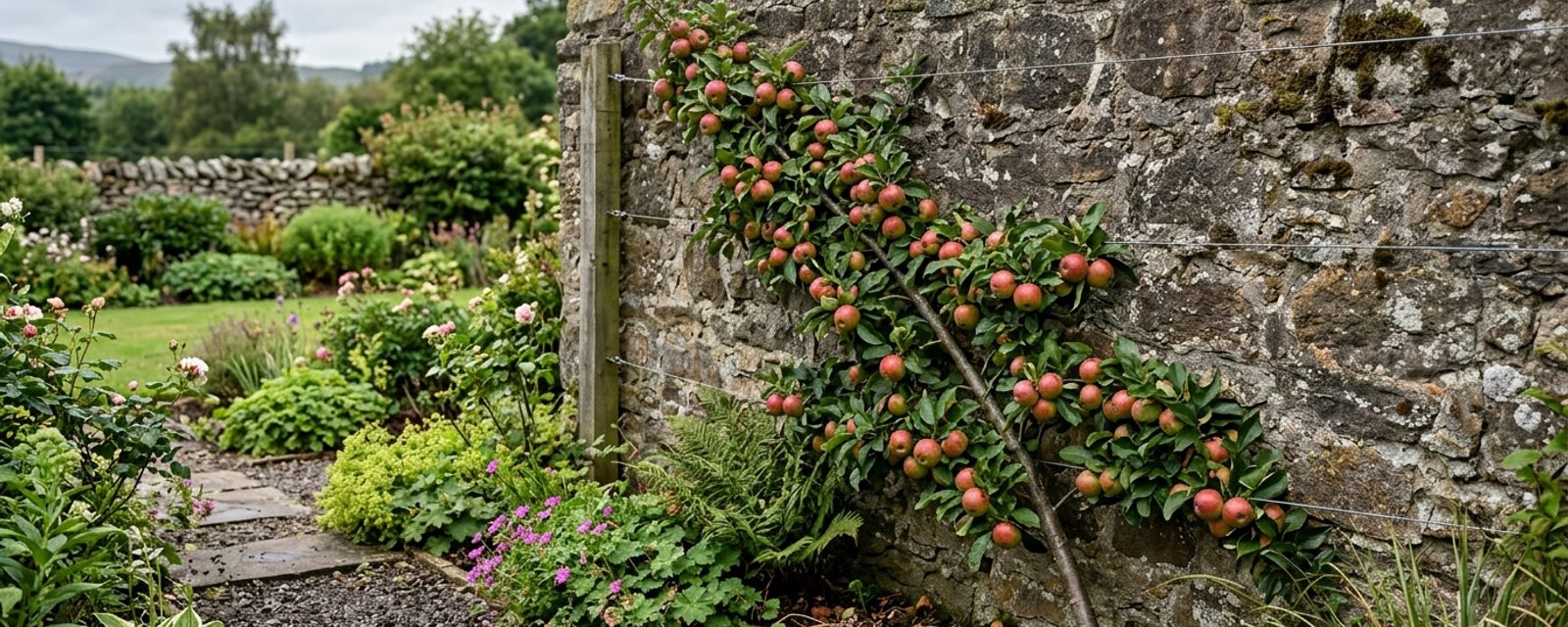
- M26: dwarfing, 2.4-3m. Bush, pyramid, spindlebush, cordon or espalierA fruit tree trained flat against a wall or wire framework with horizontal tiers of branches, most often apples and pears. Full definition →, and good for containers.
- MM106: semi-dwarfing, 3-4m. All forms except standards; tolerant of a range of soils, including grassed orchards and poor soils.
- MM111: vigorous, 4-4.5m. Standards and half-standards.
- M25: very vigorous, 4.5m or more. Standards, for a proper orchard-sized tree.
Buy a tree already grafted onto the rootstock you want; you can't change it later. For a small garden, M27, M9 or M26 grown as a cordon, stepover or trained espalier fits where a full standard tree never would.
Fruit Tree Rootstocks in Scotland → compares how each rootstock actually performs against Scottish soil and exposure, beyond size alone.
Pollination
Apple varieties are classified into flowering groups, so you can choose two that flower at the same time and pollinate each other. James Grieve and Scrumptious are both group 3; Egremont Russet and Ribston Pippin are both group 2. Two varieties from the same group, or adjacent groups, will usually overlap enough to crop well. A handful of varieties, including Ribston Pippin, are self-fertileA plant that can set fruit using its own pollen, without needing a second, different variety nearby to cross-pollinate it. Full definition →: they'll set some fruit alone, but self-fertile trees still crop better with a partner nearby.
A small number of varieties, Bramley's Seedling among them, are triploids: they produce mostly sterile pollen, so they can't effectively pollinate another tree even though they still need pollinating themselves. A triploidAn apple (or other fruit) variety with an extra set of chromosomes, making its own pollen largely useless for pollinating other trees. Full definition → needs two other cultivarsA plant variety that arose or was bred under cultivation and is kept true by deliberate propagation, rather than a naturally occurring wild species. Full definition → nearby, both flowering at the same time as it and as each other, not just one. Crab apples flower over an unusually long period and are genuinely useful pollinators, since their long window overlaps with more groups than a single eating-apple variety can.
Fruit Tree Pollination Groups Explained → works through flowering groups, triploids and self-fertility across apples, pears, plums and cherries together.
Planting
Choose a fertile, free-drainingSoil that lets water pass through quickly rather than pooling, so roots aren't sitting in wet ground after rain. Full definition → site in full sun; avoid a spot prone to waterlogging. If planting into a lawn, clear a circle of grass at least 1m across first. For a trained form against a wall or fence, plant 30cm out from it, giving the roots room. Plant bare-root trees any time from autumn to spring while dormant; containerised trees can go in at any time of year. In a container, use a pot at least 45cm across with loam-based compost, and choose a dwarfing rootstock (M9 or M26).
Care
Water newly planted trees regularly through dry spells for their first couple of years; once established in the ground, they shouldn't need routine watering. Container trees need a steady supply of moisture through the growing season, plus a high-potassium liquid feed every fortnight. A well-mulchedA layer of material spread over the soil around plants to suppress weeds, retain moisture, and improve soil structure as it breaks down. Full definition → tree in the ground generally needs no additional feeding.
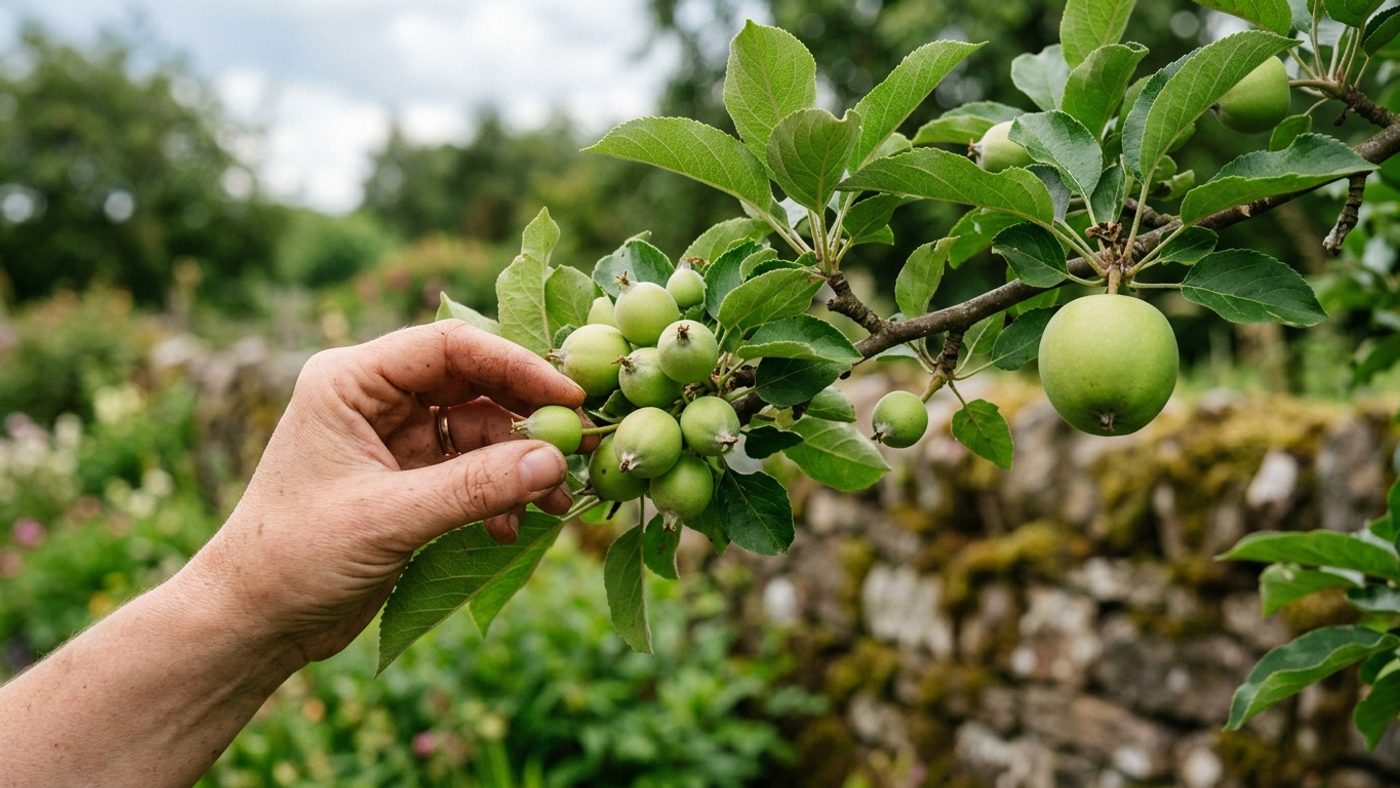
Trees naturally shed some immature fruit in early summer, known as June dropA tree's natural shedding of some immature fruit in early summer, thinning its own crop rather than a sign of a problem. Full definition →: it can look alarming but isn't generally a cause for concern, and a good crop usually remains. If the tree is still carrying more fruit than it can properly size after the June drop, thin further in early July: for dessert apples, down to one or two fruits every 10-15cm. Thinning also helps even out biennial bearingA fruit tree's tendency to crop heavily one year and barely at all the next, then repeat that cycle rather than cropping evenly every year. Full definition →, where a tree crops heavily one year and barely the next, a pattern some varieties are simply naturally prone to, not a sign of a sick tree.
Pruning and training forms
A freestanding bush or standard tree needs pruning only in winter, while dormant. A trained form is different: once its basic framework is established, it's pruned mainly in late summer instead, to keep its shape and encourage fruiting spursWhether a fruit tree carries its fruit mainly on short side-shoots along older wood (spur-bearing) or at the tips of the previous year's growth (tip-bearing). Full definition → rather than leafy growth.
- Cordon: a single stem grown at a 45° angle, carrying short fruiting side-shoots. Space-efficient, good for a small garden or a row along a boundary.
- Espalier: a central trunk with horizontal tiers of branches trained flat, typically against a wall or wires.
- Fan: a short trunk with branches radiating outward, also usually wall-trained.
- Step-over: kept to just 45-60cm tall, a single horizontal pair of branches per side; low enough to step over, and useful as an edging.
- Arch or tunnel: vertical cordons trained up and over a walkway.
Don't seal a pruning cut with wound paint: there's no real need, since it's unlikely to help healing or stop disease getting in, and a cut left alone heals better than one that's bandaged or painted. The one exception among fruit trees is plums and cherries, where a wound paint is still worth using specifically to keep out silver leaf spores, not apples.
Varieties
23 AGMThe RHS's Award of Garden Merit: a UK-wide trials award for reliable performance, not a Scotland-specific recommendation. Full definition → apple varieties suit a home garden, out of more than 60 UK-wide, split across dessert and cooking types and three ripening seasons, including named types beyond these three; the rest haven't been checked for the 'northerly, colder rainfall' trait specifically.
★ Our pick for Scotland
James GrieveAGM
Dessert · early (Sept-Oct) · pollination groupA classification of fruit tree varieties by when they flower each spring, used to check whether two varieties can pollinate each other. Full definition → 3
Confirmed 'suitable for northerly, colder rainfall areas': a genuine regional trait, not a guess.
Why this one: Confirmed 'suitable for northerly, colder rainfall areas': a real regional-suitability trait, not an inference from where it was bred. It also has a genuine Scottish origin, raised by Edinburgh nurseryman James Grieve before 1893, a nice detail but not the reason it's the pick here.
Also worth considering
Egremont RussetAGM
Dessert · mid (Oct-Dec) · pollination group 2 · partially self-fertile
Carries the same trait as James Grieve: 'suitable for northerly, colder, higher rainfall areas'. Also partially self-fertile, though a partner nearby still helps it crop reliably most years.
ScrumptiousAGM
Dessert · early (Sept-Oct) · pollination group 3 · self-fertile
Self-fertile outright, a real option where there's only room for a single tree, which the usual pollination-partner requirement otherwise rules out.
Show other recommended varieties (1)
Bramley's SeedlingAGM
Cooking · late (Nov-Feb) · pollination group 3 · triploid
The standard UK cooking apple. It's a triploid, so it can't act as an effective pollinator: it needs two other cultivars flowering at the same time nearby, not just one, a real planning constraint before choosing it as a garden's only cooker.
Best Apple Varieties for Scotland → compares all named apple varieties head-to-head, with the practical detail that doesn't fit in a summary card.
Harvesting
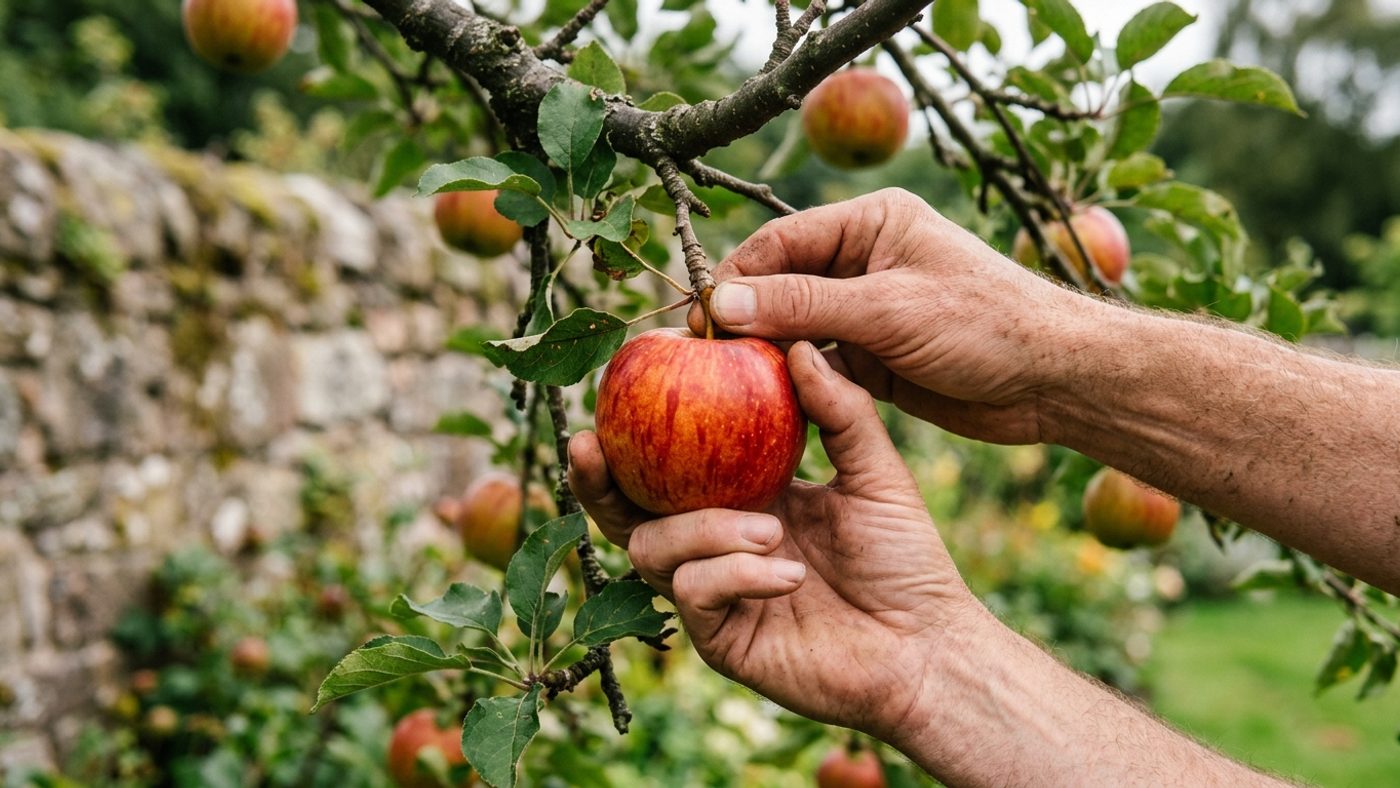
Pick once fruits have swelled to a good size, started to colour, and taste sweet — apples don't ripen further once picked. Cup the apple in your hand, lift it gently and give it a slight twist; a ripe one comes away easily with its stalk intact. Early varieties like James Grieve and Scrumptious are ready from September; later varieties such as Bramley's Seedling hang on into November.
Common problems
- Apple scab causes dark, scabby blotches on leaves and fruit. Rake up and dispose of fallen leaves in autumn to cut the fungus's overwinteringKeeping a plant alive and intact through the cold months, whether left outdoors, moved under cover, or stored dormant. Full definition → source.
- Fruit aphids, including woolly aphid and rosy apple aphid, distort new growth and shoots.
- Codling moth caterpillars tunnel into the fruit itself, usually found at the core when an apple is cut open.
See more problems
- Powdery mildew coats leaves and shoots in a white film; apples are among the plants it affects most.
- Apple canker causes sunken, cracked patches of bark that can girdle and kill a branch. Cut out affected wood back to clean growth.
- Bitter pit shows as dark sunken spots on stored fruit. It's a calcium disorder, not pest or disease damage, driven by an irregular water supply rather than usually a true lack of calcium in the soil. Consistent watering and mulching through the season matters more here than in a hot, dry summer.
- Biennial bearing, a heavy crop one year followed by almost nothing the next, is a cropping pattern some varieties are naturally prone to, not a sign of a dying tree. Deliberate thinning after June drop helps even it out over following years.
- Brown rot turns fruit soft and brown with pale concentric rings, usually spreading from a wound or through fruit touching in storage. Remove affected fruit promptly.
- Honey fungus is a serious root disease with no cure; remove and destroy an affected tree.
Common questions
Do I need two apple trees to get fruit?
Not always: a self-fertile variety such as Scrumptious will fruit alone, though even self-fertile trees tend to crop better with a second tree from the same or an adjacent pollination group nearby. Full sourced breakdown: <a href="/tools/garden-myths/apples/">Apple Myths →</a>
What does a pollination group number actually mean?
Apple varieties are classified into flowering groups so you can pick cultivars that flower at the same time and can pollinate each other. Two varieties from the same group, or from adjacent groups, will usually overlap enough to pollinate successfully. Crab apples flower over an unusually long period and are particularly useful pollinators for exactly this reason, since a long flowering window overlaps with more groups than a single eating-apple variety can.
What's a triploid apple, and why does it matter?
A small number of varieties, including Bramley's Seedling and Ribston Pippin, produce mostly sterile pollen and can't effectively pollinate other trees, even though they still need pollinating themselves. A triploid needs two other cultivars planted nearby, both flowering at the same time as it and as each other, not just one partner as with an ordinary variety.
How small can an apple tree actually be kept?
As small as 1.2-1.8m on M27, the most dwarfing rootstock: small enough for a cordon, stepover or trained espalier in a garden with no room for a full orchard tree. Full sourced breakdown: <a href="/tools/garden-myths/apples/">Apple Myths →</a>
Sources
8 sources, and what each was used for
- RHS: getting started, rootstocks (M9/M26 dwarfing, MM106 semi-dwarfing), pollination requirement, 23 AGM varieties across dessert/cooking/dual-purpose and three seasons, site and soil prep, planting method and timing, container growing, watering, feeding, June drop and thinning, trained forms (cordon/espalier/fan/step-over/arch), pruning timing, harvesting method, storage, and the nine named problems
- RHS: full rootstock table: M27, M9, M26, MM106, MM111, M25, with exact ultimate heights and spreads and named use (stepover, cordon, espalier, bush, standard) for each
- RHS: how pollination groups work, self-fertile varieties still cropping better with a partner, triploid varieties (Bramley's Seedling, Holstein, Ribston Pippin, Blenheim Orange, Catillac) needing two other cultivars flowering at the same time, crab apples as long-flowering universal pollinators
- RHS: pollination group 3, AGM, 'suitable for northerly, colder rainfall areas', season of use, disease susceptibility list
- RHS: pollination group 2, partial self-fertility, AGM, 'suitable for northerly, colder, higher rainfall areas', season of use
- RHS: pollination group 3, self-fertile, AGM, season of use
- RHS: AGM, triploid status and pollination requirement, season of use, vigour and recommended rootstock
- rhsplants.co.uk: confirms Ribston Pippin as a second triploid, pollination group 2, season of use