
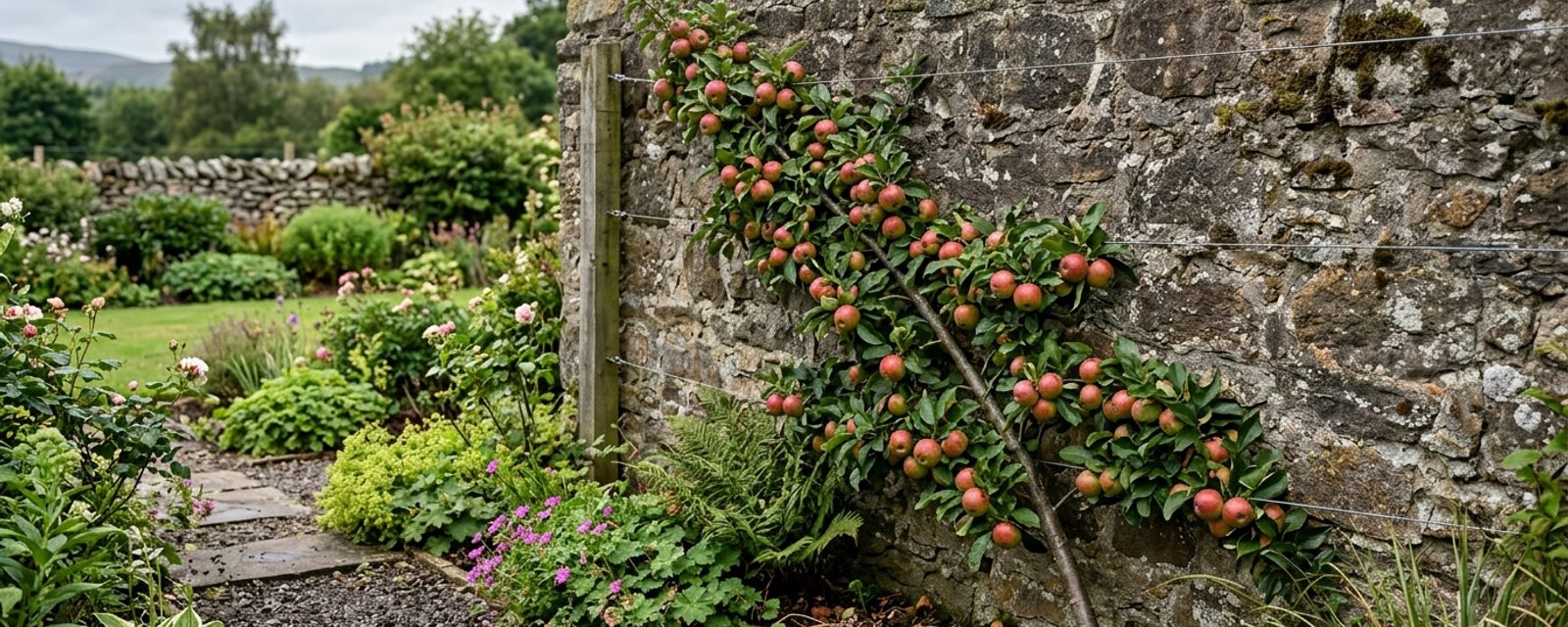
Scotland's growing season runs shorter and cooler than the rest of the UK, and that changes which apple varieties are actually worth the space in a Scottish garden. The grow-your-own guide lists 23 Award of Garden Merit (AGMThe RHS's Award of Garden Merit: a UK-wide trials award for reliable performance, not a Scotland-specific recommendation. Full definition →) apple varieties, but AGM is a UK-wide award, not a Scottish recommendation. Six of the 23 carry a further, more specific tag on their own individual plant pages: "suitable for northerly, colder, higher rainfall areas." That's the real shortlist for a Scottish garden, and it's the starting point for this guide.
Quick answer
For most Scottish gardens with room for two trees, James Grieve is the strongest all-round pick, an early dessert apple that carries the northerly-suitability tag, crops reliably, and pollinates easily alongside other mid-season varieties. If space allows only one tree, Scrumptious is the better choice since it's self-fertileA plant that can set fruit using its own pollen, without needing a second, different variety nearby to cross-pollinate it. Full definition → and doesn't need a second variety nearby. For the longest storage life into winter, Edward VII is worth the extra wait.
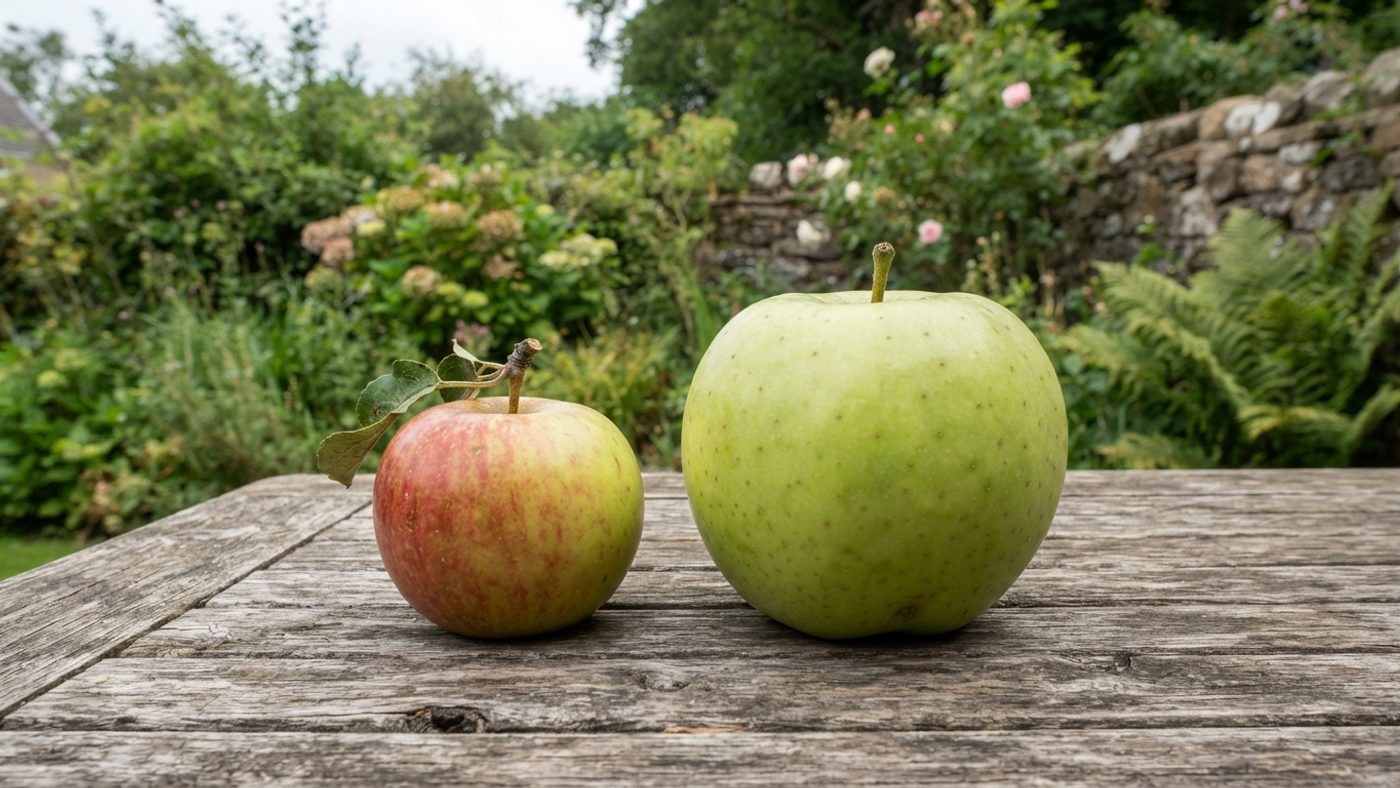
The six regionally-tagged varieties
Ripening date and pollination groupA classification of fruit tree varieties by when they flower each spring, used to check whether two varieties can pollinate each other. Full definition → are what actually separate these six once site suitability is settled, and both change how a two-tree planting plan needs to fit together.
| Variety | Type | Ripens | Pollination group | Notes |
|---|---|---|---|---|
| James Grieve | Dessert | Early (Sept–Oct) | 3 | Reliable early cropper |
| Egremont Russet | Dessert | Mid (Oct–Dec) | 2 | Partially self-fertile |
| Emneth Early | Culinary (codling type) | Early (Aug–Sept) | 3 | Heavy, typically biennialA plant that completes its life cycle over two years: growth in year one, then flowering, seeding and dying in year two. Full definition → crops, needs thinning |
| Grenadier | Culinary | Early (Aug–Sept) | 3 | Reliable early cooker |
| Lord Lambourne | Dessert | Mid-late (late Sept–Nov) | 2 | Good flavour, moderate vigour |
| Edward VII | Culinary | Very late (Dec–April) | 6 | Needs a late-flowering pollinator; long storage |
Emneth Early's own page goes further than a bare tag, stating it will "produce heavy, typically biennial crops that need thinning for size" in these conditions, worth knowing before planting it expecting a light, even annual harvest. Biennial bearingA fruit tree's tendency to crop heavily one year and barely at all the next, then repeat that cycle rather than cropping evenly every year. Full definition → (heavy crop one year, little the next) is a trait to watch across several of these varieties; see biennial bearing for what causes it and how to manage it.
Edward VII sits in pollination group 6, the latest-flowering of the six, and needs a pollinator flowering at the same time, most of the other early and mid-season varieties here won't overlap with it, so pair it with another late-flowering apple rather than assuming any tree in the garden will do.
A late spring frost at blossom time can wipe out a season's pollination regardless of which variety is planted, and a sheltered site away from a frost pocketA low-lying spot where cold air drains and pools on still nights, making it noticeably more frost-prone than the surrounding area. Full definition →, exposed hillside or coastal wind matters more here than the variety choice itself. The regional frost dates page shows how much frost timing itself shifts from one part of Scotland to another.
A crab apple is worth considering alongside any of the varieties here: it flowers over an unusually long period, so it can act as a pollinator for a wider range of pollination groups than a second eating or cooking apple would.
Pollination planning: triploids need two neighbours, not one
A small number of apple varieties are triploids: their pollen is mostly sterile, so while they still need pollinating themselves, they can't do the job for another tree in return. Plant one and it needs two other compatible varieties nearby, both flowering at the same time as it and as each other, not the one partner an ordinary two-tree garden usually plans for.
Three triploids are relevant here:
| Variety | Type | Pollination group | Pollinator partners needed |
|---|---|---|---|
| Bramley's Seedling | Culinary (standard UK cooker) | 3 | Two, not one, and holds its own separate AGM outside the main 23-variety list |
| Ribston Pippin | Dessert | 2 | Two, not one, no regional-suitability tag on its own page |
| Warner's King | Culinary | 2 | Two, not one, no regional-suitability tag on its own page |
The general fruit-pollination guidance names five triploids, Bramley's Seedling, Holstein, Ribston Pippin, Blenheim Orange, Catillac, but doesn't include Warner's King in that list. Warner's King's own individual plant page states "triploidAn apple (or other fruit) variety with an extra set of chromosomes, making its own pollen largely useless for pollinating other trees. Full definition →" outright, so plan it the same way as the other two: two pollinator partners, not one.
For a garden with space for only two trees, all three of these are awkward choices unless a third tree can be fitted in.
The single-tree option: Scrumptious
Scrumptious is explicitly self-fertile on its own page, a genuine option where there's only room for one apple tree, which the pollination requirement of most other varieties here would otherwise rule out. It's an early dessert apple (Sept–Oct, pollination group 3), and doesn't carry the northerly-suitability tag.
The other 17 AGM varieties
The remaining 17 of the 23 AGM varieties, Ashmead's Kernel, Charles Ross, Christmas Pippin, Discovery, Fiesta, Golden Noble, Greensleeves, Howgate Wonder, Kidd's Orange Red, Lane's Prince Albert, Laxton's Fortune, Peasgood's Nonsuch, Ribston Pippin, Scrumptious, Sunset, Warner's King, and Worcester Pearmain, all carry the same hardiness ratingThe RHS's H1a–H7 scale for how much cold a plant can survive outdoors, H1a being tender indoor-only and H7 hardy anywhere in the UK. Full definition →, H6 (hardy throughout the UK and northern Europe, down to around -15 to -20°C), as the six regionally-tagged varieties above, cold tolerance isn't what separates the two groups, since it's identical across all 23; the regional tag is a separate, narrower call made on only six of them. That doesn't mean the other 17 perform badly in Scotland, a variety without the tag can still crop perfectly well in a sheltered Scottish garden. None of the 23, tagged or not, is flagged for scab resistance specifically; scab is worth managing as its own issue on any of these rather than choosing a variety to avoid it. Worcester Pearmain is worth flagging separately: it's a "tip bearerWhether a fruit tree carries its fruit mainly on short side-shoots along older wood (spur-bearing) or at the tips of the previous year's growth (tip-bearing). Full definition →," fruiting mainly at the ends of its shoots rather than on short spurs along the branch like most apples here, which changes how it should be pruned, see the full growing guide for pruning by habit.
Older Scottish-raised apples outside the AGM system entirely, without a sourced trait record to check, aren't covered here.
RootstockThe root system and lower stem a fruit tree is grafted onto, chosen to control the tree's eventual size rather than for its own fruit. Full definition → choice, how large the tree ends up, from the very dwarfingHow much a fruit tree's rootstock limits or allows its eventual size, from extremely dwarfing (smallest) through to very vigorous (largest). Full definition → M27 up to the vigorous M25, applies to any of these varieties and is a decision made independently of which variety is planted; the full growing guide covers rootstocks, pollination-group mechanics, planting, training and pruning in depth.
The best overall pick, and when something else wins
James Grieve is the strongest general-purpose choice: it carries the regional-suitability tag, ripens early enough to beat a short season, and its pollination group sits comfortably alongside other mid-season varieties for straightforward two-tree planting. It also has a genuine Scottish origin: raised by Edinburgh nurseryman James Grieve before 1893. Three situations point elsewhere:
- Only room for one tree: Scrumptious, for its self-fertility.
- Longest storage into winter: Edward VII, ready from December through April, though it needs a late-flowering pollinator.
- Dedicated cooking apple: Grenadier for an early, reliable cooker, or Bramley's Seedling for the standard UK cooking apple, keeping in mind its triploid pollination needs.
Storage and keeping
Beyond the storage life given for each variety above, only firm, unblemished apples keep well, bruised or damaged fruit should be used first rather than stored. Storing them in freezer bags with a few pinholes for ventilation, kept in the fridge or another cool, frost-free place and checked regularly, keeps apples in good condition for several months.
Common problems relevant to variety choice
Apple scab and powdery mildew are the two fungal issues most likely to matter in a higher-rainfall garden, but neither is a trait any of the 23 varieties above is bred to resist, the regional tag covers climate suitability, not disease resistance, so scab and mildew are worth managing as their own issue regardless of which variety is planted, alongside apple canker, which favours wet, heavy soils. Aphids and woolly aphid affect most varieties similarly regardless of pick. Codling moth damages fruit rather than favouring particular varieties, but pheromone traps set in May help interrupt its cycle. Grease bands applied around trunks in autumn stop wingless female winter moths climbing up to lay eggs, reducing damage from moth caterpillars the following spring. Bitter pit, a calcium-related storage disorder, and brown rot, which spreads fast between stored fruit, are both reasons to store only sound, unblemished apples as noted above. Honey fungus is a soil-borne risk worth checking for before planting on a site with a history of tree loss, regardless of variety.
A sulphate of potash feed applied in late winter or early spring encourages flowering and fruit set across all varieties.
Common questions
Do I need two apple trees to get fruit?
Most apple varieties need a second, compatible variety flowering at the same time nearby to pollinate reliably. Scrumptious is the exception among the varieties covered here, it's self-fertile and will fruit alone. Triploid varieties (Bramley's Seedling, Ribston Pippin, Warner's King) need two other compatible varieties, not one, since they can't effectively pollinate anything else themselves.
Which apple variety is best for a small Scottish garden with only one tree?
Scrumptious, since it's self-fertile and doesn't rely on a second tree flowering at the same time. Its size is then a rootstock decision rather than a variety one, the full growing guide covers rootstock choice from dwarfing to vigorous.
Does AGM mean an apple variety is recommended for Scotland?
No. AGM is a UK-wide award for garden performance and reliability. Only six of the 23 AGM varieties named carry a further, separate tag for suitability in northerly, colder, higher-rainfall conditions: James Grieve, Egremont Russet, Emneth Early, Grenadier, Lord Lambourne, and Edward VII.
Is Warner's King really a triploid, given it's missing from RHS's main pollination list?
Yes. The general fruit-pollination page lists five triploids and doesn't include Warner's King, but its own individual plant page states "triploid" explicitly. Plan for it needing two other pollinator varieties, not one.
Sources
14 sources, recorded with what each was used for
- Apples: Grow Your Own: The 23 AGM varieties, general cultivation
- James Grieve (AGM): Regional-suitability tag, ripening season, pollination group
- Egremont Russet (AGM): Regional-suitability tag, partial self-fertility
- Emneth Early (AGM): Regional-suitability tag, biennial-bearing note
- Grenadier (AGM): Regional-suitability tag, ripening season
- Lord Lambourne (AGM): Regional-suitability tag, ripening season
- Edward VII (AGM): Regional-suitability tag, pollination group, storage life
- Malus domestica Bramley's Seedling (C) AGM: Triploid status, pollination requirement
- Ribston Pippin (AGM): Triploid status
- Warner's King (AGM): Triploid status, absent from the general triploid list
- Scrumptious (AGM): Self-fertility
- Fruit Pollination: General triploid list (Bramley's Seedling, Holstein, Ribston Pippin, Blenheim Orange, Catillac)
- How to Grow Apples: General cultivation, storage method
- Essential Apple Care Guide: Sulphate-of-potash feeding, grease bands, pheromone traps