
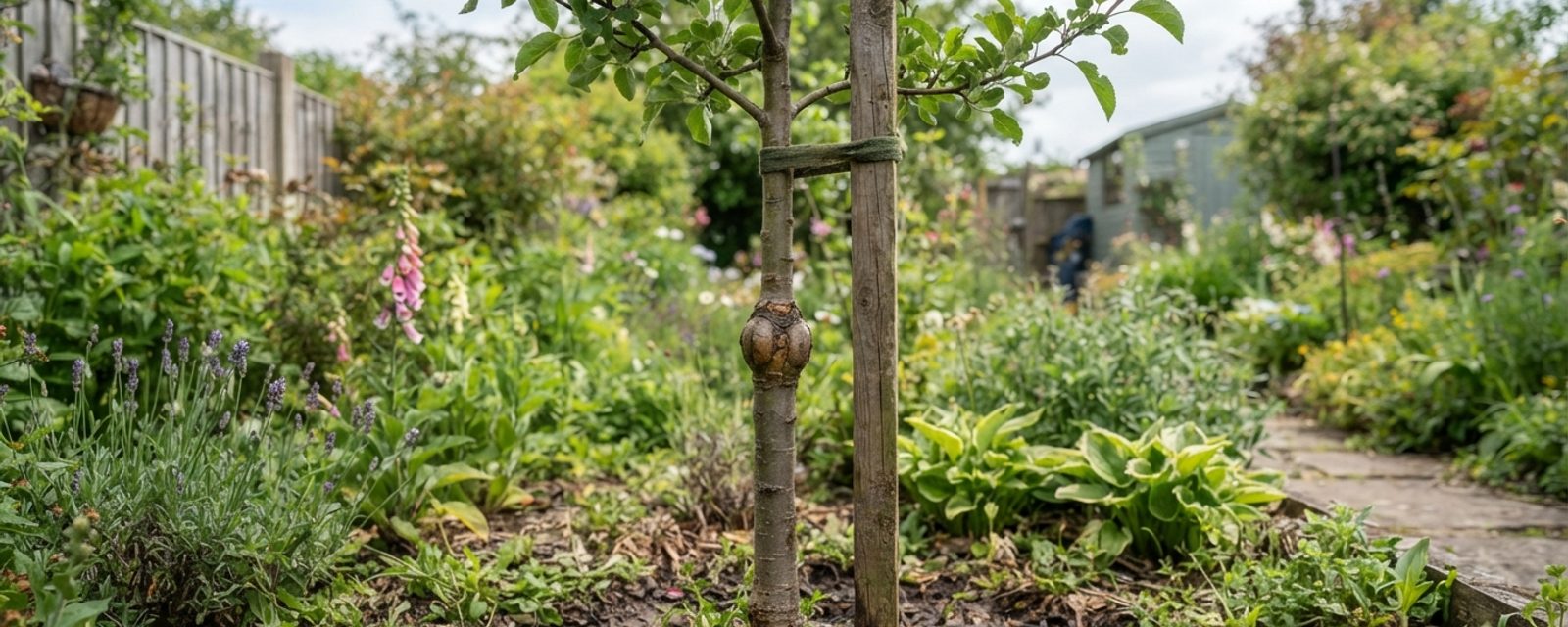
Every graftedJoining a chosen fruiting variety onto a separate rootstock, so the tree grows the fruit of one plant on the roots of another. Full definition → fruit tree is, physically, two trees. The top, the scion, is the variety you actually want to eat: a Bramley, a Victoria plum, a Stella cherry. Below it, hidden under the soil and the first few inches of trunk, is a completely different plant: the rootstockThe root system and lower stem a fruit tree is grafted onto, chosen to control the tree's eventual size rather than for its own fruit. Full definition →, selected not for its fruit but for what it does to the roots and the union above them. The two are joined at a visible swelling or kink low on the trunk, usually a hand's width or two above ground. That join, not the variety label on the tree, is what decides how big the tree will get, how soon it fruits, and how much support it will need for the rest of its life, and, on an exposed Scottish site, how easy it is to keep standing through a winter gale.
The graft union: what it is and why it limits the tree
Grafting works because a wounded stem tries to heal itself. When a scion is cut to fit snugly against a rootstock, with the thin green cambium layer just under the bark of each lined up against the other, the tree responds to the wound by growing callus tissue that seals the join and gradually fuses the two cambium layers into one continuous piece. Given a clean cut and good contact, new growth typically appears within six to eight weeks, and the union then stays intact, and load-bearing, for the tree's entire life.
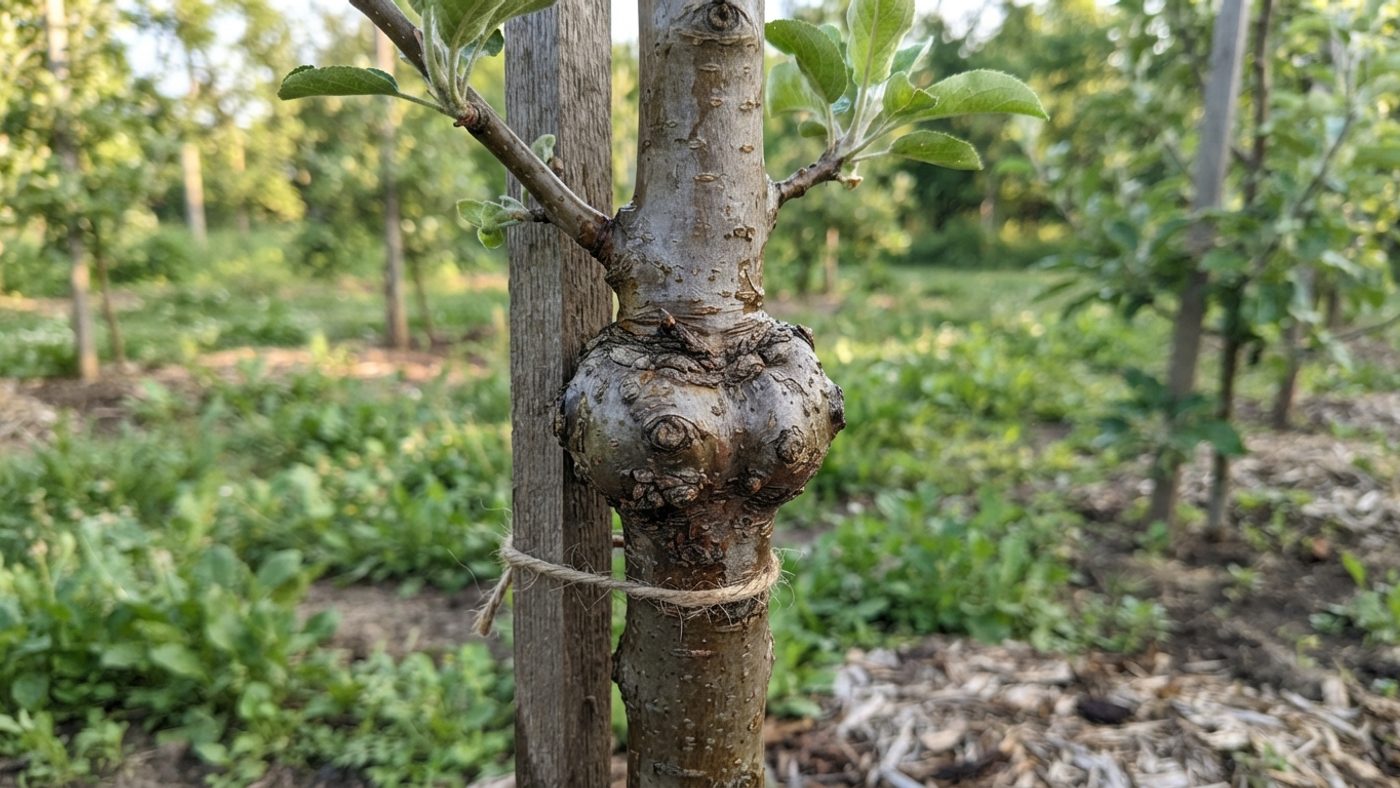
Once fused, the union is not a neutral join. It's the only route water and nutrients can take from the rootstock's roots up into the scion's branches, and the only route sugars produced by the scion's leaves can take back down to the roots. Any restriction at that junction, a narrower band of vascular tissue, incompatible cell chemistry between two different rootstock and scion genotypes, a slight misalignment carried forward from the graft, throttles that two-way traffic to some degree. A dwarfing rootstock is, mechanically, one that restricts this flow more; a vigorous one restricts it less. That's the entire basis for the size categories nurseries print on their labels. It's also why a graft union that fails outright is so damaging: if the join separates, or develops the corky, impermeable layer that marks a failed graft, nutrient flow between rootstock and scion stops, the top of the tree starves and dies back, and the rootstock is often left alive underground, sometimes throwing up suckersA shoot that grows from a plant's roots or lower trunk, separate from the main framework, usually removed before it diverts energy. Full definition → of its own.
The same restricted plumbing that limits a tree's ultimate height also brings it into cropping earlier than a tree grown on its own roots would. A vigorous root system pushes a young tree into leafy growth first and fruiting later; a restricted one runs out of room to put on more wood and diverts more of its resources into flower buds sooner. That's why the most dwarfing rootstocks in every genus tend to fruit soonest, and the most vigorous ones tend to take longest to get going.
Rootstock codes across apples, pears, plums and cherries
Each fruit genus has its own family of rootstocks, because they aren't interchangeable between species, an apple rootstock won't take an apricot graft. But the underlying logic (restrict the union more, get a smaller, earlier-fruiting tree; restrict it less, get a bigger, slower one) is identical across all four.
| Crop | Rootstock | Vigour | Approx. height | Years to first crop | Staking |
|---|---|---|---|---|---|
| Apple | M27 | Extremely dwarfingHow much a fruit tree's rootstock limits or allows its eventual size, from extremely dwarfing (smallest) through to very vigorous (largest). Full definition → | 1.2–1.8m | ~2 years | Permanent |
| Apple | M9 | Dwarfing | 1.8–2.4m | 2–3 years | Permanent |
| Apple | M26 | Dwarfing | 2.4–3m | 2–3 years | Permanent |
| Apple | MM106 | Semi-vigorous | 3–4m | 3–4 years | For its first ~5 years |
| Apple | MM111 | Vigorous | 4–4.5m | 4–5 years | Only while young |
| Apple | M25 | Very vigorous | 4.5m+ | 5–6 years | Only while young |
| Pear | Quince C | Dwarfing | 2.5–3m | ~4 years | Permanent |
| Pear | Quince A | Semi-vigorous | 3–4.5m | ~4 years | For its first ~5 years |
| Plum | Pixy | Semi-dwarfing | 3–4m | 3–4 years | Permanent |
| Plum | St Julien A | Semi-vigorous | 4.5–5m | 3–4 years | For its first ~5 years |
| Cherry | Gisela 5 | Semi-dwarfing | 2.4–3m | 3–4 years | Permanent |
| Cherry | Colt | Semi-vigorous | 6m | 3–5 years | Permanent to establishment |
Pears have no widely available very-vigorous rootstock to match apples' M25, Quince A is as far as the vigorous end goes for pears. Height and cropping-age ranges for the same code also vary between sources, M9 and M26 especially, since actual size depends on soil, form and how the tree is trained as well as the rootstock itself.
Rootstock is chosen once, at the nursery: buy a tree already grafted onto the code you want, since a rootstock can't be swapped or changed on a tree that's already growing. Whether that tree arrives bare-rootA plant, usually a fruit tree or hedging, sold with its roots exposed rather than in a pot, and only available while dormant. Full definition → or container-grown is a separate, unrelated choice about delivery and planting timing, it doesn't change anything about how the rootstock behaves once it's in the ground.
What actually differs between the categories
Vigour category is shorthand for a bundle of practical consequences, not just a height:
| Category | Rootstocks | Staking | Soil and feeding | Best suited to |
|---|---|---|---|---|
| Dwarfing / extremely dwarfing | M27, M9, Quince C | Permanent, for life | Needs reliably fertile soil, plus steady watering and feeding — the restricted roots can’t forage far on their own | Containers and very small gardens; fruits soonest |
| Semi-dwarfing / semi-vigorous | M26, MM106, Quince A, Pixy, St Julien A, Gisela 5, Colt | First ~5 years only, or to establishment | Tolerates a wider range of soils | A full-size but manageable garden tree |
| Vigorous | MM111, M25 | Only while young | Tolerates poor soils best of all | Large gardens or orchards; slowest to first crop |
On an exposed site, the dwarfing rootstocks' permanent stake is doing real work every winter, not just holding up a young tree, it's the reason those smaller trees stay upright through a gale that a young, lightly-staked vigorous tree might not.
Rootstock has no bearing on pollination requirements or blossom's frost tolerance: a self-fertileA plant that can set fruit using its own pollen, without needing a second, different variety nearby to cross-pollinate it. Full definition → variety fruits alone and an early-flowering one still flowers early, whatever it's grafted onto. Both come down to variety and siting, not the rootstock code, see the apple, pear, plum and cherry growing guides for pollination-group detail specific to each crop.
The Scottish angle: does climate change the calculation?
It's tempting to assume Scotland's cooler, shorter growing season calls for a more vigorous rootstock to compensate, the way a grower might choose a faster-maturing vegetable variety. That doesn't hold up. Rootstock vigour governs the mechanical restriction at the graft union, how much wood and root the tree can build, not the tree's tolerance of cold or its ability to ripen fruit faster in a shorter season; those are governed by variety choice (early- versus late-ripening cultivarsA plant variety that arose or was bred under cultivation and is kept true by deliberate propagation, rather than a naturally occurring wild species. Full definition →) and siting, not by rootstock code. A more vigorous rootstock builds a bigger tree over more years; it doesn't make that tree cope with cold or a short season any better once it's cropping.
Wind is the more genuine Scottish-specific consideration, and it points the opposite way from vigour-for-climate-compensation. Met Office regional climate data for eastern and western Scotland shows sheltered inland areas of both averaging around 5 days of gale-force wind a year, but exposed coasts, islands and uplands running much higher, over 20 days a year in exposed eastern uplands, and over 25 days a year in the Hebrides. A taller, more vigorous tree simply catches more wind higher off the ground through exactly the years, before it's fully rooted in, when it's staked only lightly or not at all, since vigorous-rootstock trees are typically left unstaked once established. A smaller tree on a dwarfing or semi-dwarfing rootstock, kept on a permanent stake for its whole life, is mechanically easier to protect in an exposed plot, and easier to underplant with windbreak hedging or fit against a sheltering wall.
In an exposed Scottish garden, the deciding factor is less about rootstock vigour interacting with climate and more about site shelter and how much staking commitment you're prepared to keep up. A gardener on an exposed coastal or upland plot has a genuine reason to lean toward a smaller, permanently staked tree, regardless of how mild or short the growing season is; a gardener in a sheltered city garden or walled plot is freer to choose on the basis of eventual size and cropping speed alone, the same trade-offs a grower anywhere in the UK would weigh.
How to choose in practice
- Start from available space, not desired vigour. Measure the planting spot at the tree's eventual width, not its current empty gap, an MM111 or M25 apple needs several metres of clearance in every direction at maturity.
- Weigh patience against permanence. Dwarfing rootstocks reward with fruit in two to three years but commit you to permanent staking and closer attention to watering and feeding for the tree's whole life; vigorous rootstocks are closer to a self-sufficient long-term planting once past their first few years, but ask for a five- or six-year wait for a first proper crop.
- Factor in exposure honestly. On a windy coastal, upland or otherwise exposed Scottish site, a smaller, permanently staked tree on a dwarfing or semi-dwarfing rootstock is the easier tree to keep intact through winter gales, independent of any climate-driven vigour argument.
- Match soil to rootstock, not the reverse. The more dwarfing rootstocks generally need reliably fertile, weed-free soil to perform; poorer or heavier soils suit the more vigorous end of each range better, which argues for going up a vigour class on a thin or neglected plot even in a small garden.
- Don't assume every code is stocked locally. Not all rootstocks above are equally available from every nursery, check what a specific supplier offers a given variety grafted onto before settling on a code, since the choice is often narrower in practice than the full published range suggests.
Common questions
What does a fruit tree rootstock actually do?
It forms the root system and lower trunk that a chosen fruit variety is grafted onto, and the degree of restriction at the graft union between the two sets everything else: eventual height, years to a first crop, and how much staking the tree will need.
Which apple rootstock is best for a small Scottish garden?
M9 or M26 suit most small to medium gardens, giving a tree roughly 1.8–3m tall that fruits within two to three years, provided the soil is reasonably fertile and the tree is kept permanently staked, which also happens to be the easier size to keep upright on an exposed plot. M27 is smaller still but needs the best soil and most consistent care, so it’s better suited to a container than open ground.
Do I need to stake a fruit tree forever?
It depends on the rootstock, not the variety. Trees on dwarfing and semi-dwarfing rootstocks (M27, M9, M26, Quince C, Pixy, Gisela 5, Colt) need permanent staking because their restricted root systems can’t anchor the tree unaided even at maturity. Trees on more vigorous rootstocks (MM111, M25, St Julien A, Quince A, MM106) generally only need staking for their first several years while the root system establishes.
Does living in a colder or windier part of Scotland mean I should choose a more vigorous rootstock?
No — vigour and cold tolerance are unrelated. If wind exposure is the concern, it points the other way: a smaller, permanently staked tree is usually the easier one to protect on an exposed site.
Can I turn a vigorous rootstock into a smaller tree through pruning instead?
Pruning shapes and restrains growth, but it doesn’t override what the graft union restricts. A tree on a vigorous rootstock like M25 or MM111 will keep pushing vigorous regrowth after hard pruning and needs it repeated; choosing a more dwarfing rootstock from the outset achieves a small permanent size with far less ongoing pruning effort.
Sources
6 sources, recorded with what each was used for
- RHS: Rootstocks for fruit: Every rootstock code, vigour category, height range, and staking requirement in the comparison tables
- RHS: Fruit basics — rootstocks: General framing of what a rootstock controls and why
- RHS: Grafting ornamental plants and fruit trees: The graft-union healing mechanism and typical callus timing
- RHS: Graft failure in trees: What happens when a graft union fails
- Met Office: Eastern Scotland climate: Average annual gale-day counts for exposed vs. sheltered eastern Scotland
- Met Office: Western Scotland climate: Average annual gale-day counts for exposed vs. sheltered western Scotland, including the Hebrides