
Codling Moth is a minor pest that affects apples and quince in Scotland. Here is what it looks like, how to spot the damage, and which controls have been tested.
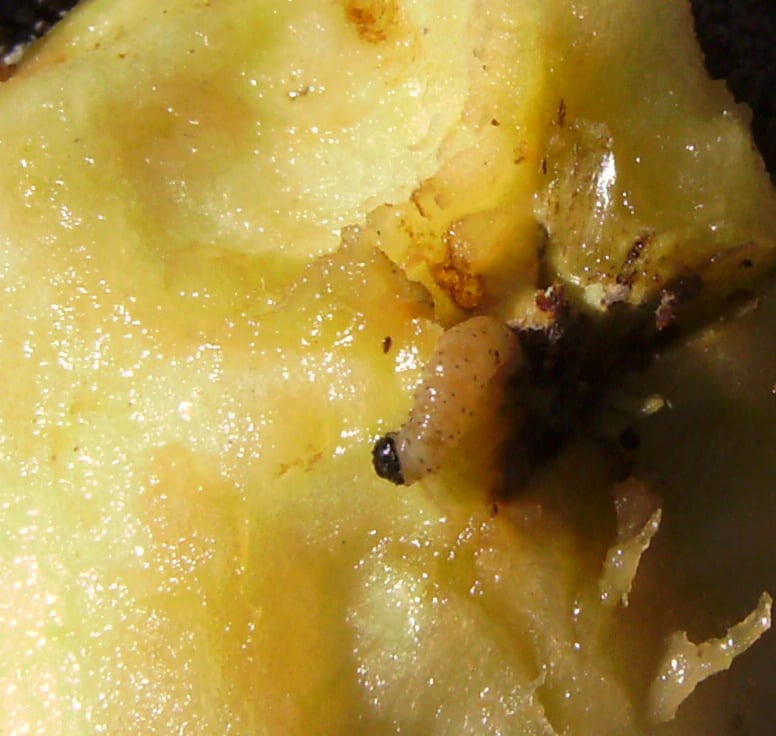
What does it look like?
The adult is a small moth, up to 22mm across the wings, blackish-brown and grey speckled with a bronze patch near the wingtip. It's the larva that actually gives the pest away: a small white, brown-headed caterpillar found tunnelling into the fruit's core.
What causes it
Eggs are laid on developing fruit during a specific window, June to mid-July, so it's the overlap between that window and the fruit's own developmental stage that decides whether a tree is at risk that year. Adults only fly and mate on warm evenings above roughly 15°C, so a run of cool evenings during that window genuinely limits how much egg-laying actually happens.
Is this pest active now?
Watch from late May, when adults emerge, through mid-July, the window eggs are laid on developing fruit.
Symptoms
An exit hole appears on the side of the fruit or at the end opposite the stalk, and cutting the fruit open reveals tunnelling and frass around the core. Affected fruit often ripens early and drops from the tree ahead of the rest of the crop.
Life cycle
Adults emerge from late May into June and lay eggs on developing fruit through to mid-July. In southern Britain this is usually one full generation plus a partial second, though only in hot summers warm enough to support it. Caterpillars bore into the fruit and feed in the core for around four weeks, then leave to overwinterKeeping a plant alive and intact through the cold months, whether left outdoors, moved under cover, or stored dormant. Full definition → as non-feeding caterpillars sheltering in bark crevices or leaf litter, pupating the following spring.
Why this matters in Scotland
A second generation only happens in a hot summer warm enough to keep giving adults evenings above roughly 15°C to fly and mate in, and that's a rarer bar to clear here than in southern England.
Fewer warm evenings across a Scottish summer means less opportunity for a second generation to get going even in a good year, so the total egg-laying a tree faces tends to land at the lighter end of what RHS already calls a tolerable loss UK-wide.
Controls: what actually works
All the methods below are backed by real evidence, not just repeated folklore.
Hang pheromone traps from May to monitor activity
A trap doesn't stop the moth on its own, but knowing when adults are actually active locally is what lets any other measure be timed properly instead of guessed at.
Encourage natural predators: birds, wasps and ground beetles
All three are natural enemies that help keep populations down without any product or hand intervention needed.
Biological control: pathogenic nematodes applied to the trunk and branches in September-October
Timed for after caterpillars have already left the fruit to overwinter in bark crevices, this targets them at exactly the point they're vulnerable and out in the open rather than hidden inside fruit.
Frequently asked questions
What should I do first if I find codling moth in my garden?
Start with hang pheromone traps from may to monitor activity. After that, encourage natural predators. Work through the rest in order of how well-evidenced they are if the first two aren’t enough on their own.
Will codling moth kill my plants?
Not usually outright, but it can genuinely cost you part of that year's harvest, not just something cosmetic a plant shrugs off. See the controls above for what actually reduces that risk.
When are codling moth most active in Scotland?
Check the seasonal activity section above. Scottish timings can run a few weeks behind the UK-generic figures.
Should I just leave codling moth alone?
In most gardens, yes. codling moth are food for birds, wasps and predatory insects, and a healthy garden carries some without trouble. Tolerance is also RHS's official position now, for that same reason.
Sources
5 sources, recorded with what each was used for
- RHS1: identification, symptoms, the fruit-development-window trigger, life cycle and generations, pheromone traps, encouraging predators, nematode drench timing, tolerance framing, absence of a chemical control
- RHS1: confirming codling moth directly on apples' own growing page
- RHS1: confirming pears' own growing page does not name this pest, supporting its exclusion from affected_crops despite being named on the dedicated codling moth page
- RHS1: confirming codling moth directly on quince's own growing page
- NIAB: the one-full-plus-partial-second-generation pattern, only in hot summers, and the roughly 15°C evening flight threshold, used to derive the Scotland-specific fewer-generations reasoning