
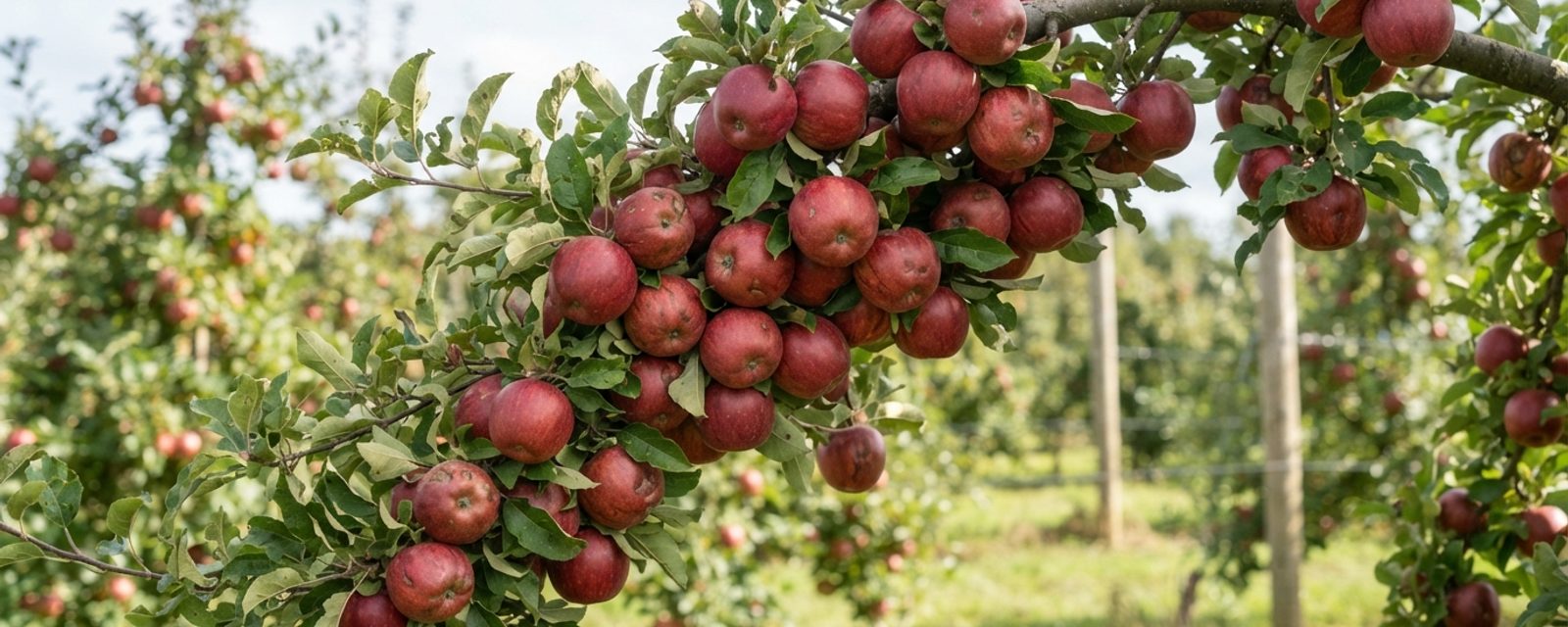
An apple tree doesn't ripen its way through a season the way a courgette plant or a row of runner beans does. Most of a mature tree's crop sets in the same few weeks of blossom in spring, grows through the same stretch of summer, and then becomes ready to pick within the same narrow window in autumn, typically a few weeks, not a rolling months-long trickle. There's no picking-frequency trick that spreads it out, the way there is with a crop you can pick little and often. When an apple tree crops heavily, it tends to become ready almost all at once.
That single-window habit is compounded by something apples do that few other fruits do in quite the same way: a heavy year sets up a bare one afterwards. A tree that pours its resources into ripening a big crop has little left over to build the flower buds it needs for next spring, so the glut this autumn is often followed by next to nothing the autumn after. Dealing with a glut of apples, then, is really two separate problems: getting through this year's single heavy picking window without waste, and stopping this year's heavy crop from creating next year's empty one.
The biennial bearing problem, in brief
A tree that crops heavily one year and diverts its spare energy into fruit rather than flower-bud formation typically produces a thin blossom, and a thin crop, the year after. That light year then lets the tree rebuild its flower buds, setting up another heavy year, and the cycle repeats on its own once it starts. Two things commonly start the cycle in a tree that wasn't previously affected: a starved or drought-stressed season where the tree can't support a heavy crop, or a spring frost destroying that year's blossom outright, both of which push the tree's resources into building buds rather than ripening fruit. A late spring frost hitting open blossom is a familiar, recurring hazard in most Scottish gardens. Some varieties, 'Bramley's Seedling', 'Blenheim Orange' and 'Laxton's Superb' among them, are naturally prone to this pattern regardless of weather. Siting a new tree somewhere sheltered, away from a known frost pocketA low-lying spot where cold air drains and pools on still nights, making it noticeably more frost-prone than the surrounding area. Full definition →, exposed hillside or coastal wind, is worth weighing up alongside variety choice, since it's the frost side of this cycle that a planting decision can actually influence; the apple growing guide covers site selection and planting in full. Thinning breaks the cycle by keeping any one year from being heavy enough to trigger a bare one after it, and it's covered in full, including the bud- and flower-thinning options that come before fruit thinning, on the biennial bearing page.
June drop thins the crop for you, usually not enough on its own
Most apple trees shed a share of their own immature fruit in early summer without any help, a natural correction known as June dropA tree's natural shedding of some immature fruit in early summer, thinning its own crop rather than a sign of a problem. Full definition →, triggered when a tree has set more fruitlets than it can properly size. In an ordinary year it's often enough on its own, and the crop that remains after it needs no further intervention. In a genuinely heavy year, June drop is only a partial fix: it can look dramatic on the ground underneath the tree while still leaving far more fruit on the branches than the tree can size up well, and that's the situation a glut actually starts from.
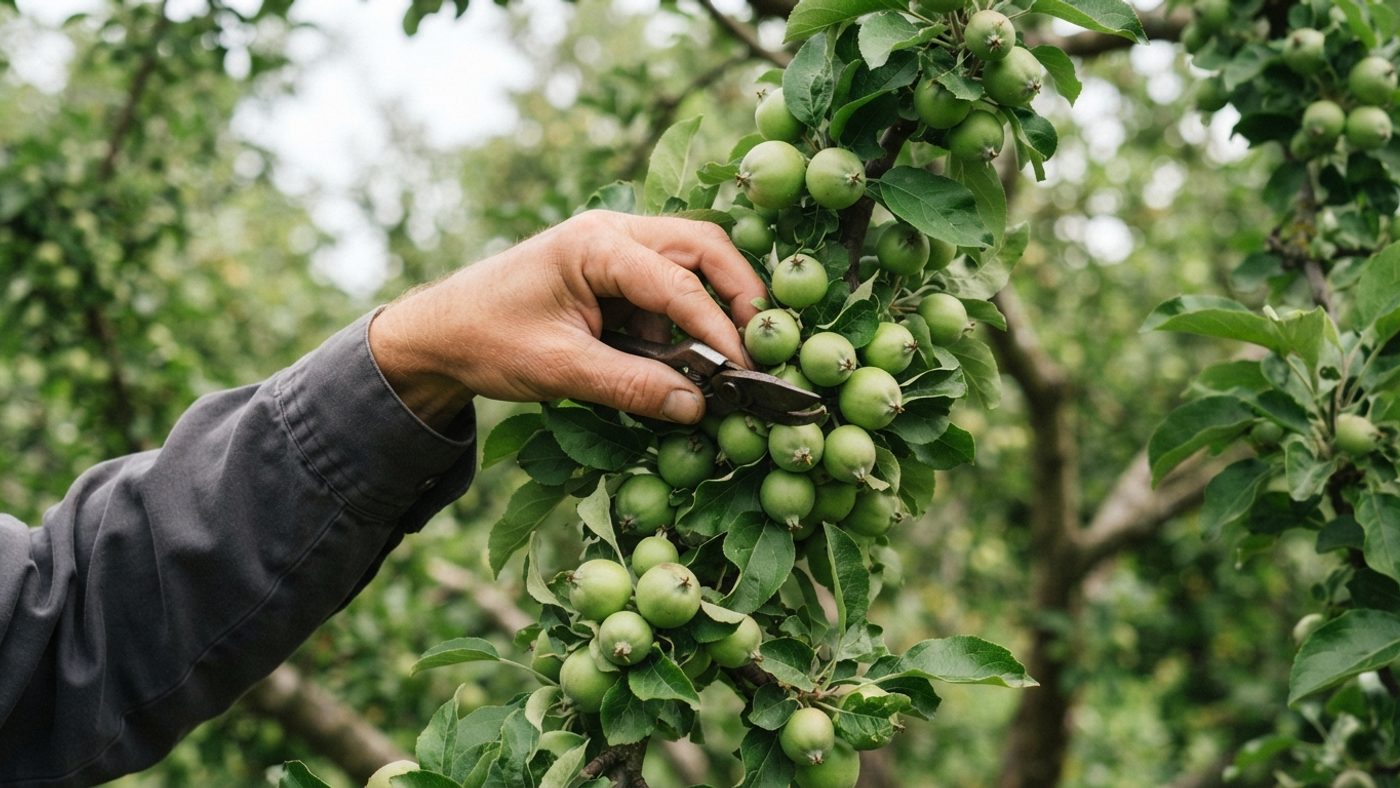
A crop is worth checking for further thinning if fruit is visibly touching within clusters, or more than a couple remain on a single spur, once June drop has finished. Where the crop still looks crowded by that standard, thin further by hand in early July, finishing by mid-July. The spacing differs by type: dessert apples can be thinned less severely, to one or two fruits every 10-15cm, while cooking apples need harder thinning, to one fruit every 15-23cm, since a cooking apple's value is in fewer, larger fruits rather than a heavier count of smaller ones. Within each cluster, leave just one fruit (the strongest and best-shaped) and remove the misshapen or blemished ones along with the "king" fruit at the centre of the cluster, which is often oddly shaped. A firm tug between thumb and forefinger, or a pair of scissors or secateurs for a fruit that won't twist off cleanly, does the job.
That early-July-to-mid-July window is UK-wide, and a Scottish garden's typically later, cooler spring pushes blossom, and the ripening calendar behind it, later than England's. Treat that window as a guide rather than a fixed deadline: judge from June drop's own timing on the tree in front of you, and from how crowded the remaining fruit clusters actually look, rather than the calendar alone.
Thinning this hard can feel wasteful when the tree is visibly loaded, but the fruit removed this way was never going to size up well regardless, and thinning is also what keeps this year's crop from being heavy enough to set up next year's bare one under biennial bearingA fruit tree's tendency to crop heavily one year and barely at all the next, then repeat that cycle rather than cropping evenly every year. Full definition →.
Spreading one glut into several smaller pickings
Because an individual apple tree's crop becomes ready in one narrow window, the real way to avoid a single overwhelming picking day is to have more than one window across the garden. Named varieties ripen at genuinely different points across autumn, and choosing across that spread turns one glut into several smaller, more manageable ones.
| Variety | Type | Picked | Pollination groupA classification of fruit tree varieties by when they flower each spring, used to check whether two varieties can pollinate each other. Full definition →* |
|---|---|---|---|
| Emneth Early | Culinary | Early (Aug–Sept) | 3 |
| James Grieve | Dessert | Early (Sept–Oct) | 3 |
| Egremont Russet | Dessert | Mid (Oct–Dec) | 2 (partially self-fertileA plant that can set fruit using its own pollen, without needing a second, different variety nearby to cross-pollinate it. Full definition →) |
| Lord Lambourne | Dessert | Mid-late (late Sept–Nov) | 2 |
| Edward VII | Culinary | Very late (Dec–April) | 6 |
*Pollination group is which varieties flower at the same time and can pollinate each other, so two trees from the same or a neighbouring group are needed for a reliable crop; the apple growing guide covers this in full. Apart from Egremont Russet, none of the above is self-fertile, so spreading a glut across varieties this way still means planning for at least two compatible trees.
Edward VII's window is the widest of the five because it covers when the fruit is at its best to eat, not just when it's picked off the tree: like other late-keeping culinary varieties, it's harvested in autumn and then improves in storage over the following months, so "ripens" here means its full season of use rather than a single picking date.
A garden with an early cropper like James Grieve or Emneth Early alongside a late one like Edward VII isn't picking the same volume of fruit in one week that a single-variety planting would produce; it's picking a smaller amount in September and another smaller amount weeks or months later. Edward VII needs a late-flowering pollinator, since most early and mid-season varieties won't overlap with its flowering time, so it isn't a drop-in addition to an existing planting without checking that. The full comparison across all the regionally-suited varieties, including pollination pairing, is on the best apple varieties for Scotland page; the apple growing guide covers rootstockThe root system and lower stem a fruit tree is grafted onto, chosen to control the tree's eventual size rather than for its own fruit. Full definition → and planting decisions that also affect how much any one tree eventually crops.
Once it's picked: short-term keeping versus a real store
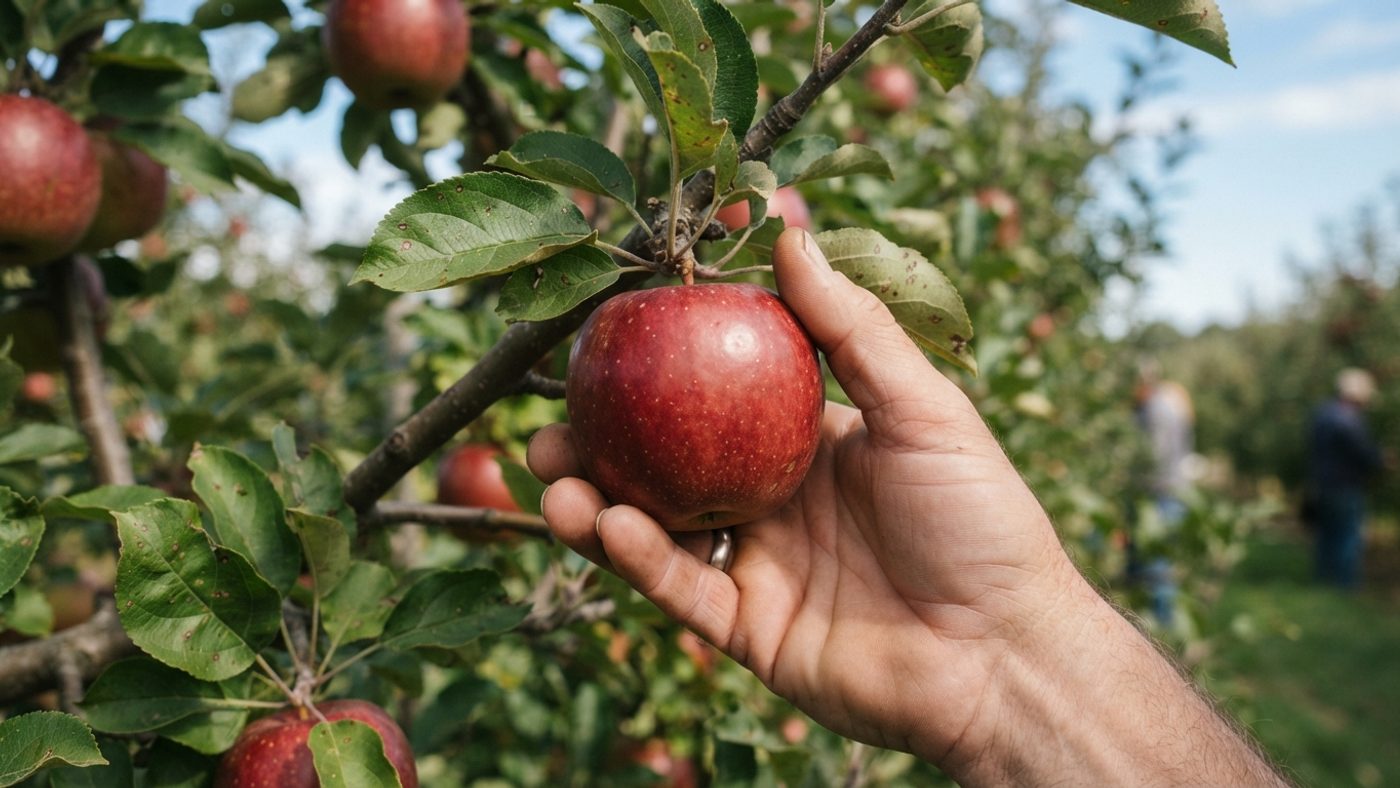
A ripe apple lifts away easily when cupped in the hand and given a gentle twist, stalk intact; one that resists needs more time. Picking only what's actually ready, rather than clearing a branch in one go, spreads even a single variety's picking across a few visits rather than one afternoon. Apples don't ripen further once off the tree, so an early variety picked at the start of the glut needs eating within days rather than sitting on a worktop waiting its turn. A later-picked batch has more give: kept somewhere cool and out of direct sun for a week or two, undamaged fruit will hold while you work through it, longer than many other fruits keep once picked. That's a stopgap, not storage: it buys a couple of weeks, not months. Turning a genuinely late-keeping variety like Edward VII or 'Bramley's Seedling' into a store that lasts into winter is a different job with its own temperature target, container choice and checking routine, covered in full on the storing apples & pears for winter page.
Windfalls and fruit you won't get through
A glut year usually means windfalls too, fruit that drops before or as it ripens, often bruised on landing. Bruised or split fruit is the same rot risk in a glut as it is in store: it doesn't keep, and it's worth clearing from the ground promptly rather than left to soften further, since fallen fruit left in place draws wasps and provides an easy route in for rot and for pests overwinteringKeeping a plant alive and intact through the cold months, whether left outdoors, moved under cover, or stored dormant. Full definition → nearby. Sound fruit that's simply surplus to what one household can eat or store is worth passing on rather than left to spoil: neighbours, a local community larder, or a village hall harvest table are all common, practical outlets for more apples than one kitchen can use. Cooking or freezing down surplus fruit is a genuine option for what neither eating fresh nor giving away accounts for, though it's a kitchen step beyond what this page covers.
Common questions
Is a heavy glut every year normal, or does it mean something's wrong with the tree?
A single heavy year on an otherwise healthy tree is normal, not a fault. What isn't sustainable is a heavy year every year without any thinning, since that's exactly the pattern that tips a tree into biennial bearing: a heavy crop one year and almost nothing the next.
If June drop already thinned the tree, do I still need to thin by hand?
Check what's left after June drop finishes before deciding. If the crop still looks crowded (fruit touching in clusters, more than a couple per spur), thin further in early July: one or two dessert apples every 10-15cm, or one cooking apple every 15-23cm, finishing by mid-July.
Will thinning this year's crop stop next year being bare?
It reduces the risk rather than removing it outright. A heavy, unthinned crop is what typically triggers a thin one the year after, so keeping this year's crop within what the tree can comfortably size lowers the chance of a bare follow-up year. See the biennial bearing article for the full mechanism and the bud- and flower-thinning options that work better than fruit thinning alone.
Is there a way to avoid a single overwhelming picking day altogether?
Growing more than one variety with different ripening windows is the main lever available: an early dessert apple like James Grieve alongside a late one like Edward VII turns one picking event into two or three smaller ones spread across autumn. See best apple varieties for Scotland for the full comparison.
What do I do with the fruit once it's actually picked, if I don't want to build a proper winter store?
Early varieties are best eaten within days regardless. For anything picked later, undamaged fruit kept cool and out of direct sun will hold for a week or two as a stopgap. Anything longer than that needs the conditions and checking routine on the storing apples & pears for winter page.
Sources
8 sources, recorded with what each was used for
- RHS: Apples, grow your own: June drop description, harvesting method (cup, lift, twist), early-vs-late variety storage-life distinction
- RHS: Fruit thinning: Exact thinning spacing and timing for apples, thinning's role in avoiding biennial bearing, method, removing the "king" fruit
- RHS: Fruit, biennial bearing: Biennial bearing mechanism
- RHS: 'James Grieve' AGM: Ripening season, pollination group
- RHS: Egremont Russet AGM: Ripening season, pollination group
- RHS: 'Emneth Early' AGM: Ripening season, pollination group
- RHS: 'Lord Lambourne' AGM: Ripening season, pollination group
- RHS: 'Edward VII' AGM: Ripening/season of use, pollination group, late-flowering pollinator requirement