
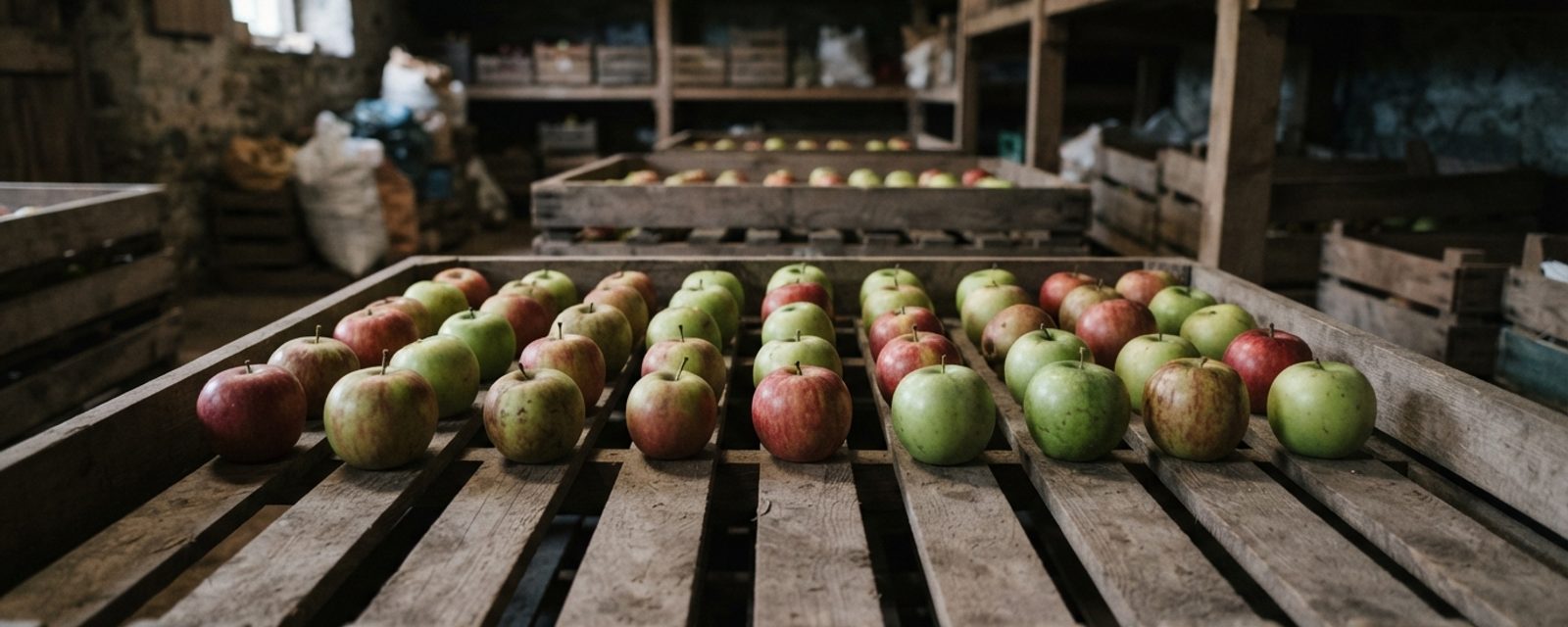
You've just brought in a full crop off the tree, a crate of apples, a bowl of pears, maybe both, and there's more here than you can eat in the next fortnight. Nothing about how you picked them was wrong, but a warm kitchen worktop isn't where either fruit is meant to sit for the next few months, and left there, the softest ones will start to go over within days and take their neighbours with them.
Late-maturing apple varieties keep for months in a cool, dark, well-ventilated spot around 4-7°C, laid out on slatted trays or crates so the fruit doesn't touch. Pears store the same way but for a shorter window, two weeks to three months depending on variety, and unlike apples they're picked deliberately under-ripe and need a separate warm-up step indoors afterwards to finish ripening before eating. Early-season fruit of either kind doesn't store at all and should be eaten within days. Apples and pears can share a shed, a tray, and a checking routine, but they don't behave identically once they're off the tree.
Not every apple or pear is a keeper
This is the one thing that separates tree fruit from most other winter-stored produce: storage life is set largely by variety, not just by technique. A perfectly handled early apple still won't last past a couple of weeks, and a perfectly handled late apple can last past Christmas, the variety decides the ceiling, good storage conditions only get you to it.
Early-season apples are bred and grown to be eaten as they come off the tree. Early croppers like James Grieve are best eaten fresh or cooked shortly after picking, not held back for winter, worth knowing since James Grieve, raised in Edinburgh and a regular recommendation for Scottish gardens, is exactly this kind of apple: reliable in a shorter, cooler season, but not a keeper. Late-maturing varieties are a different proposition: Ashmead's Kernel and Christmas Pippin keep well through to Christmas, Edward VII can store until March, and Fiesta is a reliable stayer. Jonagold and Winston are dessert apples worth storing, and Bramley's Seedling and Lane's Prince Albert are culinary apples that keep especially well.
Pears split the same way, though the named long-keeper is different. Joséphine de Malines is the standout, a variety that often keeps into the New Year, notably longer than most. Conference and Doyenné du Comice are worth keeping in store among dessert pears, and Catillac among culinary pears.
| Fruit | Variety | Type | Typical keeping |
|---|---|---|---|
| Apple | James Grieve | Early dessert | Days — eat fresh, don’t store |
| Apple | Jonagold, Winston | Dessert | Several weeks to months |
| Apple | Bramley’s Seedling, Lane’s Prince Albert | Culinary | Several months |
| Apple | Ashmead’s Kernel, Christmas Pippin | Dessert | Through to Christmas |
| Apple | Edward VII | Culinary | Until March |
| Pear | Conference, Doyenné du Comice | Dessert | Weeks to a few months |
| Pear | Catillac | Culinary | Weeks to a few months |
| Pear | Joséphine de Malines | Dessert | Into the New Year — the longest-keeping named pear in RHS guidance |
For more on which named varieties suit Scottish growing conditions, see Best Apple Varieties for Scotland and Best Pear Varieties for Scotland; the apple and pear growing guides cover planting, pollination, pruning and how to tell fruit is ready to pick.
Setting up the storage space
Aim for an even 4-7°C, frost-free, dark, well-ventilated, and slightly humid. Pears tolerate the cold end of that range better than apples do: pears can be held down to 0°C, while apples start suffering below about 2.8°C, so it's the apples that need the closer watch if a space runs colder than intended.
No source has measured conditions inside a Scottish shed specifically, so here's the reasoning rather than a lifted figure: a Scottish outbuilding is usually cool enough for this without any extra help, and a hard-frost night can still push it below freezing, exactly the risk that 2.8°C/0°C floor is warning against. The bigger day-to-day problem tends to be damp rather than cold, a wet autumn and winter means an unheated shed or garage is more likely to sit humid than bone dry, and that dampness feeds rot and mould just as readily as low temperature does. Standing containers up off a concrete floor, giving the space an occasional airing on a dry day, and checking fruit slightly more often than the schedule below suggests are practical adjustments worth making here.
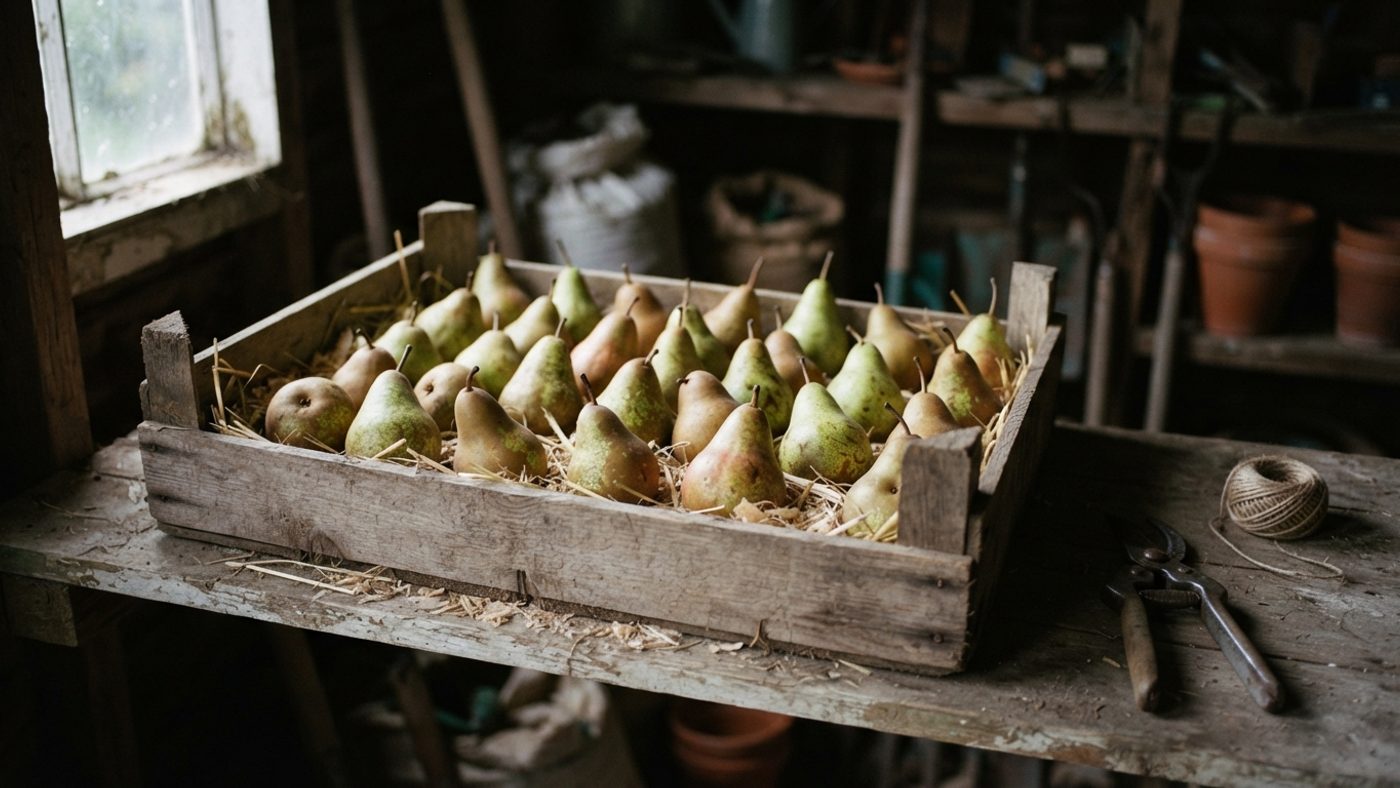
For containers, use slatted crates, open slatted shelving, polystyrene or papier-mâché trays, or shallow wooden boxes, anything that lets air move around the fruit rather than trapping moisture against it. A stack of old seed trays with the fruit spaced out works just as well as anything bought specially. A second option for apples specifically: wrapping each fruit individually in paper before placing it gently in a box, though this will be a hindrance to regular inspection.
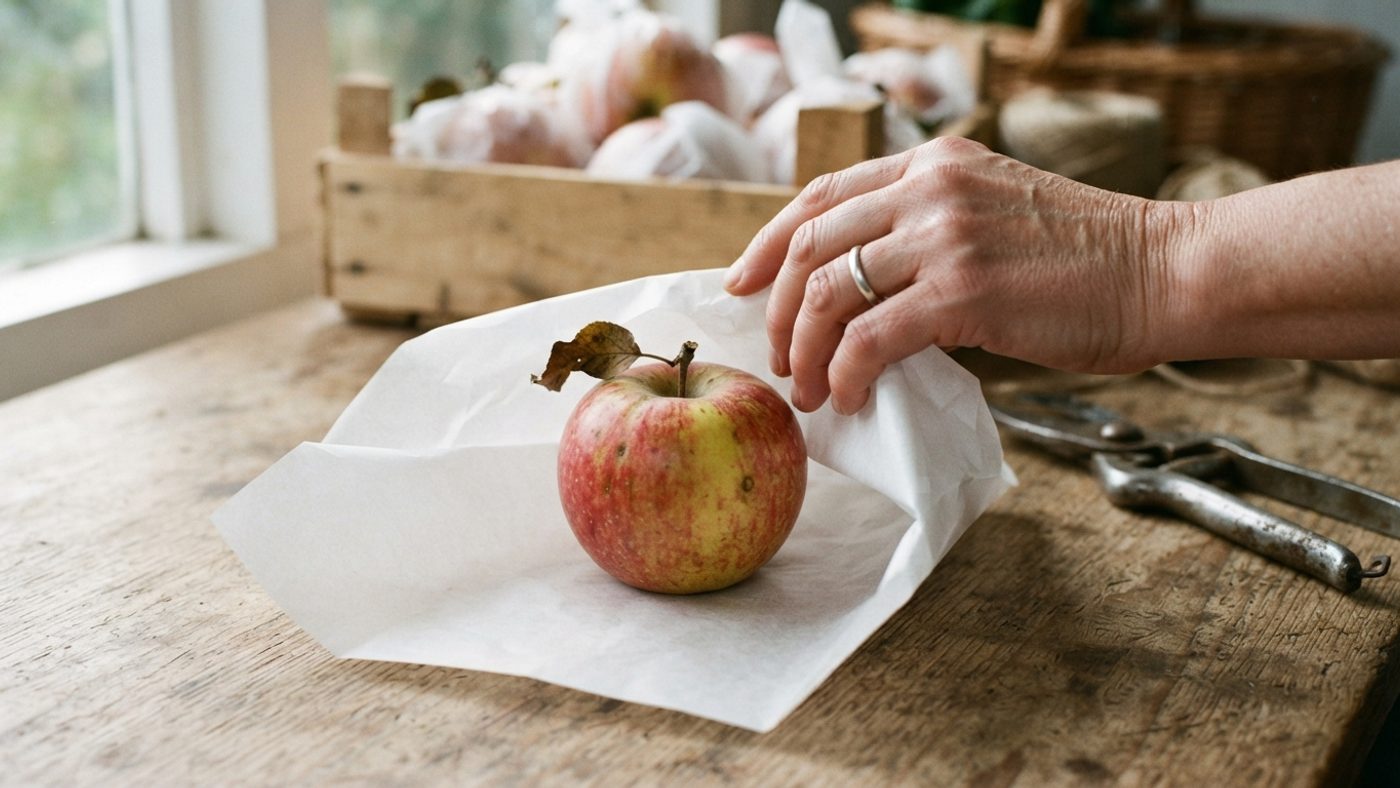
Whichever container you use, the fruit goes in a single layer, not stacked, with each apple or pear positioned so it isn't touching its neighbours. Keep different varieties apart from each other too, specifically mid-season varieties separate from late-season ones, because fruit ripening at different rates speeds up the ripening of whatever's next to it, the same ethylene effect behind the old advice to keep a fruit store away from other ripening produce generally.
The one-bad-apple problem, and how to check for it
Bruised, blemished, or damaged fruit doesn't keep, it's the entry point for rot, and rot spreads to whatever's touching it. Both RHS and Garden Organic are explicit that only truly undamaged fruit should go into store: check each apple or pear over as you pick it, and set aside anything bruised, split-skinned, or already showing insect damage for eating or cooking that day.
Once fruit is in store, checking is not a one-off task. Check stored fruit regularly and discard anything showing signs of decay as soon as it's spotted, before it spreads. Pears need this done more often than apples: they ripen and pass their best quickly and need daily checking once they're close to ready, since a pear that's gone soft or brown can turn a whole tray in days if it's missed. Apples move more slowly and a weekly check is generally enough. The clearest test for whether a stored apple has actually reached its best is taste, not appearance, pull one from the batch every few weeks once it's within the general storage window below.
If mice or other rodents can get into the storage space over winter, a lidded box or crate gives them less of a way in than an open tray, worth considering for anywhere fruit is stored for months at a time.
Getting realistic about how long fruit will actually last
| Type | Typical storage life |
|---|---|
| Mid-season apples | 4-8 weeks |
| Late-season apples | Several months (needing 4-5 weeks in store before peak eating condition) |
| Pears | 2 weeks to 3 months |
Pears as a group have a shorter and narrower window than late apples: even a long-keeping pear like Joséphine de Malines is described as lasting into the New Year, not through to spring, well short of what a good culinary or dessert apple can manage. If you've got more early fruit than you can realistically eat fresh, storing it isn't really an option since it won't keep, cooking it down into a puree or sauce and freezing that instead makes use of a glut that would otherwise spoil on the worktop.
Do apples and pears actually store the same way?
On equipment and environment, yes: both want the same cool, dark, frost-free, well-ventilated space, the same slatted trays or crates, the same single layer with fruit not touching, the same regular checking for rot.
The difference is in the biology underneath, and it comes down to when each fruit is picked. RHS's pear guide is explicit that pears are harvested just before they're fully ripe, firm and only just starting to change colour, then need a separate ripening period off the tree afterwards, anywhere from about a week for early varieties to several months for late ones, before they're ready to eat, with a pear brought in from cold storage typically needing a few more days at room temperature to finish softening. Apples carry no such second stage.
RHS and Garden Organic disagree on pears specifically once you get past the shared basics: RHS treats apples and pears under one storing framework with the same trays and conditions, while Garden Organic is more cautious about pears, describing them as difficult to store well for any real length of time, and recommends against wrapping pears in paper, a technique it recommends for apples.
Common questions
Can I store apples and pears together in the same box?
Not ideally. Both RHS and Garden Organic recommend keeping varieties, and by extension fruit types, separate in storage, since fruit ripening at different rates can speed up ripening in whatever’s stored alongside it. Separate trays in the same cool space is the better approach.
Why do my pears go mealy or grainy instead of soft when I bring them in?
The likely explanation is that the fruit ripened on the tree rather than being picked slightly under-ripe. RHS’s guidance is to pick pears while still firm, with only a subtle colour change, and let them finish ripening off the tree, since a pear left to fully ripen on the branch tends not to develop the right texture afterwards.
One fruit in the crate has gone soft, do I need to check every piece it was touching?
Yes, worth doing rather than skipping. Check the fruit immediately next to a rotting piece even if it looks fine, rot can spread through a point of contact before it shows on the surface. If neighbouring fruit looks and feels sound, it’s fine to leave in place, just watch it more closely at the next check.
Should I wash apples and pears before storing them?
Neither RHS nor Garden Organic recommends washing fruit before storage, both focus instead on selecting only undamaged, unblemished fruit and keeping it dry, dark, and well-ventilated.
Is there a way to make my pears last longer than a few weeks?
Variety choice matters more than technique here, Joséphine de Malines is named by RHS as keeping into the New Year, well past most other pears. Beyond variety, the same cool, dark, well-ventilated conditions and daily checking near ripening are what RHS and Garden Organic both point to.
Sources
4 sources, recorded with what each was used for
- RHS: Fruit — storing: Temperature and humidity targets, storage duration ranges by fruit and season, container types, wrapping method, spacing and variety-separation advice, checking routine for pears
- RHS: Apples — grow your own: Harvesting technique, early vs late variety distinction, named variety storage behaviour (James Grieve, Ashmead’s Kernel, Christmas Pippin, Edward VII, Fiesta)
- RHS: Pears — grow your own: Harvesting technique, off-tree ripening process and timescales, named variety storage behaviour (Joséphine de Malines)
- Garden Organic: Harvesting and storing fruit: Apple wrapping method, fruit selection standard, checking routine, and its more cautious position on pear storability and wrapping