
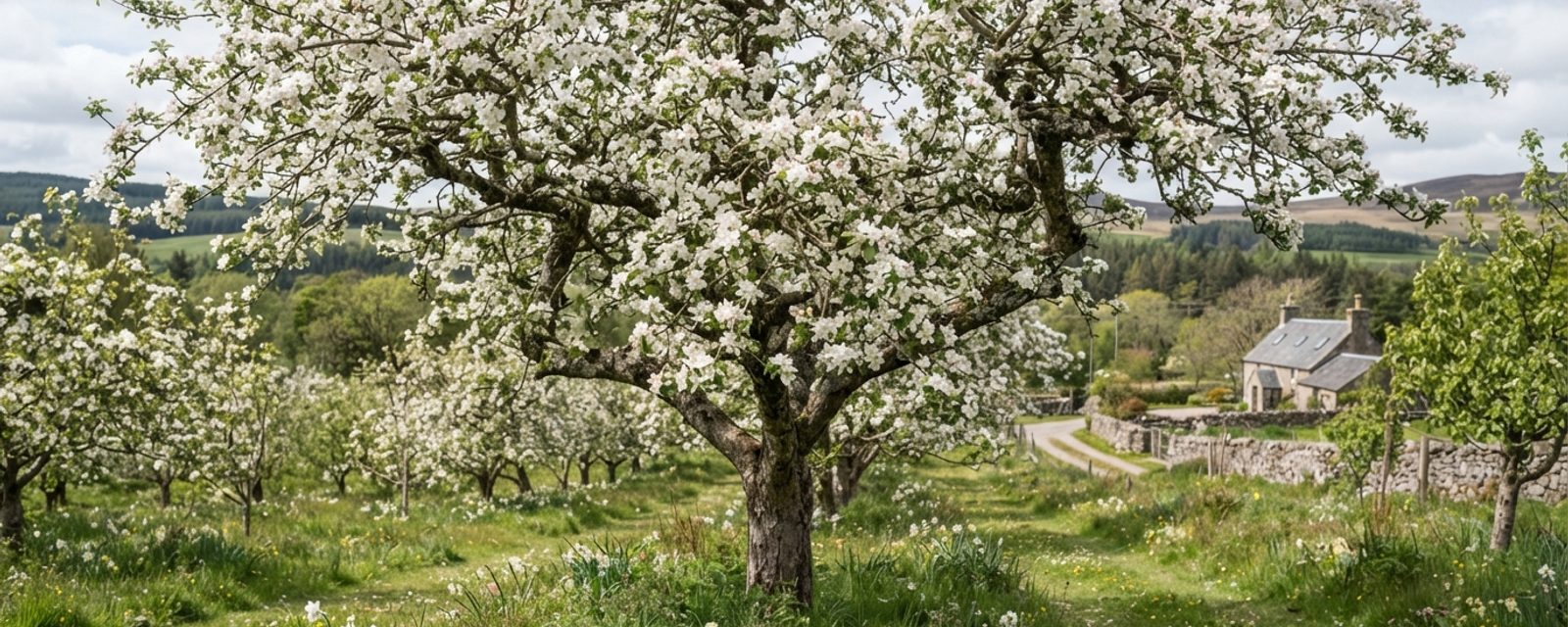
Buy one apple tree expecting fruit, and you might get flowers and nothing else. The reason is pollination compatibility, and the rules are different depending on whether you're planting apples, pears, plums, or cherries. Treat all four the same way and you'll either waste a second tree you didn't need, or end up with one tree that blossoms well every spring and fruits for nobody.
Apples have their own numbered flowering-group system, covered in full in the apple growing guide. Pears, plums, and cherries each follow different rules of their own. Where a numbered group applies at all, it's simply a rough bloom-timing band, varieties in the same or a neighbouring group flower closely enough together for insects to move pollen between them; a variety three or more groups away is likely to have finished or not yet started flowering by the time the other one blooms.
Pears: apples' numbering, with more exceptions
Pears use the same numbered flowering-group system as apples. Most pear trees still need a different pear variety flowering at the same time nearby to crop well, and it's worth checking whether a neighbouring garden already has a compatible pear before assuming a second tree is needed.
Where pears diverge is in their exceptions. Conference, in Group 3, can set fruit without being pollinated at all, a real self-fertileA plant that can set fruit using its own pollen, without needing a second, different variety nearby to cross-pollinate it. Full definition → case rather than just a hardy cropper, though it still fruits more heavily with a partner nearby. Beyond that, plan on a second variety from the same or an adjacent group:
| Variety | Group | Note |
|---|---|---|
| Conference | 3 | Sets fruit unpollinated |
| Concorde | 3 | Needs a partner |
| Beth | 3 | Needs a partner |
| Beurré Hardy | 3 | Needs a partner |
| Williams' Bon Chrétien | 3 | Needs a partner |
| Louise Bonne of Jersey | 2 | Needs a partner |
| Doyenné du Comice | 4 | Needs a partner |
| Onward | 4 | Needs a partner |
| Pitmaston Duchesse | 4 | Needs a partner |
| Merton Pride | 3 | TriploidAn apple (or other fruit) variety with an extra set of chromosomes, making its own pollen largely useless for pollinating other trees. Full definition →, needs two partners |
| Catillac (culinary) | 4 | Triploid, needs two partners |
A triploid variety produces mostly sterile pollen, so it can't act as a pollinator for another tree, and it needs two other compatible trees, not just one, flowering at the same time to be pollinated itself. Among pears, that's Merton Pride and the culinary pear Catillac.
Plums: self-fertility is the default, not the exception
Plums flip the pattern. Victoria, Czar, Opal, Blue Tit, Marjorie's Seedling, Belle de Louvain, Pershore, Warwickshire Drooper, Imperial Gage, and Oullins Gage are all self-fertile, so one tree is normal here, not a lucky exception, though it's still worth checking the specific variety before buying since not all of them are. Cambridge Gage is partly self-fertile. Jefferson gage is self-incompatible and does need a partner. Among damsons, Farleigh and Prune Damson are both self-fertile.
For the varieties that do need a partner, growers fall back on the same flowering-group language used for apples and pears, but gages and damsons cross freely with plums as one broad family rather than sitting in a separately numbered system: any nearby plum in flower at the right time will generally do the job, without needing to match a specific group number. With plums, the first question is whether the variety is self-fertile, not which numbered group it belongs to. A second, different variety flowering at a similar time can still help some self-fertile plums crop more heavily, an improvement rather than a requirement.
Plum blossom opens early and is exposed to late frost, which is a bigger practical risk than finding a partner for most varieties: an early cold snap can wipe out a season's flowers regardless of how well two trees are paired. Pershore, Czar, and Blue Tit are named by RHS as frost-resistant, generally because a later-flowering variety misses more of the frost window, so it's worth choosing one of these three deliberately on a site prone to a late cold snap, and siting the tree away from a known frost hollow, not only for their self-fertility. The same risk applies to pear and cherry blossom, both of which also open early in the season.
Cherries: split by type, not by number
Cherries split into sweet cherries (Prunus avium) and acid cherries (Prunus cerasus), and pollination advice tracks that split rather than a numbered flowering groupA classification of fruit tree varieties by when they flower each spring, used to check whether two varieties can pollinate each other. Full definition →. Acid cherries are self-fertile, so one tree is enough: Morello, the traditional acid cherry, needs no partner and grows well even on a shaded wall, useful wherever the only free spot isn't in full sun.
Sweet cherries are mixed, and the variety matters more than anything else. Stella, Lapins, and Sweetheart are self-fertile. Kordia and Summer Sun are not: they need a pollination partnerA second, different variety of the same fruit planted nearby so the two can cross-pollinate each other, needed by any variety that isn't self-fertile. Full definition → flowering at the same time, so pairing either with a self-fertile variety like Stella, chosen so its bloom overlaps, is the practical fix. If you only have room for one cherry tree, buy a self-fertile variety.
Cherries aren't classified into numbered flowering groups at all; compatibility is entirely self-fertile-or-not, variety by variety.
| Crop | Compatibility system | Self-fertile examples | Needs-a-partner examples | Triploid / other quirks |
|---|---|---|---|---|
| Apples | Numbered flowering groups; some self-fertile exceptions | A handful, e.g. Scrumptious | Most varieties, unless paired within group | Triploids (e.g. Bramley’s Seedling) need two partners, not one |
| Pears | Same numbered flowering-group system as apples | Conference (sets fruit unpollinated) | Beth, Beurré Hardy, Williams’, Louise Bonne, Doyenné du Comice, Onward, Pitmaston Duchesse | Merton Pride and Catillac are triploid, needing two partner trees |
| Plums, gages, damsons | Self-fertility first; group-matching only as a fallback | Victoria, Czar, Opal, Blue Tit, Marjorie’s Seedling, Belle de Louvain, Pershore, Warwickshire Drooper, Imperial Gage, Oullins Gage, Farleigh Damson, Prune Damson; Cambridge Gage (partly) | Jefferson gage | Gages and damsons cross freely with plums as one family, no separate numbering |
| Cherries | Split by species (sweet vs acid), not numbered groups | Acid cherries generally (e.g. Morello); sweet: Stella, Lapins, Sweetheart | Sweet: Kordia, Summer Sun | No named cultivarA plant variety that arose or was bred under cultivation and is kept true by deliberate propagation, rather than a naturally occurring wild species. Full definition → carries a numbered pollination group |
Where Scotland's climate matters, and where it doesn't
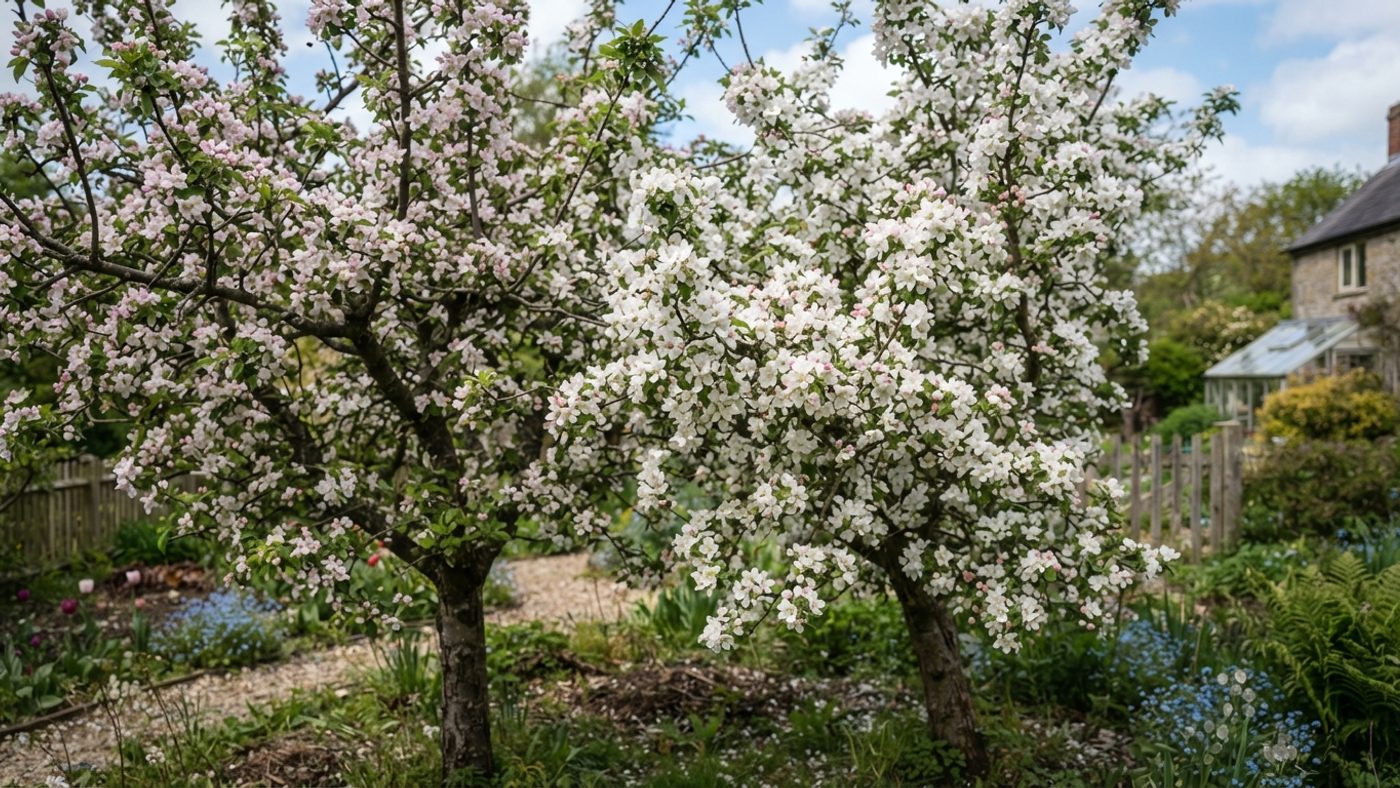
The self-fertility lists and group numbers themselves don't change north of the border. What changes is how forgiving the system is in practice: cross-pollination depends on insects actually flying between two compatible trees while both are in flower, within the roughly 18m RHS gives as the usual limit, and a colder, wetter spell gives them fewer good flying hours to do it in than a milder spring further south. That's a reasonable extra argument for choosing a self-fertile variety where there's room for only one tree: it still needs pollen moved within its own flowers, but it isn't depending on a second tree flowering in step with it as well.
Late frost at blossom time is a separate risk, and one that a compatible pollination partner does nothing to solve: an early cold snap can damage or kill open flowers outright, whatever else is flowering nearby. It's a genuine risk anywhere blossom opens early, plums and pears especially, and choosing a named frost-resistant variety plus siting a tree away from a known frost hollow are the real defences, not pollination-group matching.
What to actually do
One tree, no compromise on cropping: a self-fertile plum (Victoria, Czar) or a self-fertile cherry, sweet (Stella, Lapins) or acid (Morello), are the most reliable single-tree choices among the four crops. One pear tree: Conference is the one genuine exception, fruiting without a partner, though a second tree still helps it crop more heavily. One apple tree: only specific self-fertile varieties will crop reliably alone, the apple growing guide covers which ones, and the triploid trap to avoid.
Two trees needed, no way round it: most apples, most pears (bar Conference), Jefferson gage, and sweet cherries such as Kordia or Summer Sun. Match flowering group or timing, and for a triploid pear or apple, remember it needs two other compatible trees, not one. Only room for one hole, not one tree: a "family" tree, two or three compatible varieties graftedJoining a chosen fruiting variety onto a separate rootstock, so the tree grows the fruit of one plant on the roots of another. Full definition → onto a single rootstockThe root system and lower stem a fruit tree is grafted onto, chosen to control the tree's eventual size rather than for its own fruit. Full definition →, solves the space problem directly; a dwarfing rootstock does the same by keeping both trees small enough to fit, covered in full in the fruit tree rootstocks article. Already have a neighbour's tree nearby: worth checking, for pears especially, whether a compatible tree is already growing next door before planting a second one of your own.
For growing detail beyond pollination, see the pear, plum, and cherry growing guides.
Common questions
Do I need two trees for every fruit tree I plant?
No. It depends on the crop and variety. Most apples and most pears need a compatible partner. Plums are usually self-fertile, so one tree is normal. Cherries split by type: acid cherries are self-fertile, sweet cherries vary by variety, so check before buying.
Which of the four crops is easiest to grow as a single tree?
Plums and cherries, because self-fertility is the norm rather than the exception in both, whereas it’s the rarer case for apples and pears. If your garden only has room for one fruit tree full stop, that’s the practical reason to lean toward a plum or a cherry over an apple or a pear, rather than starting from which fruit you’d prefer to eat.
Are there triploid pears, the way there are triploid apples?
Yes. Merton Pride and the culinary pear Catillac are both triploid: like their apple counterparts, they produce mostly sterile pollen and need two other compatible pear trees flowering at the same time, not just one.
Why don’t cherries use numbered pollination groups like apples and pears do?
Cherry pollination advice is organised by species, sweet versus acid, and by each variety’s self-fertility status, rather than by numbered flowering groups. Acid cherries are self-fertile as a rule; sweet cherries need checking variety by variety, and none of them carries a numbered group.
Does Scotland’s climate make fruit tree pollination harder?
It can make it less forgiving. A colder, wetter spell gives pollinating insects fewer good flying hours in the window when two compatible trees are both in bloom, a reasonable extra argument for a self-fertile variety where the choice exists. Late frost at blossom time is a separate risk that affects any early-flowering blossom, plums and pears especially, best managed by choosing a named frost-resistant variety and avoiding a known frost hollow, rather than by pollination-group matching.
Sources
7 sources, recorded with what each was used for
- RHS: Fruit basics — fruit pollination: General flowering-group framework, self-incompatibility, the 18m cross-pollination distance, triploid pollen sterility
- RHS: Choosing pear cultivars: Named pear varieties and flowering groups, Conference self-fertility, Merton Pride/Catillac triploid status
- RHS: Pears — grow your own: General pear pollination need
- RHS: Choosing plum, gage and damson varieties: Self-fertility status of named plum, gage and damson varieties
- RHS: Plums — grow your own: Plum self-fertility as the default pattern
- RHS: How to grow cherries: Sweet versus acid species split, named cherry self-fertility status, Morello’s shade tolerance
- RHS: Fruit — protecting from frost: Frost-resistant plum varieties (Pershore, Czar, Blue Tit)