
Apple Canker is a common disease that affects apples in Scotland. Here is what it looks like, the conditions it needs, and the controls that actually work.
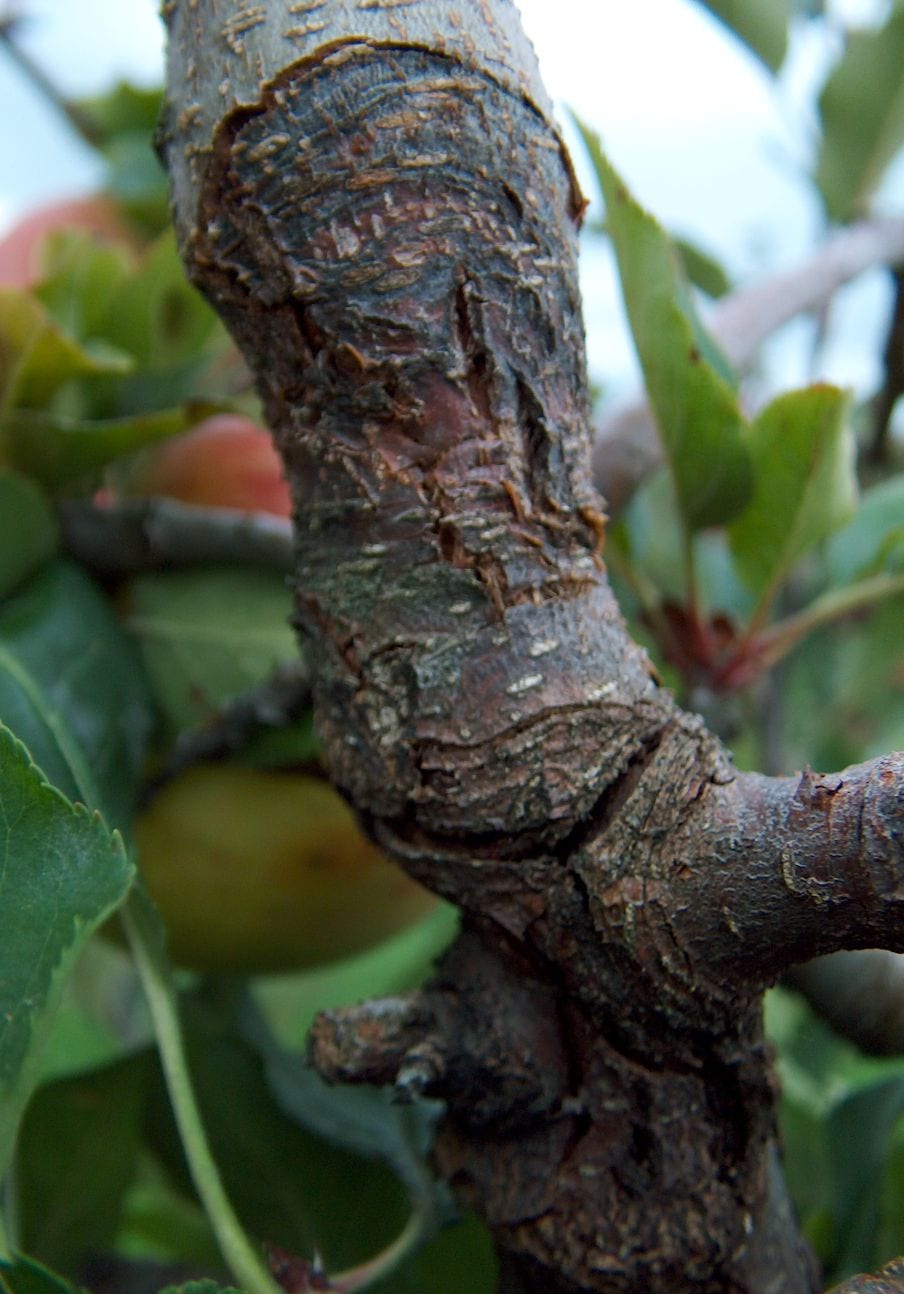
What does it look like?
Round or oval patches of dead, sunken bark, often starting at a wound or a bud. On small branches and fruiting spursWhether a fruit tree carries its fruit mainly on short side-shoots along older wood (spur-bearing) or at the tips of the previous year's growth (tip-bearing). Full definition →, the infection can girdle and kill the stem in a single season, with bark flaking off. On larger branches and the trunk, cankers are perennial: the affected area sometimes shows concentric rings marking periods of active spread, older cankers lose their bark to expose dead wood underneath, and raised edges form as the tree tries to grow bark back over the damage. Developing fruit can be attacked too, and will rot and fall.
What causes it
Wet, heavy or acid soil makes this genuinely worse, which is why drainage and soil pH are worth checking alongside anything you do at the tree itself.
Is this disease active now?
New cankers form from mid-spring, and once they’ve formed they stay visible all year round.
Symptoms
A canker on a small branch can kill it outright within a season. On a larger branch or the trunk, it’s a slower fight: the canker spreads in some periods and the tree’s bark grows back over it in others, and it can genuinely go either way. Left alone, the usual outcome is the branch eventually dying above the canker, or breaking once it’s weakened enough.
Life cycle
The fungus produces water-dispersed spores from the edges of lesions in summer, and airborne spores from small red structures in winter and spring. Both can start new infections, almost always through a wound: a pruning cut, a leaf scar, frost damage, or damage from scab disease or woolly aphid all count. Once a canker is established on a larger branch, it settles into a slow back-and-forth between the fungus spreading and the tree’s own bark trying to grow back over it.
Why this matters in Scotland
A lot of Scottish garden ground is wet, heavy or acid, and that’s exactly the soil profile that lets this canker take hold most easily. A tree here starts at a real disadvantage before pruning or hygiene even come into it.
Controls: what actually works
All the methods below are backed by real evidence, not just repeated folklore.
Improve drainage, and lime the soil if it’s acid
Addresses the growing conditions that let canker take hold in the first place, not just the symptoms once they’ve already appeared.
Cut out all infected wood, completely, back to clean green tissue
Smaller affected branches and spurs should come out entirely. On larger branches, remove every trace of infected bark and wood you can reach.
Choose a resistant cultivarA plant variety that arose or was bred under cultivation and is kept true by deliberate propagation, rather than a naturally occurring wild species. Full definition → where you’re planting new
No variety is fully resistant in every condition, but some show real resistance, including ‘Lord Derby’, ‘Winston’ and ‘Crawley Beauty’. Others are particularly susceptible and worth knowing before you plant, including ‘Cox’s Orange Pippin’, ‘James Grieve’ and ‘Worcester Pearmain’.
Frequently asked questions
What should I do first if I find apple canker in my garden?
Start with improve drainage, and lime the soil if it’s acid. After that, cut out all infected wood, completely, back to clean green tissue. Work through the rest in order of how well-evidenced they are if the first two aren’t enough on their own.
Is there a spray that works?
No. There are no amateur chemical treatments available for apple canker. The controls that work are cultural: the measures listed above.
When are apple canker most active in Scotland?
Check the seasonal activity section above. Scottish timings can run a few weeks behind the UK-generic figures.
Sources
1 source, recorded with what each was used for
- RHS1: identification, symptoms, mechanism/biology, soil-condition trigger, active timing, drainage/liming and pruning controls, resistant and susceptible cultivars