
Honey Fungus is a serious disease that affects apples, plums and damsons in Scotland. Here is what it looks like, the conditions it needs, and the controls that actually work.
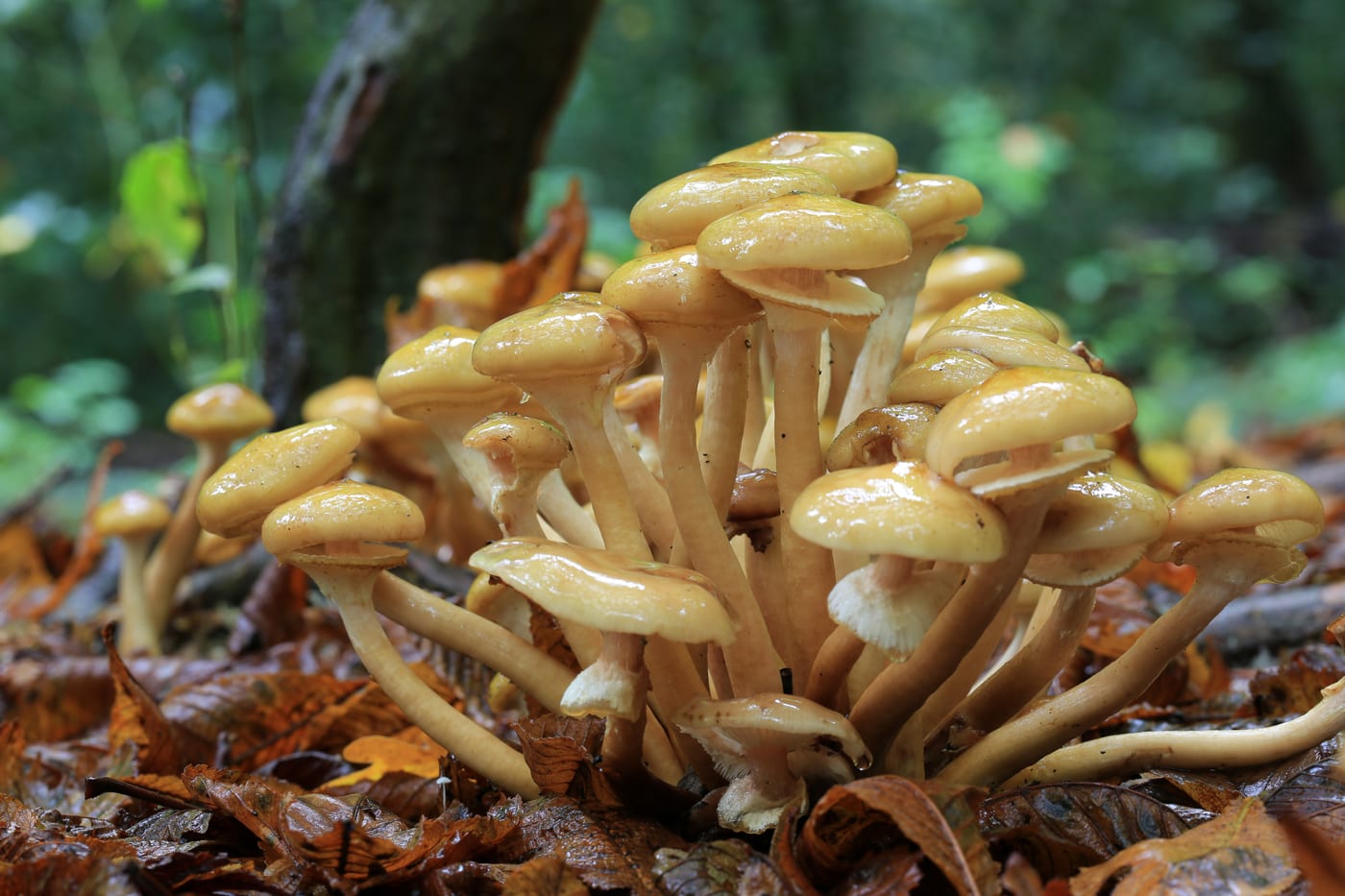
What does it look like?
Clumps of honey-coloured mushrooms sometimes appear at the base of an infected plant in late summer and autumn, but their absence doesn't mean the disease isn't present. Peeling back bark at ground level can reveal white fungal growth between the bark and wood, often with a distinct mushroom smell.
What causes it
Moist soil is what this fungus actually needs to spread, since its rhizomorphs travel through soil at typical depths of 2.5-20cm, deeper still if the soil dries out. Proximity is the other real factor: rhizomorphs can spread roughly a metre a year and infect a plant as far as 30m from the original source, so an old infected stump or a badly affected neighbour is a genuine risk to healthy plants nearby, not just a contained problem.
Is this disease active now?
The fungus itself is active in the soil year-round, but the honey-coloured mushrooms that give the clearest visible sign only appear from late summer into autumn.
🌱 Plants at risk
Honey Fungus also affects these crops:
Symptoms
Above ground, the upper part of the plant can die back, sometimes suddenly in hot, dry weather, with paler, smaller leaves, poor flowering or an unusually heavy flowering just before death, early autumn colour, and bleeding or cracked bark at the base. Below ground, black or brown root-like 'bootlaces' called rhizomorphs spread out through the soil from the infection.
Life cycle
The fungus persists as mycelium and rhizomorphs in the soil and in infected wood year-round, with mushrooms fruiting above ground only in late summer and autumn. Spread happens through direct root-to-root contact and through rhizomorphs travelling independently through soil; newer research also points to spores playing a bigger role in starting a fresh infection than previously thought.
Why this matters in Scotland
This disease needs moist soil to spread through, and that's a condition a Scottish garden meets more often across the year than a drier one further south.
A garden here is less likely to get the kind of prolonged dry spell that would naturally slow this fungus down mid-season, so once it's established, there's less of a seasonal check on it than in a garden further south.
Controls: what actually works
All the methods below are backed by real evidence, not just repeated folklore.
Excavate and destroy all infected root and stump material, by burning or via landfill
Infected wood left in the ground is exactly what lets the fungus keep spreading to nearby plants, so full removal is what actually stops it rather than just cutting back what's visible above ground.
Install a 45cm-deep vertical barrier of butyl rubber or heavy-duty plastic to protect healthy plants nearby
Since rhizomorphs spread through the soil itself, a physical barrier sunk deep enough blocks that route directly, protecting a healthy tree from an infection already established next door.
Deep cultivation to break up rhizomorphs in the soil
Physically disrupting the rhizomorphs interrupts the route the fungus uses to travel between plants, useful alongside removal and barriers rather than as a stand-alone fix.
Avoid using infested compost around woody plants
One of the honey fungus species produces rhizomorphs that show up often enough in compost heaps that bringing in contaminated compost is a genuine way to introduce the disease to ground that was never infected in the first place.
Frequently asked questions
What should I do first if I find honey fungus in my garden?
Start with excavate and destroy all infected root and stump material, by burning or via landfill. After that, install a 45cm-deep vertical barrier of butyl rubber or heavy-duty plastic to protect healthy plants nearby. Work through the rest in order of how well-evidenced they are if the first two aren’t enough on their own.
Is there a spray that works?
No. There are no amateur chemical treatments available for honey fungus. The controls that work are cultural: the measures listed above.
When are honey fungus most active in Scotland?
Check the seasonal activity section above. Scottish timings can run a few weeks behind the UK-generic figures.
Sources
6 sources, recorded with what each was used for
- RHS1: identification, symptoms above and below ground, the moisture-and-proximity trigger, life cycle and spread mechanism, removing infected material, vertical barriers, deep cultivation, absence of a chemical control, the 'most destructive' severity framing
- RHS1: confirming honey fungus directly on apples' own growing page
- RHS1: confirming honey fungus directly on plums' own growing page
- RHS1: confirming honey fungus directly on damsons' own growing page
- RHS1: confirming honey fungus directly on cherries' own growing page
- Gardener's World12: corroborating apple as a vulnerable host, and independently corroborating symptoms and the no-chemical-control position