
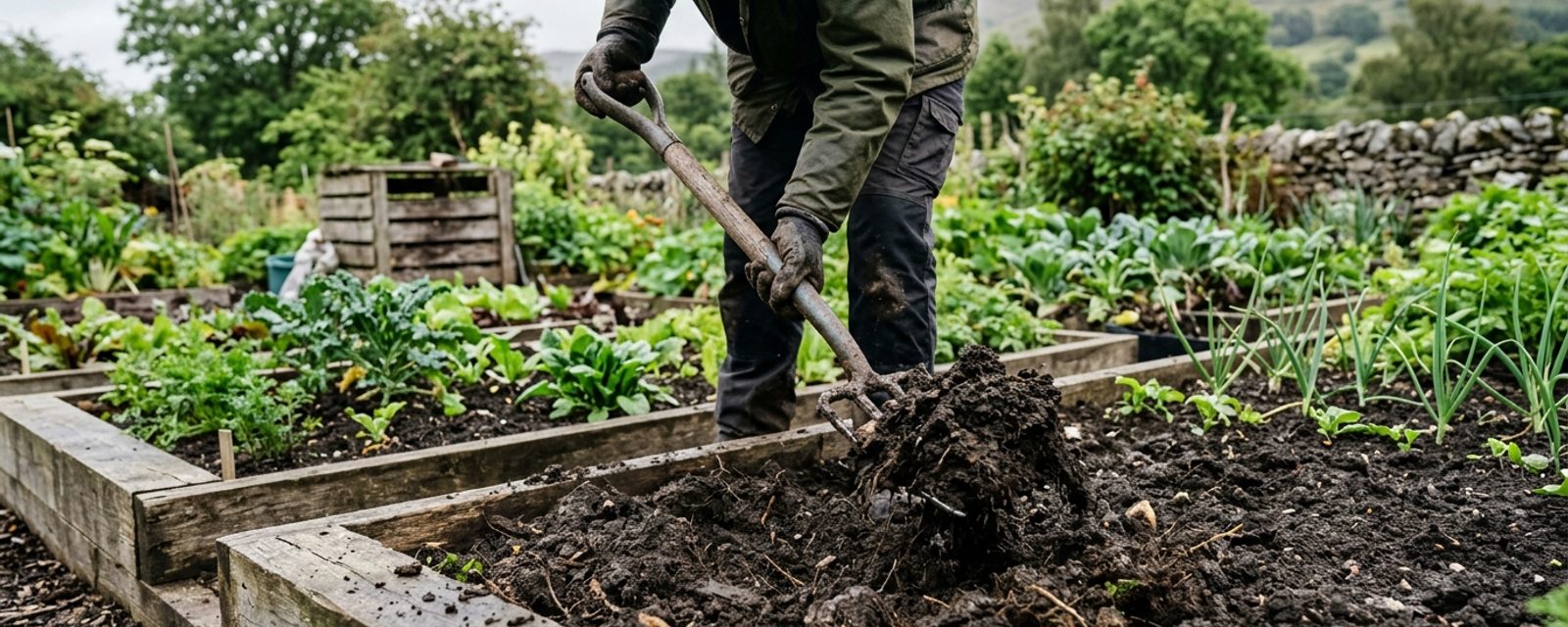
Soil is the quiet reason a crop that thrives for a friend down south sulks in your bed. Scotland's ground carries the marks of its climate and geology. High rainfall, cool temperatures and a lot of upland have left much of the country with soil that is naturally acidic, often heavy, and slow to warm in spring. None of that is a problem you cannot work with, but it pays to know which soil you have before you decide what to grow.
Naturally acidic ground
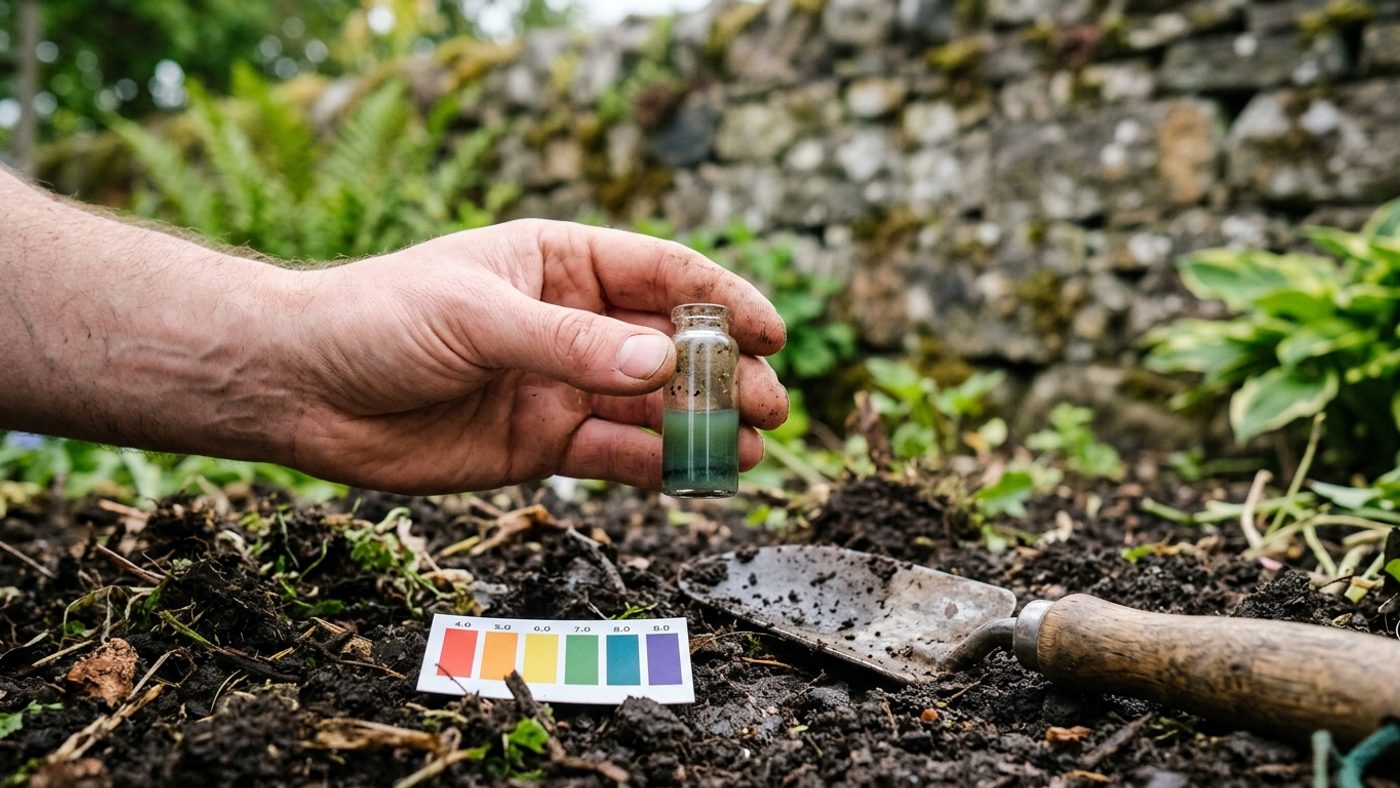
Across much of Scotland the soil is naturally acidic, and the effect is strongest in the wetter uplands where persistent rain leaches lime and nutrients down out of reach. In the highest, wettest places that process builds peat. Acidity suits some crops beautifully: potatoes are happy in it and acid-loving fruit like blueberries thrive. It works against others, and it is the single soil fact most worth knowing about your own plot. A cheap pH test kit answers it in minutes.
Lowland ground, upland ground, and two real exceptions
Soil doesn't split into the same six regions as this site's frost data. The James Hutton Institute's National Soil Map of Scotland and the Scottish Government's own Soil Framework organise the country's soils around geology and altitude instead, and that gives a genuinely different, more useful picture than a six-way regional split would.
The main pattern is lowland versus upland. Scotland's soils overall run more acidic and more organic than the rest of the UK's, because most of the underlying rock is acid and slow to weather, and the cool, wet climate reinforces that rather than counteracting it. That acidity isn't spread evenly, though: the Central Valley, the Central Belt and the mineral-soil ground on its flanks, sits on brown earths (moderately acid soils with a plain brown topsoil, nothing like the paler, more acid layers below) and other mineral soils, giving it the country's most productive farmed ground. The Highlands and the Southern Uplands, by contrast, are dominated by peat, peaty gleys (soils that stay wet enough, often enough, to turn grey and blotchy rather than brown right through) and peaty podzols, especially on their wetter western sides. Podzols, acid soils with a distinctive pale, leached layer just under the surface, cover almost a quarter of Scotland's land area on their own, several times the European average.
Granite reinforces the same pattern wherever it surfaces, rather than marking out any one region on its own. The Cairngorms are a granite massif at the heart of the Highlands; Galloway's hills, in the far southwest, are built on granite intrusions at Cairnsmore of Fleet and the Merrick, with the acid peatland of the Silver Flowe sitting on that same ground. Granite is acid rock and weathers slowly, so wherever it reaches the surface the soil above tends toward the same acid podzol as the wider Highlands and Southern Uplands, one geological cause showing up in more than one place, not a northeast-versus-southwest divide.
There are two real exceptions to "Scotland is acidic," both genuinely sourced rather than assumed. The most striking is machair: a low, fertile coastal plain found mostly in the Outer Hebrides, with smaller patches on the Inner Hebrides and the mainland coast, built by storms blowing shell-rich sand inland. That sand runs up to 80–90% ground seashell by content, and the shell content makes machair genuinely alkaline, pH normally above 7, in sharp contrast to the acid ground a short walk inland. It's a narrow coastal strip, not "the islands": cross onto ordinary Hebridean ground away from the machair and you're back on the same acid peat and podzol as the rest of upland Scotland.
The second exception is Orkney, for a different reason: its bedrock is Old Red Sandstone rather than granite or the acid schists of the Highlands, overlain by a fertile boulder clay (a dense, stony clay left behind by the last ice age). That gives Orkney's farmed ground a real mix, gleys, peat and brown forest soil rather than the podzol-dominated pattern of the Highlands, Southern Uplands and Hebrides, and is a large part of why Orkney has historically supported some of Scotland's most productive island farming. Shetland doesn't share this: its ground is closer to the acid, peaty pattern of the wider uplands.
Postcode is a weaker guide to soil than it is to frost. Whether you're on lowland mineral ground, upland peat or podzol, a machair strip or Orkney's sandstone-and-boulder-clay ground changes what a pH test will tell you far more than which climate region you're in.
Why pH is a real decision: clubroot
Acidity is not just about nutrients. Clubroot, the most serious soil-borne disease of the cabbage family, is worse in acidic soil, and raising the pH with lime is one of the recognised ways to reduce how badly it takes hold. That turns soil pH into an actual growing decision. If you grow brassicas on naturally acidic Scottish ground, liming to bring the pH up is part of keeping clubroot in check.
Raising the pH: what liming actually takes
Liming isn't a pinch-and-hope job, how much you need depends on your soil type and how far you're trying to shift it. RHS figures for lifting soil toward pH 6.5, a reasonable all-round target for most vegetables, work out as follows:
| Starting pH | Sandy soil | Loam | Clay |
|---|---|---|---|
| 6.0 | 0.4 kg/m² | 0.5 kg/m² | 0.6 kg/m² |
| 5.5 | 0.7 kg/m² | 0.8 kg/m² | 1.0 kg/m² |
| 5.0 | 1.0 kg/m² | 1.2 kg/m² | 1.4 kg/m² |
| 4.5 | 1.3 kg/m² | 1.5 kg/m² | 1.8 kg/m² |
Clay holds more lime before its pH moves, which is why the same shift costs more per square metre on clay than on sand. Apply lime in winter, just before digging, for annual vegetable beds, not at the same time as manure or fresh compost, and not within three months of a fresh pH test, since either will throw the reading off.
Heavy, slow-warming lowland soils
Away from the hills, a lot of Scottish lowland ground is heavy: clay-rich, slow to drain and slow to warm. That has a direct effect on timing. Cold wet soil in spring holds seedlings back and rots seed that goes in too early, which is a large part of why Scottish sowing runs later than the date on the packet. Working in organic matter, raising beds to lift roots above the wet, and waiting for the soil to warm all do more here than they would on a light southern loam. Raised beds aren't a modern idea here: the lazybed (feannagan), built up by hand from turned turf and manure, is the traditional Scottish answer to exactly this problem, still visible as ridge-and-furrow patterns on old crofting ground, a raised bed today is doing the same job.
Flooded-plot drainage → covers the allotment-specific version of this problem: diagnosing a waterlogged corner first, then the realistic order to try raised paths, raised beds and a proper French drain.
Which of your crops actually mind?
Given how much of Scotland runs acidic, it's worth being specific about which crops that helps and which it works against, using this site's own per-crop pH data rather than general advice.
| Crop | Preference | Note |
|---|---|---|
| Blueberries | Acid, pH 4.5–5.5 | The most acid requirement of any crop this site covers; usually grown in ericaceous (lime-free) compost or a dedicated bed rather than ordinary garden soil |
| Potatoes | Tolerates acid soil | Avoid liming a potato bed, raising the pH raises the risk of potato scab |
| Strawberries, Raspberries | Slightly acidic | Do best without liming |
| Plums, Cherries | Slightly acidic, pH 6–6.7 | Close to neutral, a much gentler preference than blueberries' |
| Cabbage, Broccoli, Cauliflower, Kale, Brussels sprouts, Calabrese, Kohlrabi | Neutral to slightly alkaline | The same liming that raises pH also controls clubroot |
| Onions, Leeks, Garlic | Neutral to alkaline | Growth restricted on acid ground |
| Grapes, Asparagus, Rhubarb, Sweetcorn | Neutral to alkaline | Do better once pH is closer to neutral than Scotland's acid default |
| Blackcurrants, Redcurrants, Tayberries, Loganberries, Quince, Sorrel, Bay | Tolerant | Cope with acid, neutral or alkaline ground about equally, a safe default where changing pH isn't worth the effort |
Peat, and why to leave it in the ground
Scotland holds a great deal of the UK's peat. The best thing a gardener can do with it is leave it where it is. Peatlands are major carbon stores and irreplaceable habitats, and peat-based composts draw on them. Peat-free composts are now widely available and work well, and choosing them is one of the most meaningful green choices a Scottish grower can make. Peat is heaviest in the same upland ground described above, the Highlands and Southern Uplands, especially their wetter western sides, which isn't a coincidence: the same cool, wet, acid conditions that produce podzols are what let peat form in the first place.
Working with what you have
The through-line is the same as the rest of Scottish growing: do not fight the conditions, match them. Test your pH and lime for brassicas if you need to. Lighten and raise heavy ground rather than sowing into cold mud. Pick crops that suit acid soil where changing it is a struggle. Go peat-free. Every crop guide notes where soil and pH change the answer.
Soil is also where gardening folklore is thickest, and where it costs the most money. Coffee grounds to acidify soil that's already acidic. Sand dug into clay. Gritted planting holes that turn into sumps. None of it does what it is sold as doing, and some of it makes matters worse.
Sources
- RHS: soil pH and testing: the link between acidic soil, liming and clubroot suppression; general pH guidance for brassicas
- RHS: clubroot: clubroot severity in acidic soil and liming as a recognised control method
- NatureScot: soils of Scotland: Scottish soil acidity, peat distribution and upland soil character as regional context
- Garden Organic: peat-free growing: peat-free compost availability and effectiveness as the basis for the peat-free recommendation
- RHS: Lime and Liming: sandy/loam/clay lime-application-rate table, and winter/pre-digging timing advice
- Scottish Government: Scottish Soil Framework: acid-parent-rock and climate explanation for Scotland's overall acidity; Central Valley mineral-soil vs Highlands/Southern Uplands peaty-soil split; podzol/peat/gley proportion figures
- Scotland's Soils: Guide to Soil Types: podzol, gley and brown-earth soil-type definitions
- Scotland's Soils: National Soil Map of Scotland: James Hutton Institute/Macaulay Institute as the mapping authority; the 1947-1981 survey establishing the soil-vs-frost-region mismatch
- Joint Nature Conservation Committee: Geological Conservation Review (machair): machair definition, 80-90% shell-sand composition, pH normally above 7, Outer Hebrides concentration
- NatureScot: Landscape Character Assessment — Dumfries and Galloway: granite intrusions at Cairnsmore of Fleet and the Merrick, Southern Uplands
- Wikipedia: Geology of Orkney: Old Red Sandstone/boulder-clay parent material and the resulting gley/peat/brown-forest-soil mix. Flagged: a stronger primary source (James Hutton Institute's 2016 Orkney Soil Memoir) exists but its PDF could not be rendered as extractable text in this build; swap this citation if that becomes possible.