
Pyrus communis
Pears reverse the biggest rule apples taught you: they're picked before they're ripe and finish off the tree. Get the rootstockThe root system and lower stem a fruit tree is grafted onto, chosen to control the tree's eventual size rather than for its own fruit. Full definition → and site right and Scotland grows good pears, but site choice matters more here than for any other fruit tree covered so far.
Pears want a warmer, more sheltered site than apples to crop reliably, and it varies by variety rather than being a blanket rule. Conference copes with cooler conditions better than most pear varieties; Beurré Superfin and Gorham carry the opposite, needing real warmth and shelter to perform.
Choosing a rootstock
A pear tree is a graftJoining a chosen fruiting variety onto a separate rootstock, so the tree grows the fruit of one plant on the roots of another. Full definition →: the rootstock controls its eventual size, not the variety or the tree's age. Pears have just two standard rootstocks, a narrower range than apple trees' six:
- Quince C: dwarfing, 2.5-3m. CordonA fruit tree or bush trained as a single main stem with short fruiting side-spurs, usually grown at an angle against a wall, fence or wire. Full definition →, bush or central leaderTwo more fruit tree shapes: central leader keeps one dominant upright trunk; half-standard is a free-standing tree on a clear trunk of about 1.2–1.5m. Full definition →; the smaller-garden option.
- Quince A: semi-vigorousHow much a fruit tree's rootstock limits or allows its eventual size, from extremely dwarfing (smallest) through to very vigorous (largest). Full definition →, 3-4.5m. Fan, cordon, bush, central leader, half-standard or espalierA fruit tree trained flat against a wall or wire framework with horizontal tiers of branches, most often apples and pears. Full definition →, the more versatile choice for trained forms.
Neither reaches the very vigorous end apple rootstocks go to: apples' M25 grows into a full-size, 4.5m-plus standard tree, and RHS lists no pear equivalent. Buy a tree already grafted onto the rootstock you want; it can't be changed later.
Fruit Tree Rootstocks in Scotland → compares how each rootstock actually performs against Scottish soil and exposure, beyond size alone.
Pollination
Most pear varieties need a different variety flowering at the same time nearby to crop well, the same flowering-group system apples use. Conference is a genuine exception: it sets fruit without being pollinated at all, though it still crops better with a partner. Concorde is partially self-fertileA plant that can set fruit using its own pollen, without needing a second, different variety nearby to cross-pollinate it. Full definition → too. Beyond those two, plan on two trees from the same or an adjacent pollination groupA classification of fruit tree varieties by when they flower each spring, used to check whether two varieties can pollinate each other. Full definition →.
Fruit Tree Pollination Groups Explained → works through flowering groups, triploids and self-fertility across apples, pears, plums and cherries together.
Planting
Choose a warm, sunny, sheltered site, protected from late frosts that can damage blossom. No special soil preparation is usually needed; work organic matter into poor soil before planting. Space trees on Quince A 3.5-5.5m apart, on Quince C 2.5-3.5m apart; espaliers and fans at least 3.6m apart, cordons around 75cm apart. Plant bare-root trees from autumn to spring while dormant; containerised trees any time of year. In a container, use a pot 45-50cm wide and deep with loam-based compost, and choose a dwarfing rootstock.
Care
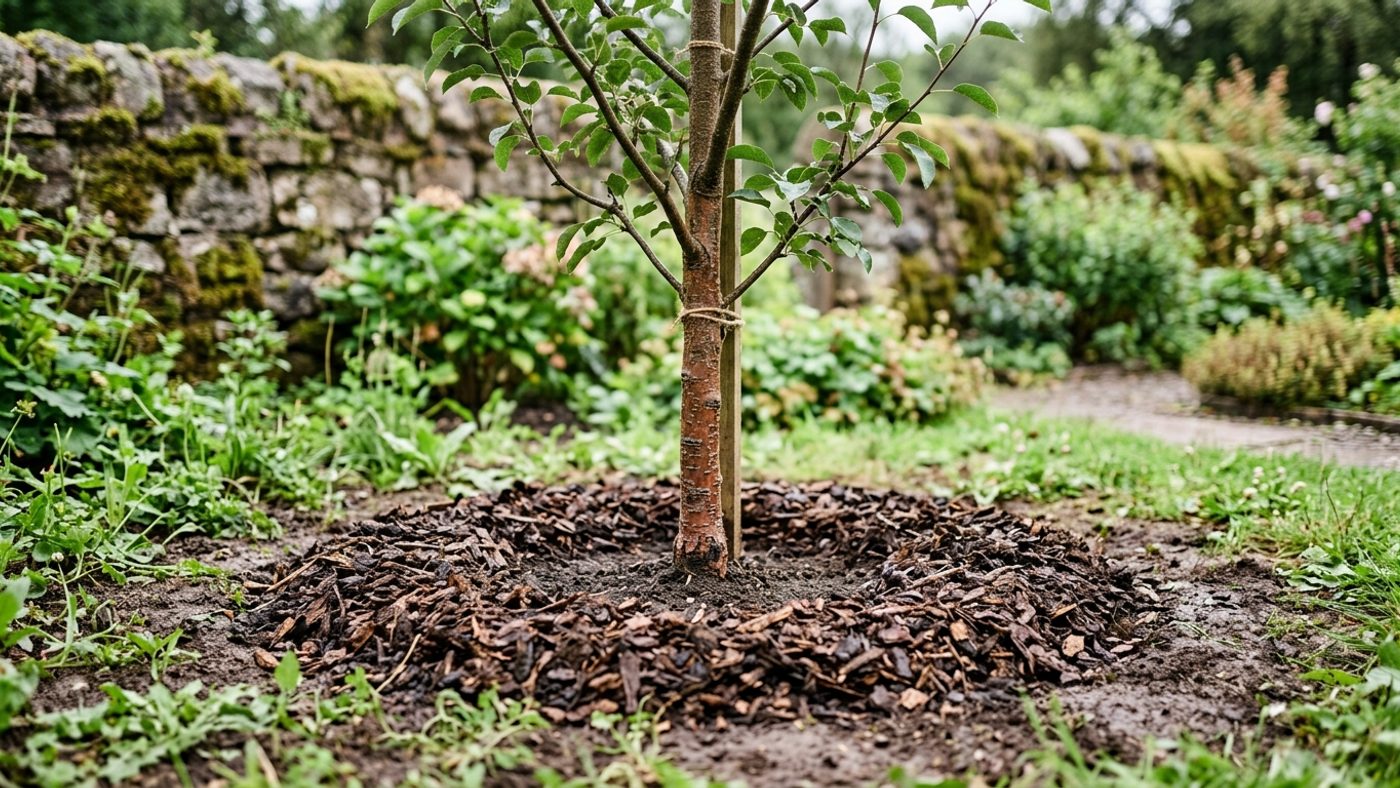
Water newly planted trees regularly through dry spells for their first couple of years; established trees in the ground need watering only in very dry spells while fruit is swelling. Mulch each spring, leaving a small mulch-free circle around the trunk to prevent rot; a well-mulchedA layer of material spread over the soil around plants to suppress weeds, retain moisture, and improve soil structure as it breaks down. Full definition → tree generally needs no extra feeding. Container trees need steady moisture through the growing season plus a high-potassium liquid feed every fortnight.
Pruning and training forms
A free-standing bush or standard tree is pruned in winter, while dormant. Trained forms are pruned mainly in late summer instead, once their basic framework is established, to keep their shape and encourage fruiting spursWhether a fruit tree carries its fruit mainly on short side-shoots along older wood (spur-bearing) or at the tips of the previous year's growth (tip-bearing). Full definition →.
- Cordon: a single stem at 45°, spaced around 75cm apart; space-efficient for a small garden.
- Fan: a short trunk with branches radiating outward, usually wall-trained for extra warmth.
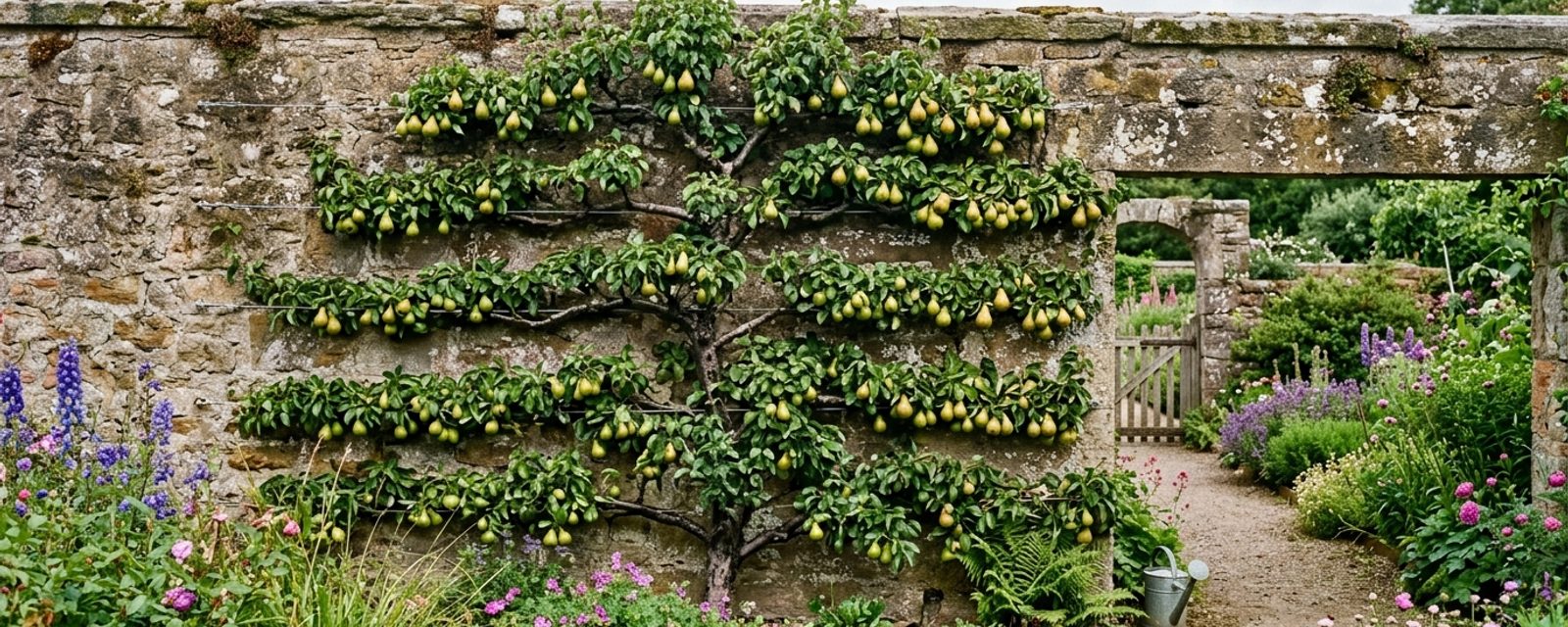
- Espalier: a central trunk with horizontal tiers, needs at least 3.6m to spread.
- Step-over: kept low, a single horizontal pair of branches; useful as an edging.
A wall-trained fan or espalier suits pears especially well here, since the wall's stored warmth and shelter helps exactly the varieties that need it most.
Varieties
8 pear varieties carry the Award of Garden Merit, a shorter, complete list, unlike apples' 23-variety subset of a much longer UK-wide total. Dessert and cooking uses split the list, and season of use spreads from late August to the New Year, so there's more to choose between here than warmth tolerance alone.
The remaining varieties: Beurré Superfin (late, excellent flavour, needs a warm sheltered site), Doyenné du Comice (mid-season, exquisite flavour and texture, but only moderate crops), Gorham (early, reliable, best in a warm spot), and Joséphine de Malines (late, reliable, often keeps into the New Year).
★ Our pick for Scotland
ConferenceAGM
Dessert · mid-season (Oct-Nov) · pollination group 3 · self-fertile
It sets fruit without a pollinator, and copes with cooler conditions better than most pears, the same kind of direct regional fit James Grieve carries among apples.
Why this one: Two things line up here that don't for most pear varieties. First, it genuinely copes with cooler conditions better than most pear varieties. Second, it sets fruit without being pollinated at all, though it crops better with a partner nearby, useful where there's only room for one tree. Between the two, it's the variety this guide leads with rather than the best-known name (Comice) or the classic cooker.
Also worth considering
Beurré HardyAGM
Dessert · mid-season (Nov-Dec) · pollination group 3
RHS calls it 'a very hardy, vigorous tree' with resistance to scab, useful in a wetter climate, though it still wants a sheltered, sunny site and is slow to start bearing fruit.
ConcordeAGM
Dessert · mid-season · pollination group 3 · partially self-fertile
Reliable, heavy crops on a fairly compact tree. Independently confirmed partially self-fertile, a second workable option alongside Conference for a single-tree garden.
Show other recommended varieties (1)
BethAGM
Dessert · early (Sept) · compact tree
A compact variety that ripens early, useful in a smaller garden or where a long, warm autumn can't be relied on to finish the crop.
Best Pear Varieties for Scotland → compares all named pear varieties head-to-head, with the practical detail that doesn't fit in a summary card.
Harvesting and storage
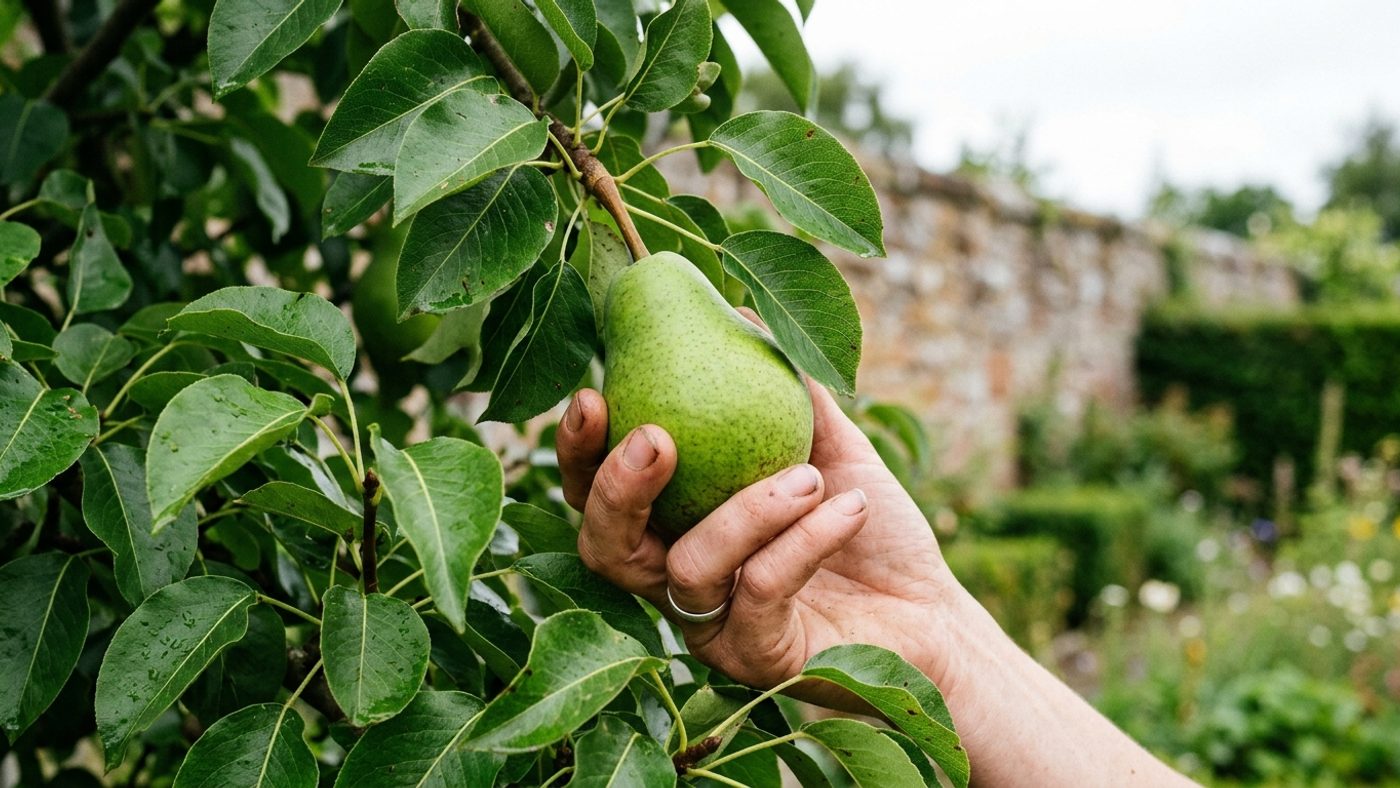
Pick pears before they're fully ripe, while still firm and swollen. Early varieties like Beth are ready from late August; later varieties such as Joséphine de Malines hang on into autumn. Once picked, early varieties finish ripening indoors in about a week; later varieties can take months in cool storage before they're ready.
Common problems
- Fruit aphids distort new growth and shoots, the same problem apples carry.
- Pear scab causes dark, scabby blotches on leaves and fruit, the same fungus that affects apples. Rake up fallen leaves in autumn to reduce the overwinteringKeeping a plant alive and intact through the cold months, whether left outdoors, moved under cover, or stored dormant. Full definition → source.
- Brown rot turns fruit soft and brown with pale concentric rings, usually spreading from a wound or where fruit touches in storage.
See more problems
- Pear rust causes bright orange spots on leaves; part of its life cycle needs a nearby juniper, so removing a juniper host within reach can help break the cycle.
- Pear blister mite causes small blister-like pimples on leaves that turn pink then black; mainly cosmetic on an otherwise healthy tree.
- Pear midge larvae cause young fruitlets to swell then blacken and drop in early summer. Pick up and destroy fallen fruitlets promptly to stop the larvae completing their life cycle in the soil.
- Codling moth caterpillars are named as a pear pest by Gardener's World, in contrast to RHS's own pear problems list, which omits it; worth checking fruit for the same core-tunnelling caterpillar known from apples.
- Wasps, including social wasps and hornets, are drawn to fruit already damaged or split, and will enlarge that damage. Pick ripening fruit promptly and remove any already split.
- Biennial bearing, a heavy crop one year followed by little the next, is a cropping pattern some varieties are naturally prone to, the same as apples. Thinning helps even it out.
Common questions
Do pears ripen on the tree like apples?
No: pick pears while still firm and swollen, then let them finish ripening off the tree: about a week indoors for early varieties, months in cool storage for later ones. A pear left until soft on the tree is usually already overripe or spoiling at the core. Full sourced breakdown: <a href="/tools/garden-myths/pears/">Pear Myths →</a>
Do I need two pear trees to get fruit?
Not always: Conference sets fruit without a pollinator, though it still crops better with one nearby, and Concorde is independently confirmed partially self-fertile; most other pear varieties do need a partner flowering at the same time. Full sourced breakdown: <a href="/tools/garden-myths/pears/">Pear Myths →</a>
Do all pear varieties need a hot climate?
No: it is variety-specific, not a crop-wide rule: Conference copes with cooler conditions better than most pears, while Beurré Superfin and Gorham genuinely need a warm, sheltered site. Full sourced breakdown: <a href="/tools/garden-myths/pears/">Pear Myths →</a>
Does codling moth affect pears as well as apples?
Sources disagree: RHS's own pear problems list doesn't name codling moth, but Gardener's World lists it directly alongside caterpillars, so it's worth checking pears for the same core-boring caterpillar as apples rather than assuming the omission means they're safe. Full sourced breakdown: <a href="/tools/garden-myths/pears/">Pear Myths →</a>
Sources
6 sources, and what each was used for
- RHS: getting started, rootstocks (Quince A, Quince C), pollination requirement, 8 AGMThe RHS's Award of Garden Merit: a UK-wide trials award for reliable performance, not a Scotland-specific recommendation. Full definition → varieties with individual descriptive tags, site and soil prep, planting method and spacing by rootstock, container growing, watering, feeding, trained forms, pruning timing, harvesting method (picked before fully ripe, ripens off the tree), storage, and the nine named problems
- RHS: confirms the two pear rootstocks with exact ultimate heights: Quince C (dwarfing, 2.5-3m) and Quince A (semi-vigorous, 3-4.5m), and named forms for each
- RHS: general pollination-group mechanics shared with apples; pears are not separately detailed on this page beyond the general fruit-tree model
- RHS: pollination group 3, self-fertility ('can set fruit without being pollinated'), AGM, season of use, disease susceptibility
- RHS: pollination group 3, AGM, 'a very hardy, vigorous tree', scab resistance, season of use, H6 hardiness ratingThe RHS's H1a–H7 scale for how much cold a plant can survive outdoors, H1a being tender indoor-only and H7 hardy anywhere in the UK. Full definition →
- gardenersworld.com: independently confirms Concorde as partially self-fertile; names codling moth and caterpillars among pear pests, not on RHS's own problems list; corroborates November-March bare-root planting and late-August-onwards harvesting