
Pear Rust is a common disease that affects pears in Scotland. Here is what it looks like, the conditions it needs, and the controls that actually work.
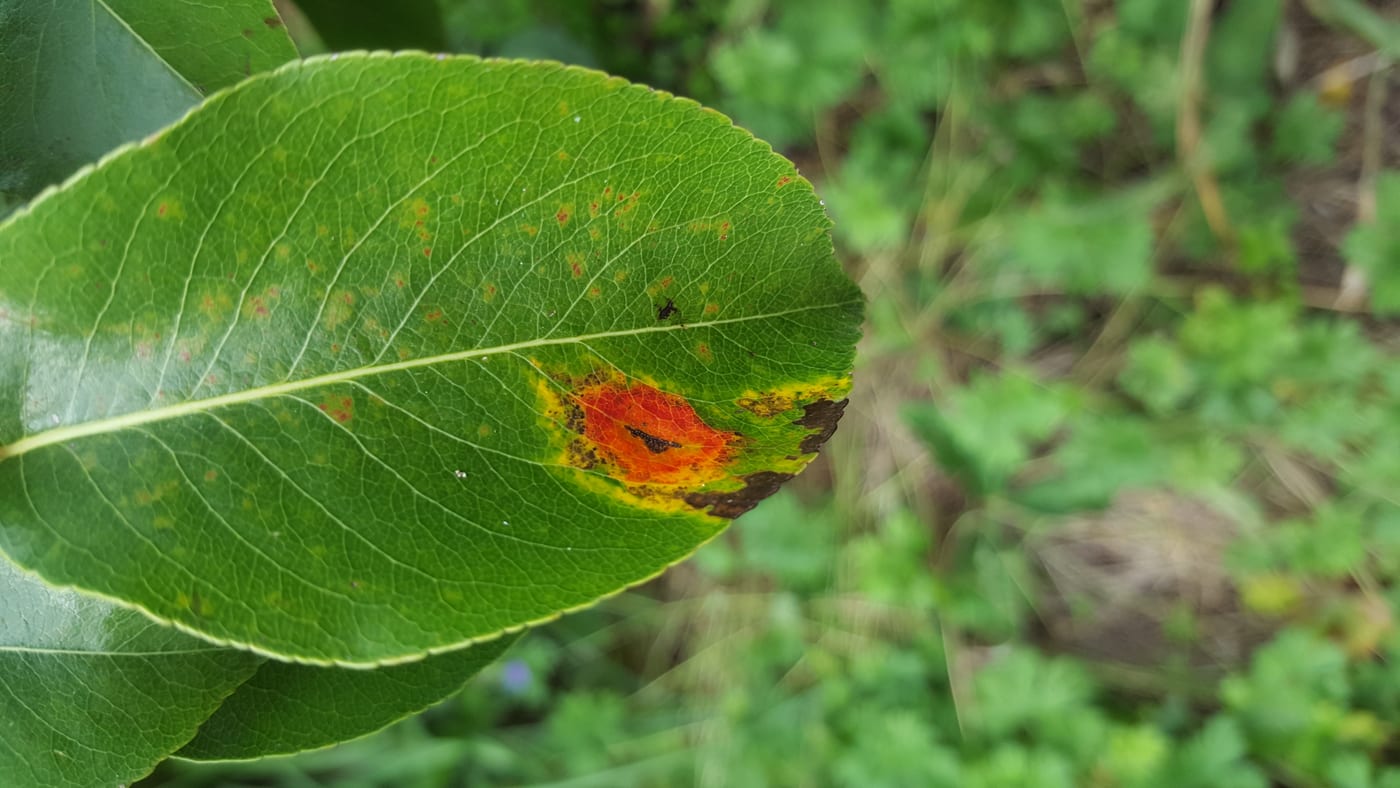
What does it look like?
Bright orange spots appear on the upper leaf surface in summer. As the season progresses, brown, gall-like outgrowths develop on the lower leaf surface directly beneath each orange spot. Fruit is rarely affected, though it can be in bad cases, and in mainland Europe perennial cankers have been recorded developing on branches.
What causes it
High humidity in spring triggers the orange, jelly-like spore growths on the juniper host, which is the stage that starts the year's infection cycle on nearby pears.
Is this disease active now?
Orange leaf spots appear on pear from spring into summer, with the gall-like growths on the leaf underside developing as summer progresses and continuing to appear into autumn.
Symptoms
Individual leaf lesions can grow together and cover much of a leaf when infection is severe, and heavily affected leaves can drop early. Occasionally infected fruit mummifies and falls rather than developing normally.
Life cycle
The fungus needs both hosts to complete its cycle. On pears, the brown fungal growths on the underside of infected leaves release spores that can't reinfect pear, but travel on the wind to infect nearby juniper instead. Those junipers develop perennial swellings that, during wet weather the following spring, extrude orange jelly-like growths releasing a different spore stage that reinfects pear leaves, starting the cycle again. The juniper stage is what lets the fungus survive winter, when pear trees are dormant and leafless.
Why this matters in Scotland
The RHS/Sylva Foundation monitoring project has tracked this disease becoming markedly more common across the UK over roughly the last twenty years, for reasons that aren't understood. Any pear-growing area, Scotland included, has more reason to expect it now than a gardener would a generation ago.
Controls: what actually works
Not every method here works equally well: some are backed by real evidence, others are simply traditional and untested.
Remove ornamental juniper growing near the pear tree, or vice versa, if either host can be spared
Since the fungus needs both hosts to complete its cycle, eliminating one nearby breaks it. The susceptible hosts are ornamental juniper cultivarsA plant variety that arose or was bred under cultivation and is kept true by deliberate propagation, rather than a naturally occurring wild species. Full definition →, Juniperus chinensis, J. sabina, J. scopulorum and J. virginiana among them, not Scotland's native juniper (Juniperus communis), a declining species with its own conservation value in Highland pinewood and scrub habitats; don't remove a native juniper on the strength of this alone. Pacific Northwest Extension gives a specific distance: removing susceptible juniper within a 1,000ft radius of the pear tree, or separating the two hosts by 0.5 to 2 miles, has been recommended where that's practical, though most garden plots can't reach that separation, which is why removing one host nearby is usually the only realistic version of this control.
Prune out the perennial swellings (galls) on an infected juniper where the juniper itself is being kept
Removes the source of the spring spore stage that goes on to reinfect nearby pears, without removing the juniper entirely.
Prune out any branch cankers on the pear tree itself
Where perennial cankers have developed on pear branches, removing them cuts down the amount of fungus surviving on the tree year to year.
Don't strip off infected pear leaves through the season
RHS specifically advises against removing heavily infected leaves, since the leaf-stage growths don't reinfect the pear itself, only nearby juniper, so stripping leaves costs the tree photosynthesis for no real control benefit.
Rake up and dispose of fallen pear leaves in autumn
RHS's general rust-diseases advice is to compost spring/summer-affected leaves, since those spores are short-lived, but to dispose of late-season material differently, since it can carry overwinteringKeeping a plant alive and intact through the cold months, whether left outdoors, moved under cover, or stored dormant. Full definition → spores. Applied here as general rust hygiene rather than a pear-rust-specific finding, since pear rust's own leaf-stage spores infect juniper rather than reinfecting pear directly.
Frequently asked questions
What should I do first if I find pear rust in my garden?
Start with remove ornamental juniper growing near the pear tree, or vice versa, if either host can be spared. After that, prune out the perennial swellings (galls) on an infected juniper where the juniper itself is being kept. Work through the rest in order of how well-evidenced they are if the first two aren’t enough on their own.
Is there a spray that works?
No. There are no amateur chemical treatments available for pear rust. The controls that work are cultural: the measures listed above.
When are pear rust most active in Scotland?
Check the seasonal activity section above. Scottish timings can run a few weeks behind the UK-generic figures.
Sources
2 sources, recorded with what each was used for
- RHS1: causal organism, affected hosts, identification, life cycle, conditions, the UK-prevalence trend, and the juniper-removal/pruning/leave-leaves-alone controls
- Pacific Northwest Extension18: independent corroboration of the causal species and life cycle, additional symptom detail (fruit mummification, leaf lesion coalescing), and specific host-separation distances RHS doesn't give