
Cabbage White Caterpillars is a common pest that affects kale, broccoli and cabbage in Scotland. Here is what it looks like, how to spot the damage, and which controls have been tested.
What does it look like?
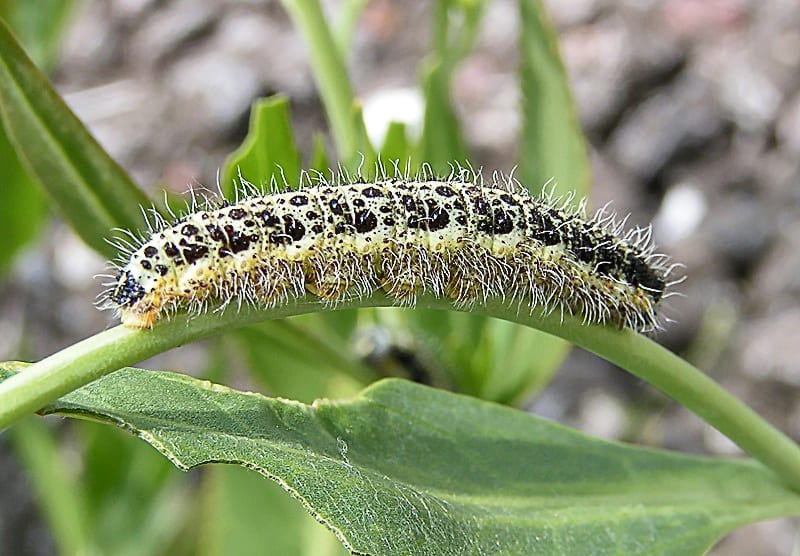
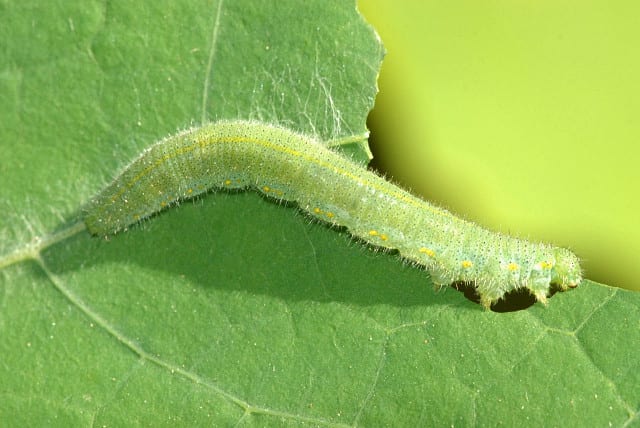
Large white caterpillars are yellow and black with obvious hairs; small white caterpillars are pale green and covered in short, velvet-like hairs.
The colour difference is the practical field distinction between the two commonest species.
🌱 Plants at risk
Cabbage White Caterpillars also affects these crops:
Symptoms
RHS: 'Holes are eaten in the outer leaves of all brassicasThe cabbage family: cabbage, kale, broccoli, cauliflower, Brussels sprouts, kohlrabi, swede, turnip and more, sharing the same pests, diseases and rotation rules. Full definition → and damage may also be seen on the inner leaves of cabbages when the heart is cut through.'
Life cycle
Large and small white butterflies produce two generations over the summer; cabbage moth runs two or three overlapping generations, and the diamond-back moth can manage several more in a good year. Caterpillars are typically seen June-July and again August-September for the white butterflies, and July-September for cabbage moth, with activity overall running May through October. Cabbage moth pupates and overwinters in the soil; cabbage white butterfly caterpillars instead pupate above ground, on any suitable vertical surface.
Controls: what actually works
Not every method here works equally well: some are backed by real evidence, others are simply traditional and untested.
Physical barrier: grow brassicas under fine netting or horticultural fleeceA lightweight, breathable fabric laid or draped over plants to trap a little warmth and keep off frost, wind and some flying pests. Full definition → to exclude adult butterflies
RHS: 'Growing brassicas under fine netting or horticultural fleece can exclude adult butterflies.'
Same logic as carrot fly: exclude the adult and there are no larvae. Barriers are the one control that works on both of Scotland's main brassica insect problems.
Tolerate populations
Tolerate them where you can: they feed parasitoid wasps, social wasps and birds. Accepting some damage lets natural predation do the population control for you.
Inspect regularly and hand-pick eggs and caterpillars
Inspect regularly to catch infestations early, and hand-pick eggs and caterpillars.
Checking leaf undersides for egg clusters before they hatch is the high-leverage version: one wipe removes what would be dozens of caterpillars.
Biological control: pathogenic nematodes
Pathogenic nematodes are among the recommended controls.
Proprietary repellent product (not named, see policy)
One proprietary repellent product is also recommended. We do not name it. The option is described here so you know it exists, without us endorsing or linking a specific brand.
Natural predators of cabbage white caterpillars
These 3 creatures eat cabbage white caterpillars, and each has its own page here on how to get more of them in your garden: what to plant, or what to order and when.
Frequently asked questions
What should I do first if I find cabbage white caterpillars in my garden?
Start with physical barrier. After that, tolerate populations. Work through the rest in order of how well-evidenced they are if the first two aren’t enough on their own.
Will cabbage white caterpillars kill my plants?
They rarely kill established plants. The damage is usually cosmetic on outer leaves, and natural predators often bring numbers under control without you doing anything.
Should I just leave cabbage white caterpillars alone?
In most gardens, yes. cabbage white caterpillars are food for birds, wasps and predatory insects, and a healthy garden carries some without trouble. Tolerance is also RHS's official position now, for that same reason.
Sources
1 source, recorded with what each was used for
- RHS1: biodiversity framing and tolerance advice, five species, large/small white caterpillar identification, damage description, netting/fleece, hand-picking, pathogenic nematodes, proprietary repellent