
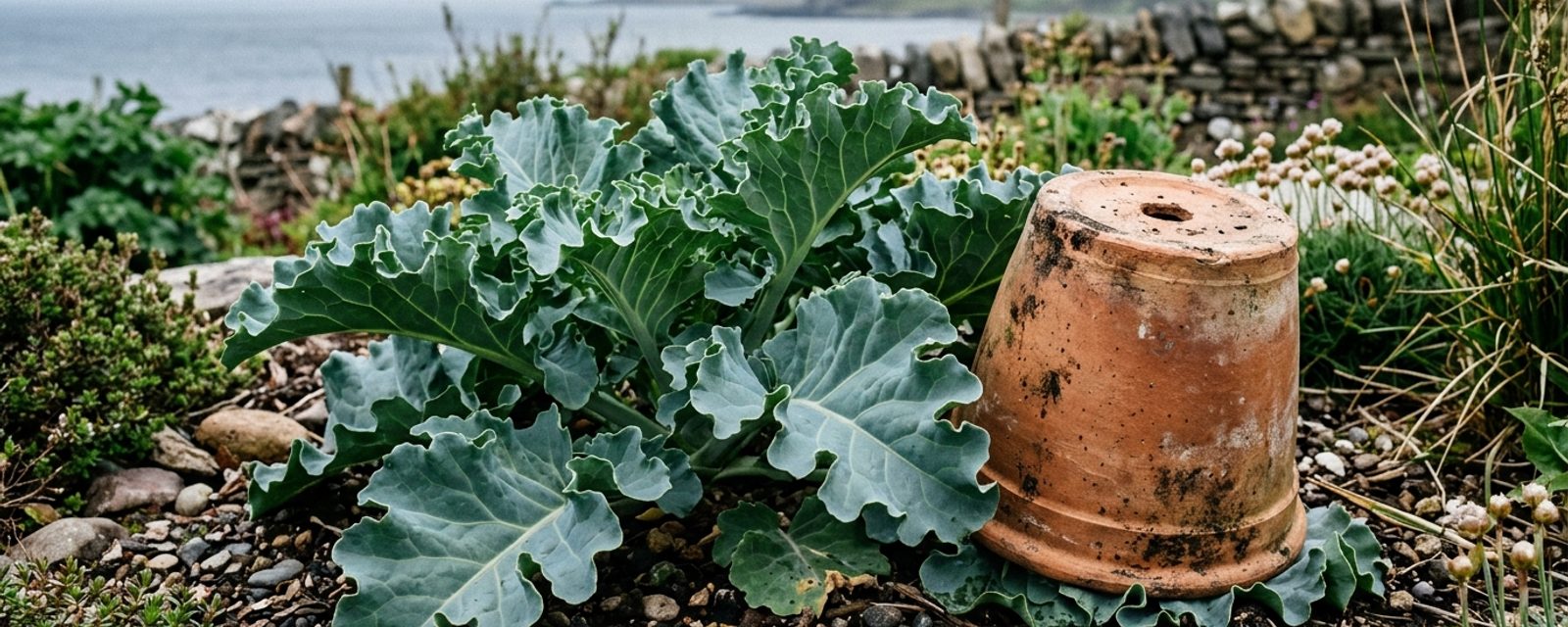
Crambe maritima
Sea kale is unusual among Scottish garden vegetables for actually favouring the climate rather than merely surviving it: it's native to our own coastline and hardy to well below -20°C. What it asks for instead is patience and a technique, not shelter from the cold.
This is a long-lived coastal perennial, not a leafy annual despite the shared "kale" name: a clump of large, wavy-edged blue-green leaves with a long tap rootA single, thick, dominant root growing straight down from a plant, storing energy and anchoring it, as opposed to a spreading mass of fine roots. Full definition → that resents being moved once planted. Grown mainly for its blanchedExcluding light from part of a growing plant, usually by earthing up, wrapping or covering, so it grows pale, tender and less bitter. Full definition → spring shoots, produced by excluding light from the crownThe base of a perennial plant where roots and shoots meet, often sold and planted as a ready-made dormant plant rather than grown from seed. Full definition → over winter, it rewards a slow start with a harvest few Scottish gardens ever grow. Left uncovered to flower, it carries fragrant white flowers that draw pollinating insects, worth knowing if you'd rather grow one plant ornamentally than force it every year.
Perennial Vegetables Worth Growing in Scotland → compares sea kale against the other permanent-bed crops worth the same long-term commitment.
Planting
Plant a young pot-grown plant, or a root cutting known as a "thong", into its permanent position in early spring: choose the site carefully, since the long tap root makes established plants very difficult to move later. Root cuttings go in about 2.5cm deep, pointed end down, spaced 60cm apart. Seed is also an option, though the hard seed coat needs soaking and scoring before sowing in a cold frame in spring or autumn. Choose a sunny or lightly shaded site with fertile, very well-drained soil and enough depth and width for the tap root to spread; sea kale isn't suited to containers. It's genuinely suited to a coastal planting, at home with the salt spray a shingle or sandy beach exposes it to in the wild, but that's not the same as tolerating open wind: shelter the site from strong wind even on an exposed coastal plot. It tolerates acid, alkaline or neutral soil, so pH isn't a real constraint here.
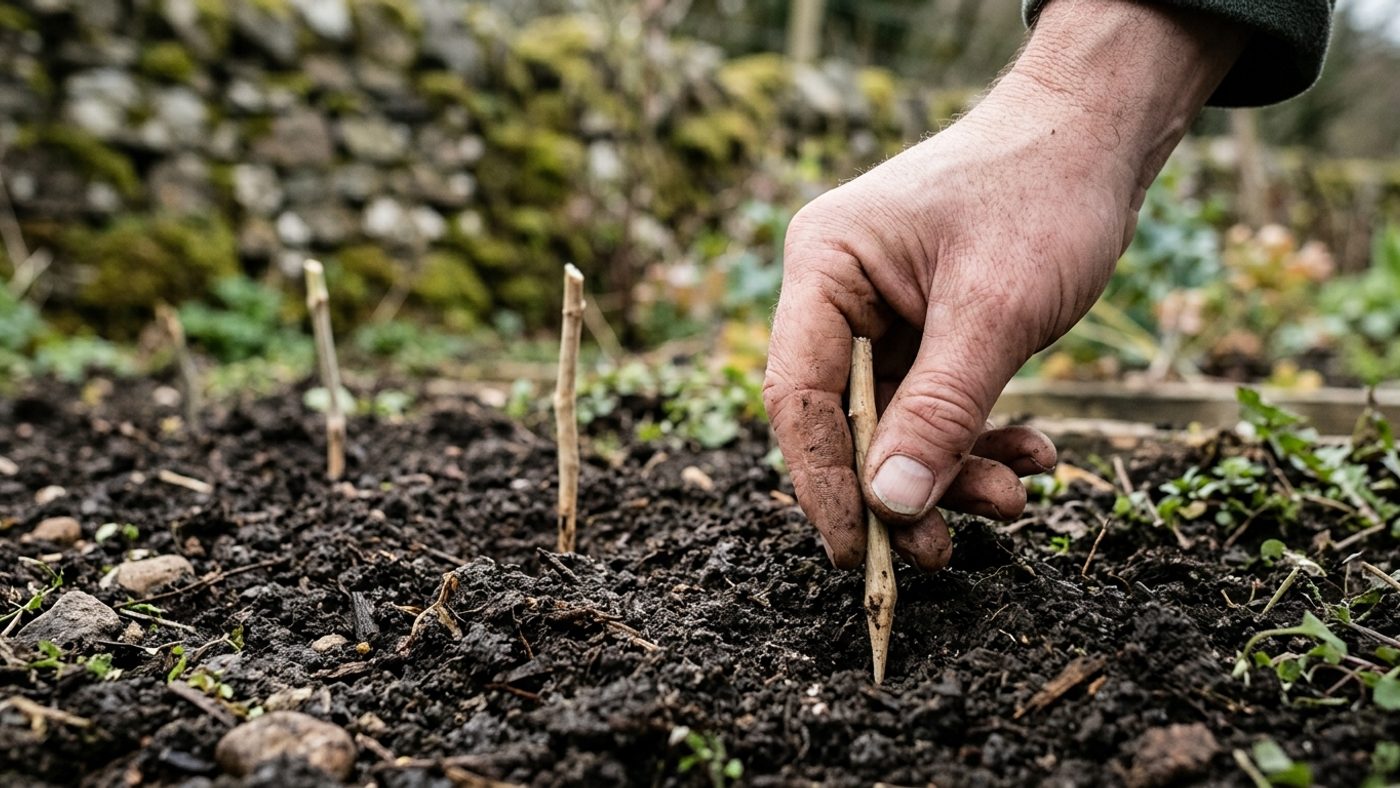
The first two years
Leave the plant alone through its first year to build a strong root system. Don't force or cut any shoots until the second spring after planting, and never force the same plant in consecutive years afterwards either, or the crown weakens.
Varieties
Care
Add a thick mulchA layer of material spread over the soil around plants to suppress weeds, retain moisture, and improve soil structure as it breaks down. Full definition → of well-rotted manure or garden compost each spring. Beyond that, an established plant needs very little routine attention: water during extended dry spells, but otherwise this is a genuinely low-maintenance perennial once its site and root system are settled.
Blanching and harvesting
From midwinter, cover the crown completely with an upturned pot, bucket or forcingCovering plants to exclude light and speed early, tender growth in the dark, most associated with rhubarb and sea kale in late winter. Full definition → jar to exclude all light. This is what produces the pale, tender, mild shoots sea kale is grown for; left uncovered, the shoots stay green and noticeably more bitter. Cut shoots once about 20cm long, eaten raw or steamed, with a flavour close to asparagus. The young leaves are edible too, cooked as a vegetable, and young flowering shoots can be cooked like sprouting broccoli: a genuinely three-part harvest from one plant across a season.
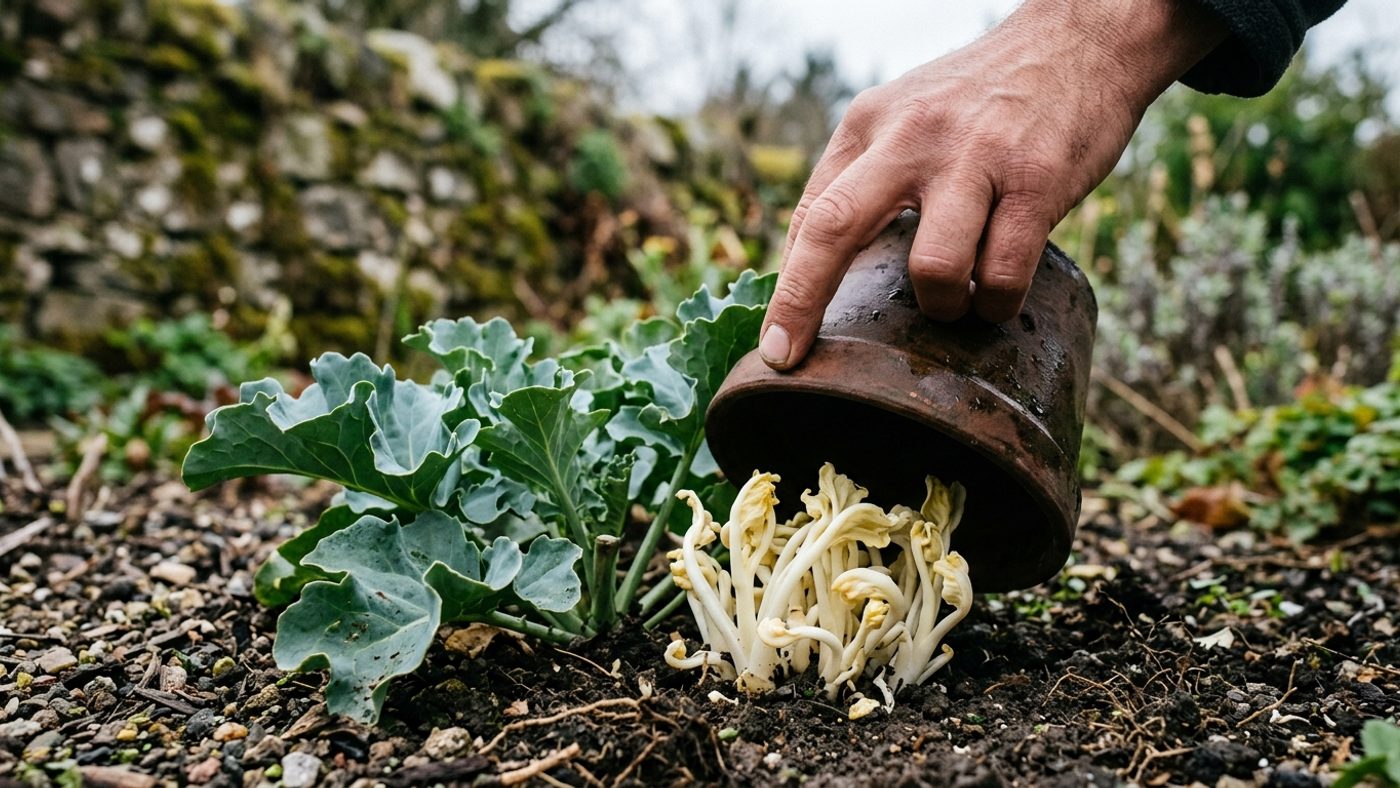
Forcing Chicory, Sea Kale & Strawberries → covers the same blanching principle applied across all three crops, plus what it buys you in each case.
Common problems
- Slugs and snails are named as a problem by both RHS and Gardener's World.
- Caterpillars can damage foliage, the same family of pests that troubles other brassicasThe cabbage family: cabbage, kale, broccoli, cauliflower, Brussels sprouts, kohlrabi, swede, turnip and more, sharing the same pests, diseases and rotation rules. Full definition →.
- Clubroot is a real risk, since sea kale shares its wider family with the brassicas clubrootA soil-borne fungal disease of the brassica family that swells and distorts roots, and survives in soil for years. Full definition → usually targets: avoid a site where cabbages, kale or other brassicas have grown recently, the same precaution that crop applies to itself.
See more problems
- Flea beetle is named by Gardener's World, though not by RHS's own page for this species.
Common questions
Is sea kale the same thing as ordinary kale?
No, despite the shared name. Ordinary curly or cavolo nero kale is a leafy annual or biennialA plant that completes its life cycle over two years: growth in year one, then flowering, seeding and dying in year two. Full definition → brassica grown for its leaves. Sea kale is a coastal perennial in the same wider family, native to British and Irish coastlines including north-east Scotland, grown mainly for its blanched spring shoots rather than for leaves.
How long before I get a harvest?
Not in the first year. Don't force or cut a plant until its second spring, giving the root system a full year to establish first. From then on, expect a real harvest each spring, produced by blanching rather than by simple waiting.
What does blanching actually involve?
Covering the crown completely to exclude light, using an upturned pot, bucket or forcing jar, from midwinter onward. This produces the pale, tender, mild-flavoured shoots sea kale is grown for; left uncovered, the shoots stay green and much more bitter.
Is it only the shoots that are edible?
No. The blanched shoots are the main harvest, eaten raw or steamed like asparagus, but the young leaves are also edible cooked as a vegetable, and young flowering shoots can be cooked like sprouting broccoli. It's a genuinely three-part harvest from one plant.
Sources
4 sources, and what each was used for
- RHS: hardiness (H7The RHS's H1a–H7 scale for how much cold a plant can survive outdoors, H1a being tender indoor-only and H7 hardy anywhere in the UK. Full definition →), site/soil requirements and pH direction, coastal siting and pollinator value, size, native range, propagation methods named, pest and disease list (slugs, caterpillars, clubroot)
- gardenersworld.com: the fuller practical vegetable-growing guide for this crop: planting timing and method, seed preparation, spacing (60cm), root-cutting depth and method, blanching/forcing method and the second-year rule, shoot harvesting method, edible use, and pests (club root, flea beetles, slugs and caterpillars, corroborating RHS)
- scotland-species.nbnatlas.org: native status in Scotland specifically, 880 Scottish records, establishment means: Native, IUCN Red List: Least Concern
- RHS: the one named cultivar (Lilywhite), its size and description, and independently confirms that young leaves are edible cooked and young flowering shoots are cooked like sprouting broccoli, beyond the shoot harvest Gardener's World describes