
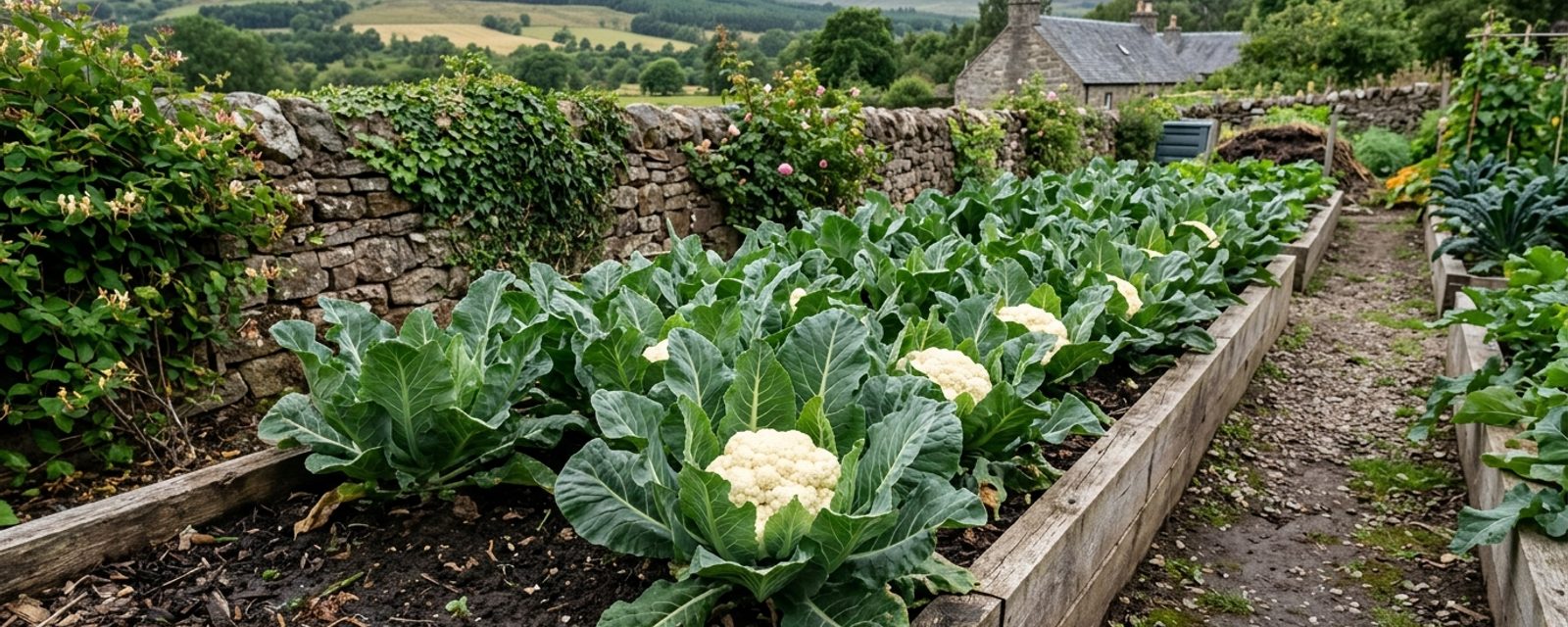
Brassica oleracea (Botrytis Group)
Cauliflower is the brassicaThe cabbage family: cabbage, kale, broccoli, cauliflower, Brussels sprouts, kohlrabi, swede, turnip and more, sharing the same pests, diseases and rotation rules. Full definition → most easily knocked off course — a single cold snap, a late transplant, or one inconsistent watering can trade a full head for a small, disappointing one.
Cauliflower has a reputation for being fussy, and the reputation is earned: unlike kale or swede, which mostly shrug off a bad week, this is a crop that doesn't forgive a lapse. Get the timing and the consistency right, though, and it's no harder than any other brassica.
Buttoning: the one failure worth knowing in advance
A small, premature head is called buttoning, and it's a check in growth, not a disease or a pest. The triggers are root disturbance from transplanting too late, loose soil, irregular or insufficient watering, and cold temperatures in spring, or a hot spell.
Every one of those is a condition a Scottish spring can supply for free. That is not a reason to avoid the crop, it is the reason to treat the few things you control, transplant timing, firm soil, and steady watering, as non-negotiable rather than optional.
Choosing a type, and why it matters more here
Cauliflower is sown across three type-windows, and the type changes how forgiving the crop is, not just when it's ready:
- Early-summer types, sown indoors in mid-to-late winter, are the fastest but the most exposed to a late cold snap.
- Summer/autumn types, sown indoors in spring or outdoors mid-to-late spring, are the mid-season default.
- Winter/spring types, sown latest, from late spring to early summer, are bred to be hardier and stand through cold, cropping well beyond winter into spring or even early summer.
A Scottish garden rarely gets a settled, predictable summer, which is exactly the condition the fast early-summer types are betting on. The hardier winter/spring types trade speed for tolerance of the unsettled weather that causes buttoning in the first place.
Varieties
RHS lists ten AGMThe RHS's Award of Garden Merit: a UK-wide trials award for reliable performance, not a Scotland-specific recommendation. Full definition → varieties across all three types, plus orange, green and purple colour types and a romanesco with lime-green peaked floretsThe individual small flower-bud clusters that make up a broccoli, cauliflower or romanesco head. Full definition →. The award is UK-wide, not a Scottish one.
★ Our pick for Scotland
ClaptonAGM
Autumn
Resistant to club rootA soil-borne fungal disease of the brassica family that swells and distorts roots, and survives in soil for years. Full definition →, with large white heads of excellent flavour.
Why this one: Club root is the single most consequential brassica disease on Scotland's naturally acidic, often wet soils, and there is no cure once it takes hold. Clapton is specifically named club-root resistant, which makes it the one sourced choice that addresses the biggest risk to this crop here, rather than a bare "best for Scotland" claim.
Also worth considering
JeromeAGM
Spring
Copes well with cold weather. Top-quality white heads in early spring.
Moby DickAGM
Autumn/Winter
White head with strong foliage that protects it from early frosts.
Best Cauliflower Varieties for Scotland → compares all named cauliflower varieties head-to-head, with the practical detail that doesn't fit in a summary card.
Soil and site
Cauliflower wants deep, fertile, moisture-retentive but free-drainingSoil that lets water pass through quickly rather than pooling, so roots aren't sitting in wet ground after rain. Full definition → soil, with a couple of bucketfuls of well-rotted manure or garden compost per square metre dug in beforehand. It prefers a soil pH around 6.5: if your ground is very acidic, as much of Scotland's naturally is, apply lime the previous winter to raise the pH and deter club root at the same time.
If potatoes share your rotationMoving each crop family to different ground each year, on a multi-year cycle, so pests and diseases that build up in soil don't get a repeat host. Full definition →, keep the lime off their bed instead: raising the pH helps cauliflower but raises the risk of scab on potatoes.
Sowing, transplanting and care
Sow about 1.5cm deep, timed to your chosen type: indoors from mid-to-late winter for early-summer types, indoors in spring or outdoors mid-to-late spring for summer/autumn types, or late spring to early summer for hardy winter/spring types.
Transplant at 10-15cm tall, at about six weeks old, on time rather than late, since a delayed transplant is a known cause of buttoning. Space plants 45-70cm apart depending on variety (15cm for mini varieties), with rows 60-70cm apart.
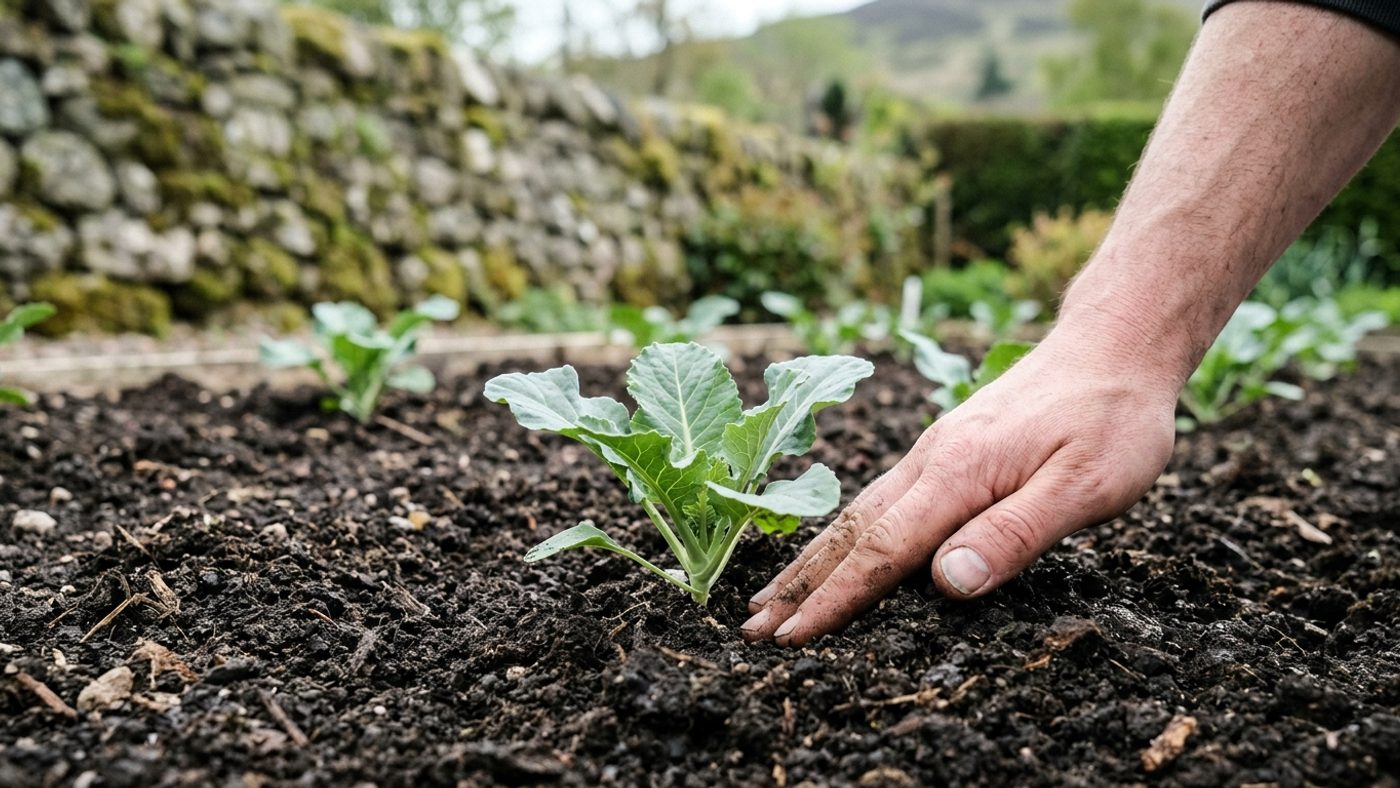
Keep the soil damp at all times but never waterlogged, which matters most while the curdThe tight, edible white (or coloured) head of a cauliflower, made up of undeveloped flower buds packed closely together. Full definition → is forming. Irregular watering is on the same buttoning cause list as cold weather, so a consistent routine through a dry spell earns its keep here more than on most brassicas.
Harvesting
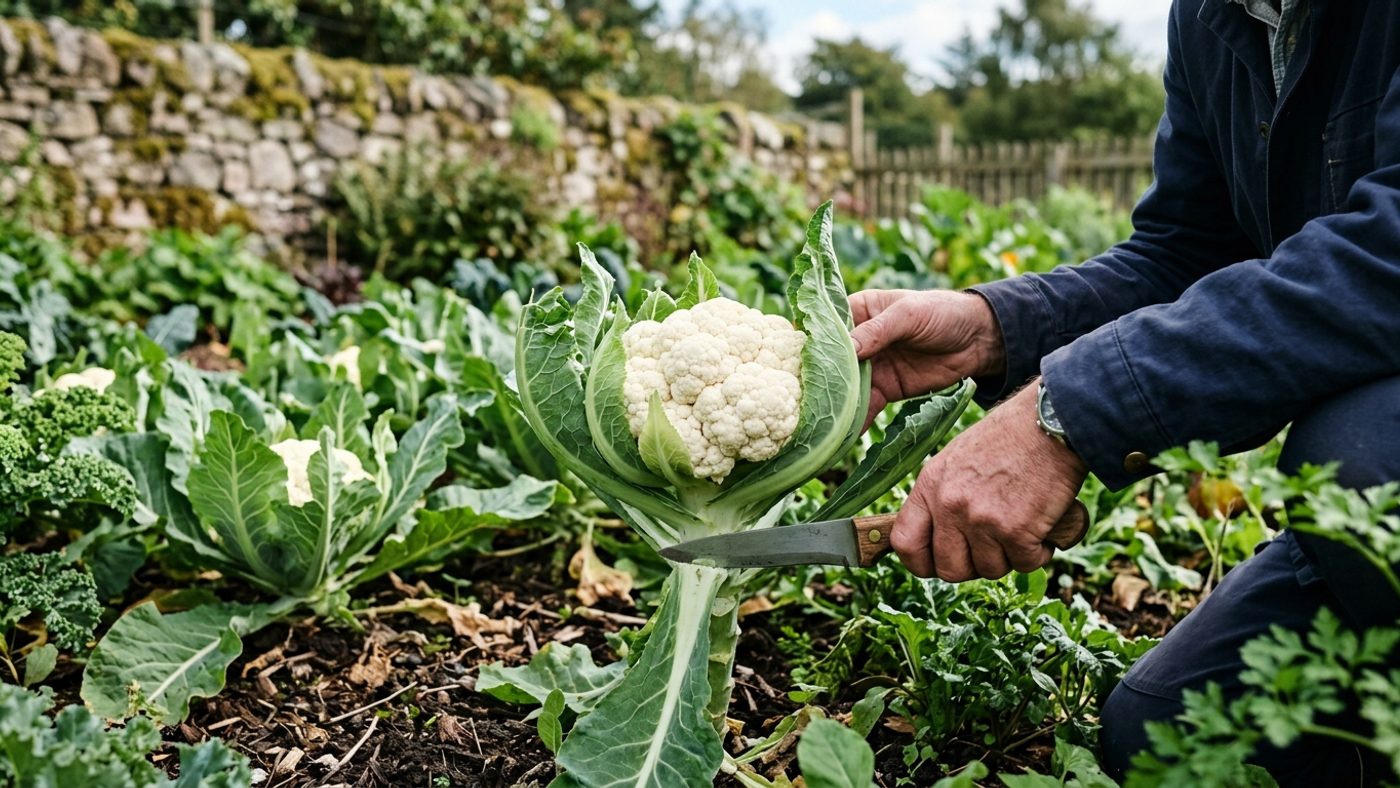
Cauliflower takes three to six months from sowing to maturity, depending on type and variety. Cut the head as soon as it's a good size while still firm and compact. Once the head starts to separate, it's past its best, so check developing heads every couple of days rather than leaving them: that window closes fast.
OverwinteringKeeping a plant alive and intact through the cold months, whether left outdoors, moved under cover, or stored dormant. Full definition → winter/spring types benefit from a little extra protection as the cold sets in: covering with fleeceA lightweight, breathable fabric laid or draped over plants to trap a little warmth and keep off frost, wind and some flying pests. Full definition →, or folding some of the plant's own outer leaves over the head, keeps frost off the curd itself.
Common problems
- Buttoning, a tiny premature head, means a check in growth (late transplant, loose soil, irregular water, cold or heat), not a disease. Prevention, not cure, covered above.
- Cabbage caterpillars can strip a plant in days. Cover with insect-proof mesh from transplanting.
- Slugs and snails and pigeons both go for young plants. Protect them until established.
See more problems
- Club root causes swollen, distorted roots. Lime the soil, rotate brassicas, and consider a resistant variety like Clapton. No chemical treatment exists.
- Flea beetles riddle young leaves with small holes, worst in warm, dry spells. Mesh over seedlings is cheap insurance.
- Cabbage root fly maggots damage roots. Mesh is the defence, and it's less troublesome in Scotland's cool summers than further south.
Common questions
Why did my cauliflower form a tiny, useless head instead of a proper one?
It's called buttoning: a growth check from things like a late transplant, loose soil, inconsistent watering or a spring cold snap, not a disease, so transplanting on time and keeping watering steady through curd formation avoids it. Full sourced breakdown: <a href="/tools/garden-myths/cauliflower/">Cauliflower Myths →</a>
Is cauliflower only white?
No: orange, green and purple varieties exist alongside white, including romanesco types, and the colour is bred in and grown, not dyed or modified. Full sourced breakdown: <a href="/tools/garden-myths/cauliflower/">Cauliflower Myths →</a>
How do I know when to harvest, and what happens if I leave it too long?
Cut it as soon as the head is a good size while still firm and tightly closed: leaving it longer doesn't improve it, since once the head starts to separate it's already past its best. Full sourced breakdown: <a href="/tools/garden-myths/cauliflower/">Cauliflower Myths →</a>
What is the difference between the three cauliflower types?
They're sown at different times and suit different seasons: early-summer types are sown indoors in mid-to-late winter for a fast summer crop; summer/autumn types are sown in spring for a mid-season harvest; and winter/spring types are sown latest, in late spring to early summer, but are the hardiest, standing through cold and cropping into spring or even early summer. In a Scottish garden, where a settled summer isn't guaranteed, the hardier winter/spring types are usually the more forgiving choice.
Sources
2 sources, and what each was used for
- RHS: sowing across three type-windows, 1.5cm depth, spacing and row spacing, transplant trigger, pH 6.5 with club root liming advice, harvest 3-6 months by type, buttoning cause and prevention, AGM varieties across all three types
- SAC/SRUC: lower incidence of the difficult brassica pests (cabbage aphid, cabbage root fly) in Scotland — applies to cauliflower as a Brassica oleracea crop sharing the pest set