
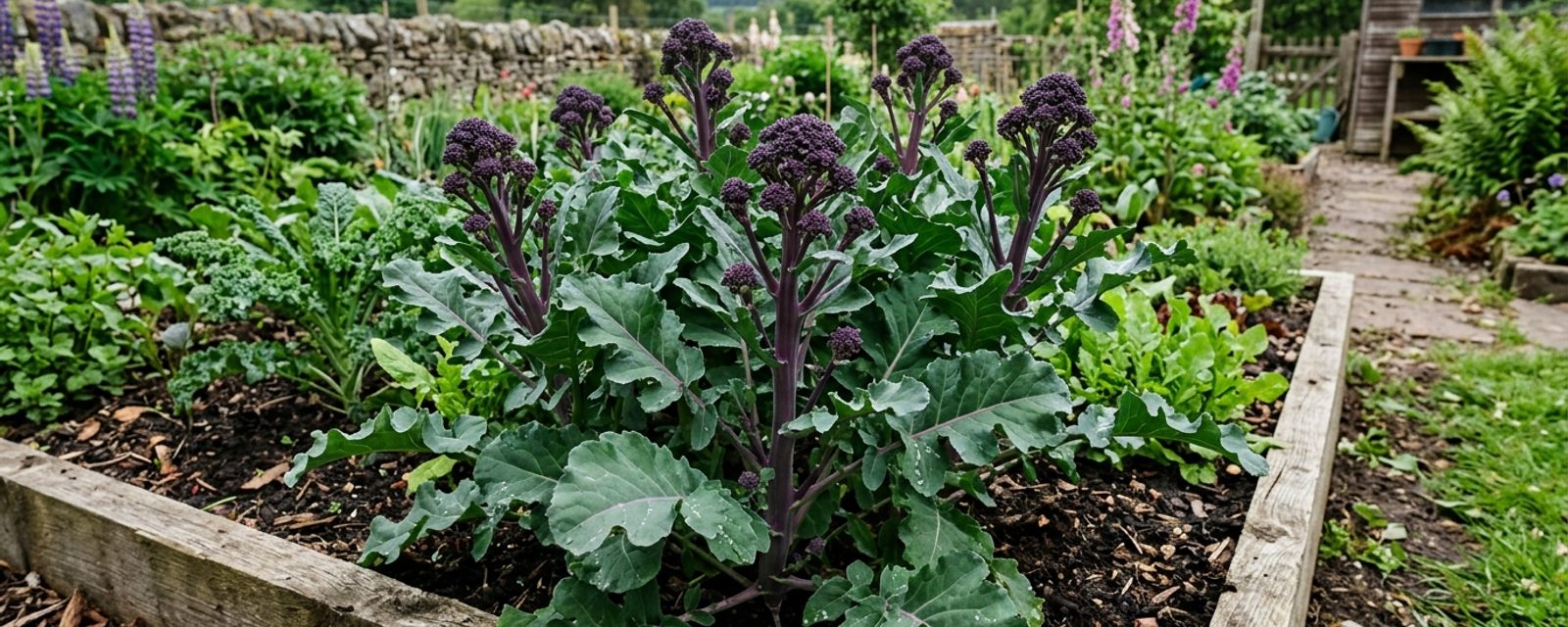
Brassica oleracea (Italica Group)
Sow broccoli on a windowsill in February and you'll be cutting purple spears in the snow by winter's end.
Broccoli, the sprouting kind, not the supermarket calabrese, is the crop that earns its keep by standing through winter and delivering fresh spears in February and March when almost nothing else is available. It is a brassicaThe cabbage family: cabbage, kale, broccoli, cauliflower, Brussels sprouts, kohlrabi, swede, turnip and more, sharing the same pests, diseases and rotation rules. Full definition →, which means it wants lime, wants mesh, and wants you to keep it away from the patch where cabbages grew last year. It takes eight months or more to reach its first harvest. A purple sprouting broccoli in the hungry gap, when the shops are selling imported greens and your plot has been bare since November, is worth every week of bed space it occupied.
Why broccoli suits Scotland
Broccoli prefers a cool summer. Hot weather can cause the flower buds to develop prematurely, reducing the crop. In much of England that is a risk worth managing. In Scotland it is barely a risk at all. A Scottish summer, cool and steady, is exactly what a broccoli plant wants. Our climate also holds down two of the difficult brassica pests: cabbage aphid and cabbage root fly are less troublesome here than further south. The plants mature more slowly, but they mature steadily.
The real Scottish advantage is winter. Traditional varieties are hardy and stand through the cold, providing harvests from winter into spring, exactly when the hungry gap leaves most other beds empty.
Varieties
Purple varieties are hardier and more productive than white, which is the trait that matters for a crop standing through a Scottish winter. These carry the RHS Award of Garden Merit, a UK-wide award, not a Scottish one.
★ Our pick for Scotland
ClaretAGM
Purple sprouting · winter
Extremely vigorous, heavy-cropping. Large tender shoots, many side-shoots for a long harvest.
Why this one: Broccoli earns its Scottish bed by cropping through the hungry gap, late winter into spring, when almost nothing else is standing. It takes eight months or more to get there, but a winter variety planted in spring occupies the ground through the whole season and delivers fresh spears in February and March. Claret is the AGMThe RHS's Award of Garden Merit: a UK-wide trials award for reliable performance, not a Scotland-specific recommendation. Full definition → that produces the most side-shoots, which is what keeps the harvest going for weeks.
Also worth considering
CardinalAGM
Purple sprouting · winter
Very hardy, crops over a long period. Large deep-purple spears with good flavour.
MendocinoAGM
Purple sprouting · early
High yields of uniform purple spears. A good early maincropping variety for summer harvests.
Show other recommended varieties (1)
Red FireAGM
Purple sprouting
Best Broccoli Varieties for Scotland → compares all named broccoli varieties head-to-head, with the practical detail that doesn't fit in a summary card.
Soil and site
Broccoli wants fertile, well-drained soil in sun or very light shade. Choose a sheltered spot. These are tall plants, up to 90cm, and a winter gale will loosen them at the roots. Broccoli prefers a soil pH of 6 to 7. If your soil is very acidic, apply lime the winter before sowing to raise the pH and deter club rootA soil-borne fungal disease of the brassica family that swells and distorts roots, and survives in soil for years. Full definition → disease. This matters more in Scotland, where naturally acidic soils are common.
Dig in two bucketfuls of well-rotted manure or garden compost per square metre several months before planting, to let the ground settle. If done just before planting, firm the soil well by treading it down. Broccoli is a brassica, so rotate it with other cabbage-family crops and do not plant it where brassicas grew last year.
Sowing and planting
Sow from February to July: indoors from February, outdoors from April. Sow two seeds per moduleA tray divided into small individual cells, each sown with its own seed or seedling, so each plant grows undisturbed roots until it's ready to plant out. Full definition →, 2cm deep, in peat-freeCompost made without peat, which is harvested from a slow-forming, carbon-storing wetland habitat that peat extraction damages. Full definition → seed compost. GerminationA seed sprouting: breaking dormancy and putting out its first root and shoot, given the right warmth and moisture. Full definition → takes about two weeks without additional heat. Thin to the strongest seedling per module. Sow small batches several weeks apart for regular pickings over a long season.
Plant out when the young plants are 10 to 15cm tall with a good root system. You can do this any time from mid-spring to late summer depending on the sowing date. Harden offGradually getting young plants raised indoors used to outdoor conditions over 7–14 days before planting out, so cold, wind and direct sun don't shock or damage them. Full definition → indoor-raised plants first. Plant deeper than they were in the pot, with the lowest leaves at the soil surface, so they root deeply and firmly. Space plants 70cm apart depending on the variety, with a similar distance between rows. Generous spacing ensures good air circulation, which reduces disease, and encourages more side-shoots.
Starting plants in modules is also worth doing if you have club root in your soil. A well-developed root system before going into the ground means the plant is less severely affected.
Watering and care
Water young plants during dry spells until they are well established. After that, you should only need to water during prolonged dry weather. A thick mulchA layer of material spread over the soil around plants to suppress weeds, retain moisture, and improve soil structure as it breaks down. Full definition → of garden compost around the plants retains moisture and suppresses weeds. If the soil is poor, apply an organic high-nitrogen fertiliser when the plants are about 20cm tall.
Weed regularly while the plants are young. Once the crop is growing strongly, the large leaves shade out most competition.
Support: broccoli plants are tall and top-heavy, and an exposed Scottish plot will loosen them at the roots. Pile soil up around the base of the stem to increase stability, and insert a sturdy cane tied to the main stem before the autumn gales arrive.
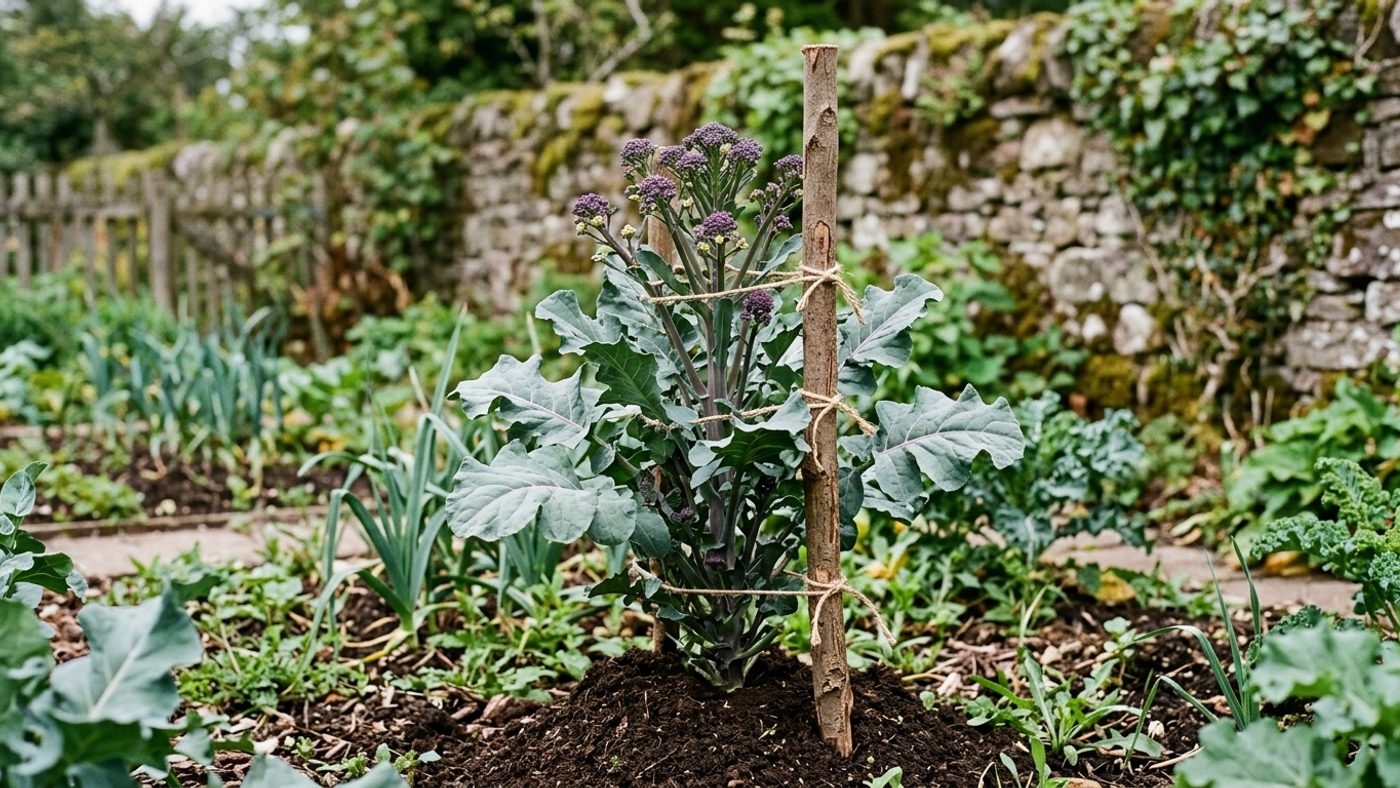
Protection: cover the crop with insect-proof mesh or fleeceA lightweight, breathable fabric laid or draped over plants to trap a little warmth and keep off frost, wind and some flying pests. Full definition →, supported on canes and pinned to the ground. Cabbage white butterflies, cabbage root fly and pigeons will all take a broccoli plant if it is not covered. The mesh is cheap, it stays on for the life of the crop, and it removes the need to patrol for caterpillars every day.
Harvesting
Broccoli is ready from June through to the following March, depending on sowing time and variety. Plants take four to ten months to start cropping, then provide pickings for up to two months. Summer varieties crop much faster than winter ones.
Harvest when the small heads or spears are well formed but still tightly in bud, before the yellow flowers open. Cut the whole shoot at the base with about 10cm of stem and any small leaves, which can all be eaten. Take the central spear first, then side-shoots will form over the following weeks. The more shoots you harvest, the more the plant produces. Check plants regularly. A spear in tight bud at breakfast is a yellow flower by dinner.
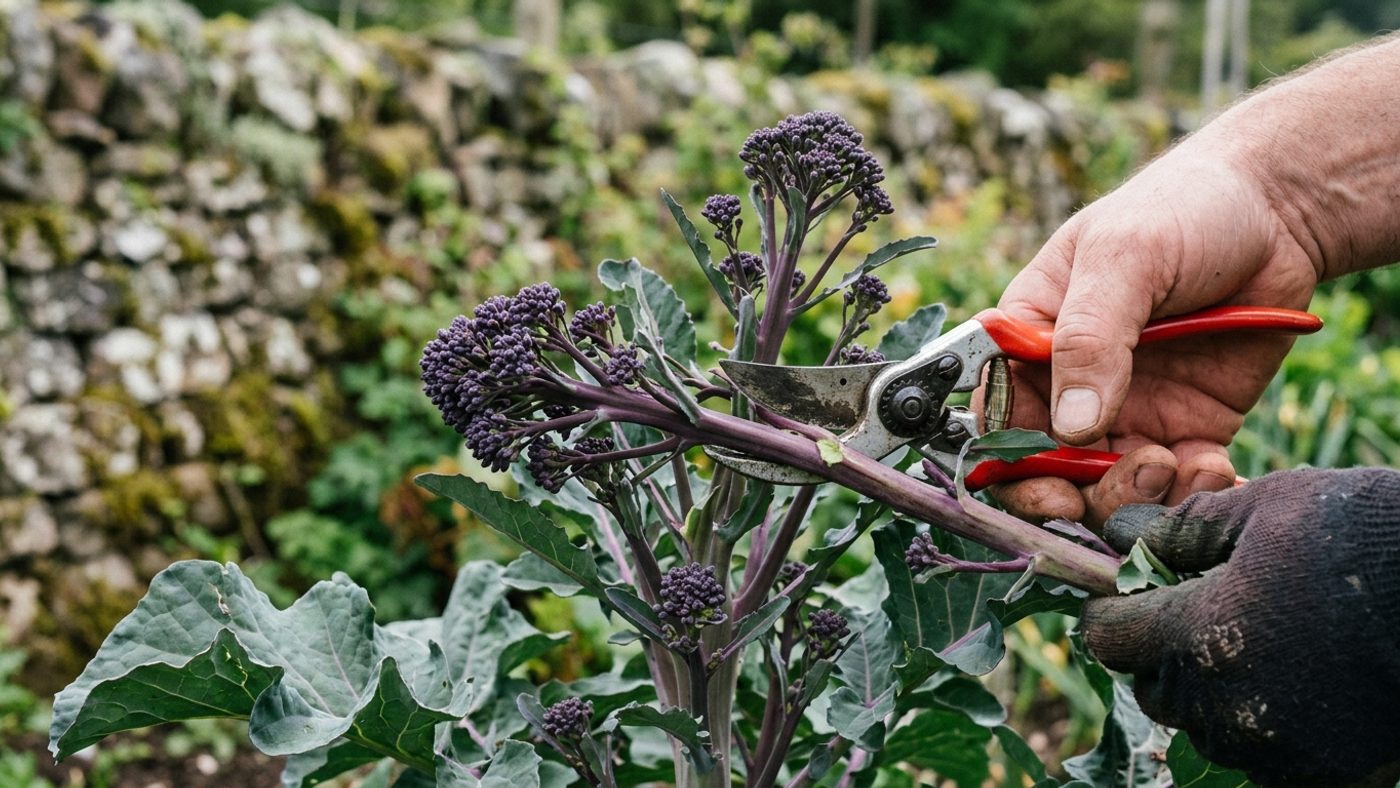
Purple varieties generally turn green when cooked. Broccoli is best used as fresh as possible but keeps in the fridge for a few days and freezes well. A winter broccoli standing through January into February, purple spears against the snow, is one of the most satisfying things in a Scottish garden.
Common problems
- Cabbage caterpillars are the larvae of cabbage white butterflies. They can strip a plant in days. Cover with insect-proof mesh from the start. If they get in, pick them off by hand.
- Pigeons will strip a broccoli plant to the stem. Mesh or netting, from the day you plant out.
- Slugs and snails go for young plants especially. Mesh and a clear bed with nowhere for them to hide help most.
See more problems
- Club root causes swollen, distorted roots. Plants wilt in dry weather. Lime the soil, start plants in modules to give them a head start, and rotate brassicas. No chemical treatment exists.
- Cabbage root fly maggots eat the roots. Mesh is the defence. Less troublesome in Scotland's cool summers.
- Flea beetle riddles young leaves with small holes, worst in warm, dry spells. Mesh over seedlings is cheap insurance.
- Bolting means the plant flowers prematurely in hot weather, leading to a smaller crop. Far less of a problem in Scotland than further south. Harvest the early buds as soon as you see them.
- Plants loosening in wind. Stake them and mound soil around the stems. An exposed Scottish plot will test the roots.
Common questions
What is the difference between broccoli and calabrese?
They're two different crops sold under the same name: calabrese is the single-head supermarket type, sown in spring and cut three to four months later, while sprouting broccoli forms small purple or white spears over four to ten months, cropped right through to spring. Full sourced breakdown: <a href="/tools/garden-myths/broccoli/">Broccoli Myths →</a>
How long does broccoli take to grow?
Four to ten months, depending on the variety and sowing time. Summer varieties are faster and more compact. Winter varieties form large plants up to 90cm tall and wide and take eight months or more, but they give you fresh spears through the hungry gap in late winter and early spring. A crop that occupies the ground that long needs to earn its keep, and a winter broccoli does exactly that.
Does broccoli need protection from pests?
Yes. It is a brassica, and brassicas attract the usual suspects: cabbage caterpillars, cabbage root fly, and pigeons. The simplest defence is to cover the crop with insect-proof mesh or fleece from the start, supported on canes and pinned to the ground. In Scotland's cool summers, cabbage aphid and cabbage root fly are less troublesome than further south, but the mesh is cheap insurance.
Why is my broccoli covered in grey caterpillars?
Cabbage white butterfly caterpillars. They can strip a plant in days. The mesh should have been on from the start. If it is too late, pick the caterpillars off by hand. The plants usually recover if the damage is not too severe, but check daily. A new batch of eggs can hatch in a week.
How do I harvest broccoli to keep it producing?
Cutting the central spear doesn't end the plant: it triggers side-shoots, so keep watering and picking as they size up, and you can expect several more weeks of harvest from the same plant. Full sourced breakdown: <a href="/tools/garden-myths/broccoli/">Broccoli Myths →</a>
Sources
2 sources, and what each was used for
- RHS: sowing Feb-Jul, 2cm depth, transplant trigger, 60-80cm spacing and rows, pH 6-7 and clubroot liming advice, harvest Jun-Mar, 4-10 months to crop, AGM varieties
- SAC/SRUC: lower incidence of the difficult brassica pests (cabbage aphid, cabbage root fly) in Scotland, and slower, steadier maturing of the brassica group in cool summers