
Brassica rapa (Rapifera Group)
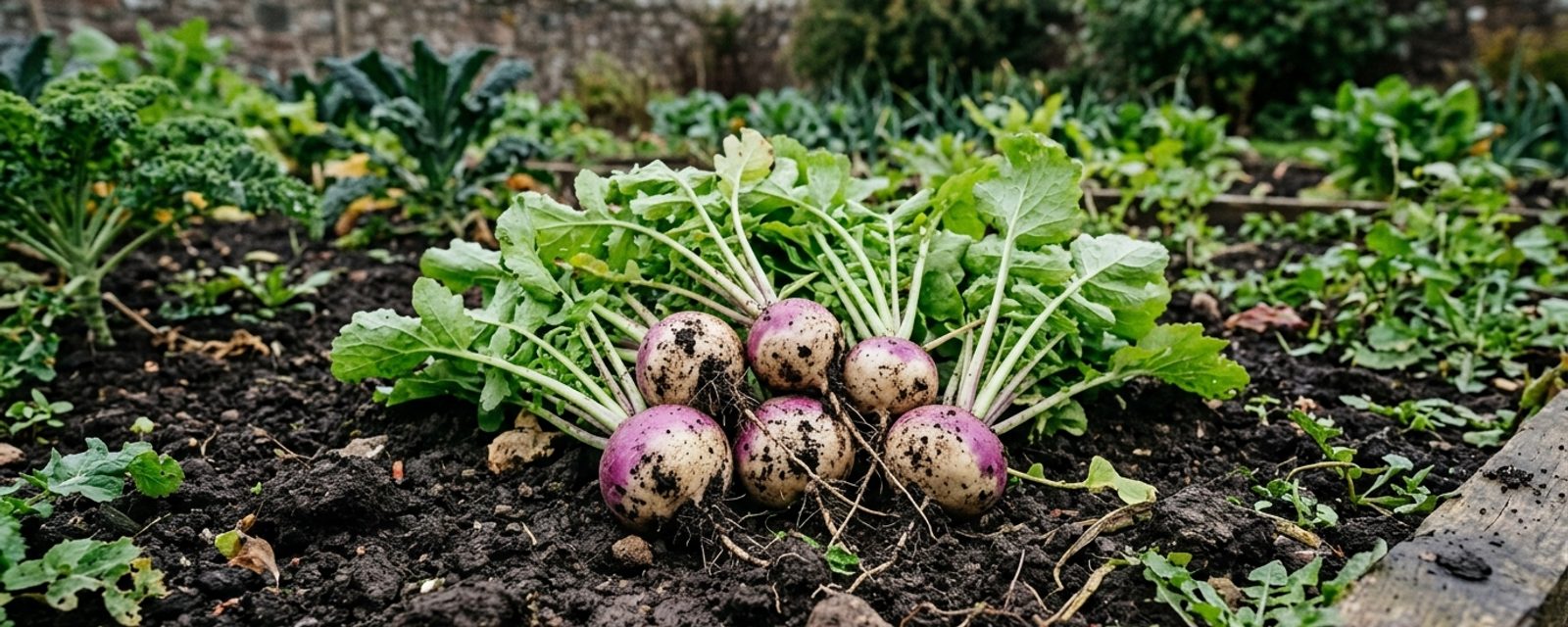
Turnip is a fast, repeatable crop that gives you two harvests, root and leaf, from one sowing.
Turnip is the quick crop in this family. Where swede takes a single sowing and up to six months to bulk up, turnip is ready in as little as six weeks and can be sown again and again through spring and summer, slotting into whatever gap opens up in the rotationMoving each crop family to different ground each year, on a multi-year cycle, so pests and diseases that build up in soil don't get a repeat host. Full definition →. It's a doubly useful crop, too: the leaves are worth eating, not just the root.
Sowing, little and often
Sow from March to mid-August, direct into the ground, about 1cm deep, in rows 23-30cm apart. Under clochesA small, portable clear cover placed over an individual plant or short row to trap warmth and keep off wind, rain and pests. Full definition →, you can start as early as February. Sow in successive small batches every couple of weeks rather than one big row, which is what turns turnip into a repeatable crop instead of a single harvest.
How far apart you thin the seedlings depends on what you're growing for. Picking small, tender baby veg, thinning may not be necessary at all. Growing full-size maincropThe main, usually latest-sown and longest-growing type of a crop, grown for bulk and storage rather than an early harvest. Full definition → roots, thin to 23cm apart (15cm for early varieties) once the seedlings are large enough to handle, and don't throw the thinnings away: they're a usable salad crop in their own right.
Site and soil
Turnip wants a sunny spot and fertile, moisture-retentive soil, dug over with plenty of compost or well-rotted manure worked in, ideally the autumn before sowing. Keep it consistently watered, particularly in any dry spell after sowing: dry conditions are what push the plant into boltingA plant switching early into flowering and seed production, usually triggered by stress, after which leaves, roots or bulbs turn bitter or unusable. Full page →, running to flower instead of forming a root, and can also make the root itself woody or split. No source publishes a soil pH figure for turnip, unlike some of its brassicaThe cabbage family: cabbage, kale, broccoli, cauliflower, Brussels sprouts, kohlrabi, swede, turnip and more, sharing the same pests, diseases and rotation rules. Full definition → relatives, so we don't state one.
Varieties
RHS lists four AGMThe RHS's Award of Garden Merit: a UK-wide trials award for reliable performance, not a Scotland-specific recommendation. Full definition → varieties, ranging from purple-topped types for the root to Japanese salad turnips grown young. The award is UK-wide, not a Scottish one.
★ Our pick for Scotland
OasisAGM
Japanese type
Slow to bolt.
Why this one: Bolting, running to flower instead of bulking up the root, is turnip's main failure mode, and RHS names Oasis specifically as slow to bolt. That is a real, sourced reason to reach for it, though it is worth being clear that bolting is triggered by dry spells rather than cold, so this is not itself a Scottish-climate pick, just a genuinely useful one wherever you garden.
Also worth considering
AtlanticAGM
Early · purple-topped
An early, purple-topped variety.
Temari RedAGM
Salad
Scarlet red skin.
Best Turnip Varieties for Scotland → compares all named turnip varieties head-to-head, with the practical detail that doesn't fit in a summary card.
Turnip tops: the second harvest
Cooked like spinach. Take them either alongside the root harvest, or grow them as their own cut-and-come-again crop, picking a few young leaves at a time so the plant keeps producing.
If you want both root and leaf from the same plant, pick lightly and leave enough foliage for the root to keep bulking up. If you're growing purely for tops, sow thickly and harvest young and often, the same way you would spinach.
Harvesting and storing
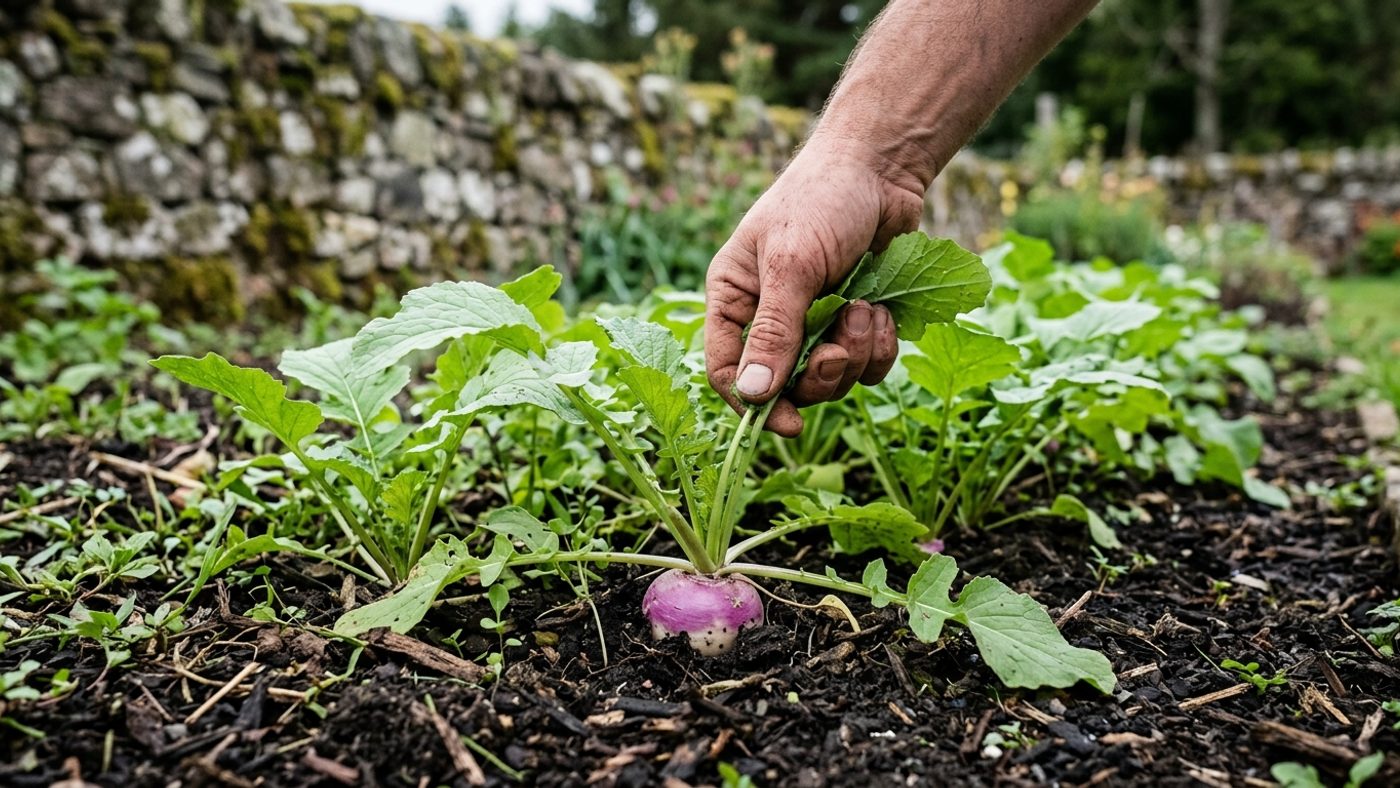
Early varieties are ready in about 6 weeks, from May to September. Maincrop varieties take about 10 weeks and are ready from October. Pull baby veg small and tender, or let maincrops size up for storage.
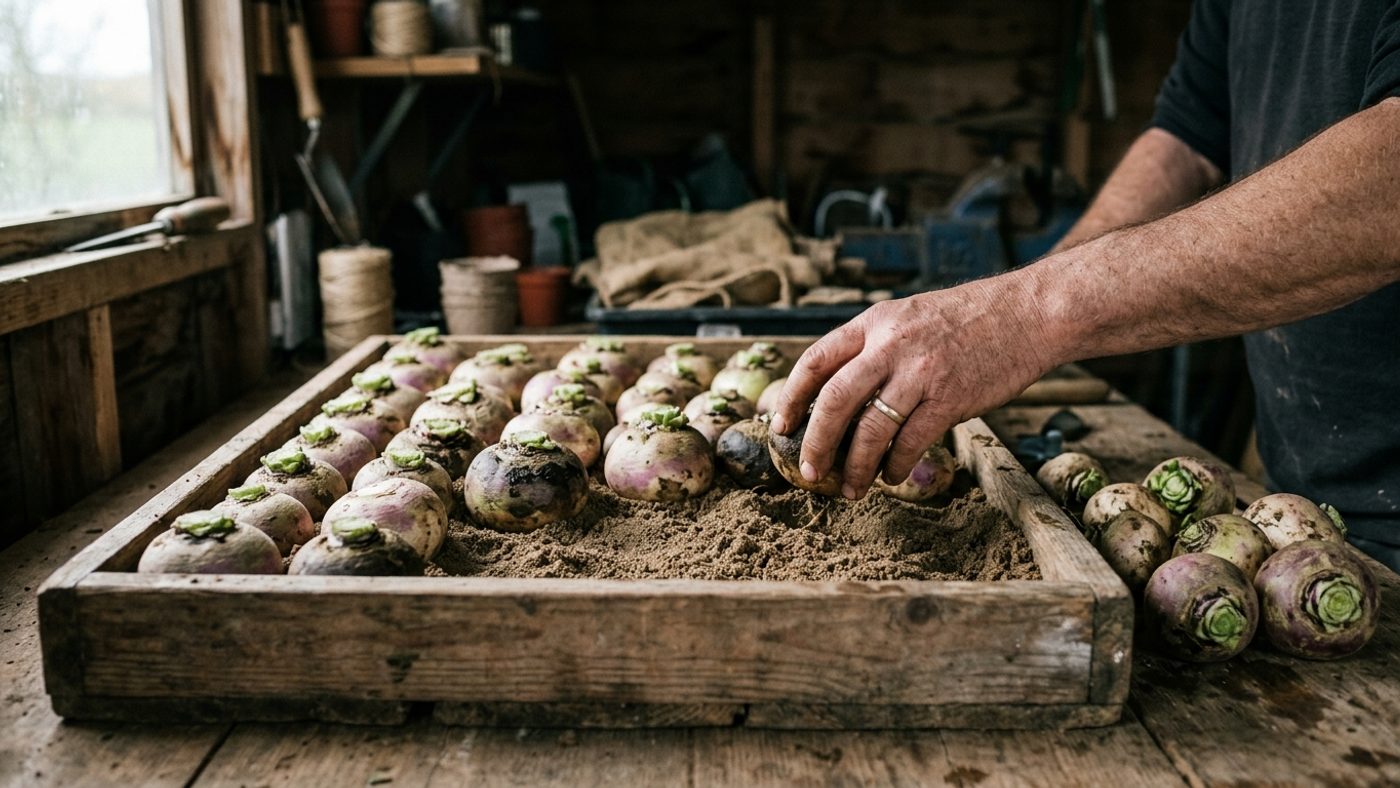
Roots lifted in autumn keep for several weeks in trays of moist sand or coir, somewhere cool and frost-free, which stretches a fast crop into a useful bit of winter storage as well.
Common problems
- Bolting is caused by dry conditions, not poor soil. Keep watering consistent, and consider 'Oasis' if it keeps happening.
- Cabbage caterpillars can strip foliage in days, which matters more here than on a root-only crop, since the leaves are part of what you're growing. Cover with insect-proof mesh from sowing.
- Slugs and snails and birds both go for young seedlings. Protect them until established.
See more problems
- Club root causes swollen, distorted roots and wilting in dry weather. Rotate brassicas. No chemical treatment exists.
- Cabbage root fly maggots damage roots. Mesh pinned down at sowing is the defence, and it's less troublesome in Scotland's cool summers than further south.
- Flea beetles riddle young leaves with small holes, worst in warm, dry spells. Mesh over seedlings is cheap insurance.
- Powdery mildew shows as a white coating on leaves, especially in dry conditions. Keep soil evenly moist and space plants well for airflow.
Common questions
Is turnip the same thing as swede?
No: despite the naming overlap in some regions, turnip (Brassica rapa) and swede (Brassica napus) are different species on different timelines: turnip is ready in 6-10 weeks and can be sown repeatedly, swede is one sowing that takes up to six months. Full sourced breakdown: <a href="/tools/garden-myths/turnip/">Turnip Myths →</a>
Can I eat turnip leaves, or are they just thinnings?
They're genuinely worth eating, not just waste: turnip tops are edible cooked like spinach, harvested alongside the roots or picked young as their own cut-and-come-again crop. Full sourced breakdown: <a href="/tools/garden-myths/turnip/">Turnip Myths →</a>
Why did my turnip run to flower instead of forming a root?
That's bolting, and it comes from dry conditions rather than poor soil: keeping the soil consistently moist, especially just after sowing, is the fix, and 'Oasis' is a specifically slow-to-bolt variety if it keeps happening. Full sourced breakdown: <a href="/tools/garden-myths/turnip/">Turnip Myths →</a>
Do I need to thin turnip seedlings?
It depends what you're growing for: baby veg picked young may not need thinning at all, but full-size maincrop roots still need thinning, to 23cm apart (15cm for early varieties). Full sourced breakdown: <a href="/tools/garden-myths/turnip/">Turnip Myths →</a>
Sources
2 sources, and what each was used for
- RHS: sowing March-Aug in successive batches, 1cm depth, spacing and row spacing, harvest 6-10 weeks, turnip tops as a second harvest, storage in moist sand/coir, bolting risk in dry conditions, AGM varieties, pest and disease list, swede/turnip naming overlap in parts of the UK
- SAC/SRUC: lower incidence of the difficult brassica pests (cabbage aphid, cabbage root fly) in Scotland — applies to turnip as a Brassica rapa crop sharing the same pest set