
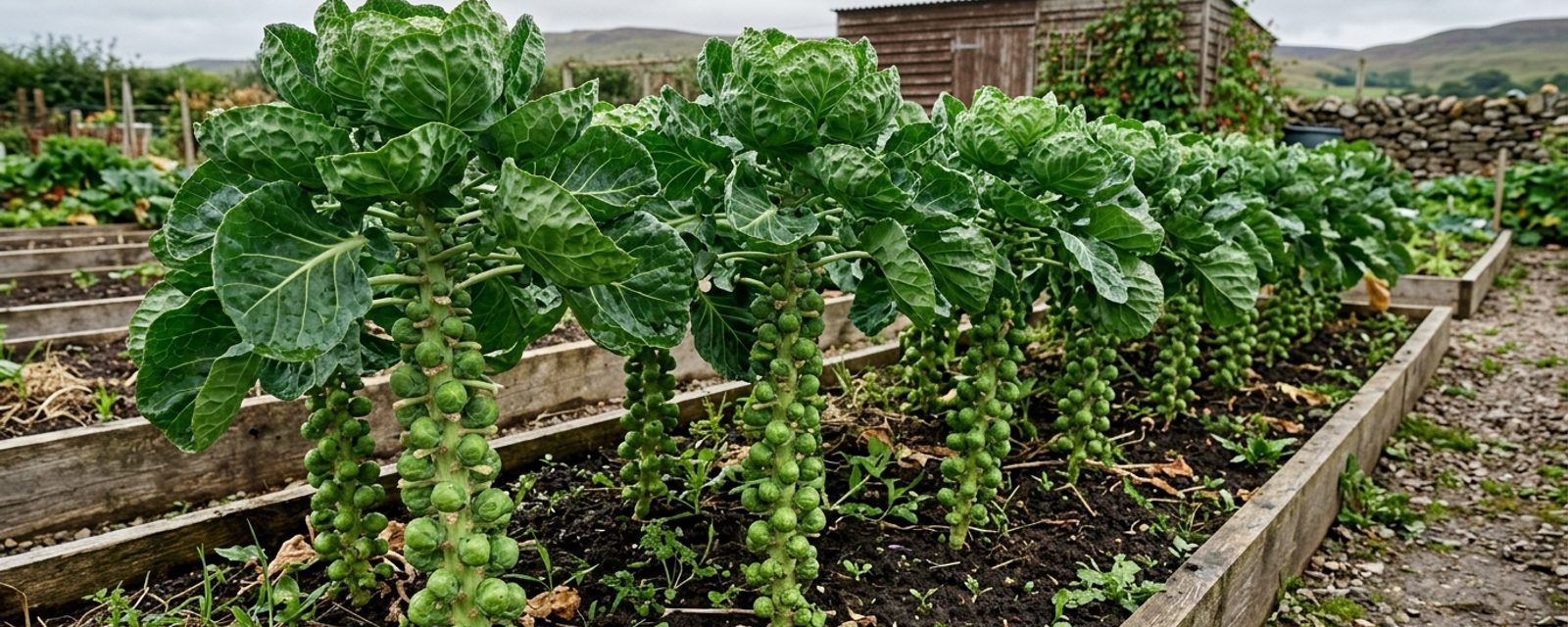
Brassica oleracea (Gemmifera Group)
Brussels sprouts occupy the ground longer than almost any other vegetable in a Scottish garden, but they're also one of the few crops where the coldest months work in the grower's favour, not against them.
Brussels sprouts are the slowest crop in the vegetable garden. Sow them in February and you will be harvesting them at Christmas. They occupy the ground for most of the year, they grow tall enough to catch the wind, and they are a brassicaThe cabbage family: cabbage, kale, broccoli, cauliflower, Brussels sprouts, kohlrabi, swede, turnip and more, sharing the same pests, diseases and rotation rules. Full definition →, which means they inherit the full pest list. But they are one of the very few crops where a Scottish winter is an advantage. Frost converts the plant's starches to sugar, and a sprout cut after a hard Scottish frost is sweeter and nuttier than anything you will buy. A properly grown crop will stand through December, January and into February, giving you fresh vegetables when the shops are selling imports and your other beds are frozen.
Why Brussels sprouts suit Scotland
A Scottish garden gives the plant time to develop its tall sturdy stem through summer, then delivers the cold that turns the starches to sugar in November and December: the cooler the autumn, the better the eating.
Our climate also holds down two of the difficult brassica pests. Cabbage aphid and cabbage root fly are less troublesome here than further south. The plants mature more slowly than they would in England, but a brassica that matures slowly in a cool summer is a brassica that forms tight, firm sprouts rather than loose open buttons.
Varieties
Crispus and Maximus have club rootA soil-borne fungal disease of the brassica family that swells and distorts roots, and survives in soil for years. Full definition → resistance confirmed on their own individual RHS pages, worth having on Scotland's naturally acidic soils — stack that with liming for double protection. Cascade's resistance is claimed on RHS's general guide only, not its own page, so treat it as less certain. All four hold the RHS Award of Garden Merit, a UK-wide award rather than a Scottish one.
★ Our pick for Scotland
CrispusAGM
Early to mid-season
Club root resistance confirmed on its own RHS page, not just the general guide. Good standing ability on tall, sturdy stalks. Can be cropped as early as September.
Why this one: Club root is the brassica disease that Scotland's naturally acidic soils actively encourage. Crispus is one of only two AGMThe RHS's Award of Garden Merit: a UK-wide trials award for reliable performance, not a Scotland-specific recommendation. Full definition → Brussels sprout varieties whose club root resistance is confirmed on their own individual RHS plant page rather than just the general growing guide — the standard remedy of liming to raise soil pH still matters regardless, but genetic resistance is a real second layer on top of it. Croppable from September, the earliest of the confirmed-resistant varieties.
Also worth considering
MaximusAGM
Late season, harvest September to February
Club root and downy mildew resistance both confirmed on its own RHS page. The longest standing period of the four, holding condition well right through winter — the pick if you want one variety to cover the whole season.
CascadeAGM
Mid-season, harvest November to February
RHS's general guide claims club root resistance, but Cascade's own individual variety page doesn't repeat that claim — treat it as unconfirmed rather than equal to Crispus or Maximus. Its own page does rate it hardy on exposed UK sites, a real advantage on a windy plot.
Show other recommended varieties (2)
IgorAGM
Mid to late season
Uniform dark green sprouts on a sturdy stem up to 80cm tall. No club root resistance claimed anywhere — the one to be most cautious with on acidic or unlimed ground.
Red Bull
Red/purple
Attractive red-purple sprouts, compact habit. Does not carry the RHS Award of Garden Merit.
Best Brussels Sprout Varieties for Scotland → compares all four AGM varieties head-to-head, with the practical detail that doesn't fit in a summary card.
Soil and site
Brussels sprouts want a sunny spot with fertile, well-drained, firm soil. Choose a sheltered position. These plants grow about 90cm tall on a single stem, and a winter gale on an exposed Scottish plot will loosen them at the roots or snap them entirely.
If your soil is very acidic, apply lime the winter before sowing to raise the pH to at least 6.5 and deter club root disease. This matters more in Scotland, where naturally acidic soils are common. A simple soil test kit will tell you whether liming is necessary.
Dig in two bucketfuls of well-rotted manure or garden compost per square metre, ideally the previous autumn, so the ground can settle over winter. Sprouts need firm soil to form tight buds. If you are adding compost just before planting, tread the ground down firmly before putting the plants in. Loose soil means loose sprouts.
Sowing and planting
Brussels sprouts need a long season. Start them early. Sow indoors from February to April in modular trays, two seeds per moduleA tray divided into small individual cells, each sown with its own seed or seedling, so each plant grows undisturbed roots until it's ready to plant out. Full definition →, 2cm deep, in a greenhouse or on a bright windowsill. GerminationA seed sprouting: breaking dormancy and putting out its first root and shoot, given the right warmth and moisture. Full definition → takes about two weeks. Thin to the strongest seedling per module and keep them in good light. Sowing in modules also helps if you have club root in your soil. A well-developed root system before going into the ground means the plant is less severely affected.
For outdoor sowing, sow from early March to May into prepared ground. Sow seeds thinly, 2cm deep, in rows 15cm apart. Thin seedlings to 7.5cm apart, removing the weaker ones. At their final spacing, transplant young plants or thin to 60cm apart with 60cm between rows. Sprouts need wide spacing. Cramped plants produce loose open sprouts and fungal diseases move in faster.
Plant out indoor-raised or seedbed-grown plants in late spring or early summer, when they are 10 to 15cm tall. Harden offGradually getting young plants raised indoors used to outdoor conditions over 7–14 days before planting out, so cold, wind and direct sun don't shock or damage them. Full definition → indoor-grown plants first. Set each plant in its hole more deeply than it was in the pot, with the lowest leaves at the soil surface. Firm in well and water generously. Cover with insect-proof mesh from the start.
Watering and care
Water young plants regularly. Never let the soil dry out while they are establishing. Once the plants are growing strongly, you should only need to water during prolonged dry weather. A thick mulchA layer of material spread over the soil around plants to suppress weeds, retain moisture, and improve soil structure as it breaks down. Full definition → of well-rotted manure or garden compost around the plants holds moisture and suppresses weeds.
Weed regularly while the plants are young. Once the crop is tall and leafy, it shades out most competition. Remove any yellowing or faded lower leaves to keep good airflow around the plants, which helps deter fungal diseases.
If your soil is poor, apply a nitrogen-rich fertiliser in June or July to boost growth before the sprouts begin to form.
Support: in late summer, mound soil up around the base of the stems to increase stability. Taller plants may need staking with a sturdy bamboo cane, especially on exposed sites. A top-heavy sprout plant caught by an autumn gale can loosen its roots enough to stop cropping entirely. Do this before the wind arrives.
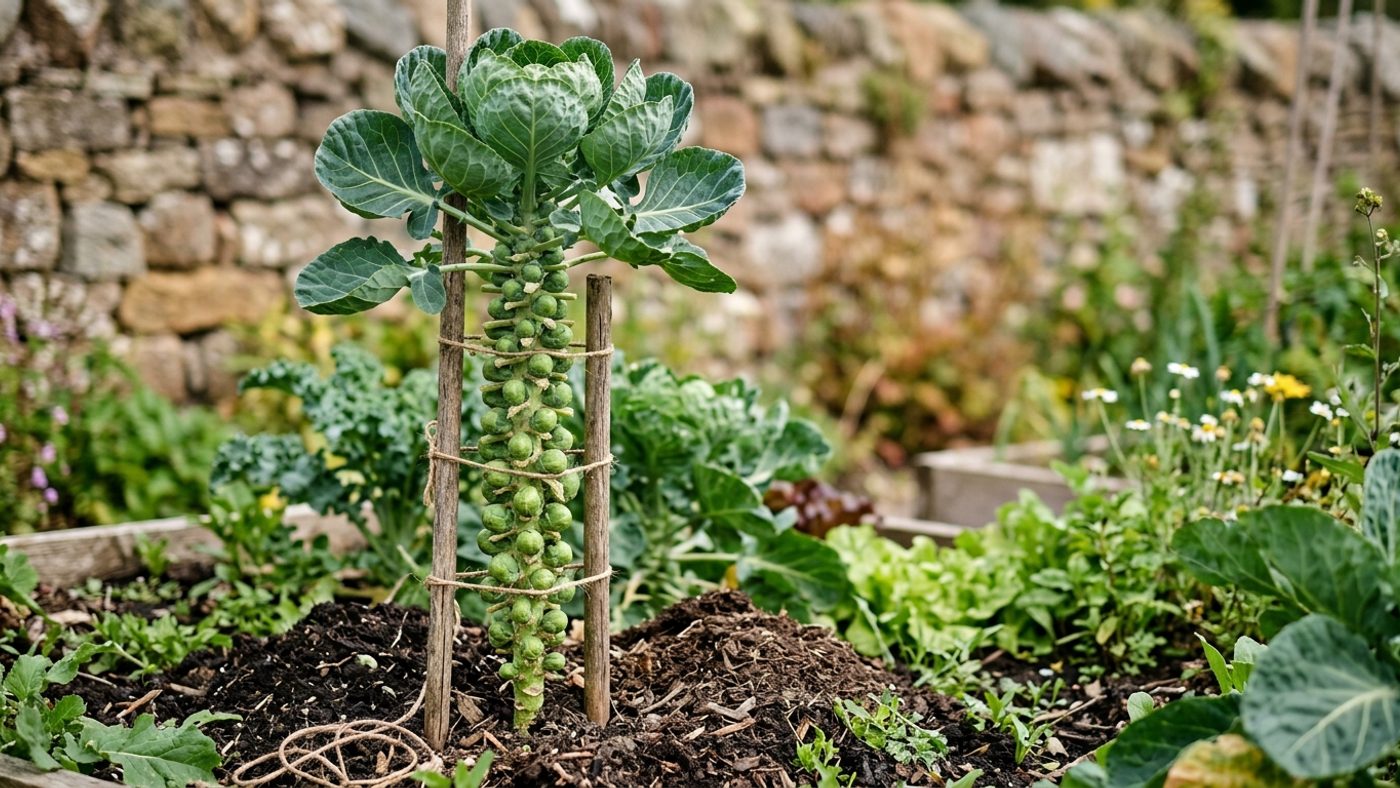
Protection: cover the crop with insect-proof mesh, supported on canes and pinned to the ground. Cabbage white butterflies, cabbage root fly and pigeons will all take a sprout plant if it is not covered. The mesh stays on for the life of the crop. It is cheap and it removes the daily patrol for caterpillars.
Harvesting
Early varieties can be ready from autumn onwards, but the main crop comes through winter. Harvest when the sprouts are about the size of a walnut, firm and still tightly closed. The flavour is sweeter after a frost. Start with the lowest sprouts on the stem and work upwards. Snap each sprout off with a sharp downward tug, removing the leaf below it at the same time. Take a few from each plant across the row rather than stripping one plant bare.
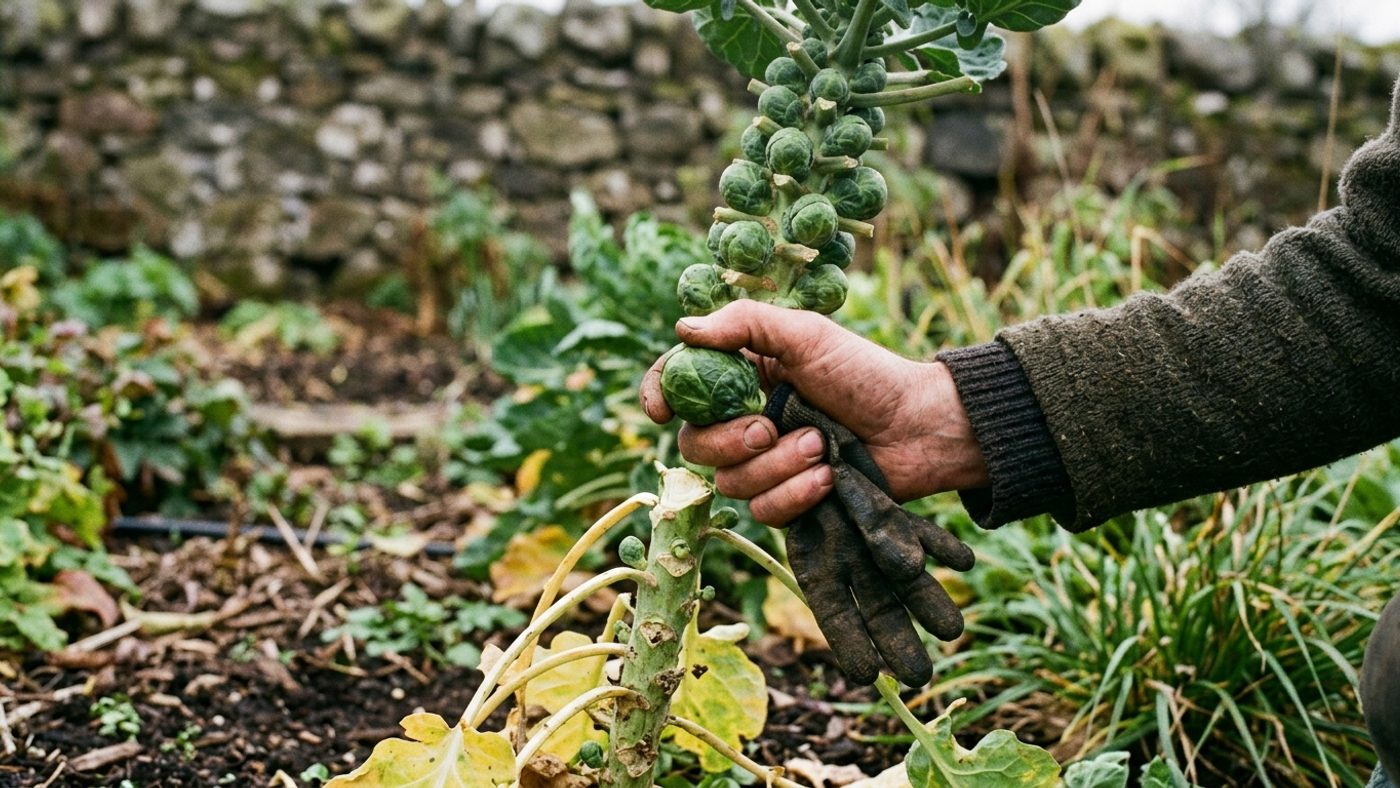
With newer varieties, the sprouts mature more uniformly. You can cut the whole stem if you prefer, then either stand it in water for a few days or hang it in a cool frost-free shed and pick sprouts as needed. Once cropping is finished, the mild-flavoured young leaves at the top of the plant, called sprout tops, can be harvested too and cooked like spring greens.
A Brussels sprout plant standing through a Scottish December, sprouts tight and bright against the snow, is one of the most dependable things a winter garden produces.
Common problems
- Cabbage caterpillars are the larvae of cabbage white butterflies. They can strip a plant in days. Cover with insect-proof mesh from the start. If they get in, pick them off by hand.
- Pigeons will strip a sprout plant to the stem. Mesh or netting, from the day you plant out.
- Plants blowing over means the ground was too loose, no soil was mounded around the stems, or the plants were not staked. An exposed Scottish plot tests all three. Do them before the autumn gales arrive.
See more problems
- Club root causes swollen, distorted roots. Plants wilt in dry weather. Lime the soil to raise pH above 6.5, start plants in modules to give them a head start, and rotate brassicas. No chemical treatment exists. Cascade and Crispus carry genetic resistance.
- Aphids cluster on the undersides of leaves and new growth, weakening plants and spreading viruses. Less troublesome in Scotland's cool summers, but check the undersides of leaves and wipe off small colonies before they build up.
- Cabbage root fly maggots eat the roots. Mesh is the defence. Less troublesome in Scotland's cool summers.
- Flea beetle riddles seedling leaves with small round holes. Mainly a problem on young plants; cover with insect-proof mesh from sowing.
- Loose open sprouts usually mean the soil was too loose or the plants were too close. Firm the ground before planting. Keep to the full 60cm spacing. F1 hybridThe first-generation offspring of two specific, deliberately chosen parent plants, bred for a predictable, uniform result but not worth saving seed from. Full definition → varieties form tighter sprouts more reliably.
Common questions
Do Brussels sprouts really taste better after frost?
Yes: the cold genuinely converts some of the plant's starches to sugars, and sprouts have their sweetest flavour when harvested after being frosted, so there's no reason to rush the first picking. Full sourced breakdown: <a href="/tools/garden-myths/brussels-sprouts/">Brussels Sprouts Myths →</a>
How long do Brussels sprouts take to grow?
A long time. Sow from February to April, plant out in late spring or early summer, and harvest from autumn through late winter. That is six to nine months from seed to plate. They occupy the ground for most of the year, but one or two plants per household is usually enough because each plant produces dozens of sprouts over several months.
Why do my Brussels sprouts keep blowing over?
Loose ground is the main cause: sprouts are tall and top-heavy, and wind rocks a loosely-planted stem until it loosens or topples, so firm the soil with shuffling steps before planting and stake on exposed sites. Full sourced breakdown: <a href="/tools/garden-myths/brussels-sprouts/">Brussels Sprouts Myths →</a>
How do I harvest Brussels sprouts?
Start at the bottom and work up: the lowest sprouts mature first, so pick them as soon as they're walnut-sized and firm, working upward as the higher ones catch up. Full sourced breakdown: <a href="/tools/garden-myths/brussels-sprouts/">Brussels Sprouts Myths →</a>
Why are my sprouts loose and open instead of tight?
Usually loose soil or overcrowding: a plant that rocks in loose ground can't firm its buttons up properly, so tread the soil down hard before planting next time and keep spacing at a full 60cm. Full sourced breakdown: <a href="/tools/garden-myths/brussels-sprouts/">Brussels Sprouts Myths →</a>
Sources
2 sources, and what each was used for
- RHS: sowing Feb-May, 2cm depth, transplant trigger, 60cm spacing and rows, liming to pH 6.5 for clubroot, frost sweetening, firm soil / mounding / staking, AGM varieties and club root resistance
- SAC/SRUC: lower incidence of difficult brassica pests (cabbage aphid/root fly) and slower, steadier maturity in Scotland’s cool summers