
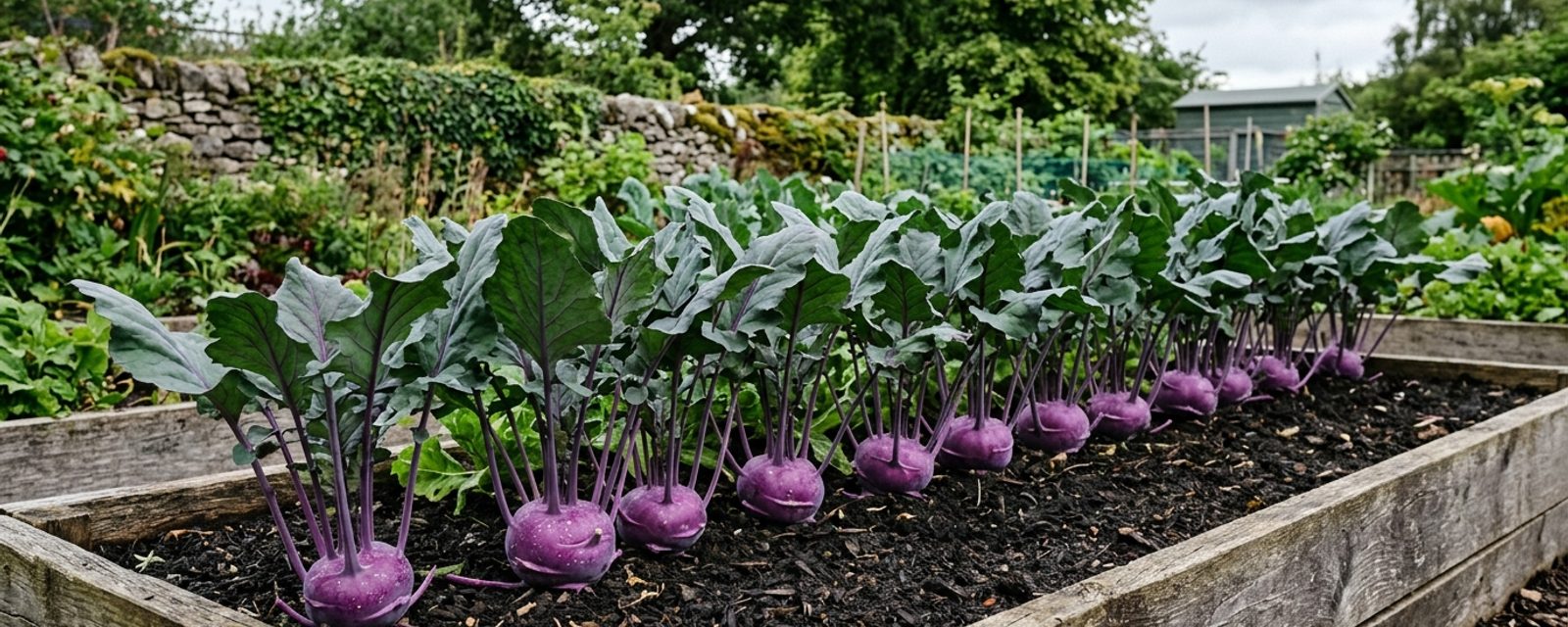
Brassica oleracea (Gongylodes Group)
Kohlrabi is a fast, unusual brassicaThe cabbage family: cabbage, kale, broccoli, cauliflower, Brussels sprouts, kohlrabi, swede, turnip and more, sharing the same pests, diseases and rotation rules. Full definition → that suits a Scottish plot well: it shares the brassica family's advantage in our cool, damp summers, and it gives you two harvests, bulb and leaves, from one plant.
Kohlrabi looks like it should be a root, sitting low and round at soil level, but it's actually a swollen stem base, often called a bulb, that develops above the ground rather than below it. It grows fast, from sowing to harvest in as little as eight weeks, and it has a short window where it's worth eating before it turns woody, which makes it a crop you check on rather than one you leave alone.
Sowing, and the one thing that trips it up here
Sow indoors from spring in cooler areas, or direct outdoors from March to July (August in mild areas), about 1.5cm deep. Sow in successive small batches for a continuous supply rather than one row all at once.
The one moment that needs care is the transplant itself. Move it out into conditions below 10°C and it can bolt before it bulks up, so get that specific window right rather than assuming the crop's general fondness for cool weather covers it.
Move seedlings out at no more than 5cm tall, about three to four weeks after sowing, once temperatures are reliably above 10°C. Harden offGradually getting young plants raised indoors used to outdoor conditions over 7–14 days before planting out, so cold, wind and direct sun don't shock or damage them. Full definition → gradually over about two weeks first.
Site and soil
Kohlrabi wants fertile, moisture-retentive soil in a sunny site. Keep it consistently watered: a dry spell does double damage here, causing both bolting and woody flesh. If your soil pH is below 6, apply lime to raise it and help deter club rootA soil-borne fungal disease of the brassica family that swells and distorts roots, and survives in soil for years. Full definition →, the same as for its brassica relatives. Space plants 15cm apart, with rows 30cm apart.
Purple or green: a real difference, not just colour
Green varieties mature faster, suiting an early spring sowing, while purple varieties are hardier and slower-growing, better suited to a late-summer sowing where the plant has to cope with less settled weather on the way to harvest.
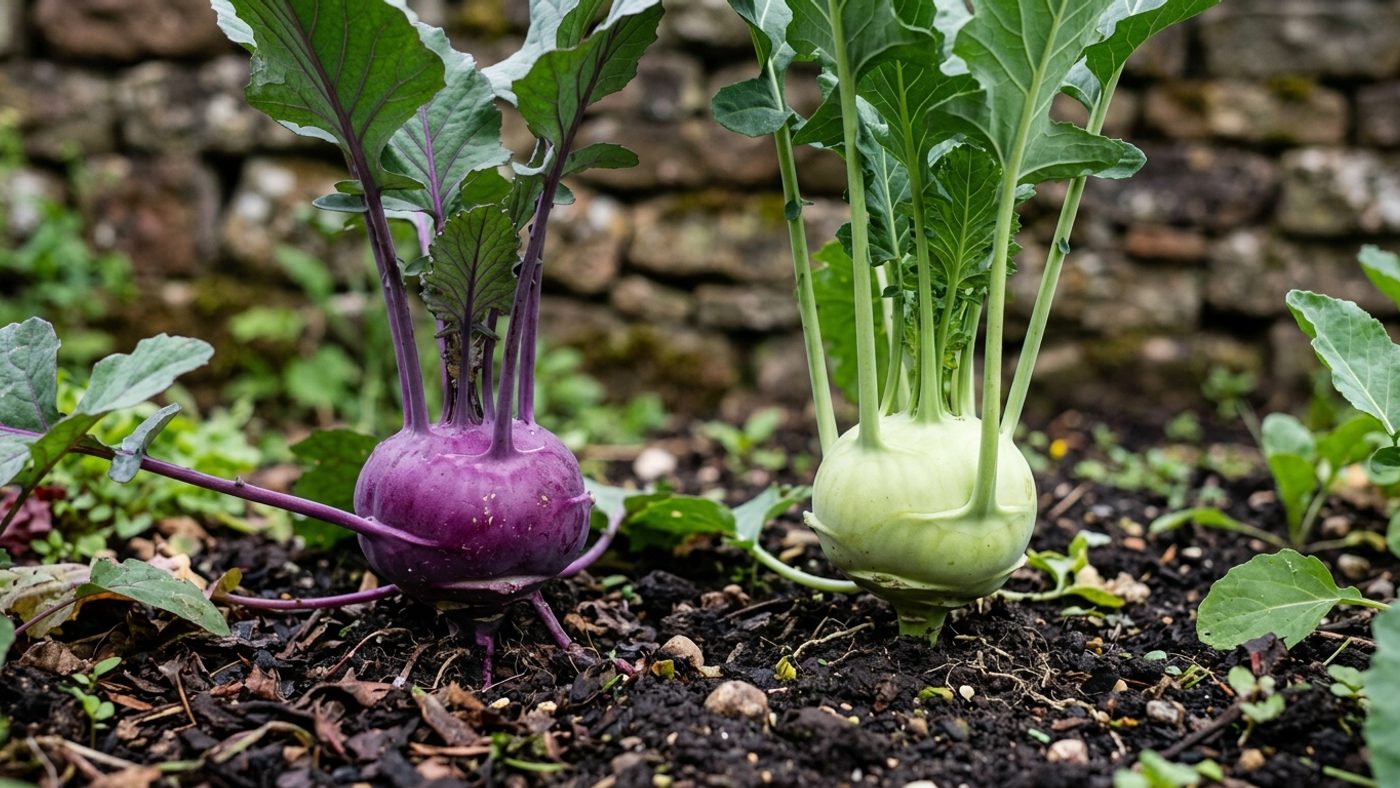
'Korist' (pale green, suited to early sowings) also carries the RHS Award of Garden Merit, a UK-wide award, not a Scottish one. 'Kossak' doesn't hold the AGMThe RHS's Award of Garden Merit: a UK-wide trials award for reliable performance, not a Scotland-specific recommendation. Full definition →, but is rated H5The RHS's H1a–H7 scale for how much cold a plant can survive outdoors, H1a being tender indoor-only and H7 hardy anywhere in the UK. Full definition →, a step hardier than the other three.
★ Our pick for Scotland
KolibriAGM
Purple
Hardier and slower-growing than green types.
Why this one: Purple kohlrabi is hardier and slower to mature than green, which is exactly the trait worth having for a late-summer sowing in a Scottish garden, where settled weather can't be counted on the way it might be further south.
Also worth considering
OliviaAGM
Green
Disease-tolerant, though which disease isn't specified.
Best Kohlrabi Varieties for Scotland → compares all named kohlrabi varieties head-to-head, with the practical detail that doesn't fit in a summary card.
The leaves are worth keeping
The leaves are edible, and can be steamed like spinach. Harvest them alongside the bulb, or as baby veg in their own right. Cook them the same day where possible; they don't keep the way the bulb does.
Harvesting: a short window, checked often
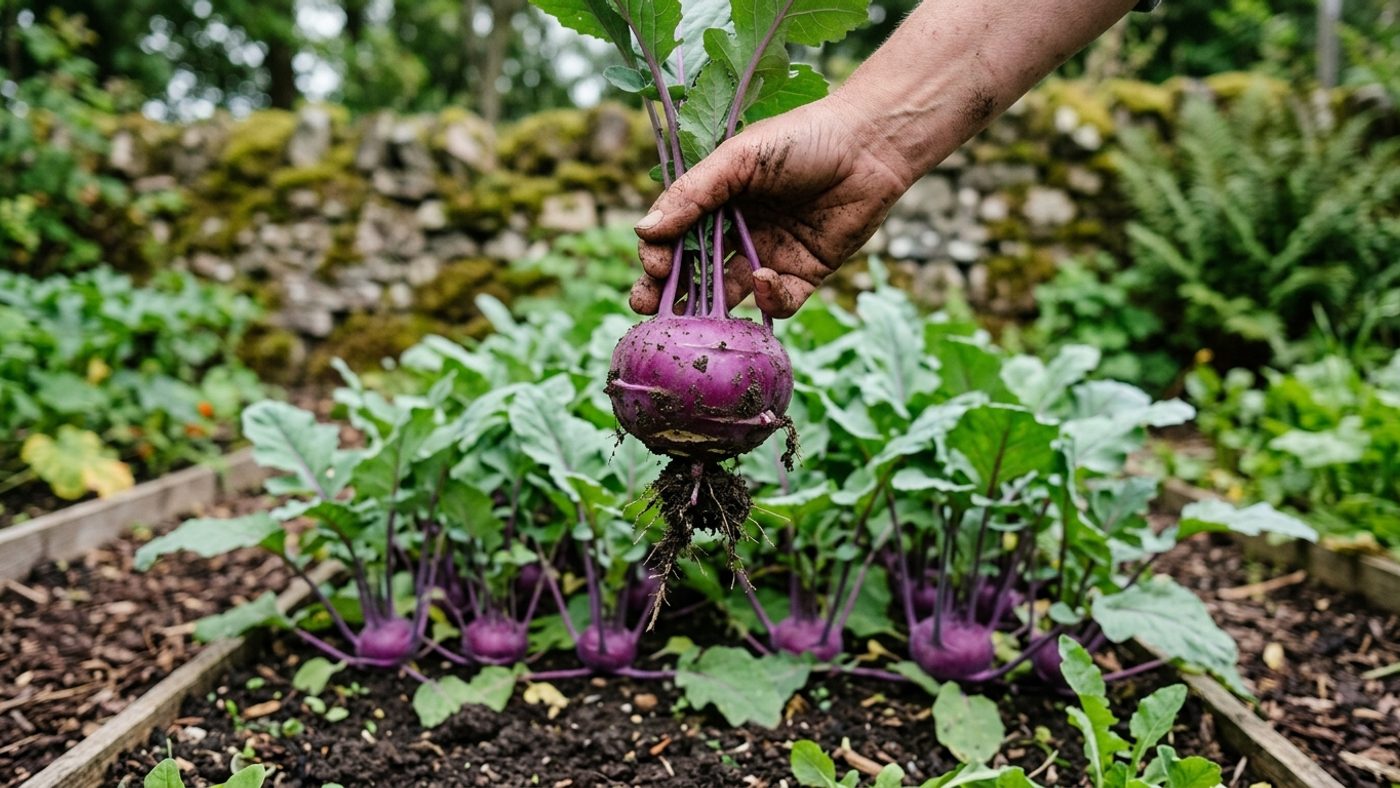
Pull the bulb at golf-ball to tennis-ball size. Bigger turns tough and woody, and it happens fast, so check developing bulbs every few days once they start sizing up rather than leaving the bed for a week. Harvest runs from May through November, potentially into December in milder areas, and takes about 8-12 weeks from sowing.
Common problems
- Woody, tough bulbs mean it was left too long, or went short of water. Harvest at golf-ball to tennis-ball size and keep the soil consistently moist.
- Bolting is caused by heat, drought or cold, not cold alone. Keep watering consistent through dry spells, not just in unsettled weather, and transplant only once it's reliably above 10°C.
- Cabbage caterpillars can strip foliage fast. Cover with insect-proof mesh from sowing.
See more problems
- Club root causes swollen, distorted roots. Lime acidic soil and rotate brassicasMoving each crop family to different ground each year, on a multi-year cycle, so pests and diseases that build up in soil don't get a repeat host. Full definition →. No chemical treatment exists.
- Flea beetles riddle young leaves with small holes, worst in warm, dry spells. Mesh over seedlings is cheap insurance.
- Cabbage root fly maggots damage roots. Mesh is the defence, and it's less troublesome in Scotland's cool summers than further south.
- Slugs and snails and pigeons both go for young plants. Protect them until established.
Common questions
Is kohlrabi a root vegetable?
No: kohlrabi forms a swollen stem base, often called a bulb, that develops above the soil surface, unlike the true underground roots of turnip or swede. Full sourced breakdown: <a href="/tools/garden-myths/kohlrabi/">Kohlrabi Myths →</a>
Can I eat kohlrabi leaves, or should I just bin the trimmings?
Yes: two independent sources confirm the leaves are harvestable alongside the bulb and can be steamed like spinach, so don't compost the trim. Full sourced breakdown: <a href="/tools/garden-myths/kohlrabi/">Kohlrabi Myths →</a>
What's the actual difference between purple and green kohlrabi?
More than colour: purple varieties are genuinely hardier and slower-growing, while green types mature faster, so green suits a quick spring sowing and purple a tougher late-summer one. Full sourced breakdown: <a href="/tools/garden-myths/kohlrabi/">Kohlrabi Myths →</a>
Why did my kohlrabi bulb turn woody?
Two causes, not one: leaving it past golf-ball to tennis-ball size is the main one, and drought stress causes woody flesh in its own right, so pull promptly and keep the soil consistently moist. Full sourced breakdown: <a href="/tools/garden-myths/kohlrabi/">Kohlrabi Myths →</a>
Sources
4 sources, and what each was used for
- RHS: sowing months and method, transplant trigger and bolting temperature threshold, 1.5cm depth, pH-6 liming threshold for club root, harvest window and golf-to-tennis-ball sizing, purple-vs-green hardiness split, AGM varieties, pest and disease list, stem-not-root description
- Garden Organic: cool, damp climate preference; leaves and baby veg also harvestable; 8-12 week maturity window; brassica-family companion note; woody-flesh-if-underwatered warning
- gardenersworld.com: corroborates spacing/depth/harvest sizing and the purple-hardier split independently of RHS; leaves edible steamed like spinach (corroborates Garden Organic); short fridge storage in a perforated bag
- SAC/SRUC: lower incidence of the difficult brassica pests (cabbage aphid, cabbage root fly) in Scotland — applies to kohlrabi as a Brassica oleracea crop sharing the pest set