
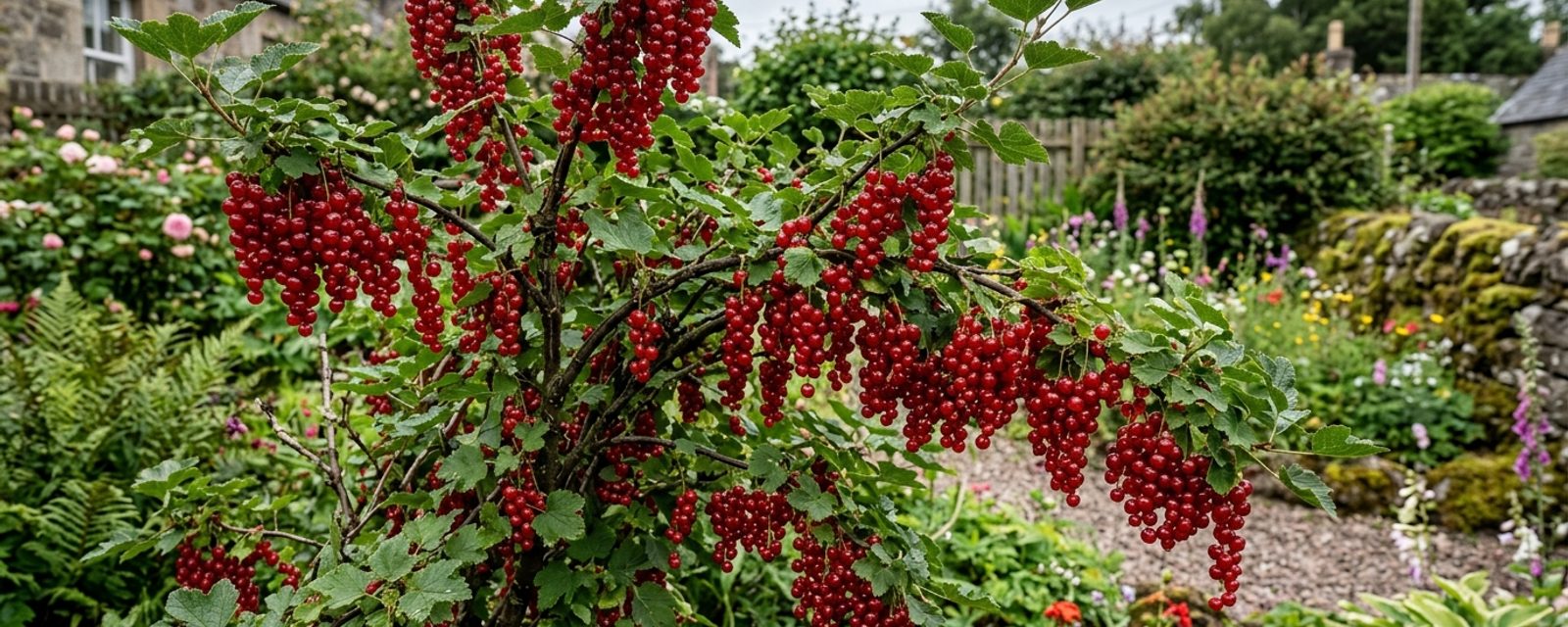
Ribes rubrum
Redcurrants and whitecurrants are genuinely one crop with two colours, not two separate plants needing separate advice, and they carry one pruning habit worth unlearning if blackcurrants taught you the wrong lesson first.
Site and planting
Redcurrants and whitecurrants tolerate sun or light shade: a sunnier spot helps, but shade genuinely doesn't rule them out. Plant bare-rootA plant, usually a fruit tree or hedging, sold with its roots exposed rather than in a pot, and only available while dormant. Full definition → bushes November to March while dormant; containerisedA plant grown and sold in a pot of compost, which can be planted out at any time of year, unlike a bare-root plant. Full definition → plants any time. Position at the same depth the plant was previously growing. Space free-standing bushes 1.2-1.5m apart, cordonsA fruit tree or bush trained as a single main stem with short fruiting side-spurs, usually grown at an angle against a wall, fence or wire. Full definition → much closer at 30-40cm, and fans 1.5m apart. In a container, use one at least 45cm wide with soil-based compost.
Edimentals: The Ornamental Edibles Worth a Spot in Your Border → covers redcurrant bushes trained as fans or cordons alongside other edible plants that earn a place in a decorative border.
Care
Water regularly during dry spells for the first couple of years; once established, bushes in the ground shouldn't need routine watering. Mulch each spring with a thick layer of organic matter, leaving a mulch-free circle around the base of the stems; a well-mulchedA layer of material spread over the soil around plants to suppress weeds, retain moisture, and improve soil structure as it breaks down. Full definition → bush generally needs no extra feeding. Container plants need a high-potassium liquid feed every fortnight through the growing season.
Net bushes as fruit ripens against birds, and again over winter, since bullfinches can peck at leaf buds. A fruit cage is the permanent solution if you grow several fruit bushes.
Pruning
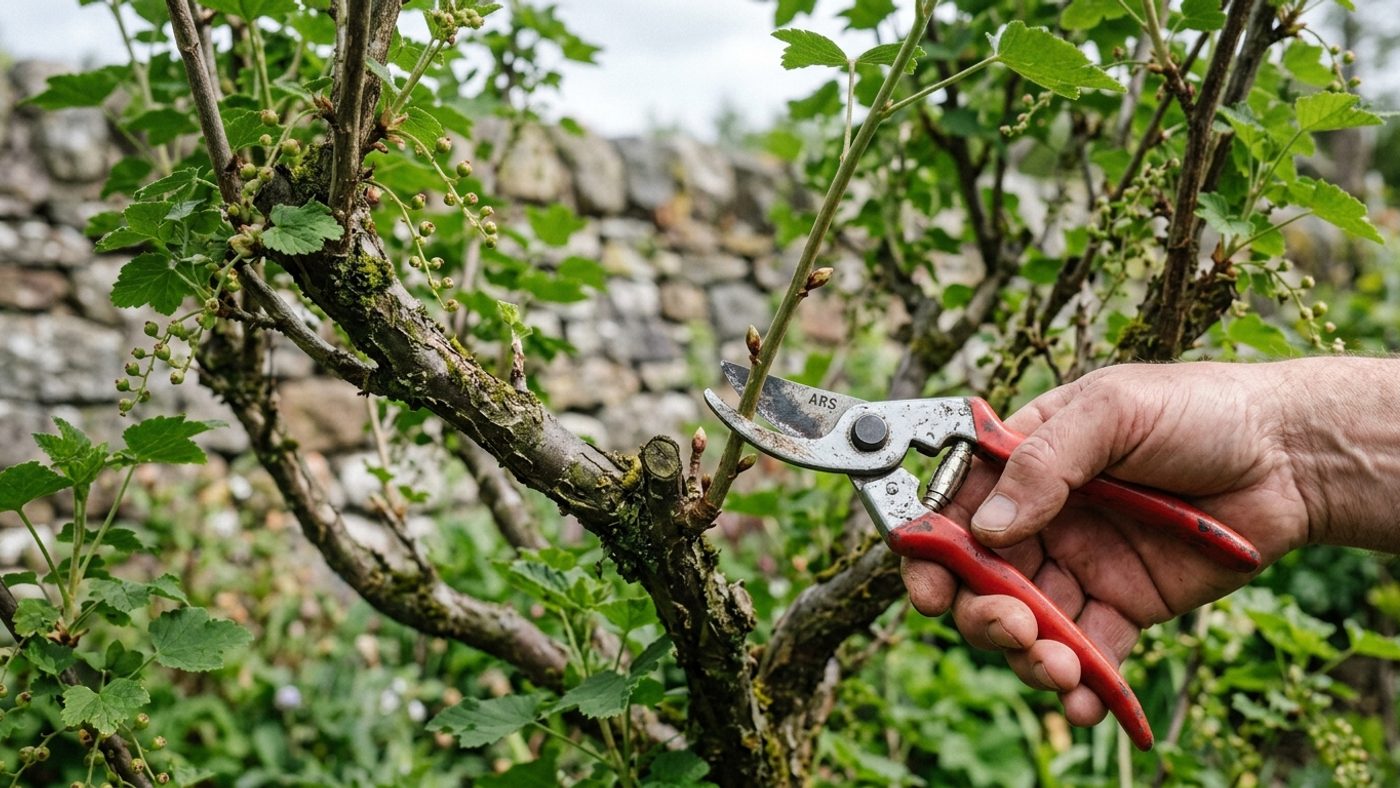
They fruit at the base of the previous year's shoots and on spurs on older wood, so pruning keeps a permanent framework: the same open-centred, goblet-shapedA bush pruned with an open middle and outward-radiating branches, so light and air reach every part rather than a dense, shaded centre. Full definition → bush with 8-10 main branches as gooseberries, not blackcurrants' annual renewal cut. Cutting the oldest stems to the base, blackcurrants' method, would remove the wood the crop depends on.
After planting, select up to five well-spaced, strong shoots and prune them back to 15-20cm. Established bushes are pruned in late winter or early spring: reduce the previous season's growth on main branches by a quarter to a half, cut side-shoots back to one or two buds, remove older, less productive branches, and take out any low branches that would sag further under a crop's weight. Cordons and fans get a second prune in summer, shortening side-shoots back to five leaves.
Varieties
4 AGMThe RHS's Award of Garden Merit: a UK-wide trials award for reliable performance, not a Scotland-specific recommendation. Full definition → redcurrant varieties and, separately, just 2 AGM whitecurrant varieties: a genuinely short list for whitecurrants, not a gap in research.
Red Lake (large, sweet, dark-red, late July) and Stanza (mid-season, large deep-red fruit, superb quality) round out the redcurrant list without a standout trait distinct from Jonkheer van Tets and Rovada. White Grape (plentiful, large, sweet, mid-summer) is the second whitecurrant option alongside Blanka.
★ Our pick for Scotland
Jonkheer van TetsAGM
Redcurrant · early July · heavy crops
The earliest of the four AGM redcurrant varieties: heavy crops of sweet-tasting currants on long strigs from early July.
Why this one: Earliness is the genuine edge here: the first of the four AGM redcurrant varieties to ripen, useful in a growing season that runs later here than in southern England. Heavy-cropping and sweet-tasting on top of that, rather than a trade-off for being early.
Also worth considering
RovadaAGM
Redcurrant · late summer · heavy crops, large fruit
A late-summer variety, extending the redcurrant season well past Jonkheer van Tets if the two are grown together.
BlankaAGM
Whitecurrant · late July · very large crops
The more productive of the two named whitecurrant varieties: a genuinely different-looking currant grown on exactly the same routine as redcurrants.
Best Redcurrant Varieties for Scotland → compares all named redcurrant varieties head-to-head, with the practical detail that doesn't fit in a summary card.
Harvesting
Ready once fruits are richly coloured, firm and juicy, usually from July onwards depending on variety. Cut whole trussesThe flowering, then fruiting, stem cluster on a tomato plant; each truss ripens its fruit together. Full definition → (strigs) rather than picking individual berries: modern varieties ripen the whole truss together, which is exactly what makes this practical. Pick on a dry day, since wet fruit spoils faster. An established bush yields about 4.5kg a year, whether it's carrying red or white fruit.
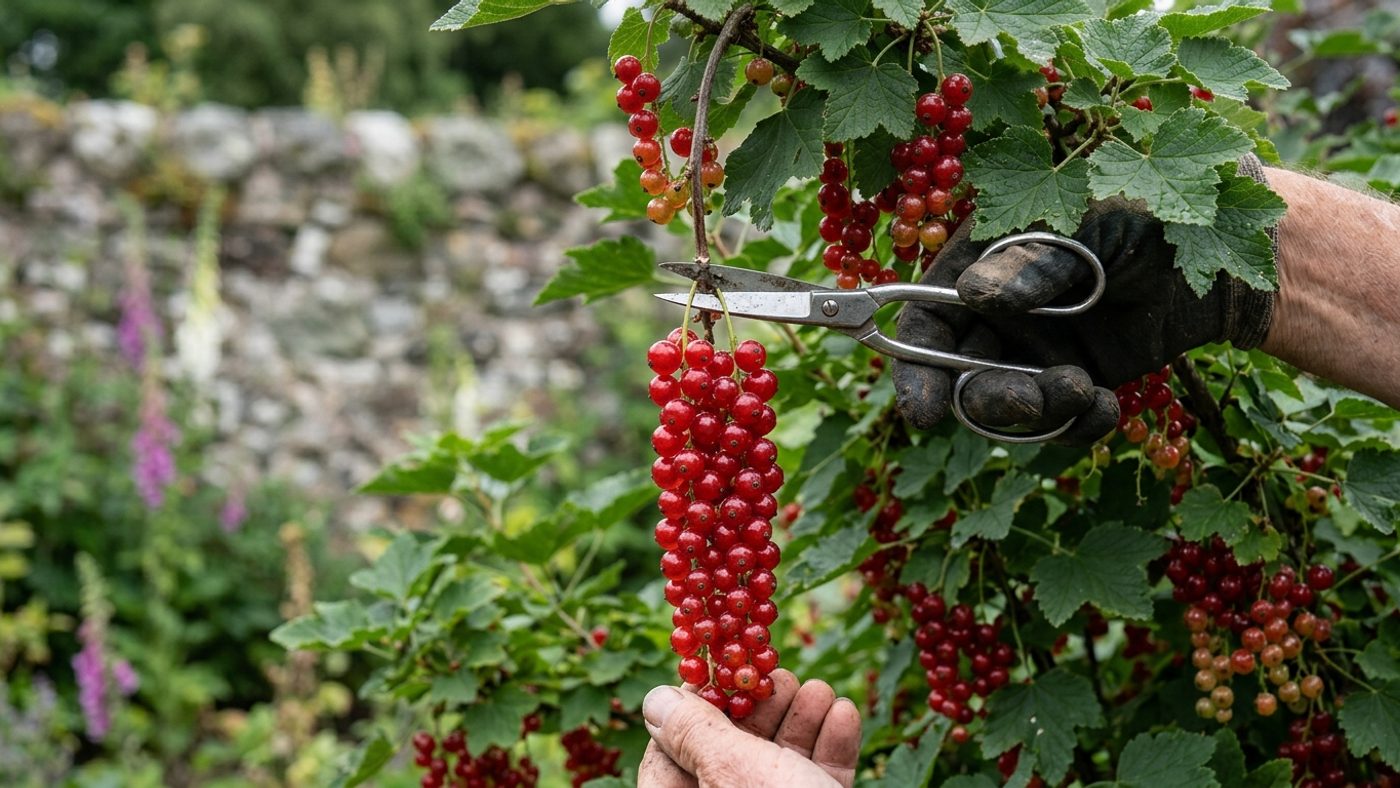
Growing an early variety like Jonkheer van Tets alongside a later one like Rovada spreads the harvest over several weeks rather than landing it all at once, the same succession logic worth applying to any fruit bush rather than something specific to currants.
Common problems
- Birds strip ripening fruit fast, and bullfinches peck at leaf buds over winter; netting or a fruit cage covers both risks.
- Gooseberry mildew affects redcurrants and whitecurrants too, the same Ribes-family risk as gooseberries.
- Currant aphids and other aphids distort new growth and shoots.
See more problems
- Sawfly larvae can strip a bush of leaves fast; check regularly and remove larvae by hand. Good pruning that keeps an open bowl shape also helps deter them.
- Currant leaf spot causes small brown spots, sometimes leading to early leaf drop. No fungicide exists for gardeners, so clearing fallen leaves in autumn is the real control.
- Grey mould and coral spot both affect damaged or dying wood; prune out and destroy affected material promptly.
- Brown scale and woolly scale are sap-sucking insects that weaken growth over time.
- Capsid bugs distort young leaves and shoot tips.
Common questions
Are whitecurrants a different crop from redcurrants?
No: whitecurrants are a form of redcurrant, the same species (Ribes rubrum), grown on exactly the same routine; the only real differences are fruit colour and a shorter list of named varieties. Full sourced breakdown: <a href="/tools/garden-myths/redcurrants/">Redcurrant Myths →</a>
Should I prune redcurrants the same way as blackcurrants?
No: redcurrants and whitecurrants fruit at the base of the previous year's shoots and on spurs on older wood, so pruning keeps a permanent framework of branches; cutting whole old stems to the base each winter, the blackcurrant method, would remove the wood this crop actually fruits on. Full sourced breakdown: <a href="/tools/garden-myths/redcurrants/">Redcurrant Myths →</a>
How should I pick redcurrants and whitecurrants?
Cut whole trusses, known as strigs, rather than picking individual berries: modern varieties ripen the whole truss at roughly the same time, which is what makes cutting the strig practical. Full sourced breakdown: <a href="/tools/garden-myths/redcurrants/">Redcurrant Myths →</a>
Do redcurrants need full sun?
Not necessarily: RHS names sun or light shade as suitable for both, and Gardener's World says plants should still crop well in semi-shade even though a sunny spot is preferable. Full sourced breakdown: <a href="/tools/garden-myths/redcurrants/">Redcurrant Myths →</a>
Sources
4 sources, and what each was used for
- RHS: getting started, 4 AGM redcurrant varieties, planting timing and spacing by form, container growing, watering, feeding, mulching, pruning timing by form (bush once, cordon/fan twice), fruiting on the base of previous year's shoots and spurs on older wood, harvesting method (whole trusses), yield, bird protection, and named problems
- RHS: confirms whitecurrants as a form of redcurrant with identical growing conditions, 2 AGM whitecurrant varieties (Blanka, White Grape), and simultaneous-truss ripening in modern varieties
- RHS: the open-centred, goblet-shaped bush with 8-10 branches, initial pruning after planting (five shoots cut to 15-20cm), established winter pruning (reduce main-branch growth by a quarter to a half, side-shoots to 1-2 buds, remove older branches and low growth), and summer pruning for cordons/fans (side-shoots to five leaves)
- gardenersworld.com: independently corroborates spacing (1.5m between bushes), partial-shade tolerance, pruning timing and the open-bowl-shape goal, harvesting whole trusses on a dry day, and sawfly/bird pest pressure