
A plant earns its place in a decorative border by doing decorative work, holding a shape, carrying a colour, filling a season, not by being pretty for a vegetable. Most edible plants never clear that bar; they're foliage-and-yield machines bred to crop hard and look forgettable. But a handful were either bred specifically for looks, or simply happen to carry genuine architectural, floral or colour presence alongside their crop, and those few can be planted exactly where you'd plant an ornamental perennial, climber or shrub, because that's structurally what they are. This is the idea behind "edimentals": edible plants selected and placed for their design value first, their harvest second. It's had a moment at the RHS Chelsea Flower Show, where "edimentals are all the rage" was the show's own verdict in 2026, and it isn't new, Garden Organic's own Ryton Gardens has run a large vegetable garden alongside a dedicated ornamental garden for years, treating the two as parts of one working demonstration space rather than separate zones.
In a Scottish garden, where tall structure and long seasonal interest both work hard against grey skies and a short growing window, a border built partly from edimentals isn't a compromise, it can be the stronger design choice. The shortlist here is short: globe artichoke (and its larger cousin, cardoon) for architecture, ruby and rainbow chard for colour, scarlet runner beans for vertical cover, and currant bushes for structure and blossom.
What actually makes an edible plant "ornamental enough"
The term "edimentals" is commonly credited to Scottish permaculturist Stephen Barstow's 2014 writing, popular shorthand rather than a precisely dated coinage. Height and habit, flower or foliage colour, texture, a defined season of interest: those are the terms any ornamental perennial or shrub is judged on, and an edimental has to earn its place by the same measure. A much longer list of "interesting" edibles, purple sprouting broccoli, red Brussels sprouts, purple-podded peas, don't hold up against that test: an unusual pod colour or a leaf flush isn't the same thing as genuine ornamental value. The plants below do: a real architectural silhouette, a real flower, a real foliage colour range.
Architectural structure: globe artichoke and cardoon
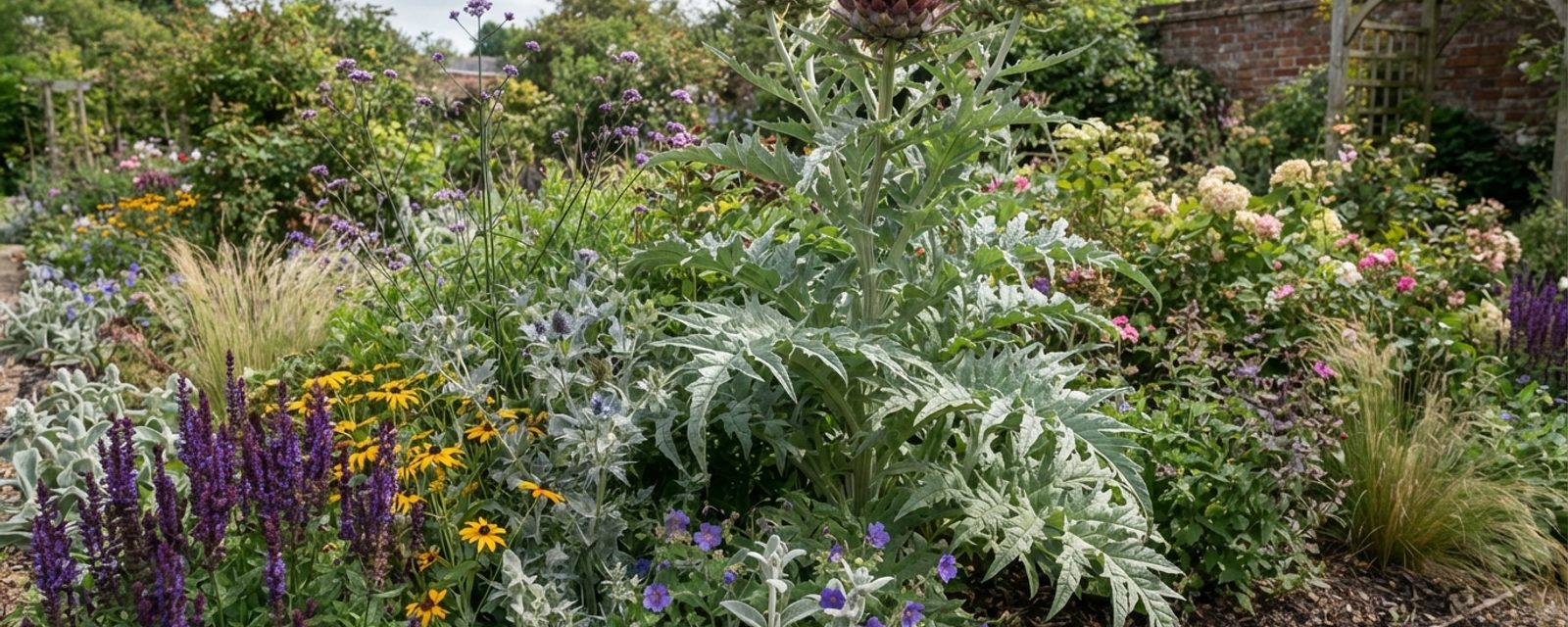
Globe artichoke (Cynara cardunculus Scolymus Group) is a large, architectural perennial reaching up to 1.5m tall and 1m wide, built around big, silvery grey-green leaves and thistle-like purple flowerheads that appear through summer and autumn. RHS's own description calls it "ornamental enough for the flower garden," not a grudging allowance, a plain statement that it belongs there. That combination of height, silver foliage and a strong flower is rare among edible plants and does real work in a Scottish border: it holds vertical structure and textural contrast against a grey sky for months at a stretch, well past the point most spring perennials have gone over.
Use it as a back-of-border anchor or a single specimen where you'd otherwise place a large ornamental thistle or cardoon-type perennial. The silver-grey foliage pairs naturally with blue and purple flowering perennials (salvias, catmint, alliums) and with other silver foliage plants, and the purple flowerheads read well against dark-leaved neighbours. It carries the RHS's pollinator badge too, so leaving a flowerhead or two to open rather than harvesting every bud has a real wildlife upside. In colder, more exposed gardens, both artichoke and cardoon can be short-lived once a hard, wet winter sets in, so plan them as a strong but not unshakeable structural presence rather than permanent architecture, and give them a sheltered spot out of the worst of the wind. A large container is also a legitimate border element in its own right where open ground is too exposed or too poorly drained to risk it. Sowing, spacing, feeding and winter protection are covered in the growing guide.
If you want more architectural height still, cardoon (Cynara cardunculus) is the artichoke's close relative and considerably bigger, a robust clump-forming perennial reaching up to 2.5m, with silvery-grey, deeply dividedPropagating a clump-forming perennial by digging it up and splitting it into several smaller pieces, each with roots and shoots attached. Full definition →, spiny leaves up to a metre long and the same large thistle-like purple flowers. It holds the RHS's Award of Garden Merit and pollinator badge, and it's arguably the single most dramatic architectural edible available, carrying the same grey-sky, long-season structural value as globe artichoke at a larger scale. Its growing needs are close enough to globe artichoke's, the same soil, sun and shelter requirements, that the artichoke growing guide's advice is a reasonable starting point until a dedicated cardoon guide exists.
Colour: ruby and rainbow chard
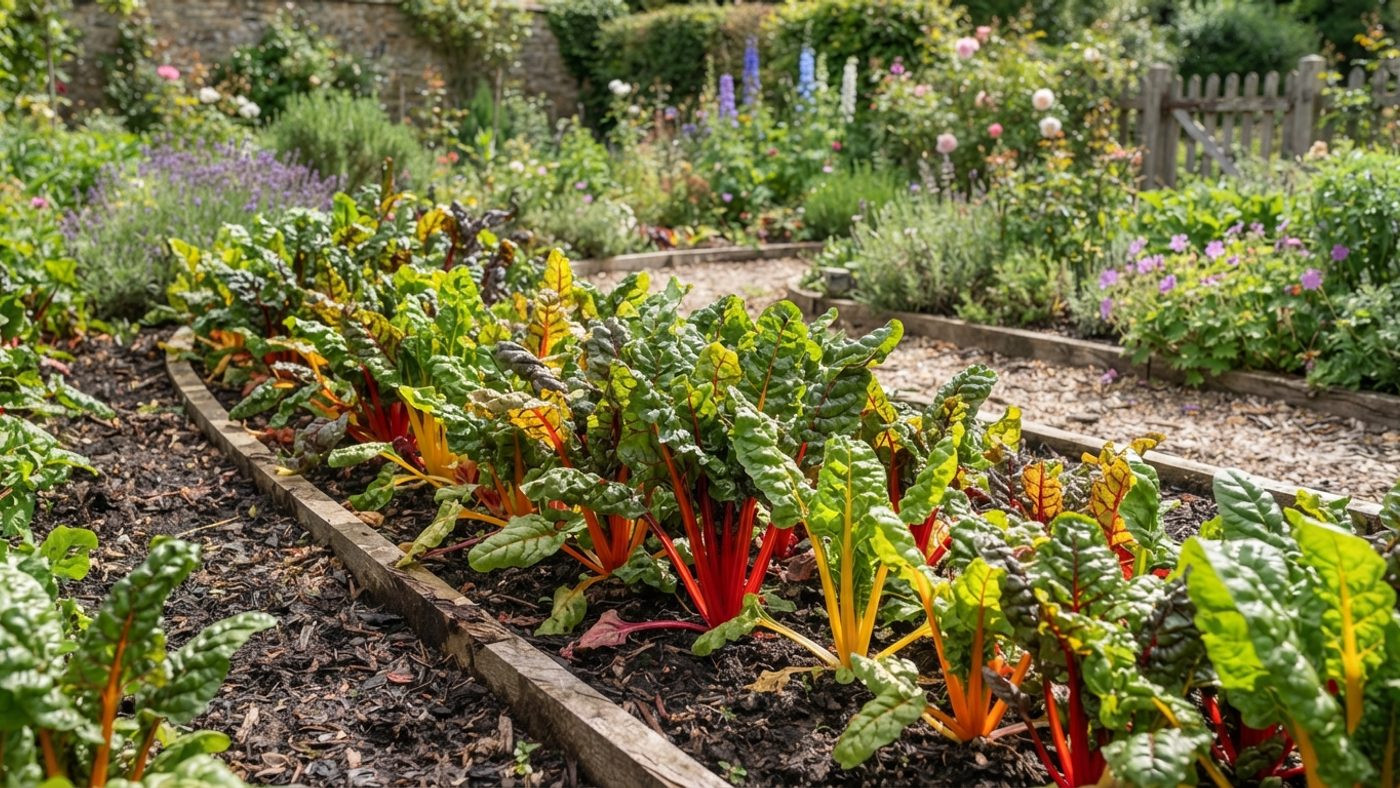
Chard's ornamental case doesn't need much building, it's one of the few vegetables the RHS names outright as an edimental example, calling rainbow chard "pretty" and stating plainly that "it was bred to be pretty." The specific trait behind that is stem colour: Beta vulgaris 'Bright Lights' produces stems across red, yellow and orange shades on the same clump-forming plant, staying compact at 0.1 to 0.5m. That's a genuine range of hot colour sitting at ground-to-knee height, exactly the kind of colour a grey Scottish border benefits from at ground level, where bedding annuals usually do the work instead.
Use chard as a front-of-border colour block rather than a single specimen, the stem-colour effect reads best in a mass rather than as an isolated plant. It pairs naturally with other hot-colour or dark-foliage planting (heucheras, dark-leaved dahlias, orange and red crocosmia) and works as a repeating rhythm plant threaded along a border edge, doing the same visual job as coloured-stem cornus in winter but through the growing season instead. Its main design limitation is height, it stays low, so it's a foreground or edging plant, not a filler for mid-border gaps. Sowing succession and harvest-cutting technique are in the chard growing guide.
At the same Chelsea show, the RHS also flagged parsnip's "stunning, acid-green" flowerheads and Broad bean 'Crimson-Flowered' as edimental exhibits in their own right. Neither has the height, colour and structural detail pinned down the way the four plants above do, so treat them as ones to watch rather than ones to build a border around yet.
Climbers: scarlet runner bean
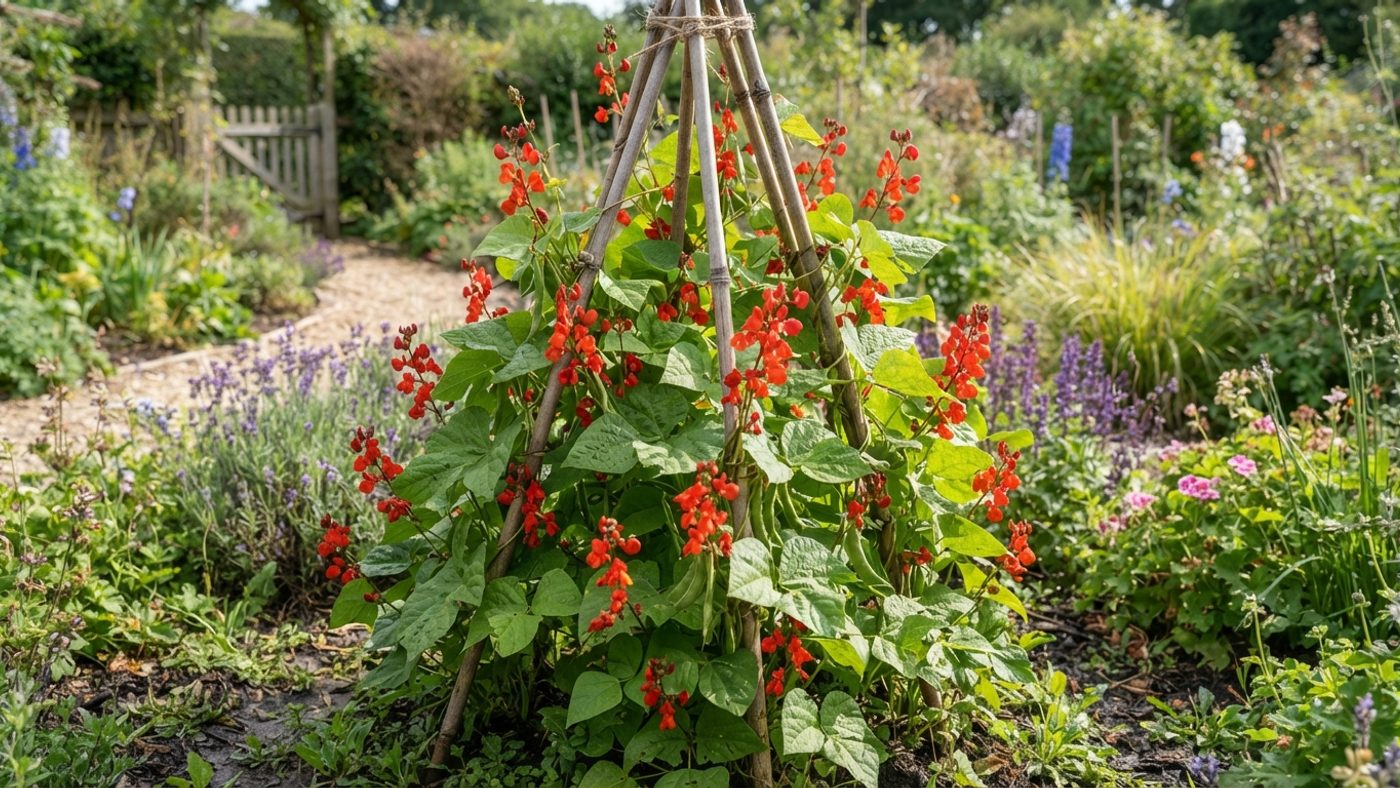
Scarlet runner bean (Phaseolus coccineus) is the strongest case of the four. It's a green-leaved twining climber reaching 2.5 to 4m, producing scarlet flowers (occasionally white) that develop into long, flat pods over an extended summer season, real, long-lasting colour at height, exactly the kind of long seasonal interest a short Scottish summer makes valuable, and it carries the RHS's "Plants for pollinators" badge. That's a plant doing the full job of an ornamental annual climber, height, flower colour, season length, wildlife value, while also cropping.
This is the plant most naturally suited to doing double duty on a support structure you'd otherwise dedicate to a purely ornamental climber: a wigwam, an obelisk, or a wall-trained frame. The scarlet flower colour is strong enough to anchor a hot planting scheme on its own, or to run against cooler foliage (dark-leaved cannas, bronze fennel) for contrast. At up to 4m on a lightweight cane structure, it also catches more wind than its slender canes suggest, so give it a firm, well-anchored support to keep the display upright in weather that would flatten a flimsier one. Its long, twining habit and high flower output make it one of the few edible plants that can genuinely substitute for a decorative annual climber like sweet pea in a cottage-garden scheme, rather than sitting apart from one, a role with real precedent in UK cottage gardening more broadly, not something specific to Scotland. Sowing timing, support structures and pinching outRemoving the soft growing tip of a stem to stop upward growth and make the plant branch out sideways instead. Full definition → are covered in the runner bean growing guide.
Woody structure and blossom: currant bushes
Currant bushes bring something none of the other edimentals offer: permanent woody structure. Common redcurrant (Ribes rubrum) is a deciduous shrub reaching 1.5 to 2.5m, producing small greenish-yellow flowers followed by hanging clusters of shining red berries, and it carries the RHS's "Plants for pollinators" badge. That's a shrub doing a genuine three-season job across the same short window a Scottish garden most needs it filled, spring blossom, summer fruit clusters hanging like jewellery against the foliage, and a deciduous woody frame carrying the border through the rest of the year.
Use currants as a border shrub layer rather than confining them to a fruit cage, a redcurrant, blackcurrant or whitecurrant reads exactly like any other flowering-then-fruiting deciduous shrub of similar size, and the hanging berry clusters are genuinely showier at close range than most ornamental shrub fruit. Blackcurrant and whitecurrant share the same general blossom-and-berry-cluster form as redcurrant. Position a currant bush where the blossom and berry clusters stay visible rather than lost among surrounding foliage, a shrub border edge or a mixed border's mid-height layer both work well. For pruning form, feeding and harvest timing, the redcurrant growing guide covers the detail (it covers whitecurrant too); blackcurrant has its own growing guide.
Putting them together
A single scheme can use all four without any of them fighting for the same job: cardoon or globe artichoke anchoring the back of a bed, rainbow chard massed along the front edge for colour at ground level, a runner bean wigwam rising through the middle distance where a sweet pea frame would otherwise go, and a currant bush marking a border corner or shrub layer where its spring blossom and summer fruit clusters carry the eye once the perennials in front of it have gone over. Currant blossom opens first in spring, chard's stem colour builds through the growing season, and artichoke, cardoon and runner bean carry the display through summer into autumn, between them they cover the full height range of a mixed border and most of the year, without any one of them needing to be the whole show. Deep winter, once currant is down to bare wood and the others have died back or come indoors, is the one stretch none of the four covers, that's a job for evergreen structure or berrying shrubs planted alongside them, not something this shortlist solves on its own.
| Plant | Design role | Key ornamental feature | Height/structure | Best border position or partner |
|---|---|---|---|---|
| Globe artichoke | Architectural | Silvery grey-green foliage; purple thistle flowerheads | Up to 1.5m tall, 1m wide, perennial | Back-of-border anchor; pairs with blue/purple perennials and other silver foliage |
| Cardoon | Architectural (larger) | Silvery-grey, deeply divided spiny foliage to 1m long; purple thistle flowers | Up to 2.5m, perennial | Dramatic single specimen or focal point (no growing guide on this site yet) |
| Ruby/rainbow chard | Colour | Stems in red, yellow and orange shades | 0.1–0.5m, clump-forming | Front-of-border colour block; pairs with dark or hot-coloured foliage |
| Scarlet runner bean | Climber | Scarlet flowers over a long summer season | 2.5–4m, twining annual climber | Wigwam or obelisk in place of a decorative annual climber |
| Redcurrant (and whitecurrant) | Woody/blossom | Greenish-yellow spring flowers; hanging red berry clusters | 1.5–2.5m, deciduous shrub | Shrub border edge or mixed-border mid-layer |
Common questions
Can you eat "ornamental" vegetables, or are they just for looks?
Yes, harvest chard, artichoke buds, runner beans or currants from a border exactly as you would from a dedicated veg bed, cutting or picking doesn’t damage the display since the plant simply carries on growing and flowering afterwards. The one exception is cutting into a border specimen so hard it loses the shape you planted it for, worth pacing your harvest a little more gently than you might in a plot grown purely for yield.
Do runner beans need a proper fence or frame to look good, or will they work loosely trained?
As a twining climber reaching 2.5–4m, scarlet runner bean needs a support structure to perform at all, ornamentally or otherwise, without one it collapses into a low tangle rather than showing off its flower and height. A wigwam, obelisk or wall-trained frame is what lets it do the vertical, flower-covered job that makes it worth planting in a border in the first place.
Will currant bushes still fruit and look good if I grow them in a border instead of a fruit cage?
Yes, the blossom and fruiting habit that make currants ornamental don’t depend on being caged. Grown in a border, a currant bush flowers and fruits exactly the same; birds simply get easier access to the crop than they would behind netting. Plenty of gardeners choose that trade-off deliberately, putting the bush’s structure and blossom on view rather than tucking it away purely for yield.
Is globe artichoke hardy enough to leave in a Scottish border over winter?
Treat it as a structural plant you might need to replace every few years rather than a one-and-done permanent shrub, especially inland or at any altitude. That framing matters for design: don’t build a scheme’s entire back-of-border height around a single artichoke if losing it in a bad winter would leave an obvious gap, plant it alongside another tall element that can carry the height on its own if needed.
What’s the actual difference between an "edimental" and just growing vegetables next to flowers?
Growing vegetables near flowers is companion planting or a simple potager layout; calling a plant an edimental is a claim about that specific plant’s own ornamental qualities, its height, flower, foliage colour or form, being strong enough to earn a place in a border on design merit alone, independent of where it’s physically positioned relative to other flowers.
Sources
7 sources, recorded with what each was used for
- RHS: 8 plants you weren’t expecting to see at RHS Chelsea (2026): The "edimentals" trend framing, rainbow chard’s edimental status, parsnip/broad bean Chelsea mentions
- Garden Organic: Ryton Gardens: Ryton Gardens running a large vegetable garden and a separate ornamental garden side by side
- RHS: Cynara cardunculus Scolymus Group (globe artichoke): Height, foliage, flower, pollinator badge, "ornamental enough for the flower garden" quote
- RHS: Cynara cardunculus (cardoon): Height, foliage, flower, AGMThe RHS's Award of Garden Merit: a UK-wide trials award for reliable performance, not a Scotland-specific recommendation. Full definition → and pollinator badge
- RHS: Beta vulgaris 'Bright Lights' (rainbow chard): Stem colour range and habit
- RHS: Phaseolus coccineus (scarlet runner bean): Habit, flower colour, height, pollinator badge
- RHS: common redcurrant (Ribes rubrum): Flower, fruit, height, pollinator badge