
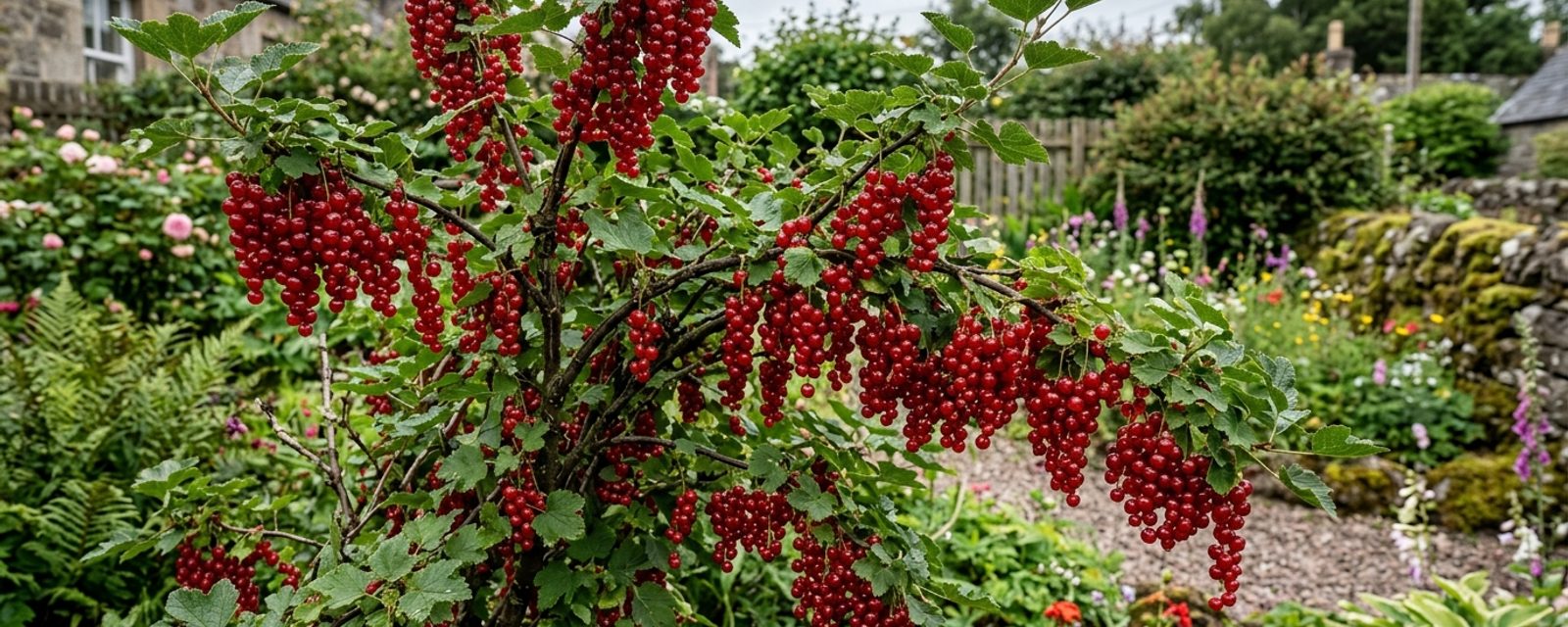
Six names on a nursery order form: Jonkheer van Tets, Red Lake, Rovada, Stanza, Blanka, White Grape. Every one carries the RHS Award of Garden Merit, and every description reads roughly the same: hardy, sun or partial shade, sheltered spot, summer fruit. The differences are real, they're just not shouted about. They show up in ripening date, mature size, time to first crop, and soil pH. For how to plant, prune and harvest a redcurrant or whitecurrant bush once one's chosen, the redcurrants growing guide covers that ground.
Quick answer
Jonkheer van Tets is the strongest all-round pick: one of the earliest to ripen, a real head start in a season that runs later here than in southern England, and it tolerates the widest soil range of the six. Rovada extends the season with a late, larger crop; Stanza suits a small garden or container; Blanka crops fastest after planting, in as little as two years.
What makes these six varieties hard to tell apart
All six hold the RHS Award of Garden Merit and are hardy to H6The RHS's H1a–H7 scale for how much cold a plant can survive outdoors, H1a being tender indoor-only and H7 hardy anywhere in the UK. Full definition →, down to -20°C, so hardiness doesn't rule any of them out anywhere in Scotland. All six are self-fertileA plant that can set fruit using its own pollen, without needing a second, different variety nearby to cross-pollinate it. Full definition → too, worth knowing in a country where a second variety for cross-pollinationPollen moving from one plant to a different, compatible variety, needed for fruit to set on any variety that isn't self-fertile. Full definition → isn't always sitting on the shelf at the nearest nursery: a single bush of any of them sets fruit alone. The differences that actually decide which one to plant sit one level down, in what doesn't show up on a plant tag.
Comparing all six AGM varieties
| Variety | Type | Ripens | Height / spread | Maturity | Soil pH |
|---|---|---|---|---|---|
| Jonkheer van Tets | Redcurrant | June–July | 1.5–2.5m / 1–1.5m | 5–10 years | Acid or neutral |
| Red Lake | Redcurrant | Mid-season | 1.5–2.5m / 1–1.5m | 5–10 years | Neutral only |
| Rovada | Redcurrant | Late summer | 1–1.5m / 1–1.5m | 5–10 years | Acid or neutral |
| Stanza | Redcurrant | Mid-to-late | 1.5–2.5m / 1–1.5m | 5–10 years | Acid or neutral |
| Blanka | Whitecurrant | Late season | 1–1.5m / 1–1.5m | 2–5 years | Acid or neutral |
| White Grape | Whitecurrant | Mid-season | 1.5–2.5m / 1–1.5m | 5–10 years | Neutral only |
Sweet-tasting fruit is named specifically for Jonkheer van Tets, and "good quality" fruit for Stanza. The other four varieties are described by size, colour and cropping, not flavour.
Best overall: Jonkheer van Tets
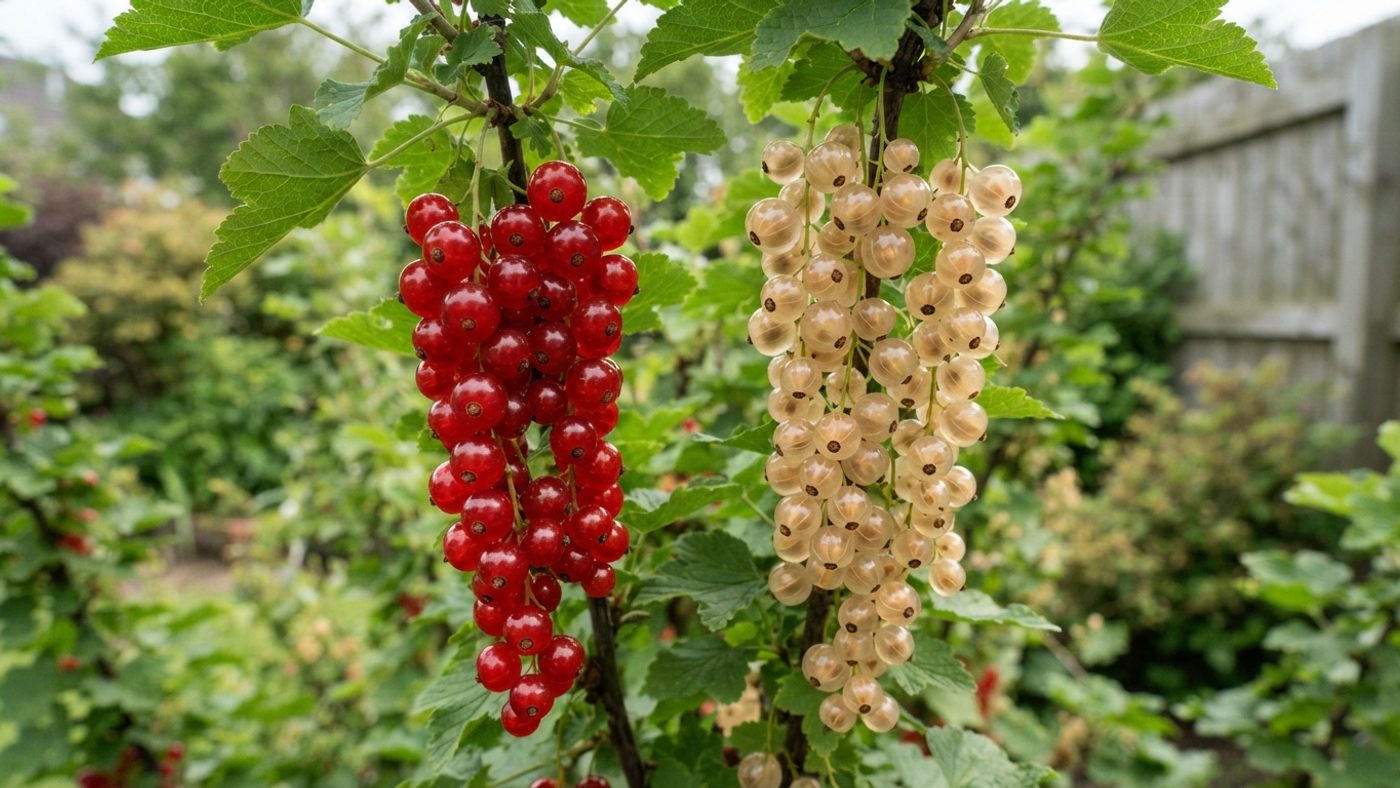
Jonkheer van Tets is the most straightforward recommendation for Scotland. It's one of the earliest of the six to ripen, fruit ready in June–July rather than waiting into late summer, a genuine head start in a growing season that starts later and runs cooler here than further south. It also tolerates the widest soil range of the group, clay, loam or sand at either acid or neutral pH, and copes with any aspect.
When a different variety wins instead
Small garden or growing in a pot: Stanza's compact habit is named specifically for this, and Gardener's World recommends it by name for small gardens. Rovada and Blanka are also more compact than the others (1–1.5m height and spread, against 1.5–2.5m for the rest), so either is a reasonable second choice where space is tight.
Fastest first crop: Blanka reaches maturity in 2–5 years, against 5–10 years for every other variety here. The ranges sit close at the edges, but Blanka is the only one of the six with any realistic chance of a crop before year five. Gardener's World independently calls it the heaviest-cropping whitecurrant, with long trussesThe flowering, then fruiting, stem cluster on a tomato plant; each truss ripens its fruit together. Full definition → of large, pearly white berries.
Extending the harvest window: pairing an early and a late variety spreads picking over more of the summer rather than concentrating it into a fortnight. Jonkheer van Tets (June–July) paired with Rovada (late summer) covers both ends; Rovada's own page describes long strings of larger fruit that make picking easier once the crop is in.
Soil pH
RHS doesn't give a single numeric pH figure for redcurrants and whitecurrants as a crop, but a tolerance is stated for each variety individually. Jonkheer van Tets, Rovada, Stanza and Blanka all tolerate acid or neutral soil. Red Lake and White Grape are narrower: neutral soil only. Ground on the west coast and at altitude tends to run more acidic than elsewhere, so testing before choosing is worth doing on that kind of plot; on acid soil, the sensible choice narrows to the other four.
Rainfall isn't uniform across Scotland either, the west coast generally sees more of it than the east (see the Scotland climate guide for the regional picture). Where summers are already drier, an early-ripening variety like Jonkheer van Tets buys less of an advantage, since there's less wet weather to dodge in the first place; on a wetter site, getting fruit off the bush before the rain sets in matters more, and the same damp keeps fungal risks like powdery mildew and grey mould, both named on every variety here, more of a live concern through the season generally.
Pest and disease risk by variety
Susceptibilities aren't identical across the six. All six share the general risks the growing guide already covers in depth: aphids, powdery mildew, capsid bugs, sawflies, leaf spot, scale insects, and grey mould among them. Beyond that shared list, a few risks are named on only some varieties' own pages:
| Variety | Extra risk beyond the shared list |
|---|---|
| Jonkheer van Tets | None beyond the shared list |
| Rovada | None beyond the shared list |
| Red Lake | Gall mites, gall midge |
| Stanza | None beyond the shared list |
| Blanka | Currant blister aphid, shield bug |
| White Grape | Gall mites |
Gall mites, gall midge, currant blister aphid and shield bug aren't covered in depth anywhere on the site yet, so treat those four as risks to watch for rather than ones with further reading here.
Birds strip ripening currants fast regardless of variety; netting and the fruit-cage advice in the growing guide's Common Problems section applies equally to all six. All six also flower in spring, so the late-frost risk that affects Jonkheer van Tets's early crop applies across the group, not just the earliest ripener; check the frost dates page before planting any of them on exposed ground.
Big bud mite, sometimes raised in general currant-growing advice, is confirmed as a blackcurrant-specific pest and doesn't apply to any of the six redcurrant or whitecurrant varieties above.
On yield, the growing guide gives roughly 4.5kg a year from an established bush, a crop-wide figure rather than a per-variety one; none of the six varieties breaks that figure down further.
Common questions
Which redcurrant or whitecurrant variety crops fastest after planting?
Blanka, a whitecurrant, reaches maturity in 2-5 years. Every other AGMThe RHS's Award of Garden Merit: a UK-wide trials award for reliable performance, not a Scotland-specific recommendation. Full definition → variety covered here, redcurrant or whitecurrant, takes 5-10 years to reach full maturity.
Can I grow a redcurrant and a whitecurrant next to each other?
Yes. They're the same species, Ribes rubrum, with identical growing conditions, so there's no separation needed and no risk of cross-pollination affecting fruit colour, since each bush produces true to its own variety.
Do I need more than one variety to get fruit?
No. All six varieties covered here are self-fertile, and none needs a pollination partnerA second, different variety of the same fruit planted nearby so the two can cross-pollinate each other, needed by any variety that isn't self-fertile. Full definition →. A single bush of any one variety will set fruit on its own.
Which variety suits a small garden or container?
Stanza first: it's named specifically for its compact habit, and Gardener's World recommends it by name for small gardens. Rovada and Blanka are worth considering too, since both stay smaller than the other four.
Does soil pH rule out any of these varieties?
On acid soil, Red Lake and White Grape are the two to avoid, since they tolerate neutral soil only. The other four, Jonkheer van Tets, Rovada, Stanza, and Blanka, tolerate acid or neutral soil.
Sources
9 sources, recorded with what each was used for
- RHS: Redcurrants, grow your own: Crop-wide AGM list (4 redcurrant varieties) and fruiting habit
- RHS: Whitecurrants, grow your own: Whitecurrant/redcurrant relationship and whitecurrant AGM list (2 varieties)
- Ribes rubrum 'Jonkheer van Tets': Hardiness, size, ripening, soil tolerance, pest/disease list
- Ribes rubrum 'Rovada': Size, ripening, soil tolerance, pest/disease list
- Ribes rubrum 'Red Lake': AGM date, size, ripening, soil tolerance, pest/disease list
- Ribes rubrum 'Stanza': Size, ripening, soil tolerance, pest/disease list
- Ribes rubrum 'Blanka': Size, maturity time, ripening, soil tolerance, pest/disease list
- Ribes rubrum 'White Grape': AGM date, size, ripening, soil tolerance, pest/disease list
- Gardener's World: How to grow redcurrants and whitecurrants: Stanza's small-garden recommendation and corroborating Rovada and Blanka traits