
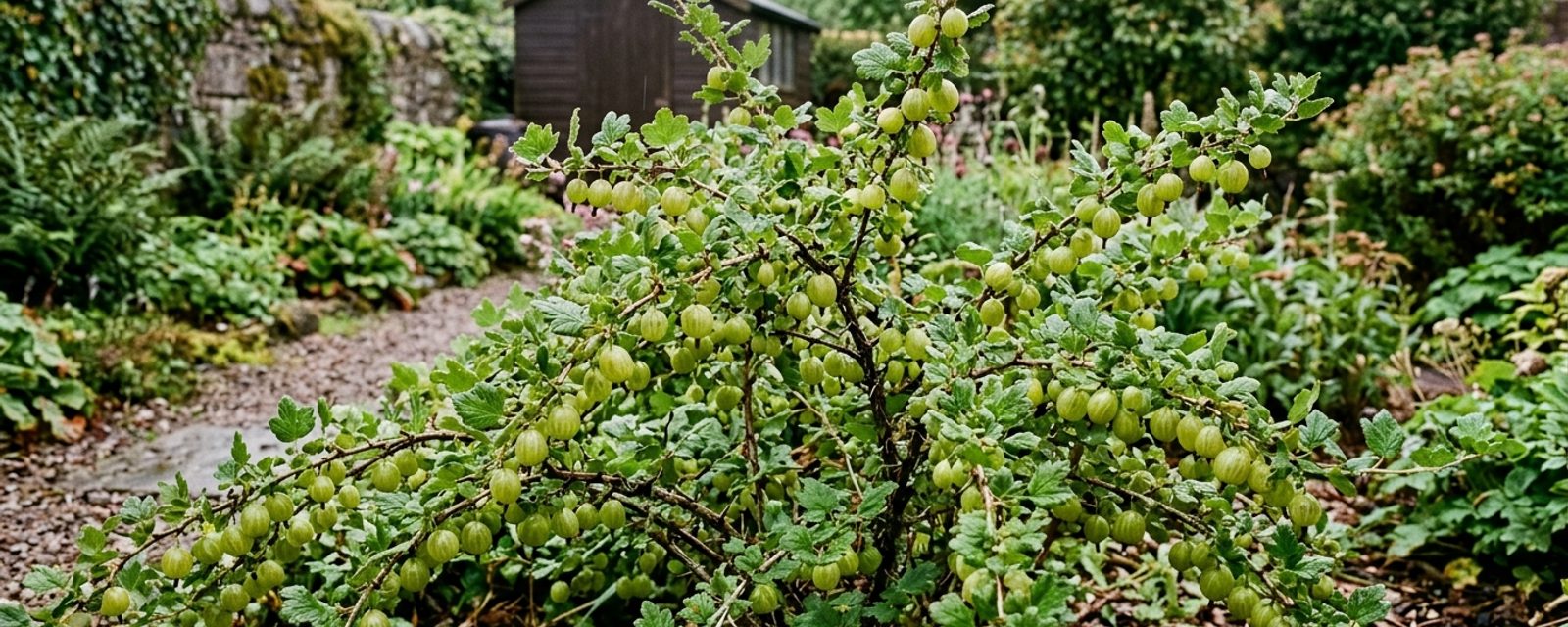
Ribes uva-crispa
A gooseberry bush crops for 10-15 years once established, closer to a blackcurrant bush in upkeep than to any tree fruit. Get two things right from the start: pruning twice a year rather than once, and choosing a variety with mildew resistance already bred in rather than hoping for the best. Mildew is this crop's single most serious problem, and Scotland's damp, humid summers favour it more reliably than a dry climate would.
The harvest happens twice too, weeks apart and for different reasons, and pruning is a two-season job with two different goals: neither is a mistake to fix, both are how gooseberries actually work.
Site and planting
Gooseberries crop best and taste sweetest in full sun, but tolerate some shade well, which is worth knowing before ruling out a partially shaded bed. Plant bare-rootA plant, usually a fruit tree or hedging, sold with its roots exposed rather than in a pot, and only available while dormant. Full definition → bushes from late autumn to early spring, ideally in late autumn, giving them time to settle before spring growth; containerisedA plant grown and sold in a pot of compost, which can be planted out at any time of year, unlike a bare-root plant. Full definition → plants can go in any time, avoiding waterlogged, parched or frozen ground. Position at the same depth the plant was previously growing. Space free-standing bushes 1.2-1.5m apart, cordonsA fruit tree or bush trained as a single main stem with short fruiting side-spurs, usually grown at an angle against a wall, fence or wire. Full definition → much closer at 30-38cm, and fans 1-1.5m apart. In a container, use one at least 40cm wide and deep with good drainage and soil-based compost.
Top 5 Crops for a Shaded Garden → covers other crops, including gooseberries, that hold up in a partially shaded bed or a tenement back green.
Care
Water regularly during dry spells for the first couple of years, ideally early morning or evening to limit moisture loss. Mulch each spring with a thick layer of organic matter, leaving a mulch-free circle around the base of the stems. A well-mulchedA layer of material spread over the soil around plants to suppress weeds, retain moisture, and improve soil structure as it breaks down. Full definition → bush generally needs no extra feeding. Be careful with nitrogen specifically if it does: too much encourages sappy growth that's prone to mildew, the opposite of the usual feeding instinct. Container plants need steady moisture through the season plus a high-potassium liquid feed fortnightly, and repotting into a larger container every few years.
If frost is forecast while plants are flowering, cover overnight with fleeceA lightweight, breathable fabric laid or draped over plants to trap a little warmth and keep off frost, wind and some flying pests. Full definition →, removing it during the day so pollinating insects can still reach the flowers. Net bushes over winter against bullfinches damaging the buds, and again in summer as fruit ripens against birds generally. A fruit cage is the permanent solution if you grow several fruit bushes.
Pruning
Gooseberries are pruned twice a year, and each session does a different job. The standard shape is an open-centred, goblet-shapedA bush pruned with an open middle and outward-radiating branches, so light and air reach every part rather than a dense, shaded centre. Full definition → bush with 8-10 main branches. After planting, select up to five well-spaced, strong shoots and cut them back by half to three-quarters; remove any others.
Winter branch-renewal pruning: remove one to three older, less productive branches each year to stimulate strong replacement shoots, keeping the centre of the bush open.
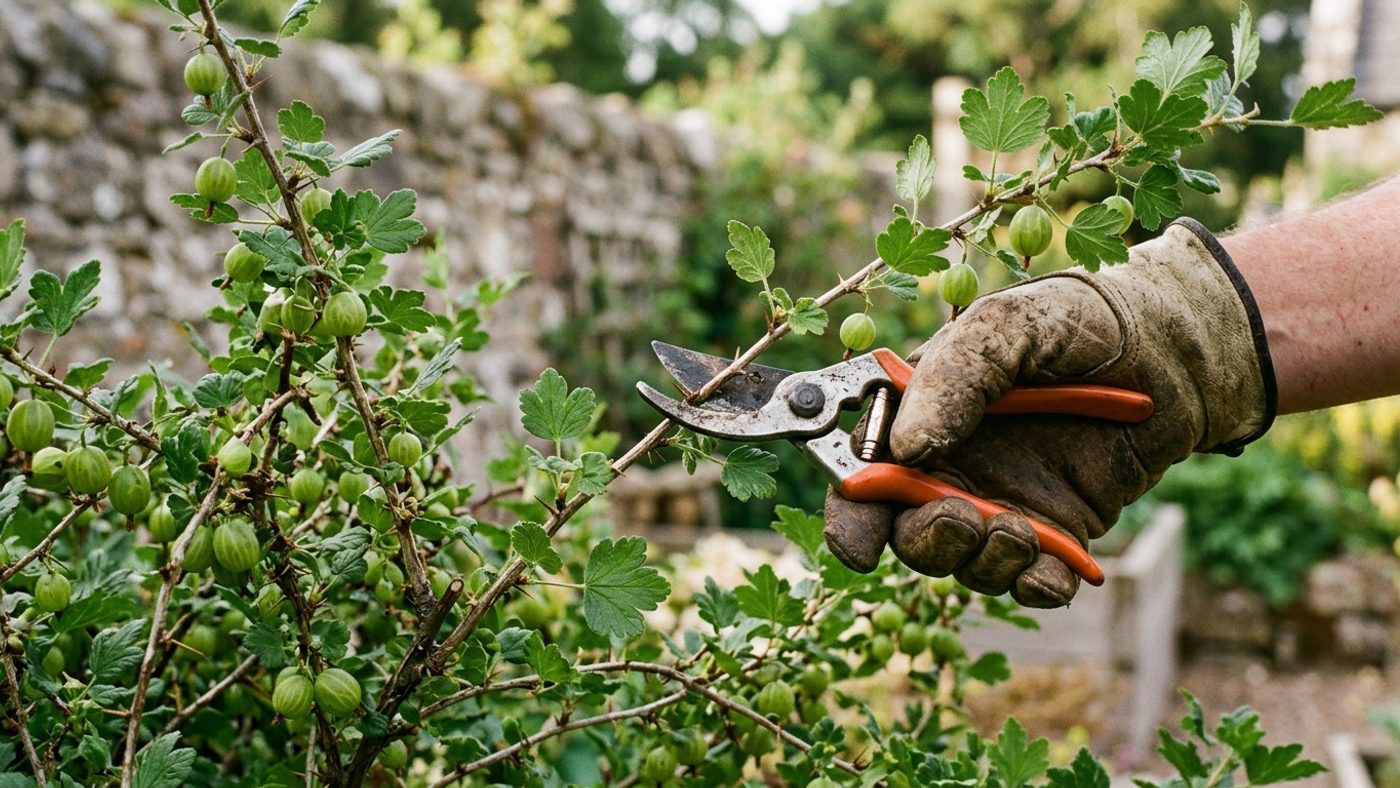
Summer spur pruning: shorten the current season's side-shoot growth back to about five leaves. This restricts growth and keeps the bush's shape, trading a larger number of smaller fruits for fewer, larger ones that are easier to pick from a thorny bush. Wear thorn-proof gloves for both sessions.
Varieties
Five gooseberry varieties carry the Award of Garden Merit; mildew resistance and shade tolerance are the two traits worth choosing between. Leveller (large yellow dessert berries, an ideal exhibition variety) and Careless (large green berries that sweeten and turn yellow left on the bush) round out the list. Neither is noted for mildew resistance or shade tolerance, though that doesn't make them any less worth growing.
★ Our pick for Scotland
GreenfinchAGM
Culinary · green fruit · mildew resistant · compact, not too spiny
It resists mildew, a real hedge against the single most serious problem gooseberries have.
Why this one: Greenfinch resists mildew, and it's also compact and less spiny than most: an easier bush to manage as well as a lower-risk one.
Also worth considering
InvictaAGM
Culinary · vigorous · heavy crops · some mildew resistance
Some mildew resistance, vigorous and heavy-cropping: a dependable culinary choice.
Whinham's IndustryAGM
Culinary/dessert · red fruit · tolerates partial shade
Tolerates partial shade, a real option for a bed that doesn't get full sun.
Best Gooseberry Varieties for Scotland → compares all named gooseberry varieties head-to-head, with the practical detail that doesn't fit in a summary card.
Harvesting
Gooseberries get picked twice, for two different reasons. In June, pick every other fruit while still green and under-ripe, for jam, pies, tarts and sauces; this also thins the bush so what's left can size up.
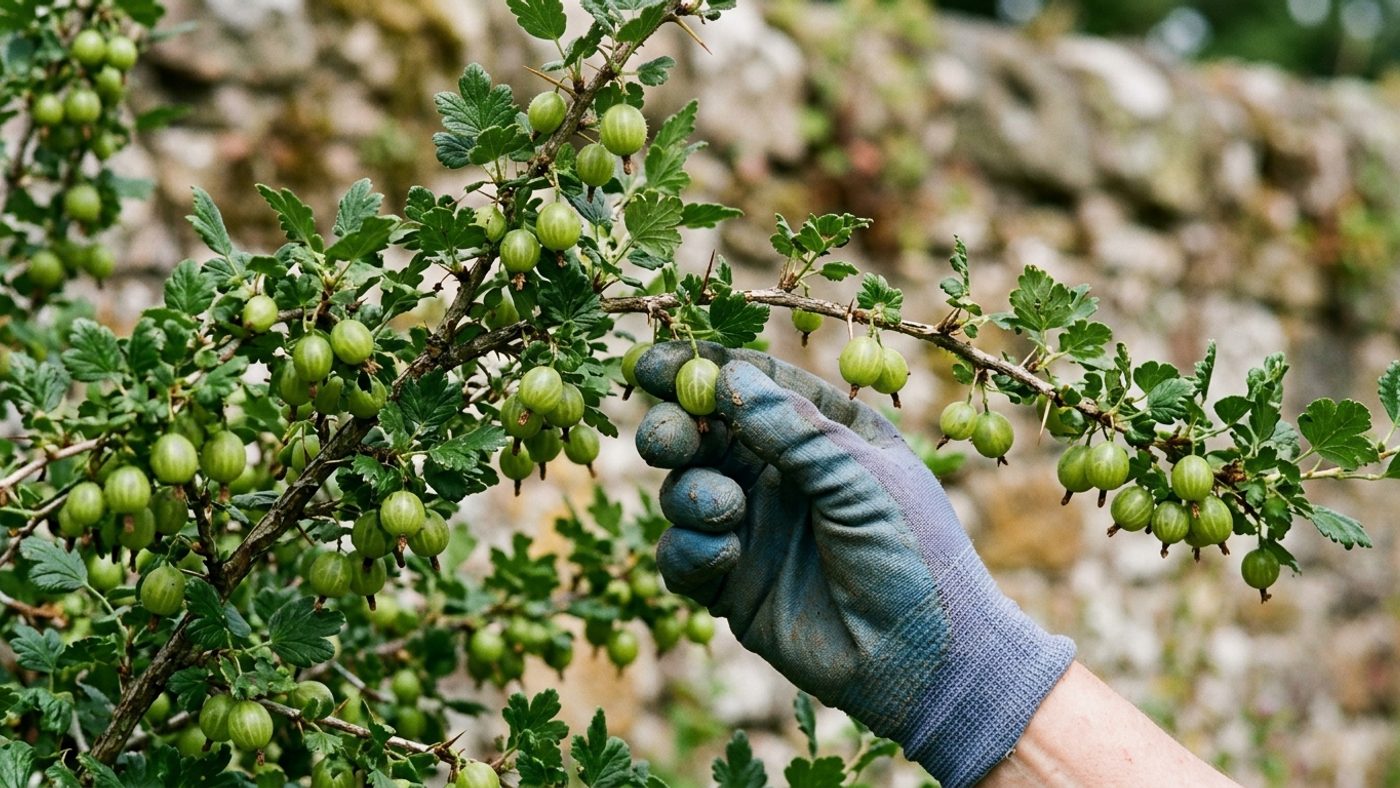
In July and August, harvest the rest once fully ripe, for eating fresh at their sweetest. An established bush yields 2.5-5.5kg a year, a cordon about 1kg. Pick with the stalk attached to avoid damaging the skin.
Common problems
- Birds target buds in winter and ripening fruit in summer; netting or a fruit cage is the reliable answer either way.
- Gooseberry mildew is gooseberries' most serious disease. Choose a resistant variety and avoid excess nitrogen feeding to reduce the risk.
- Gooseberry sawfly larvae strip leaves fast in spring and summer; check the undersides of leaves regularly and remove larvae by hand or use a biological control.
See more problems
- Fruit aphids distort new growth and shoots.
- Currant and gooseberry leaf spot causes small brown spots that can lead to early leaf drop in a bad year. No fungicide exists for gardeners, so clearing fallen leaves in autumn is the real control.
- Grey mould rots fruit and shoots in damp conditions; good airflow from correct pruning helps prevent it.
- Brown scale and woolly vine or currant scale are sap-sucking insects that weaken growth over time.
- Capsid bugs distort foliage and can cause flower buds to abort.
- Spotted wing drosophila lays eggs directly in ripening fruit; pick promptly as fruit ripens to reduce the risk.
Common questions
Should I pick gooseberries all at once when they ripen?
No: plan on two pickings: in June, pick every other fruit green and under-ripe for jam and cooking, which also thins the bush; in July and August, harvest what is left once fully ripe for eating fresh. Full sourced breakdown: <a href="/tools/garden-myths/gooseberries/">Gooseberry Myths →</a>
Do gooseberries really need pruning twice a year?
Yes: winter branch-renewal pruning removes a few older branches to stimulate replacement growth, while summer spur pruning shortens the current season's side-shoots to five leaves for larger, fewer fruits that are easier to pick from a thorny bush. Full sourced breakdown: <a href="/tools/garden-myths/gooseberries/">Gooseberry Myths →</a>
Can gooseberries grow in a shady spot?
Yes, to a real degree: gooseberries crop best and taste sweetest in full sun but tolerate some shade well, and Whinham's Industry is specifically named as suited to partial shade. Full sourced breakdown: <a href="/tools/garden-myths/gooseberries/">Gooseberry Myths →</a>
Should I feed a gooseberry bush to get a bigger crop?
Be careful with nitrogen specifically: too much encourages sappy growth that's prone to mildew; a well-mulched bush usually needs no extra feeding, and a high-potassium formula is the safer choice where one does. Full sourced breakdown: <a href="/tools/garden-myths/gooseberries/">Gooseberry Myths →</a>
Sources
3 sources, and what each was used for
- RHS: getting started, 10-15 year productive life, 5 AGMThe RHS's Award of Garden Merit: a UK-wide trials award for reliable performance, not a Scotland-specific recommendation. Full definition → varieties, planting depth and timing, spacing by form (bush/cordon/fan), container growing, support wires, watering, feeding (avoiding excess nitrogen for mildew reasons), mulching, the twice-yearly pruning requirement, the two-stage June/July-August harvest, yield figures, bird and frost protection, and the nine named problems
- RHS: the open-centred, goblet-shaped bush with 8-10 main branches, initial pruning after planting (five shoots cut back by half to three-quarters), winter branch-renewal pruning (removing 1-3 older branches), and summer spur pruning (side-shoots cut back to five leaves) with the reasoning for each season
- gardenersworld.com: independently corroborates 1.5m bush spacing, Invicta and Whinham's Industry as its own named mildew-resistant and shade-tolerant picks, summer pruning practice, and the pest list