
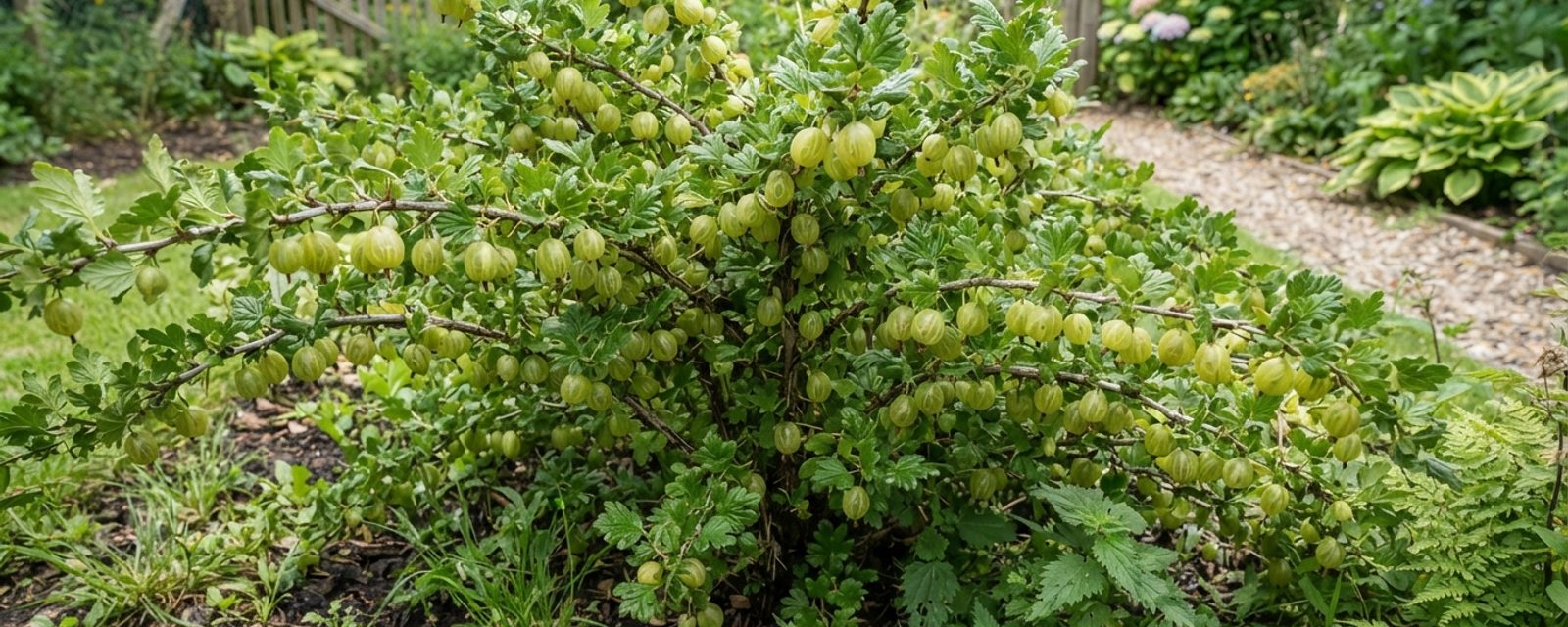
Most soft fruit gives you one problem to manage: too much ripe fruit arriving at once. Gooseberries give you a different one, because the RHS's own harvesting advice for the crop describes something genuinely unusual, a bush that gets picked twice, at two different stages of ripeness, for two different reasons. In June, while the fruit is still small, hard and green, you take a first pick of alternate berries specifically so the ones left behind grow bigger. Only in July and August, once that thinned crop has swelled and coloured up, do you take the main harvest of fully ripe fruit. The early pick isn't a lesser version of the glut, it's the technique that heads the glut off before it happens. RHS's June and July–August windows are general UK timing; in a cooler, later Scottish spring, especially further north or on an exposed or coastal site, both picks can run a week or two behind that, so treat the fruit's own colour and feel as the real signal rather than the calendar date.
That two-stage structure is worth understanding properly if you're growing gooseberries in Scotland, because it changes what dealing with a glut even means for this fruit. There's less of a mad rush to process a single bumper crop, and more of a management job spread across early and midsummer. Here's what's actually involved.
Why gooseberries get picked twice
The mechanism behind it is what makes gooseberries different. The first pick, typically in June, takes every other fruit while it's still tart and underripe, thinning the crop on the bush rather than removing surplus after the fact. With space and resources freed up, the remaining berries on each stem put on more size than they would if the whole crop had been left to mature together. The second pick, usually across July and August, is the one aimed at the fruit at its best: fully ripe, sweeter, and considerably softer. RHS advice is explicit that ripe fruit needs handling with care at this stage, since it "bursts easily" once soft, and recommends picking with the stalk still attached to avoid damaging the skin.
Practically, that means picking sessions land on the calendar several weeks apart rather than back to back, with a gap in between to get on top of pruning, netting or anything else the bush needs before the second wave arrives.
Neither pick has to be used straight away in the kitchen to be worth doing. The June thinning pick is a job for the bush first: even a handful of thinned berries going straight into the compost is doing its job, since the point is what it does for the fruit left behind, not what happens to the fruit removed.
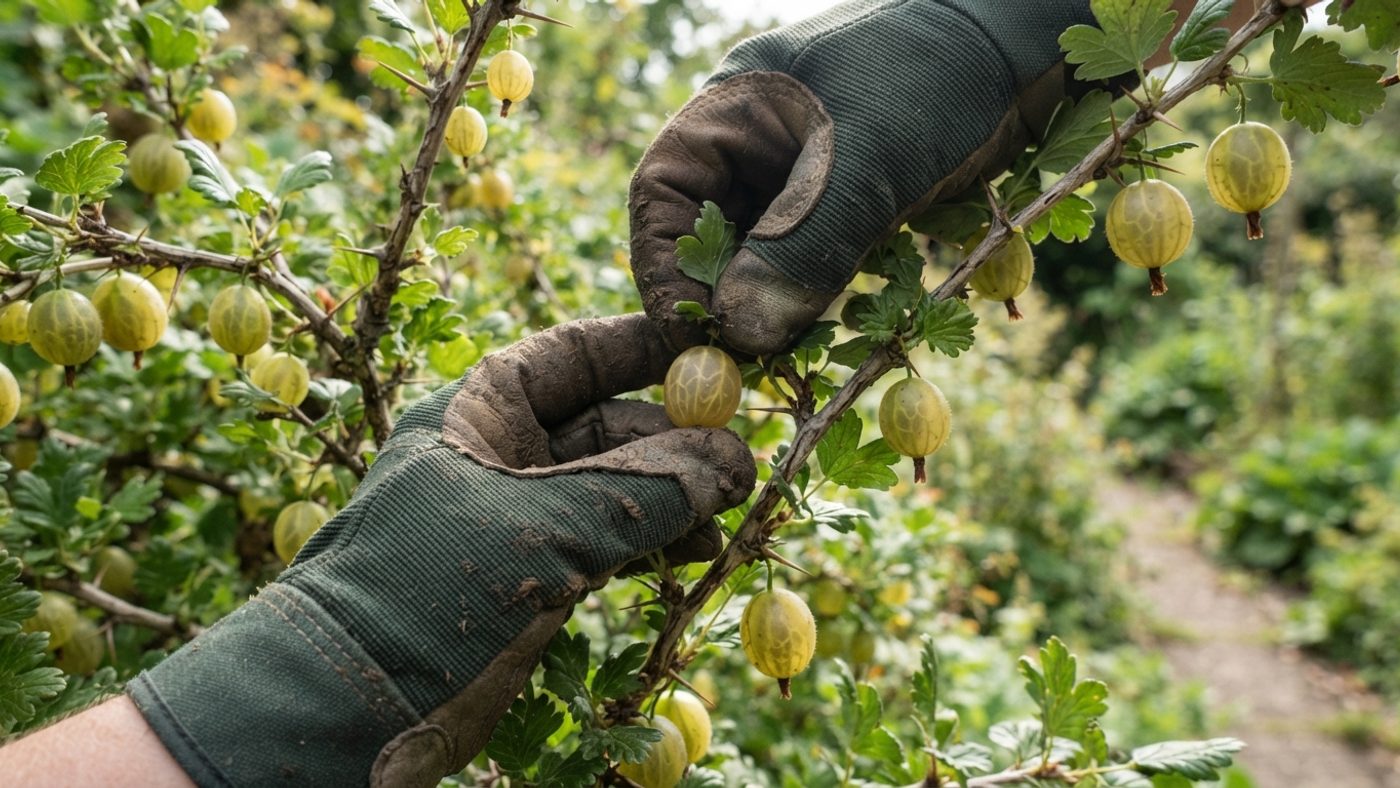
Gooseberry thorns make both sessions more of a job than picking a smooth-skinned fruit: most varieties carry spines along the stems, so gloves and a bit of patience help at both the June and the July–August pick, not just the second one.
How long ripe fruit holds on the bush
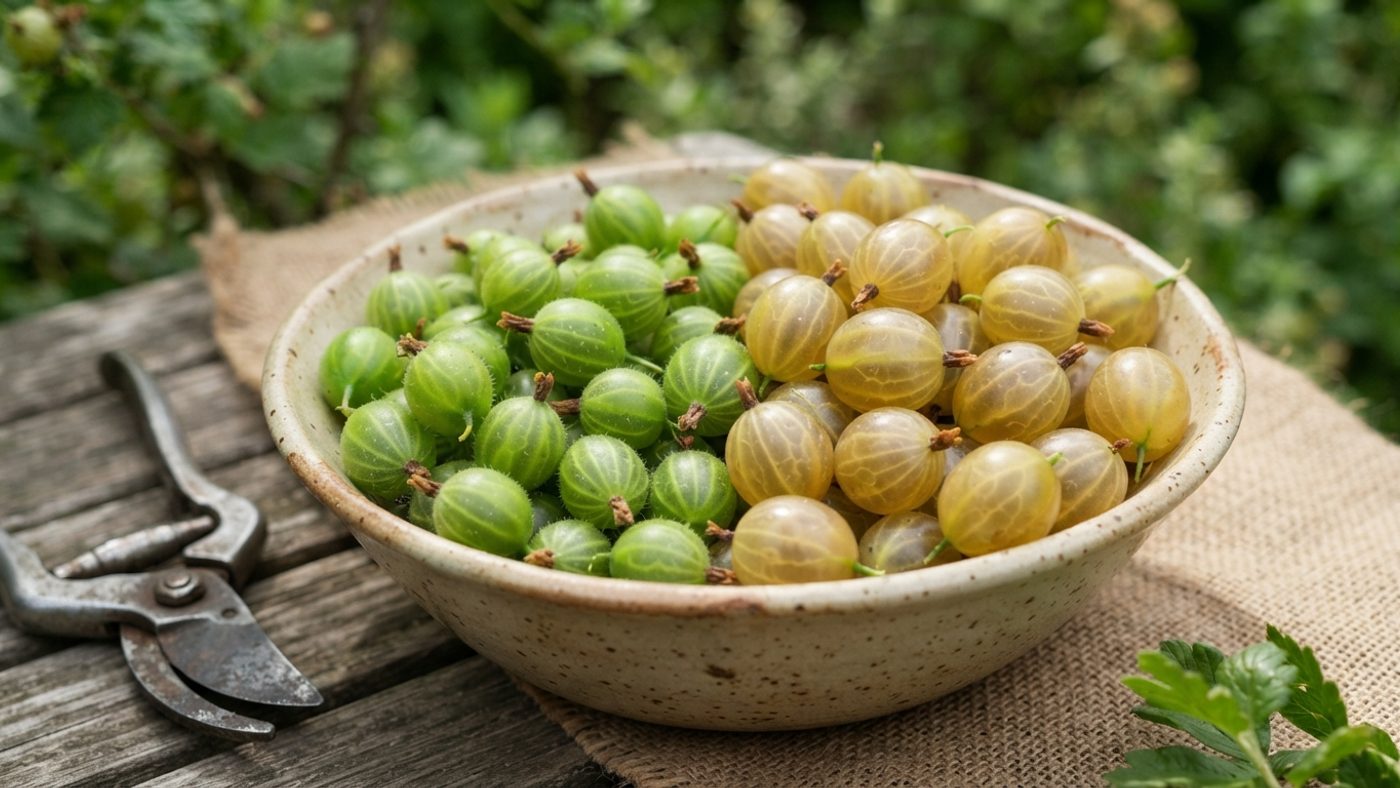
Colour is the first sign a berry has moved from the June thinning stage to the July–August ripe stage, most dessert and culinary varieties turn from green toward yellow, red or a deeper colour as they ripen, depending on the cultivarA plant variety that arose or was bred under cultivation and is kept true by deliberate propagation, rather than a naturally occurring wild species. Full definition →. Texture confirms it: RHS notes that ripe fruit bursts easily when handled, which in practice means a berry that gives slightly to gentle pressure is ready, while one that's still firm and resists is better left a few more days.
There's no fixed number of days a ripe gooseberry holds before it's lost to rot or wildlife, it depends on the weather and how quickly birds and wasps find the bush. Based on what ripe gooseberries actually are, soft-skinned, thin-fleshed fruit that RHS itself flags as bursting easily when handled, they are not a fruit built for lingering on the plant once fully coloured. Once a gooseberry has reached full ripeness, treat picking as reasonably time- sensitive rather than something to leave for a leisurely week. In practice this means working the bush over more than once during the ripe-picking window in July–August, taking the ripest fruit as you find it rather than waiting for the whole crop to turn at once. Warm spells and wet weather both speed up softening and rot, and a Scottish summer runs damp and overcast more often than not, which makes that watching-and-checking routine more useful here than it would be in a drier climate, since fruit sitting wet against the bush for an extra day or two is more likely to spoil before it's picked.
Ripe fruit left too long is also simply more fruit for birds and wasps to find, and split or overripe berries are what draws wasps in particular. Netting the bush at fruiting time, the same way it's netted over winter against bud damage, cuts down on bird losses; picking promptly once fruit softens does most of the work against wasps, since there's less split, overripe fruit sitting around to attract them.
Spreading the harvest window
Gooseberries aren't marketed by early, mid or late cropping the way some other fruits are, so variety choice on its own won't stagger ripening much. Where you do have real scope to spread the harvest is in the two-stage system itself: because the June thinning pick and the July–August ripe pick are already separated by several weeks, a single bush effectively gives you two distinct harvest windows rather than one. Growing more than one bush, or a couple of different cultivars, adds a bit more natural variation on top of that, but the built-in staggering from the thinning system does most of the work.
The basics of siting, planting and routine care are in the gooseberry growing guide.
Short-term keeping once picked
RHS doesn't publish a fridge or cool-store shelf life for gooseberries. Given how soft and thin-skinned ripe fruit already is on the bush, the safest working assumption is to treat freshly picked ripe gooseberries as a short-life fruit: keep them cool, use them promptly, and don't expect them to hold the way a firmer fruit would.
The June thinning pick behaves differently, because it's harder and less ripe. Firm, underripe gooseberries handle and store noticeably better than the soft ripe ones, which is one practical upside of the early pick beyond just improving what's left on the bush.
The Scottish angle: climate, mildew and airflow
Gooseberries, like currants, are among the soft fruits that don't need a long, hot summer to crop well, which is one reason they're a mainstay of Scottish gardens and allotments rather than a marginal crop. An established bush yields 2.5–5.5kg a year according to RHS figures, enough that the two-stage harvest is doing real work managing a genuine volume of fruit, not a token amount.
The flip side of Scotland's climate is damp, and damp, humid conditions are exactly what gooseberry mildew needs. Mildew isn't a uniquely Scottish problem, but Scotland's summers give the fungus more of the stagnant, moist air it favours, more often, than a drier UK summer would. Gooseberry mildew, caused by the fungus Podosphaera mors-uvae, is worsened by stagnant, humid air within a dense bush, and RHS guidance recommends pruning gooseberries to an open form specifically to improve air circulation and discourage it. RHS guidance doesn't connect the June thinning pick itself to airflow or mildew control, that link is the pruning, not the picking, but the same open, well-spaced bush shape that RHS recommends for mildew control also happens to make both picking sessions easier to do.
| Variety | AGMThe RHS's Award of Garden Merit: a UK-wide trials award for reliable performance, not a Scotland-specific recommendation. Full definition → | Named advantage |
|---|---|---|
| Greenfinch | Yes | Mildew resistant, compact and less spiny than most |
| Invicta | Yes | Some mildew resistance, vigorous and heavy-cropping |
| Whinham's Industry | Yes | Tolerates partial shade |
Choosing one of the resistant varieties above is worth doing in a mildew-prone garden regardless of the harvest question, see the Best Gooseberry Varieties for Scotland comparison for the full field.
A caveat: sometimes there's no glut at all
A gooseberry glut doesn't always materialise, because gooseberry sawfly can get there first. The RHS describes the caterpillar-like larvae of several sawfly species, active in overlapping generations from April through September, as capable of rapidly devouring a bush's foliage. That's a long active season for the pest to find a gap in, spanning both the June thinning pick and the July–August ripe harvest, so regular checking through spring and summer rather than a single early inspection is worth the habit. A gooseberry bush usually survives complete defoliation, but a heavily stripped plant is weakened and, per RHS guidance, "may produce a poor crop the following year." It's a leaf pest rather than a fruit pest directly, so it won't spoil the fruit already forming, but a bad sawfly year can mean there's simply less of a harvest, early or late, to manage in the first place. Checking the undersides of leaves for the small green, black-spotted larvae from spring onward is worth doing alongside the June thinning pick.
A late spring frost while the bush is in flower is the other common reason a Scottish gooseberry harvest comes in lighter than expected, since gooseberries flower early. Covering the bush with fleeceA lightweight, breathable fabric laid or draped over plants to trap a little warmth and keep off frost, wind and some flying pests. Full definition → overnight when frost is forecast, and removing it during the day for pollinating insects, is covered in the growing guide.
Common questions
Why do gooseberries get picked before they’re ripe?
The first, early-summer pick removes every other fruit while it’s still hard and green, which gives the fruit left on the bush more room and resources to grow larger before the main ripe harvest in July–August. The two picks usually land several weeks apart, giving a natural pause between them rather than one long continuous harvest.
How long do ripe gooseberries last on the bush?
The RHS doesn’t give a specific figure. What is clear is that fully ripe gooseberries are soft and burst easily, so they aren’t a fruit that tolerates being left on the bush indefinitely once coloured up, checking the bush more than once during the July–August window is the safer approach.
How long do picked gooseberries keep in the fridge?
There’s no RHS-stated storage duration for this. Ripe, soft gooseberries should be treated as short-life fruit and used promptly; the firmer, underripe fruit from the earlier thinning pick holds noticeably better than fully ripe berries.
Does picking gooseberries early help with mildew?
Not directly, according to RHS guidance, the two aren’t linked in RHS’s own advice. What does help with mildew is pruning gooseberry bushes to an open form, which improves air circulation; that same open shape also makes both the thinning pick and the main harvest easier to carry out.
Can gooseberry sawfly wipe out my harvest?
It can reduce it. Sawfly larvae feed on leaves rather than fruit, and a bush usually survives even complete defoliation, but a badly affected plant is weakened and can crop poorly the following season. Checking leaves regularly through spring and summer is worth doing.
Sources
3 sources, recorded with what each was used for
- RHS: Gooseberries, grow your own: Two-stage harvest timing (June thinning pick, July–August ripe harvest), fruit handling notes, bush yields (2.5–5.5kg), Greenfinch and Invicta mildew resistance
- RHS: American gooseberry mildew: Cause (Podosphaera mors-uvae), role of stagnant air and humidity, pruning to an open form as a control measure
- RHS: Gooseberry sawfly: Sawfly species, larval feeding behaviour, seasonal activity (April–September), impact of defoliation on following-season cropping