
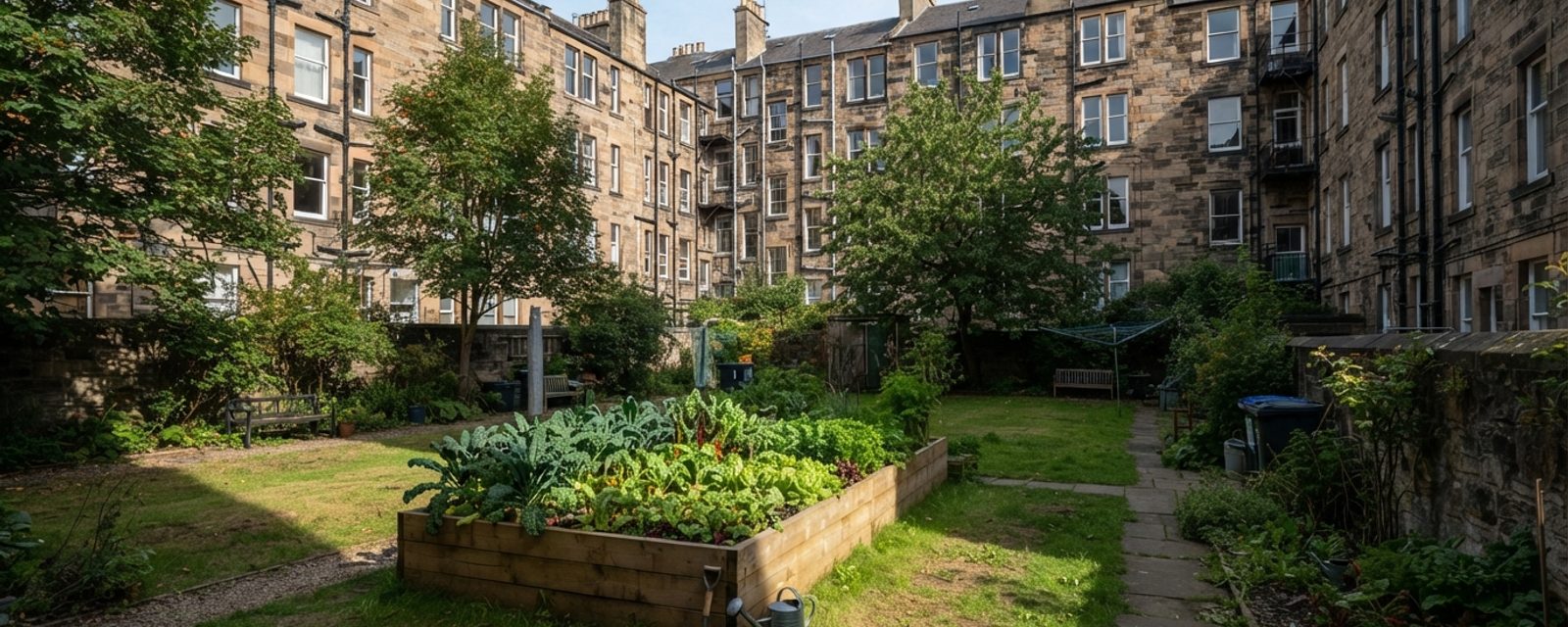
You've got a back green that's overshadowed by the tenement across the close, or a border that sits under next door's sycamore, or a narrow strip between two gable walls that seems to lose the sun by ten in the morning. You've probably already decided that growing your own food isn't really an option here, and put the idea away with the seed catalogues.
That assumption is worth testing before you file it. Not every shaded plot is the same kind of shaded, and not every food crop needs the six-hours-plus of full sun that gets treated as the default requirement in most growing advice. Some genuinely productive crops are shade-tolerant by RHS's own classification, not as a grudging fallback but as a stated, useful trait on their own growing pages. The catch is that "shade" isn't one thing, and being honest about which kind you've actually got matters more than any single crop choice.
Why so many Scottish gardens end up shaded
Tenement flats across Glasgow and Edinburgh typically share a back green, a communal patch of ground at the rear of the block, and those blocks are commonly three to four storeys of solid stone, sometimes more. Historic Environment Scotland's own account of Scotland's urban housing confirms that basic built form: tenements built as a shared, economical way to house large numbers of people, arranged around a drying green at the back reached by a passage through the building.
No planning rule specifically links tenement height to back-green sunlight. What's actually true is plainer than that: a three-or-four-storey stone block on both sides of a back green, or a narrow gap between two tall buildings in any dense city, is going to throw shade for a meaningful part of the day. That's true of dense urban housing generally, not a uniquely Scottish design feature. If your garden is shaded because it's hemmed in by tall buildings, you're dealing with ordinary urban geometry, not a design flaw specific to the tenement.
Under a large garden tree, the cause is simpler still and doesn't need a planning history at all.
Partial shade and full shade aren't the same problem
That distinction matters here, because "shade" gets used as one vague label when it actually spans a real range:
| RHS category | Direct sun at midsummer |
|---|---|
| Full sun | More than 6 hours |
| Partial or semi-shade | 3 to 6 hours |
| Light shade | Open to the sky but screened from direct sun, e.g. by a high wall or group of trees |
| Moderate shade | 2 to 3 hours |
| Deep or heavy shade | Under 2 hours, usually under dense tree cover or overhung by buildings |
That range matters for what follows. A tenement back green that gets a few hours of direct light around the middle of the day when the sun clears the roofline is partial shade, and a genuinely useful growing spot for the crops below. A narrow, deep gap between two tall buildings that never gets direct sun, or a bed permanently under a large mature tree's canopy, is closer to deep shade, and none of the five crops here, or realistically any food crop, will match a sunny plot's yield in that kind of site. Better to know that now than after a season of disappointing results.
The five picks
Each of these has a real RHS growing page stating its own shade allowance. All are also covered in more depth in GrowScotland's own crop guides, with full planting, spacing and care detail.
Chard
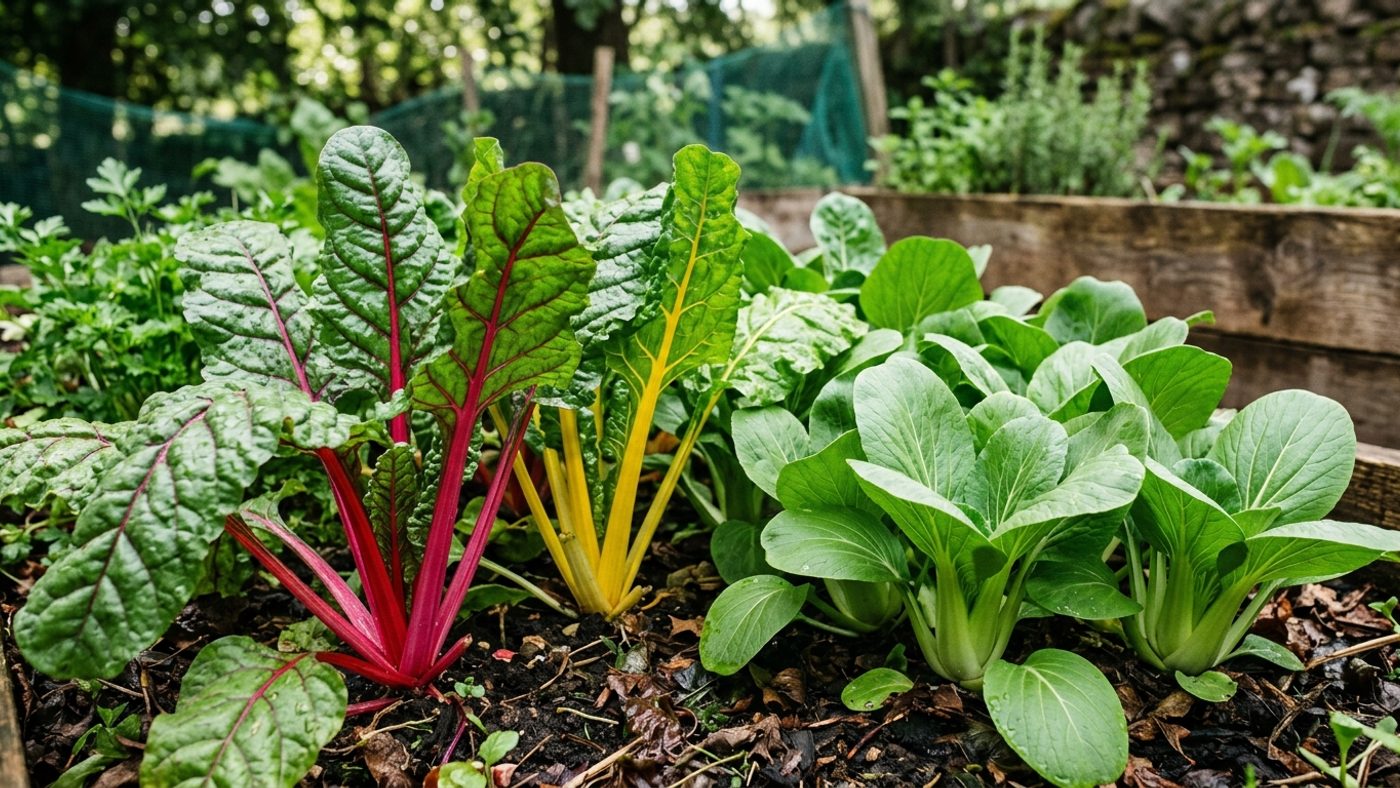
Chard does fine in full sun, or with some light shade in summer. That's a genuine partial-shade allowance, not a stretch, and it means chard is a reasonable first crop for a back green that gets a few hours of direct sun through the middle of the day. See our chard growing guide for sowing and spacing.
Pak choi
Pak choi's shade tolerance is more of a technique than a blanket allowance. A sunny spot suits early and late sowings, but light shade specifically helps a summer crop, because pak choi boltsA plant switching early into flowering and seed production, usually triggered by stress, after which leaves, roots or bulbs turn bitter or unusable. Full page →, runs to flower instead of producing leaf, in hot, dry conditions. A lightly shaded summer spot is the practical fix for that exact problem, which makes a partially shaded bed genuinely useful rather than a compromise. See our pak choi growing guide for variety choice and sowing timing.
Morello cherry
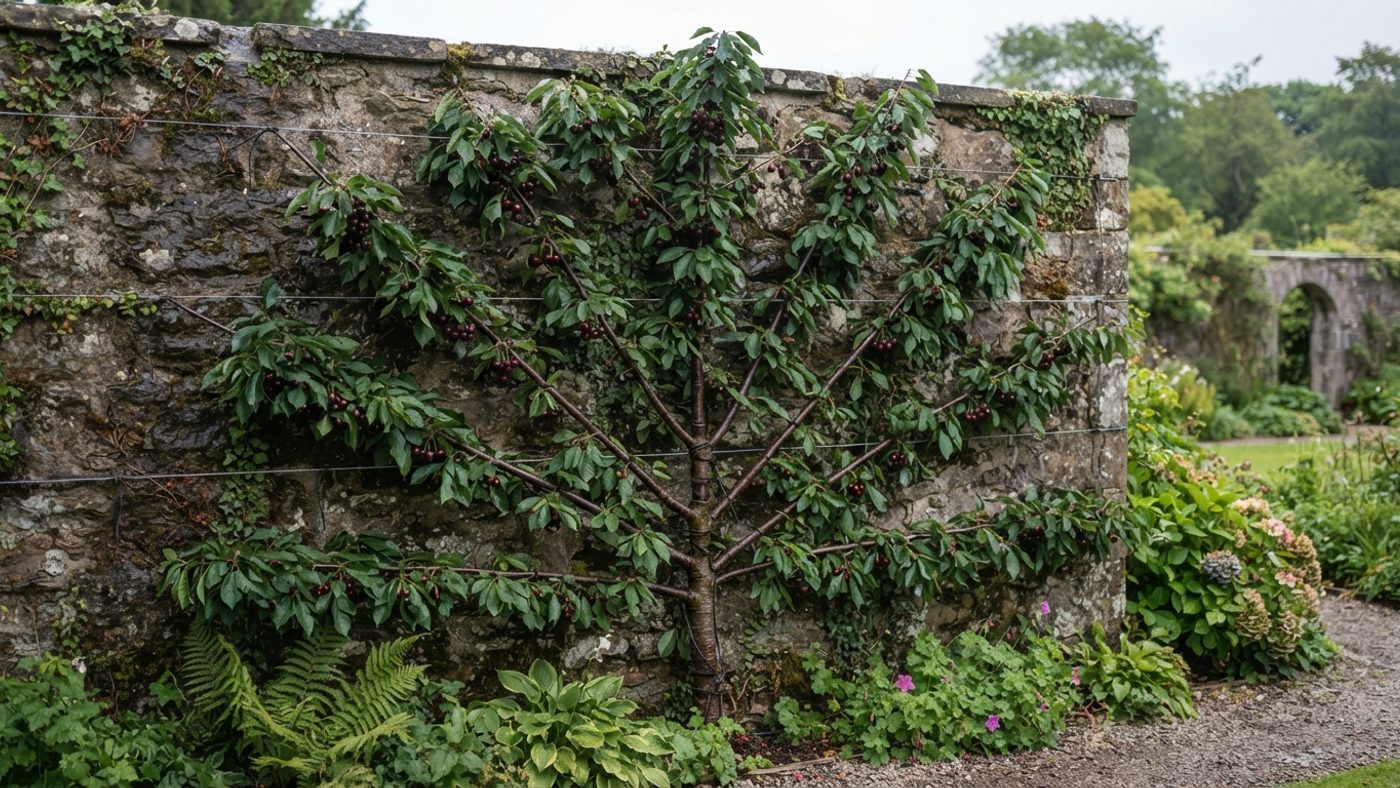
This is the one where shade tolerance changes what's possible, not just what's comfortable. RHS states Morello, a sour or cooking cherry, can be fan-trainedA fruit tree or bush trained flat with branches radiating out from a low point, the standard shape for wall-grown stone fruit. Full definition →, meaning pruned and tied flat against a wall or fence in a fan shape, against a north-facing wall, and lists partial shade among its suitable growing conditions, alongside full sun. That's a genuinely different site requirement from a sweet cherry, which needs a south- or south-west-facing wall for good results. If the only spare wall in a shaded garden faces north, a sweet cherry is off the table but a Morello isn't. It's also the slowest of the five to reward you: a trained fruit tree takes several years to establish and crop properly, against a single growing season for chard or pak choi, so it's a longer-term commitment than the leafy picks above. See our Morello cherry growing guide for training and pruning.
Gooseberry, 'Whinham's Industry'
Not all gooseberries are shade-tolerant by name, but this variety is. 'Whinham's Industry' is suited to full sun or partial shade, with an aspect that can face north, east, south or west. There's no published figure for how much shade reduces the crop, but it's a heavy, reliable cropper, so it's a sensible variety to start with if you're growing in a bed without a sunny aspect. Bushes also grow well in large containers, worth knowing if a shaded back green means a pot rather than open ground. See our gooseberry growing guide for pruning and spacing.
Redcurrants and whitecurrants
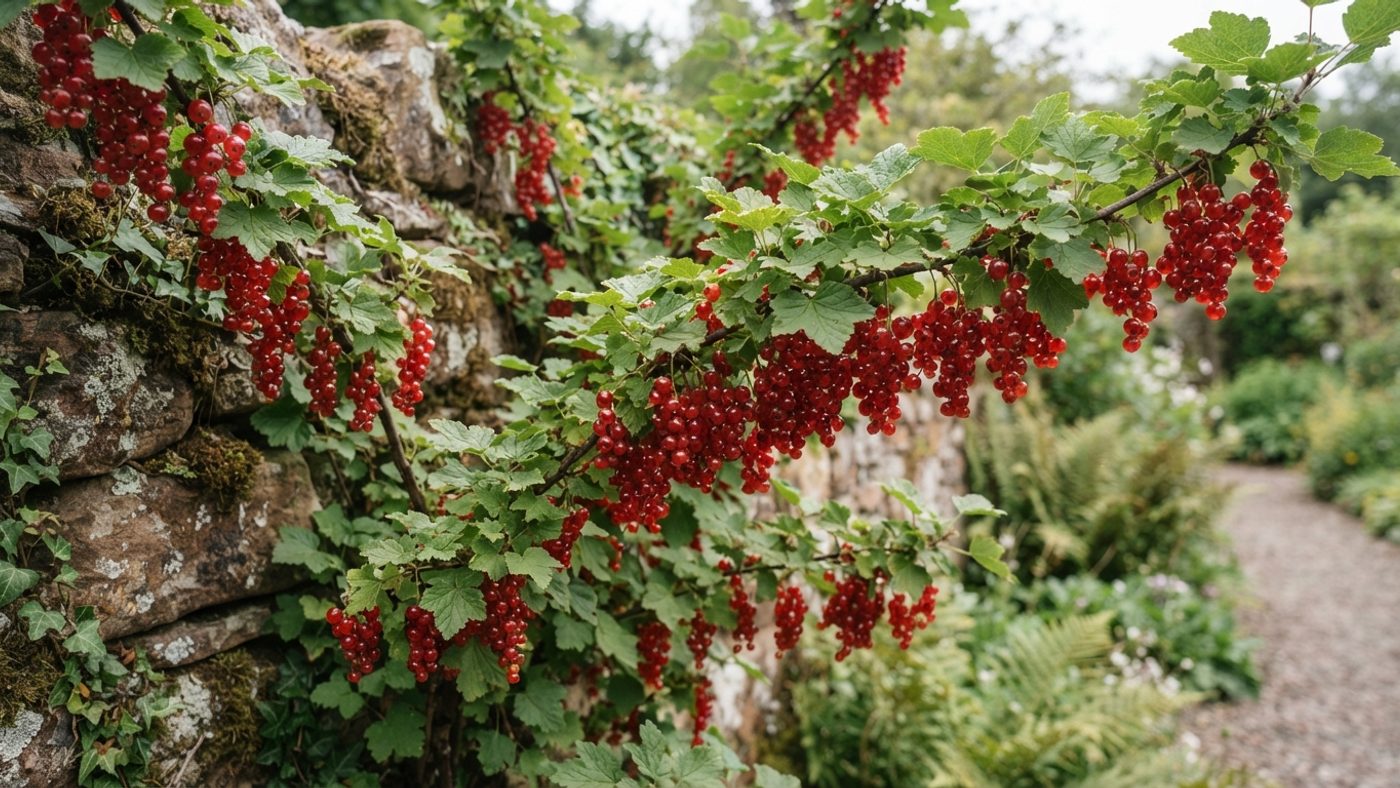
Redcurrants prefer full sun but will also grow well in partial shade, including against a north-facing wall, and whitecurrants, simply a form of redcurrant with the same growing conditions, get the identical allowance. The trade-off is honestly stated too: fruit grown in shade ripens later and is less sweet than fruit grown in full sun. Worth knowing before you plant a north wall expecting a dessert-sweet crop. Blackcurrants generally want a sunnier spot than red or white, so don't assume the same shade allowance carries across every currant colour. See our redcurrants and whitecurrants growing guide for varieties and pruning.
How the five compare
| Crop | RHS shade allowance | What shade costs you | Site that suits it |
|---|---|---|---|
| Chard | Full sun or light shade in summer | Little reported yield penalty | Back green with midday sun |
| Pak choi | Light shade recommended for summer crops | None; shade is the fix for bolting | Partially shaded bed in warm months |
| Morello cherry | Full sun or partial shade, fan-trained | None stated versus sweet cherry on a suitable wall | North-facing wall |
| Gooseberry 'Whinham's Industry' | Full sun or partial shade, any aspect | Not separately quantified by RHS | Beds without a sunny aspect |
| Redcurrants/whitecurrants | Full sun or partial shade | Later ripening, less sweetness | North-facing wall or partly shaded bed |
The pattern across all five is the same: partial shade, not deep shade. None of these fall into the two-hours-or-less deep shade category, and nothing here changes that a densely shaded, direct-sun-free site is genuinely more limited than a partially shaded one.
What else to plan for in a shaded plot
A few practical points don't show up on any RHS growing page but matter for where you actually garden.
Rhubarb and kale are both worth adding to the shortlist. Rhubarb grows best in an open, sunny site but "will also cope in light shade," and the same is true of kale: "it likes sun, but will also cope in light shade." Rhubarb needs deep, fertile, moisture-retentive soil more than any special shade handling, and kale is one of the more forgiving brassicasThe cabbage family: cabbage, kale, broccoli, cauliflower, Brussels sprouts, kohlrabi, swede, turnip and more, sharing the same pests, diseases and rotation rules. Full definition → to grow in a lightly shaded bed. See our rhubarb growing guide and kale growing guide for the rest.
Shaded, damp back greens are also good slug and snail territory, and two of the five picks here, chard and pak choi, are exactly the tender leafy growth slugs go for first. Shade doesn't cause the slug problem, but it doesn't help either, so plan for it from the start rather than after the first ravaged seedlings.
If the shade in question comes from a large garden tree rather than a building, light usually isn't the only issue: the soil under a mature tree's canopy is often dry and full of surface roots competing for water and nutrients, which can matter more than the shade itself. And if the shaded space you've got is a shared tenement back green rather than your own garden, check what your title deeds, factor, or fellow residents actually allow before digging a bed or planting a fruit bush into communal ground.
Common questions
Does a north-facing back green mean I can't grow any food there?
No. A north-facing aspect on its own doesn't rule out growing. What matters more is how many hours of direct sun the spot actually receives at midsummer, not which compass direction it faces: three to six hours puts you in RHS's partial shade band, where all five crops above are viable, and a north-facing spot between lower buildings can easily get that once the sun is high in the sky.
Will shade-tolerant crops yield as much as the same crop in full sun?
Not quite. Redcurrants and whitecurrants grown in shade, for example, ripen later and taste less sweet than the same crop in full sun. Expect a smaller, slightly later harvest from a partially shaded bed, not an identical one.
How do I tell the difference between partial shade and deep shade in my own garden?
Watch the site through a full day in midsummer and count the hours of direct, unobstructed sun it gets, ignoring hazy brightness that isn't direct light. Three to six hours is RHS's partial shade band; under two hours is deep or heavy shade, where none of the crops in this article are a safe bet.
Is a tenement back green definitely going to be shaded?
Not always, and it depends on orientation, the height of the surrounding blocks, and how far the green sits from the walls. Some back greens get a solid few hours of direct sun through the middle of the day even between four-storey buildings; others, hemmed in on a north-facing aspect, get very little. It's worth watching your own plot for a day before assuming either way.
What if I only have space for one shade-tolerant crop?
Chard is the easiest starting point: RHS's own allowance for light summer shade is generous, and it's forgiving to grow.
Sources
11 sources, recorded with what each was used for
- RHS: Shade gardening: The full sun/partial shade/light shade/moderate shade/deep shade definitions and hour thresholds
- RHS: How to grow chard: Chard's full sun or light-shade-in-summer site guidance
- RHS: How to grow pak choi: Pak choi's light-shade-for-summer-crops guidance and bolting cause/fix
- RHS: Prunus cerasus 'Morello' plant page: Morello's north-facing wall training and full sun/partial shade position listing
- RHS: Ribes uva-crispa 'Whinham's Industry' plant page: This gooseberry variety's full sun/partial shade position and any-aspect listing
- RHS: How to grow gooseberries: Confirmation gooseberries are happy in sun or light shade, in the ground and in containers
- RHS: How to grow redcurrants: Redcurrant's partial shade allowance and the later-ripening, less-sweet trade-off
- RHS: How to grow whitecurrants: Confirmation whitecurrants share redcurrants' growing conditions and shade allowance
- Historic Environment Scotland: Building modern towns and cities — urban housing in Scotland: The basic built form of tenements: typically three to four storeys, arranged around a shared rear drying green
- RHS: How to grow rhubarb: Rhubarb's stated light-shade tolerance alongside its preference for an open, sunny site
- RHS: How to grow kale: Kale's stated light-shade tolerance