
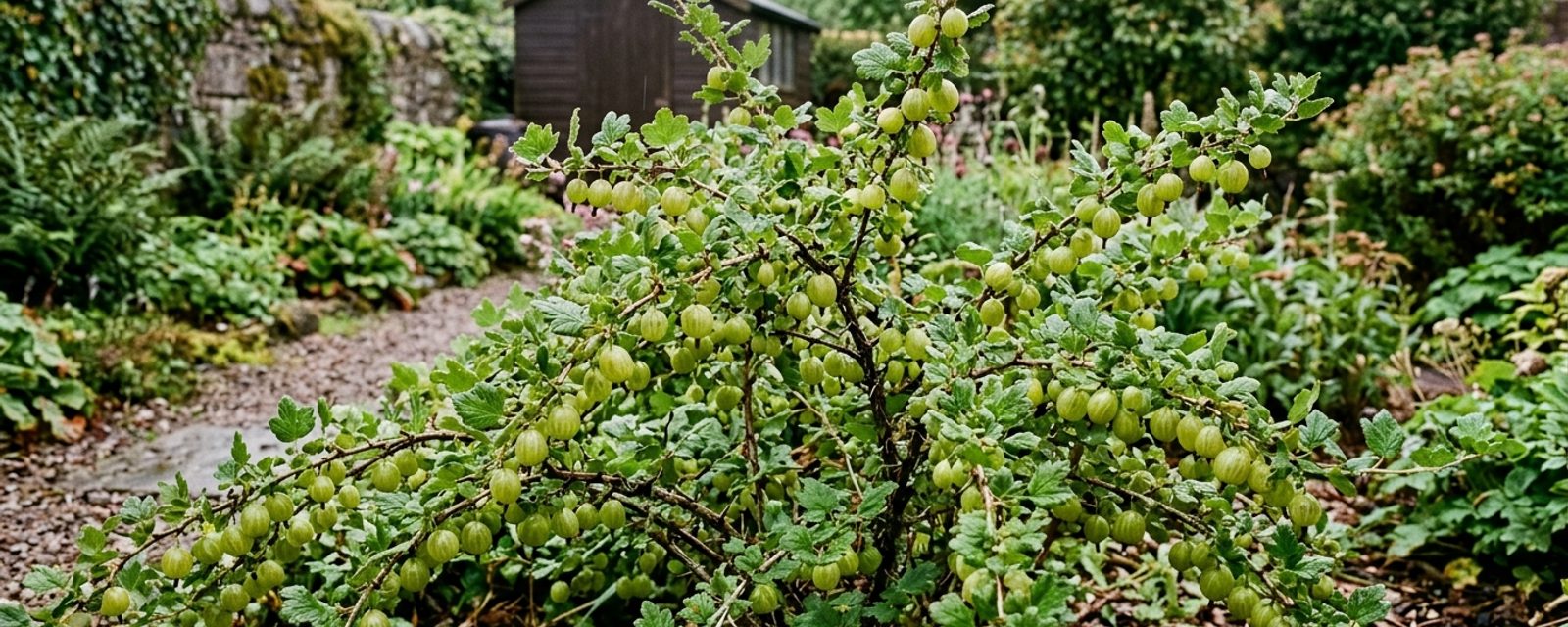
Five gooseberry varieties hold the RHS Award of Garden Merit. The gooseberries growing guide leads with Greenfinch and covers spacing, pruning, and harvest in full. This is the full five-way comparison, and Greenfinch is the best overall pick for most Scottish gardens: real mildew resistance without the trade-offs attached to the other four.
Quick answer
Greenfinch is the safest default: mildew resistant, no real trade-off. Invicta is heavier cropping but riskier on an exposed site. Whinham's Industry suits partial shade or heavy soil.
All five, side by side
| Variety | Fruit | Disease resistance | Trade-off |
|---|---|---|---|
| Greenfinch | Green, culinary | Mildew and leaf spot | None stated |
| Invicta | Green, culinary | Mildew and leaf spot | Young shoots vulnerable on exposed sites |
| Whinham's Industry | Red, dual-purpose | None stated | Tolerates partial shade and heavy soil (real advantages, not trade-offs) |
| Leveller | Yellow, dessert | None stated | Needs good soil to do well |
| Careless | Green, culinary | None stated | None stated |
All five carry the same H6 hardiness ratingThe RHS's H1a–H7 scale for how much cold a plant can survive outdoors, H1a being tender indoor-only and H7 hardy anywhere in the UK. Full definition →, the top UK band (hardy through winters down to around -20°C), so cold isn't what separates them; disease resistance and site tolerance are. All five are self-fertileA plant that can set fruit using its own pollen, without needing a second, different variety nearby to cross-pollinate it. Full definition → too, so a single bush of any of them will crop alone.
Why Greenfinch is the default, and when to pick another
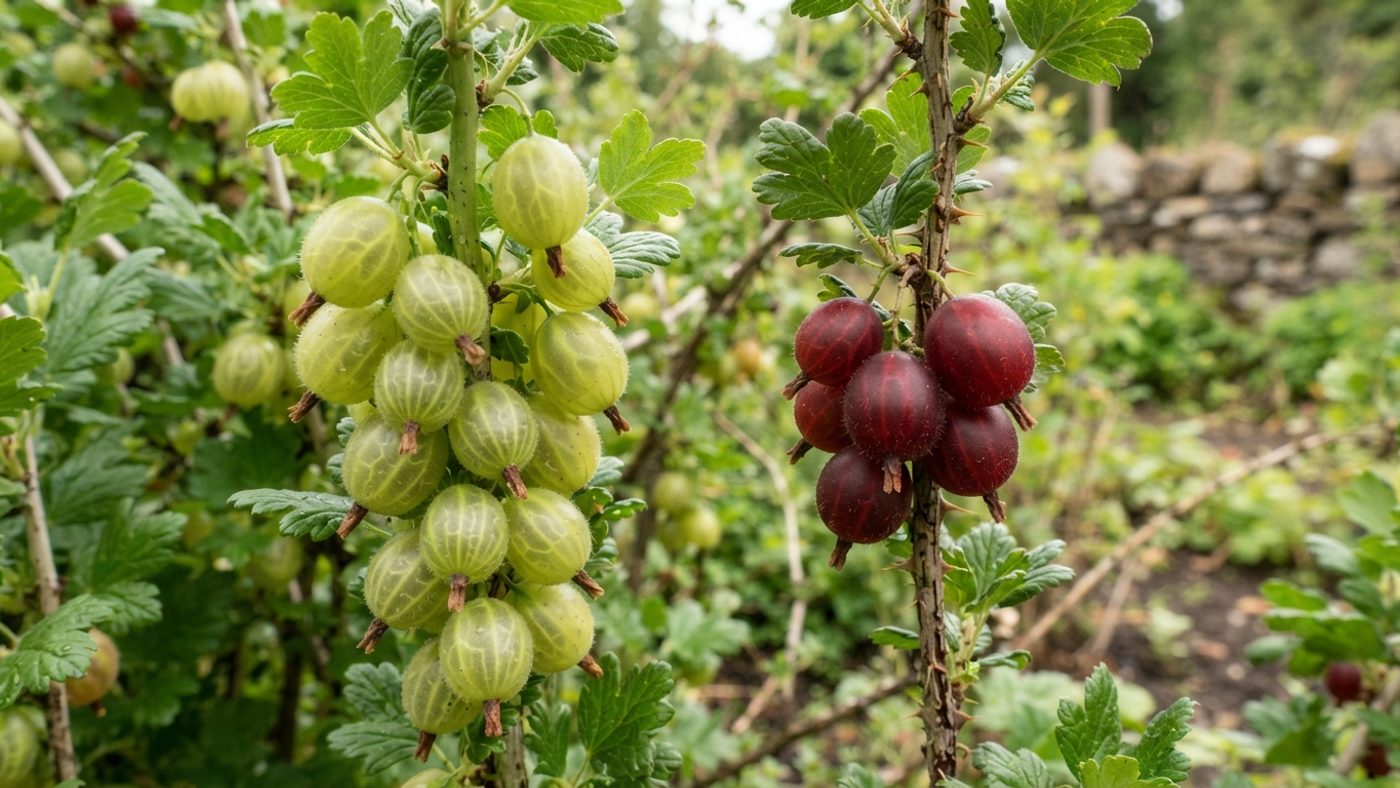
Greenfinch and Invicta are the only two with a stated resistance to mildew and leaf spot, and Greenfinch is the safer of the two: Invicta's young shoots are vulnerable to damage on exposed sites, a real cost on a windy Scottish plot that Greenfinch doesn't carry. Invicta is still the heavier cropper, has larger thorns than Greenfinch's comparatively spine-free habit, and is worth choosing over Greenfinch on a genuinely sheltered site where the exposed-shoot vulnerability doesn't apply.
Whinham's Industry doesn't carry a stated disease-resistance trait, but it's the one specifically noted as growable in partial shade and on heavy soil, a real answer to two different problems, not a lesser choice; like Invicta, it's a thorny, vigorous bush rather than Greenfinch's more compact habit. Leveller and Careless carry neither trait: Leveller for exhibition-quality dessert fruit, provided the soil is good enough, a stated requirement rather than a general caveat, and Careless a straightforward, undemanding cooker that sweetens and turns yellow left on the bush. Both are reasonable on a site where mildew risk is already low.
For spacing, pruning, the twice-yearly rhythm, and frost protection during early flowering, once a variety is picked, the gooseberries growing guide covers all of it in full.
Soil pH
No published UK figure exists for gooseberries. They generally tolerate a wide range of soil types, useful given how much Scottish garden soil runs naturally acidic.
Pests worth knowing per variety
Greenfinch and Invicta's resistance is specifically to powdery mildew (American gooseberry mildew is the gooseberry-specific strain); the resistance doesn't extend to other problems. Gooseberry sawfly and aphids affect all five varieties equally, not a distinguishing factor between them. The growing guide's Common problems section covers the full list.
Common questions
Which gooseberry is the best overall choice for a Scottish garden?
Greenfinch, for most gardens. It carries real mildew resistance, the crop's single biggest disease risk in a damp climate, without Invicta's exposed-site vulnerability or a real trade-off attached to any of the other three.
Invicta also resists mildew. What's the actual difference from Greenfinch?
Vigour, and a real caveat: Invicta's young shoots are vulnerable to damage on exposed sites, worth weighing on a windy plot. It's the heavier cropper of the two and a reasonable choice on a sheltered site; Greenfinch is the safer default where shelter isn't guaranteed.
Are Leveller and Careless worth growing without a mildew-resistance trait?
Yes, on a site where mildew risk is already low, a naturally airy, well-spaced spot. Leveller is an exhibition-quality dessert variety, but needs good soil to do well, a stated requirement rather than a general caveat. Careless is a reliable green cooker that sweetens and turns yellow left on the bush, with no particular soil demand stated.
Does a mildew-resistant variety still need good airflow and spacing?
Yes, resistance reduces risk, it doesn't remove the need for the basics. A congested, poorly spaced bush still holds humidity against its own leaves and fruit. Pair a resistant variety with proper spacing rather than treating one as a substitute for the other; the growing guide covers spacing and pruning in full.
What soil pH do gooseberries need?
No published UK figure. Gooseberries generally tolerate a wide range of soil types, useful given how much Scottish garden soil runs naturally acidic.
Sources
7 sources, recorded with what each was used for
- RHS: Grow Your Own – Gooseberries: The five AGMThe RHS's Award of Garden Merit: a UK-wide trials award for reliable performance, not a Scotland-specific recommendation. Full definition → varieties and links to each variety's own plant page
- Ribes uva-crispa 'Greenfinch': Greenfinch's mildew/leaf spot resistance and compact habit
- Ribes uva-crispa 'Invicta': Invicta's mildew/leaf spot resistance and exposed-site shoot vulnerability
- Ribes uva-crispa 'Whinham's Industry': Whinham's Industry's partial-shade tolerance
- Ribes uva-crispa var. reclinatum 'Leveller': Leveller's soil requirement
- Ribes uva-crispa 'Careless': Careless's traits and ripening
- Gardener's World: How to grow gooseberries: Whinham's Industry's heavy-soil tolerance, not stated on its own RHS page