
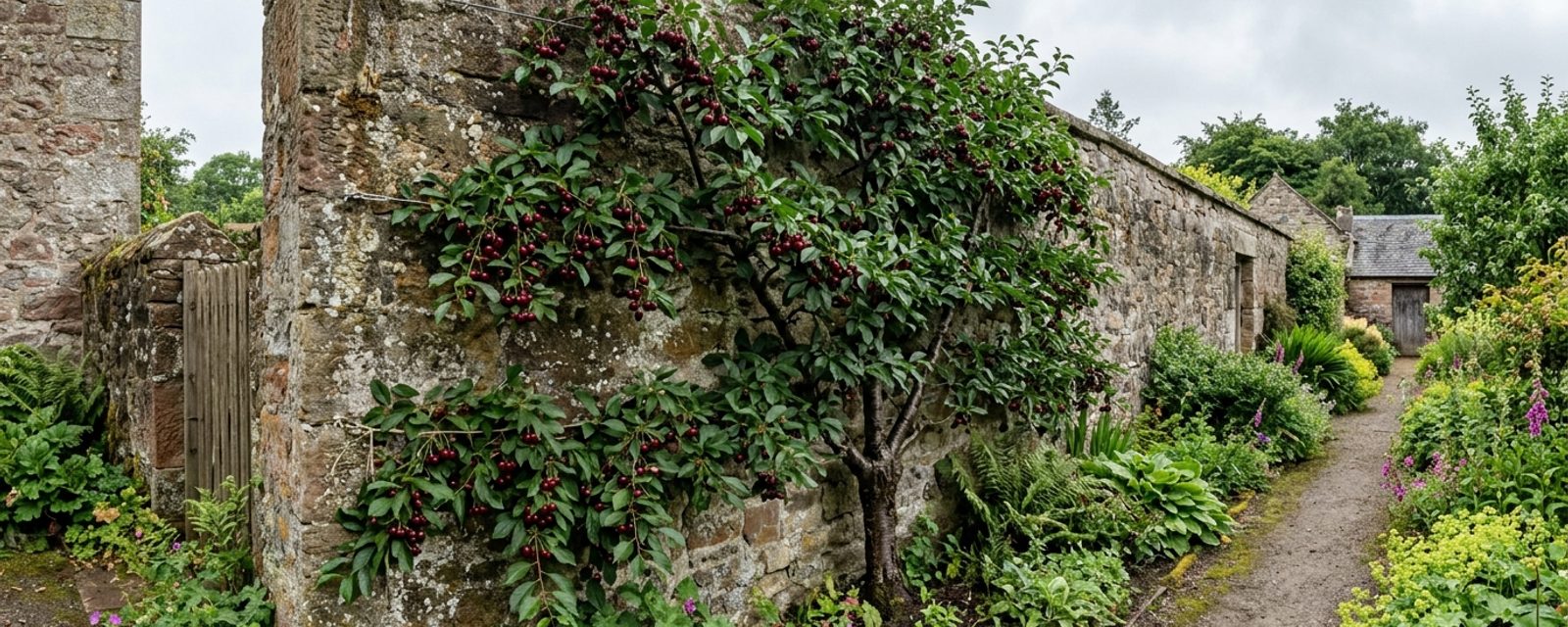
Prunus avium (sweet), Prunus cerasus (acid)
Acid and sweet cherries want genuinely different sites, not just different flavours, and a famous variety like Stella can let you down in a wet summer that a Morello wouldn't.
Cherries split into two real categories that behave differently, not one crop with two flavours. Sweet cherries want a warm, sunny wall. Acid cherries genuinely work in shade. The site you have available should decide which one you plant, not the other way round.
Choosing a rootstock
A cherry tree is a graftJoining a chosen fruiting variety onto a separate rootstock, so the tree grows the fruit of one plant on the roots of another. Full definition →: the rootstock controls its eventual size, not the variety or the tree's age. The size gap between cherries' two named rootstocksThe root system and lower stem a fruit tree is grafted onto, chosen to control the tree's eventual size rather than for its own fruit. Full definition → is unusually wide:
- Gisela 5: semi-dwarfingHow much a fruit tree's rootstock limits or allows its eventual size, from extremely dwarfing (smallest) through to very vigorous (largest). Full definition →, 3-4m. The smaller-garden option.
- Colt: semi-vigorous, 6-8m. A genuinely large tree, more than double Gisela 5's height.
Buy a tree already grafted onto the rootstock you want; it can't be changed later. For most gardens, Gisela 5 is the practical choice; Colt suits only a garden with real space to fill.
Choosing a site
Sweet cherries want a warm, sunny spot, ideally against a south- or south-west-facing wall. Acid cherries tolerate some shade and are suitable for a north-facing wall, a real option, not a fallback, if that's the only spare wall available. Soil should be deep, fertile and well-drained, ideally slightly acidic at pH 6.5-6.7, the narrowest sourced pH range of any fruit tree you're likely to grow.
Pollination
Acid cherries are self-fertileA plant that can set fruit using its own pollen, without needing a second, different variety nearby to cross-pollinate it. Full definition → as a rule. Among sweet varieties it's mixed: Stella and Lapins are self-fertile, while Kordia and Summer Sun genuinely need a pollination partnerA second, different variety of the same fruit planted nearby so the two can cross-pollinate each other, needed by any variety that isn't self-fertile. Full definition →. Check a specific variety before buying rather than assuming either way.
Fruit Tree Pollination Groups Explained → works through flowering groups, triploids and self-fertility across apples, pears, plums and cherries together.
Planting
Choose a warm, sheltered location that isn't prone to late frosts. If planting into a lawn, clear a circle of grass at least 1m across first. For a fan-trainedA fruit tree or bush trained flat with branches radiating out from a low point, the standard shape for wall-grown stone fruit. Full definition → form, plant it 25-35cm out from the wall. Plant bare-root trees November to March while dormant; containerised trees any time of year. In a container, use a pot at least 45-50cm wide and deep with loam-based compost.
Care
Water newly planted trees regularly through dry spells for at least their first year. Once established, avoid overwatering in summer — it's a named cause of fruit splitting, especially in sweet varieties. Mulch in late winter or spring; a well-mulchedA layer of material spread over the soil around plants to suppress weeds, retain moisture, and improve soil structure as it breaks down. Full definition → tree generally needs no extra feeding. Container trees need a steady supply of moisture through the growing season plus a high-potassium liquid feed every fortnight from April to August.
Pruning and training forms
The same reversed rule as plums and damsons applies here too, all three sharing the Prunus family: never prune while dormant. Prune annually as soon as harvest finishes, usually late July or August; prune young trees in spring instead. A cut made over winter risks silver leaf disease and bacterial canker.
- Bush: small, open-centredA bush pruned with an open middle and outward-radiating branches, so light and air reach every part rather than a dense, shaded centre. Full definition →, the standard free-standing shape.
- Pyramid: larger, with the central leaderTwo more fruit tree shapes: central leader keeps one dominant upright trunk; half-standard is a free-standing tree on a clear trunk of about 1.2–1.5m. Full definition → kept intact.
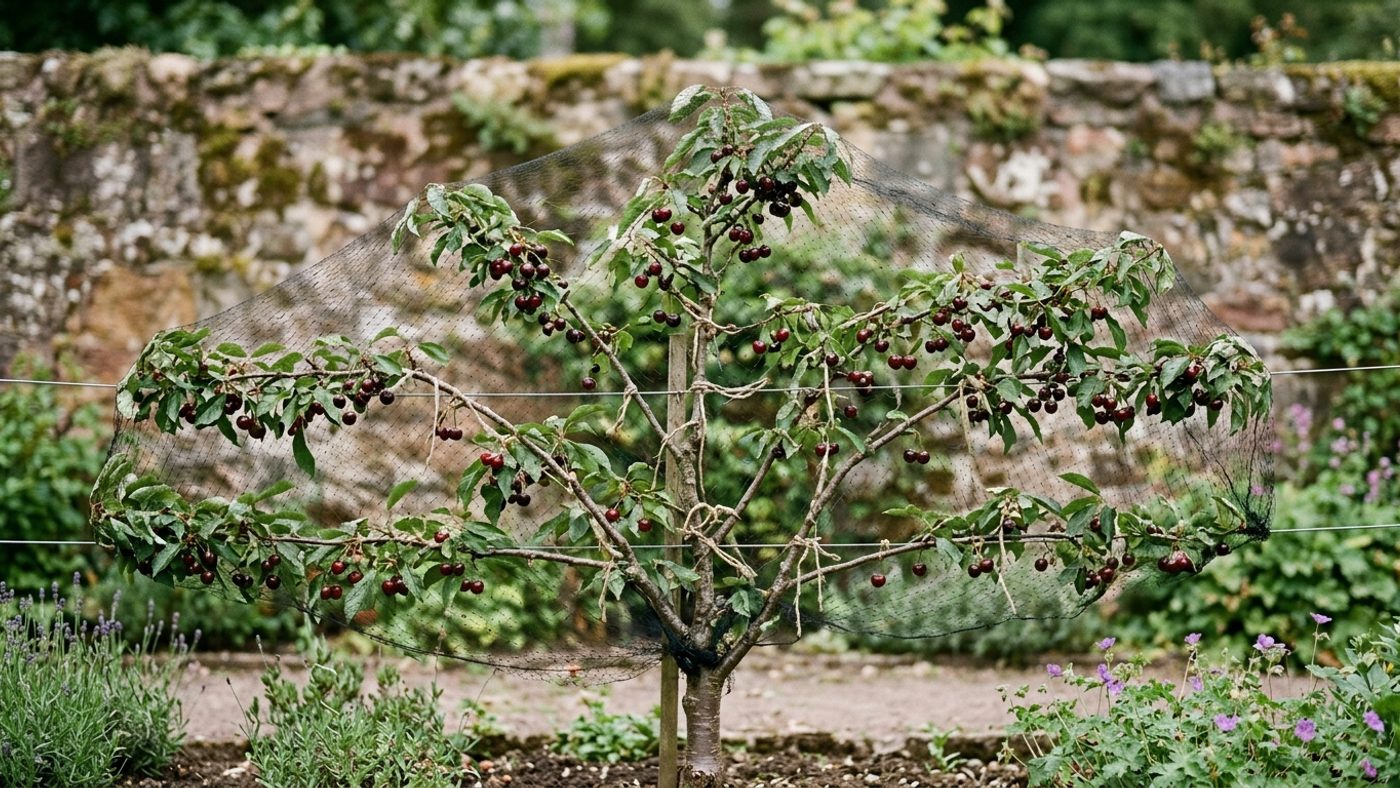
- Fan: trained flat against a wall or fence; the form that lets sweet cherries be netted against birds and lets acid cherries make use of a shaded wall.
Varieties
6 AGMThe RHS's Award of Garden Merit: a UK-wide trials award for reliable performance, not a Scotland-specific recommendation. Full definition → cherry varieties, split across sweet and acid types. Morello is the only acid cherry on the list and self-fertile by default; the sweet varieties split between self-fertile (Stella, Lapins, Sweetheart) and needing a partner (Kordia, Summer Sun).
Sweetheart (sweet, self-fertile, August harvest) and Summer Sun and Kordia (sweet, not self-fertile, July-August) round out the list. Only Morello and Stella have a confirmed site-suitability or weather-risk trait; the other three simply haven't been checked for one.
★ Our pick for Scotland
MorelloAGM
Acid cherry · self-fertile · late July-early August · H6The RHS's H1a–H7 scale for how much cold a plant can survive outdoors, H1a being tender indoor-only and H7 hardy anywhere in the UK. Full definition →
Can be fan-trained against a north-facing wall and tolerates partial shade: a genuine site-choice advantage, not a consolation prize for a shady garden.
Why this one: It's self-fertile, so one tree is enough. And it works fan-trained against a south, west or north-facing wall, tolerating partial shade where sweet cherries need a warm, sunny spot. In a garden without a south-facing wall to spare, that's the difference between growing a cherry and not.
Also worth considering
StellaAGM
Sweet cherry · self-fertile · late July · H6
The most widely grown self-fertile sweet cherry, with one real weakness: fruit 'prone to splitting in wet weather'. Still the right default for a sunny, sheltered spot, just worth weighing against a wet summer.
LapinsAGM
Sweet cherry · self-fertile · heavy crops
A second self-fertile sweet-cherry option with heavy crops, useful where Stella's splitting risk is a genuine concern.
Best Cherry Varieties for Scotland → compares all named cherry varieties head-to-head, with the practical detail that doesn't fit in a summary card.
Harvesting
Cherries ripen from early summer onwards, starting late July for the earliest varieties, depending on type. Pick during dry weather where possible, and hold the stalk rather than the fruit, which bruises easily — cutting whole bunches free with stalks intact works well too, rather than pulling individual cherries.
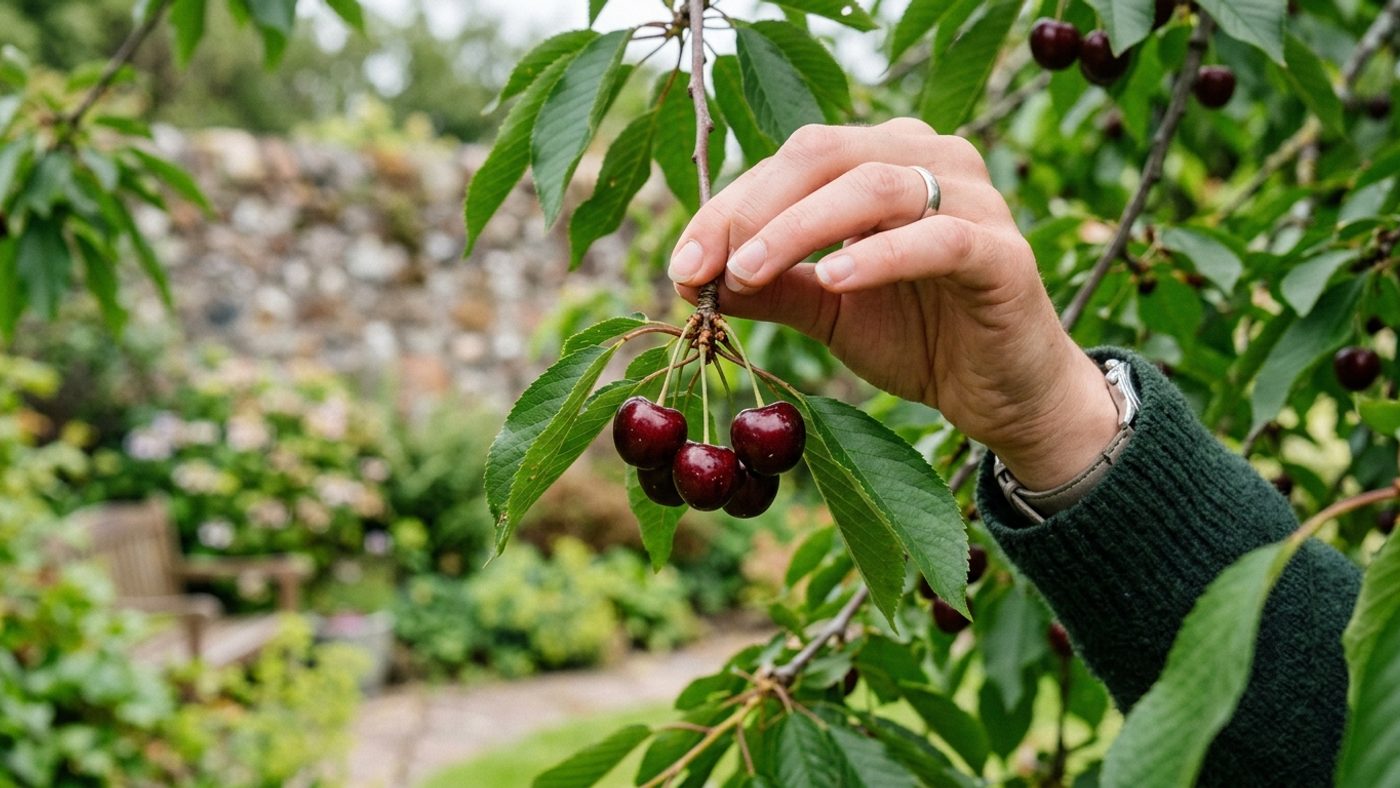
Not every cherry on a tree ripens at once, so expect to check back over several days rather than stripping the whole crop in one go. There's no dedicated storage advice for cherries the way there is for some other fruit, so treat a picked batch as something to eat, cook or freeze promptly rather than something that keeps well in a bowl.
Common problems
- Fruit aphids distort new growth and shoots.
- Brown rot and blossom wilt both affect fruit and flowers, spreading fast in damp conditions.
- Birds strip ripening cherries fast; net fan-trained trees or move potted trees somewhere protected as fruit colours up.
See more problems
- Fruit splitting follows wet weather or overwatering, especially in sweet varieties like Stella; avoid heavy watering once fruit is ripening.
- Cherry fruit drop in early summer can follow poor pollination, inadequate water, or unfavourable weather during flowering.
- Silver leaf and bacterial canker both enter mainly through pruning cuts made at the wrong time of year — the reason pruning is restricted to straight after harvest.
- Cherry leaf scorch and leaf spot cause browning or spotted leaves, sometimes leading to early leaf drop.
- Spotted wing drosophila lays eggs in ripening fruit, unlike most fruit flies which target only damaged or overripe fruit — pick promptly as cherries ripen to reduce the risk.
- Honey fungus is a serious root disease with no cure; remove and destroy an affected tree.
- Xylella fastidiosa is a notifiable bacterial disease not currently present in the UK, spread by sap-feeding insects and with cherries among its named hosts. There's no cure or treatment; report a suspected case to the relevant plant health authority rather than attempting to treat it yourself.
Common questions
What's the difference between sweet and acid cherries?
Sweet cherries (Prunus avium) are for eating fresh and want a warm, sunny spot, ideally a south- or south-west-facing wall. Acid cherries (Prunus cerasus), like Morello, are tart raw but cook well into preserves and puddings, and tolerate partial shade: genuinely suited to a north-facing wall, not just a compromise pick for one.
Do I need two cherry trees to get fruit?
Not always: acid cherries are self-fertile as a rule, and so are several sweet varieties including Stella and Lapins, but others genuinely need a partner: RHS names Kordia and Summer Sun explicitly 'not self-fertile'. Full sourced breakdown: <a href="/tools/garden-myths/cherries/">Cherry Myths →</a>
When should I prune a cherry tree?
Never while dormant: prune annually straight after harvest, usually late July or August, and prune young trees in spring instead; a dormant-season cut risks silver leaf disease and bacterial canker. Full sourced breakdown: <a href="/tools/garden-myths/cherries/">Cherry Myths →</a>
Why does my sweet cherry fruit split?
Wet weather at the wrong time, most likely: Stella's own RHS page names its fruit as prone to splitting in wet conditions, and RHS separately warns against overwatering any cherry in summer for the same reason; acid cherries like Morello carry no equivalent warning. Full sourced breakdown: <a href="/tools/garden-myths/cherries/">Cherry Myths →</a>
Sources
4 sources, and what each was used for
- RHS: getting started, sweet vs acid cherry distinction, rootstocks (Gisela 5, Colt), pollination (acid cherries self-fertile, sweet varieties mixed), 6 AGM varieties, soil pH 6.5-6.7, site orientation by type (south/south-west for sweet, north acceptable for acid), planting method and timing, container growing, watering, feeding, pruning timing (after harvest, late July/August), training forms, harvesting method, and the nine named problems
- RHS: H6 hardiness, self-fertility, fan-training against a north-facing wall, partial shade tolerance, AGM, season of use, disease susceptibility
- RHS: H6 hardiness, self-fertility, 'prone to splitting in wet weather', AGM, season of use, disease susceptibility, fan-training for bird/frost protection
- gardenersworld.com: independently corroborates Morello's self-fertility and shade tolerance, the same never-prune-in-winter rule as plums and damsons, bare-root planting autumn to spring, cutting whole bunches with stalks intact, and the pest/disease list