
Xylella fastidiosa has killed nearly 21 million olive trees in southern Italy since 2013 and turned up on lavender, rosemary and cherry across mainland Europe since. It has never been found in the UK. This page isn't a "how to control it" guide, because for a home gardener there isn't one. The useful thing to know is what it looks like, why treating it yourself is the wrong move, and who to tell if you're ever unsure.
Current status: not detected in the UK
Xylella fastidiosa has not been found anywhere in the UK, Scotland included. It is a GB quarantine pest under UK law, meaning it is prohibited from being introduced or spread, and a suspected case triggers a formal containment response, not a garden treatment.
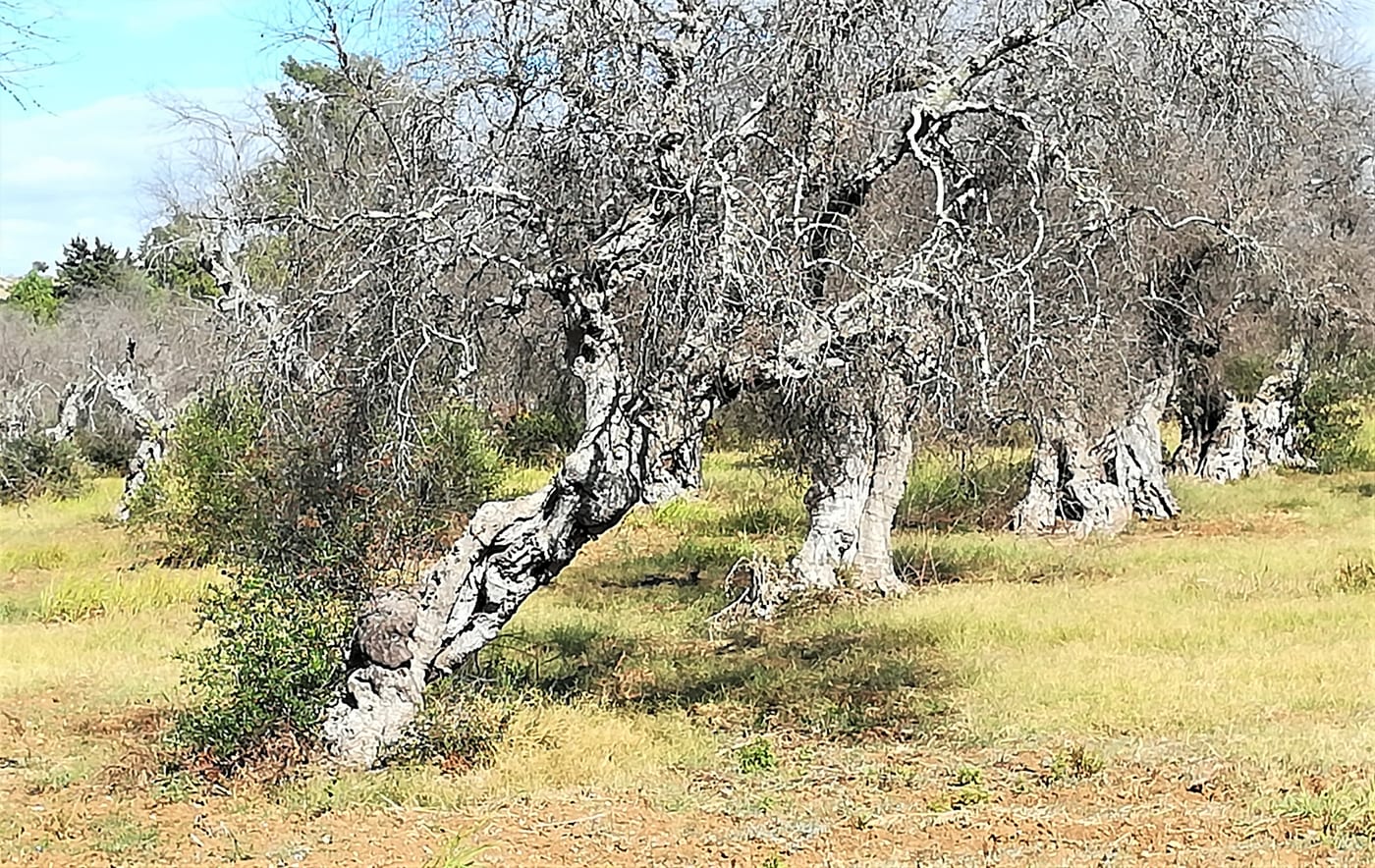
Photographed in Puglia, Italy, where the outbreak is real — not a UK or Scottish scene. Included because the disease would look the same wherever it appeared; it shows what the "Olive Quick Decline Syndrome" this page describes actually does to a tree.
🌱 Priority hosts grown on this site
Over 650 host species exist worldwide. These are the ones this site covers that count as priority or secondary hosts, not a claim that any of them are currently at risk in a Scottish garden.
What it looks like
Leaf scorch, wilting, dieback and eventual plant death are the symptoms to watch for, though all four are easy to mistake for drought stress, frost damage, or an entirely different disease. A visual check alone can't confirm it; laboratory testing is what actually does.
It spreads two different ways. Locally, sap-feeding insects, the meadow froghopper among them, pick the bacterium up from an infected plant and carry it to the next one they feed on. Long-distance spread happens a different way entirely: through the commercial trade of infected plants.
Why this matters in Scotland
The straightforward answer is that it doesn't, yet: nothing here is currently at risk, because the bacterium isn't present. What's genuinely Scotland-specific is how seriously that absence is being protected. The Scottish Government's Plant Health Centre, based at the James Hutton Institute, has mapped where the insect vectors that would spread it already live across Scotland and modelled what an outbreak's impact would look like, ahead of any actual detection rather than in response to one.
The one genuinely Scotland-specific action worth knowing before you'd ever need it: a suspected case can be reported directly to the Scottish Government's own Horticulture and Marketing Unit, not only the UK-wide portal.
What to actually do
There's no product or technique that fixes an infected plant. These are the two things that are actually within a gardener's control.
Report a suspected case, do not attempt to treat it yourself
Compile the host plant name, symptoms, origin and import history, and report to the UK Plant Health Information Portal, or in Scotland directly to the Scottish Government's Horticulture and Marketing Unit at [email protected]. Do not send plant samples to RHS.
Favour UK-grown or long-established plants over recently imported stock, especially for priority hosts like rosemary, lavender and olive
A UK garden plant grown in place for five or more years counts as low risk, since long-distance spread happens through the plant trade, not through the air. A recently imported plant, particularly from a region with a known outbreak, carries meaningfully more risk than one raised in the UK.
Frequently asked questions
Is Xylella fastidiosa in Scotland?
No, not currently anywhere in the UK. As a GB quarantine pest it's illegal to knowingly introduce or spread it, and any suspected sighting triggers a formal reporting and containment process rather than being left to a gardener to judge.
What should I do if I think a plant has it?
Don't try to treat it and don't send a sample to RHS. Note the plant's name, the symptoms, where it came from and its import history if known, then report it through the UK Plant Health Information Portal, or in Scotland directly to the Scottish Government's Horticulture and Marketing Unit at [email protected]. Early reporting is what keeps a response small: a genuine early interception means destroying one plant and surveying a 200m radius, versus a 100m destruction zone and a 2.5km buffer if it spreads before anyone catches it.
Why doesn't this page have a 'controls' list like your other pest pages?
Because there isn't one to give. Once a plant is infected there is no chemical or cultural fix, for a gardener or anyone else — the entire response is regulatory: destroying infected and nearby host plants, restricting movement, and controlling the insects that spread it, all carried out by plant health authorities. The only thing an individual gardener actually controls is whether they report a suspected case promptly and buy plants that carry less risk in the first place.
Should I be worried about my rosemary, lavender, cherry or blueberries?
Not today. These are among the plants Xylella can infect, worth knowing if you grow them, but the bacterium isn't present in the UK, so there's no current infection risk to act on. See the two things actually worth doing above; the second one is specifically about how you buy these particular plants.
Sources
4 sources, recorded with what each was used for
- RHS: identification, symptoms and their overlap with other stress causes, host plants, insect-vector and trade-based spread, UK detection status, notifiable/quarantine status, interception vs outbreak containment measures, reporting protocol, low-risk framing for UK-grown/established plants
- Scottish Government: Scotland's own reporting route via the Horticulture and Marketing Unit, and confirmation of GB quarantine pest status
- Plant Health Centre (James Hutton Institute): confirming dedicated Scottish research into the pathogen's insect vectors and outbreak risk
- Nature Italy: the scale of the Apulia, Italy outbreak (nearly 21 million olive trees killed since 2013), used in the article's opening to establish why the pathogen is taken seriously