
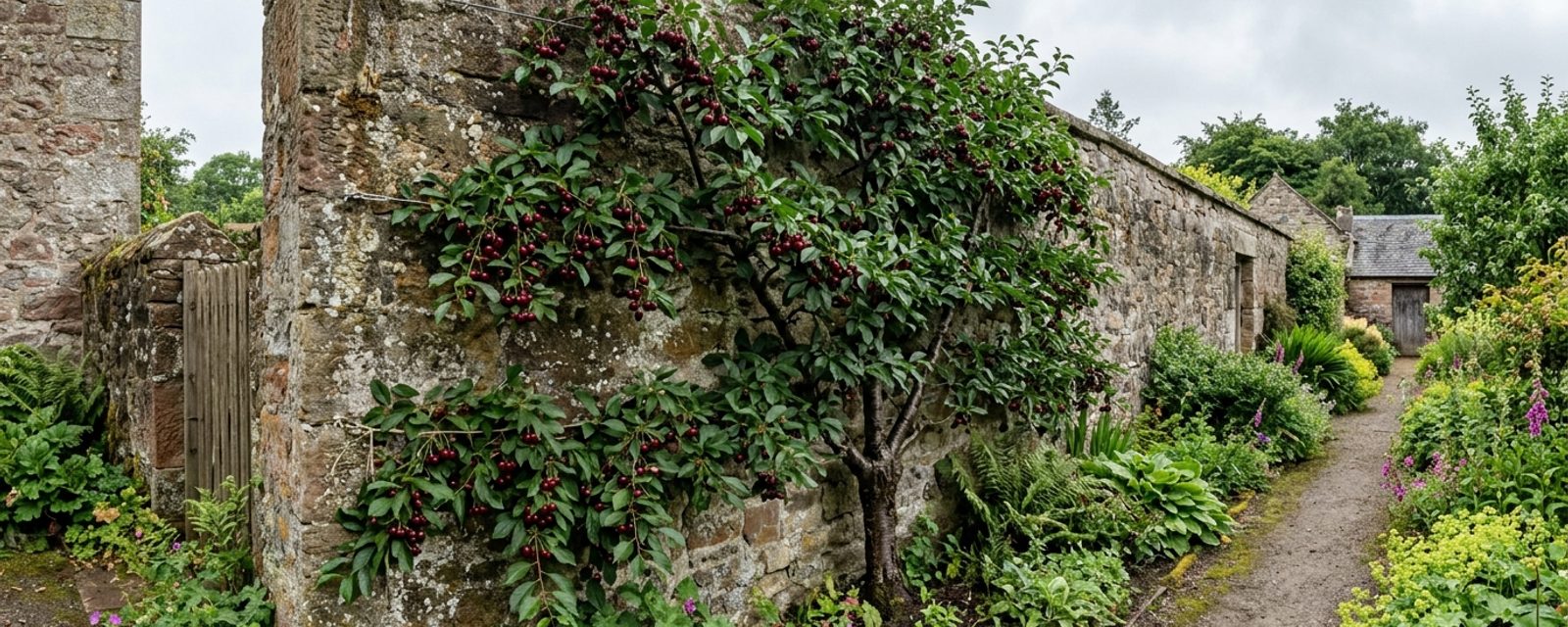
Six cherry varieties hold the RHS Award of Garden Merit. The cherries growing guide leads with three of them, Morello, Stella, and Lapins, and covers rootstockThe root system and lower stem a fruit tree is grafted onto, chosen to control the tree's eventual size rather than for its own fruit. Full definition →, soil, planting, and pruning in full. This is the full six-way comparison, including Kordia, Summer Sun, and Sweetheart, each with a real trait of its own rather than left as a name on a list. There's no single best variety here, the site decides that first: Morello for a shaded wall; Lapins, Stella, or Kordia for a warm, sunny one, and the sections below cover which of those three fits best.
Quick answer
Shaded wall: Morello (cooking). Warm, sunny wall: Lapins is the simplest all-round pick, Kordia if Stella's wet-weather splitting risk worries you, Sweetheart for the latest harvest.
All six, side by side
| Variety | Type | Fertility | Hardiness | Notable trait |
|---|---|---|---|---|
| Morello | Acid | Self-fertileA plant that can set fruit using its own pollen, without needing a second, different variety nearby to cross-pollinate it. Full definition → | H6The RHS's H1a–H7 scale for how much cold a plant can survive outdoors, H1a being tender indoor-only and H7 hardy anywhere in the UK. Full definition → | Tolerates partial shade; works on a north-facing wall |
| Stella | Sweet | Self-fertile | H6 | Fruit prone to splitting in wet weather |
| Lapins | Sweet | Self-fertile | H6 | Heavy-cropping; no splitting risk or partner requirement |
| Sweetheart | Sweet | Self-fertile | H5 | Latest-ripening; crops over a long period into early autumn |
| Kordia | Sweet | Needs a partner | H5 | Some resistance to fruit cracking/splitting |
| Summer Sun | Sweet | Needs a partner (group 4) | H6 | Good flavour; shares the top H6 hardiness rating with Morello, Stella, and Lapins |
Site decides the type; type mostly decides the variety
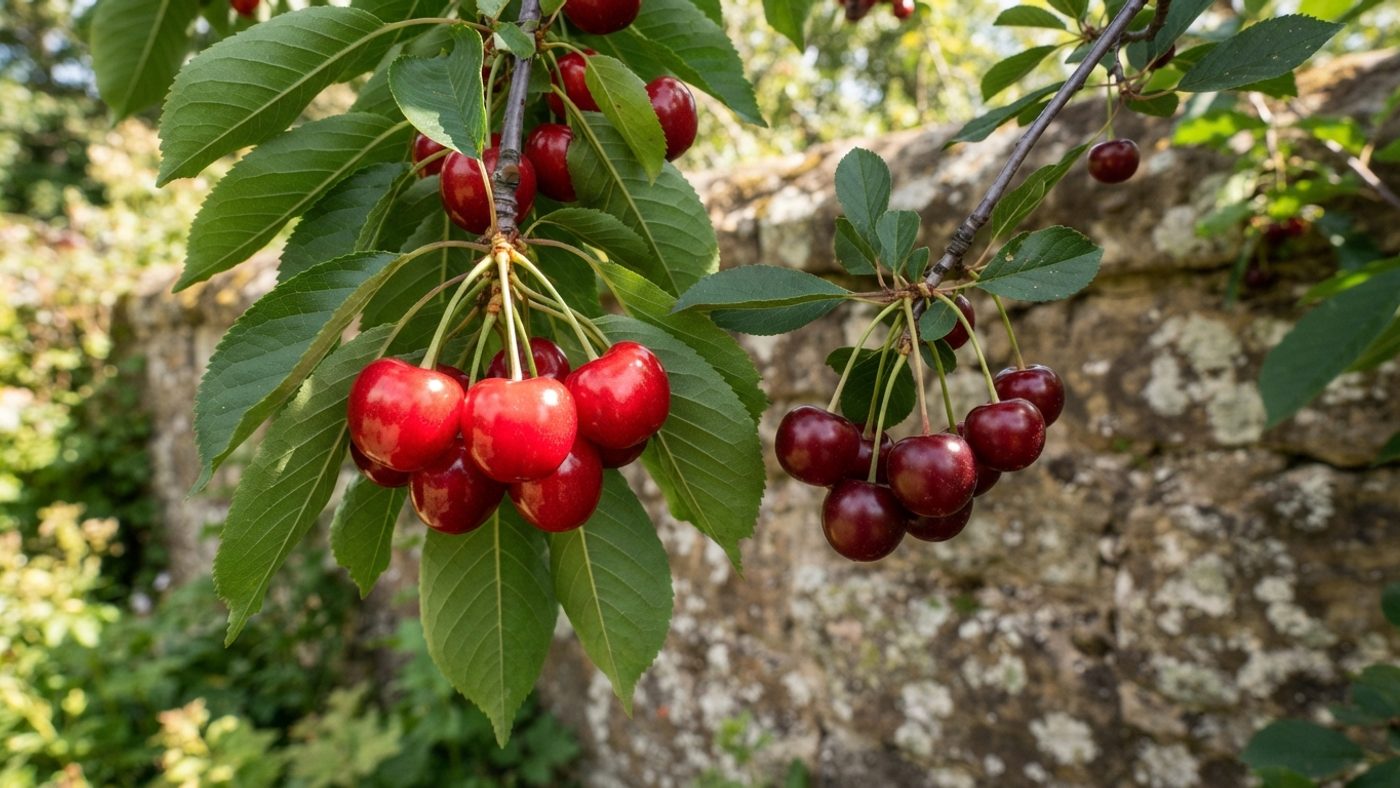
A warm, sheltered, sunny wall opens up all five sweet varieties at once, and that's where the real choice gets made: fertility, splitting risk, and ripening date all still separate them, where a shaded wall settles the question on site alone.
Stella's one real weakness is worth weighing before defaulting to it as the obvious pick: its fruit is prone to splitting in wet weather, worth weighing against how much rain a given site actually gets (see the Scotland climate guide for regional figures, since rainfall varies more within Scotland than a single "wet" label suggests). Kordia is the direct answer to that specific problem: it carries some resistance to cracking, the trade-off being that it isn't self-fertile and needs a compatible pollinator flowering in the same window, typically a second sweet variety with a matching pollination groupA classification of fruit tree varieties by when they flower each spring, used to check whether two varieties can pollinate each other. Full definition →; check with the nursery when buying rather than guessing. Lapins is the simplest alternative of the three: self-fertile, H6, the same top hardiness as Morello and Stella, without Stella's splitting caveat and without needing a partner the way Kordia does. It doesn't carry Kordia's documented cracking resistance specifically, but it also doesn't carry Stella's documented weakness, which on a wet, exposed site may be the more useful absence. Summer Sun also needs a partner (group 4) but shares the same H6 hardiness rating, worth knowing on an exposed or upland site if a second tree is already planned. Sweetheart is self-fertile and the latest-ripening of the six, a genuine option for extending the season rather than competing head-on with Stella or Lapins on timing.
Cherry blossom comes early enough in spring to be at real risk from a late frost, whichever variety is grown; a layer of fleeceA lightweight, breathable fabric laid or draped over plants to trap a little warmth and keep off frost, wind and some flying pests. Full definition → over the branches on a night frost is forecast protects the flowers, and is worth doing regardless of variety choice.
For rootstock, planting, soil, and pruning once a variety is picked, the cherries growing guide covers all of it in full.
Pests worth knowing per variety
Stella's splitting risk is a weather problem, not a pest, but it sits alongside brown rot, which also thrives in the same wet conditions and can spread through split or damaged fruit. Birds and pigeons take ripening fruit from all six varieties equally; netting, not variety choice, is the real defence. The growing guide's Common problems section covers the full list.
Common questions
Stella's fruit splits in wet weather. Is there a sweet cherry that doesn't have that problem?
Kordia. It carries some resistance to cracking, the opposite of Stella's named weakness. The trade-off: Kordia isn't self-fertile, so it needs a compatible pollinator variety flowering in the same window, where Stella crops alone. A specific pairing isn't published; check with the nursery when buying, since compatible pollination groups are usually listed at point of sale.
Which cherry is hardiest for an exposed or upland Scottish site?
Morello, Stella, Lapins, and Summer Sun all carry the top H6 rating, so hardiness alone doesn't separate them. Self-fertility does: Summer Sun needs a pollination partnerA second, different variety of the same fruit planted nearby so the two can cross-pollinate each other, needed by any variety that isn't self-fertile. Full definition → (group 4), where Morello, Stella, and Lapins all crop alone. Between those three, Lapins is arguably the most practical single-tree pick, since it carries neither Morello's cooking-only fruit nor Stella's wet-weather splitting risk.
Which cherry ripens latest, for the longest possible cherry season?
Sweetheart, which is self-fertile and ripens over a long period into early autumn. Pairing it with an earlier variety like Morello or Stella, both typically ready in late July, spreads picking across the whole cherry season rather than one concentrated harvest.
I have a shaded wall and want fruit for eating fresh, not cooking. What are my options?
Limited. Morello, the shade-tolerant option, is an acid cherry grown for cooking and preserving, not fresh eating. None of the five sweet, dessert-type AGMThe RHS's Award of Garden Merit: a UK-wide trials award for reliable performance, not a Scotland-specific recommendation. Full definition → cherries carry a shade-tolerance trait. A shaded wall suits Morello better than leaving it empty, but it won't give a sweet, fresh-eating crop.
Sources
7 sources, recorded with what each was used for
- RHS: Cherries – grow your own: The six AGM varieties, ripening windows, self-fertility flags, and links to each variety's own plant page
- Prunus avium 'Lapins': Lapins's H6 hardiness
- Prunus cerasus 'Morello': Morello's north-wall fan-training and partial shade tolerance
- Prunus avium 'Stella': Stella's fruit-splitting-in-wet-weather note
- Prunus avium 'Kordia': Kordia's H5 hardiness, splitting/cracking resistance, and pollination requirement
- Prunus avium 'Summer Sun': Summer Sun's H6 hardiness and pollination group
- Prunus avium 'Sweetheart': Sweetheart's H5 hardiness, self-fertility, and late/long ripening window