
Stand in the garden after a day of proper rain and look at where the water actually sits. Not the puddle by the gate that's gone by lunchtime, the patch further back that's still dark and soft two days later, where your boot leaves a print and the surface stays greasy underfoot longer than everywhere else. That's not the same problem as heavy clay, though the two often overlap, and it's not the same problem as a shady bed either. It's a site that holds moisture longer than most of the garden, whatever the reason: a low point, a spot near a downpipe, a free-drainingSoil that lets water pass through quickly rather than pooling, so roots aren't sitting in wet ground after rain. Full definition → loam that just happens to collect surface water off a slope above it. The question this article answers is narrow and practical: given that this one patch of ground stays damp, what should actually go in it.
Quick answer
Rhubarb is the best overall pick for a consistently damp bed that isn't actually flooding: it's a long-lived, low-fuss perennial and RHS states it wants moisture-retentive soil, so long as it "doesn't get waterlogged." If your corner is wetter than that, genuinely poorly-drained, not just damp, land cress is the better call, since RHS lists it as tolerant of poorly-drained ground directly, a tolerance rhubarb doesn't have. Celery is worth it if you want a moisture-hungry annual vegetable rather than a perennial.
Damp is not the same problem as clay, and not the same as shade
It's worth being precise about what "damp" means here, because two other GrowScotland pieces already cover conditions that get confused with it. A heavy clay garden has a structural problem as well as a wet one: clay compacts hard and resists root penetration on top of holding water, so a plant there needs to cope with both. A damp bed on free-draining loam near a downpipe or in a natural hollow doesn't have that compaction problem at all, it's wet without being structurally hostile, which genuinely widens what will grow there compared with unimproved clay. If your damp patch actually is clay, that article's picks are still worth reading alongside this one; the overlap is real. And a shaded garden is a different axis entirely: a damp bed can get full sun all day, and a shaded bed can drain perfectly well. Some crops happen to tolerate both conditions, but "likes shade" and "likes damp soil" aren't the same trait, and this list is built on the second one specifically.
The other distinction worth making before the list: damp is not waterlogged. A bed that stays moist to the touch a day or two after rain, and dries at the surface within that time, is damp. A bed where water is still visibly standing, or where digging a hole and filling it with water still shows standing water a day later, is waterlogged, and none of the five picks below are chosen for that, waterlogged roots suffocate for lack of oxygen regardless of what's planted in them, a mechanism covered in full in recovering a sodden garden after heavy rain. If your patch fails that test, a raised bed that lifts the root zone above the water table is the more honest fix than any crop choice, see raised beds vs ground growing in Scotland for that comparison.
Is this actually more of a Scottish problem?
Partly, and regionally rather than uniformly. Scotland has seen the greatest increase in rainfall of any UK nation in recent decades, while the west and the Highlands in particular see genuinely high totals: western Highland ground can exceed 3,500mm of rain a year against under 700mm on the driest eastern Scottish coasts, a range closer to the gap between England's wettest and driest counties than to a single "Scotland is wet" story. The connection to a single damp corner is a reasonable one rather than a directly measured one: total rainfall doesn't by itself prove how often any one garden has a persistently damp patch, since that also depends on the site's own slope and drainage. But a garden already receiving several times the rainfall of the driest parts of Scotland is starting from a wetter baseline before drainage or slope come into it at all, so a persistently damp corner is a more likely problem to face in a west-coast or Highland garden than UK-wide "plants for wet soil" advice tends to assume, and worth planning for rather than fighting.
Rhubarb — the best overall pick
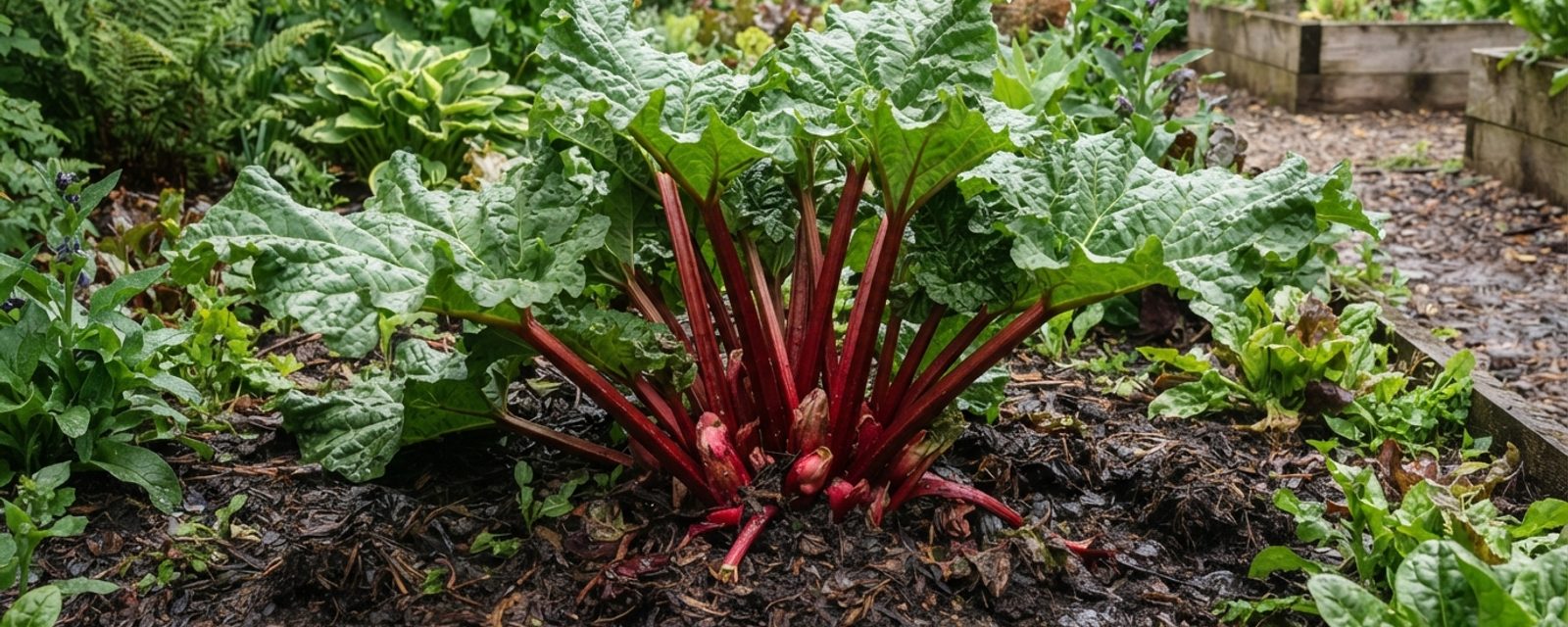
Where rhubarb does best is close to a textbook match for the kind of ground this article is about: "an open, sunny site with fertile, moisture-retentive soil that doesn't get waterlogged," consistently moist rather than standing wet. Rhubarb rewards that site with almost no ongoing effort once established. It's a long-lived perennial, productive for years from one planting, and asks for very little beyond an annual mulchA layer of material spread over the soil around plants to suppress weeds, retain moisture, and improve soil structure as it breaks down. Full definition → and, eventually, dividingPropagating a clump-forming perennial by digging it up and splitting it into several smaller pieces, each with roots and shoots attached. Full definition → an overcrowded crown. Plant a dormant bare-rootA plant, usually a fruit tree or hedging, sold with its roots exposed rather than in a pot, and only available while dormant. Full definition → crown between November and March, or a potted plant at any time of year, spacing crownsThe base of a perennial plant where roots and shoots meet, often sold and planted as a ready-made dormant plant rather than grown from seed. Full definition → 75-90cm apart since a mature clump spreads to around 1.5m wide. Skip harvesting entirely in the first year after planting, to let the crown build up strength, and never eat the leaves: they contain oxalic acid at a level that makes them unsafe, only the stalks are eaten. Timperley Early is the named variety worth seeking out for an early crop; the full rhubarb varieties guide covers the rest.
The caveat matters as much as the endorsement: "doesn't get waterlogged" is doing real work in that sentence. RHS is explicit that a genuinely poorly-drained site should get a raised bed or container instead, and that a container plant shouldn't be left sitting in a saucer of water. Rot is the real risk if that line gets crossed, waterlogged crowns and roots are exactly the mechanism behind root rot, so a rhubarb crown planted in ground that's actually waterlogged rather than just damp is a poor bet, not a resilient one. Mulch helps rather than hurts here, but keep it off the crown itself: piling mulch directly over the growing point traps moisture against it and invites exactly the rot a damp site is already more prone to, so mulch in a ring around the plant, not over the top of it. If your patch fails the drainage test above, land cress or a raised bed are the better calls, not rhubarb pushed onto ground it explicitly doesn't want.
Land cress: for the wettest, poorly-drained corners
Land cress (Barbarea verna) earns its place here on soil tolerance alone: RHS's plant record for it lists suitable moisture conditions as "moist but well-drained or poorly-drained," a direct, explicit tolerance for genuinely poorly-drained ground that rhubarb doesn't share. It also tolerates acid, alkaline, and neutral soil, grows in clay or loam, and carries an H7 hardiness ratingThe RHS's H1a–H7 scale for how much cold a plant can survive outdoors, H1a being tender indoor-only and H7 hardy anywhere in the UK. Full definition →, RHS's toughest banding, hardy in the severest UK winters, a genuine asset on the wettest corner of a west-coast or Highland garden, where that ground is both the most likely to be genuinely poorly-drained and the most likely to see a hard winter test that hardiness rating. Grown as a watercress substitute for salads, with a similar peppery bite, it's the pick for the actual wettest, lowest-lying corner of a damp bed, where rhubarb's "doesn't get waterlogged" line would be a real risk.
One risk worth naming: land cress is a brassicaThe cabbage family: cabbage, kale, broccoli, cauliflower, Brussels sprouts, kohlrabi, swede, turnip and more, sharing the same pests, diseases and rotation rules. Full definition →, and damp, often slightly acidic ground is exactly the kind of soil that favours clubroot, a soil-borne disease that swells and rots brassica roots, a real risk on the wettest, poorly-drained corner this pick is chosen for. It's also soft, seedling-stage growth that slugs go for readily, worth watching closely on ground that's already damp and therefore already good slug territory.
There's no dedicated grow-your-own guide for land cress, only the shorter plant-database page the figures above come from, so there's no published sowing depth, spacing, or harvest-window figure to give here. Work out sowing specifics by trial on a small patch first, rather than expecting the precise published schedule the other four crops below have.
Celery: a vegetable that actually wants the wet
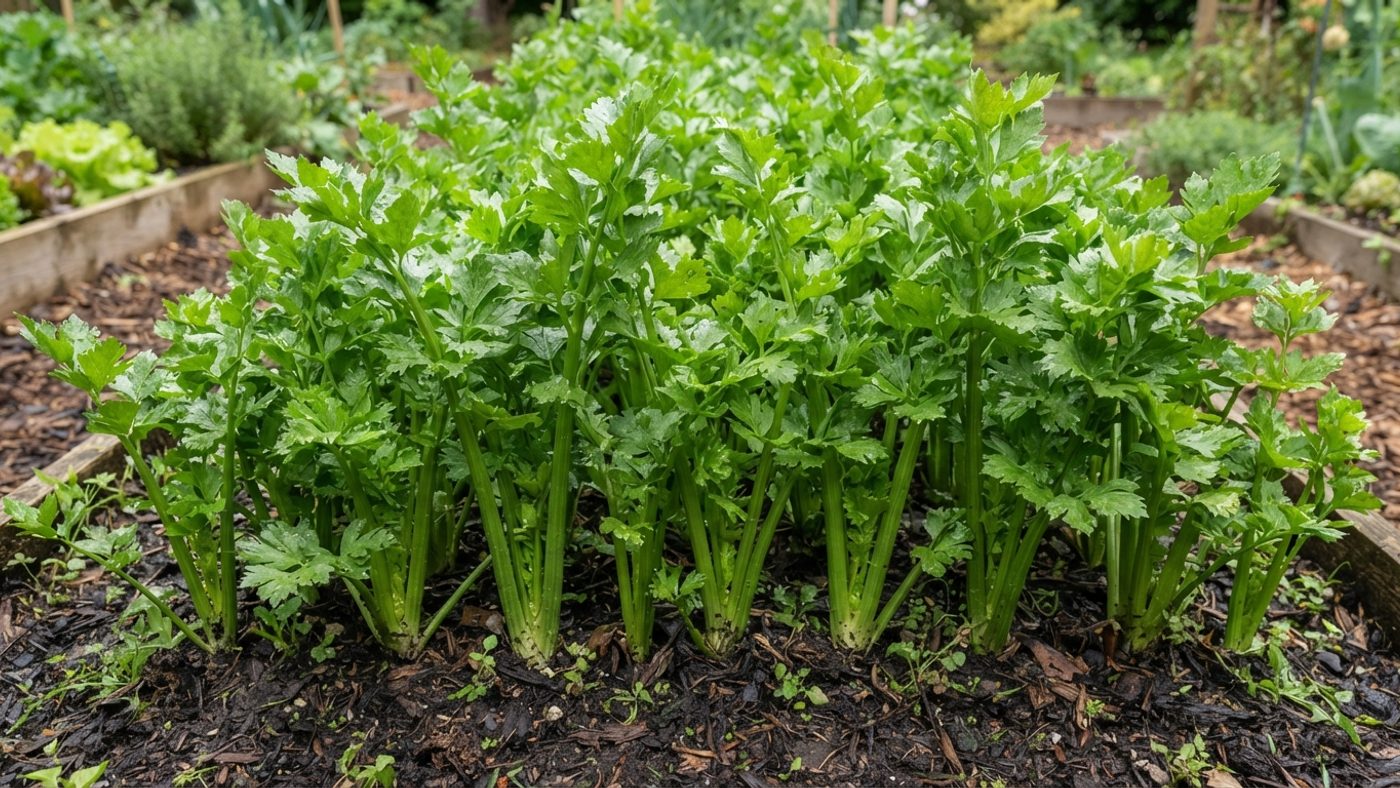
Most vegetables merely tolerate damp ground; celery is the rare one that actually needs it: "the key to success with celery is plenty of moisture throughout the growing season," that "the soil should never be allowed to dry out," and recommends "fertile, moisture-retentive soil," warning against sites "where the soil dries out rapidly." That's one of the strongest moisture endorsements RHS makes for any vegetable, which makes celery the pick for a reader who specifically wants an annual vegetable crop out of a damp corner rather than a perennial. Sow indoors mid-March to early April, and plant out in late May or early June once the risk of a late Scottish frost has passed, spacing plants 23cm apart each way in a block so they shade and blanch each other.
It's a genuinely harder crop to grow well than the others here, prone to stringy, bitter stalks if it's ever allowed to dry out or check its growth, so it rewards exactly the site this article is about rather than fighting it elsewhere in the garden where watering would otherwise be a constant chore. It's also a hungry crop on top of a thirsty one: work plenty of well-rotted manure or compost into the ground before planting, and keep feeding through the season, rather than treating the damp site alone as enough. Celeriac, its close relative, is worth a mention for anyone put off by that difficulty: it shares celery's liking for moisture-retentive soil, and is widely regarded as the easier of the two to grow, so it's worth trying on the same damp ground if celery's fussiness has put you off before. Slugs go for celery's soft young growth too, the same damp-ground risk as land cress above. See the celery varieties guide for bolt-resistantA plant switching early into flowering and seed production, usually triggered by stress, after which leaves, roots or bulbs turn bitter or unusable. Full page → picks worth knowing about before sowing.
Sorrel: a moisture-loving perennial leaf crop
Sorrel is a genuine match rather than a stretch: RHS states it "grows well in fertile, moisture-retentive soil," and specifically flags free-draining or poor soil as something to correct with organic matter rather than treating as its preference. That puts it in the same moisture-loving camp as lovage (already the clay article's herb pick) rather than with Mediterranean herbs that need sharp drainage. RHS rates it H7, hardy in the severest UK winters, so a wet west-coast or Highland bed, exactly the kind of ground the rainfall figures above point to, isn't asking anything of its hardiness that the plant doesn't already cope with. Once established as a perennial clump it provides a lemony, acidic salad and cooking leaf for years with little attention, a genuinely useful pick for the damp end of a herb bed. Sow indoors in spring, 1cm deep, or direct outdoors from mid-spring to early summer, spacing plants 20-30cm apart; a mature clump reaches around 50cm tall and wide. See the sorrel varieties guide for named types.
Chervil — a shorter-lived option for a partly shaded damp patch
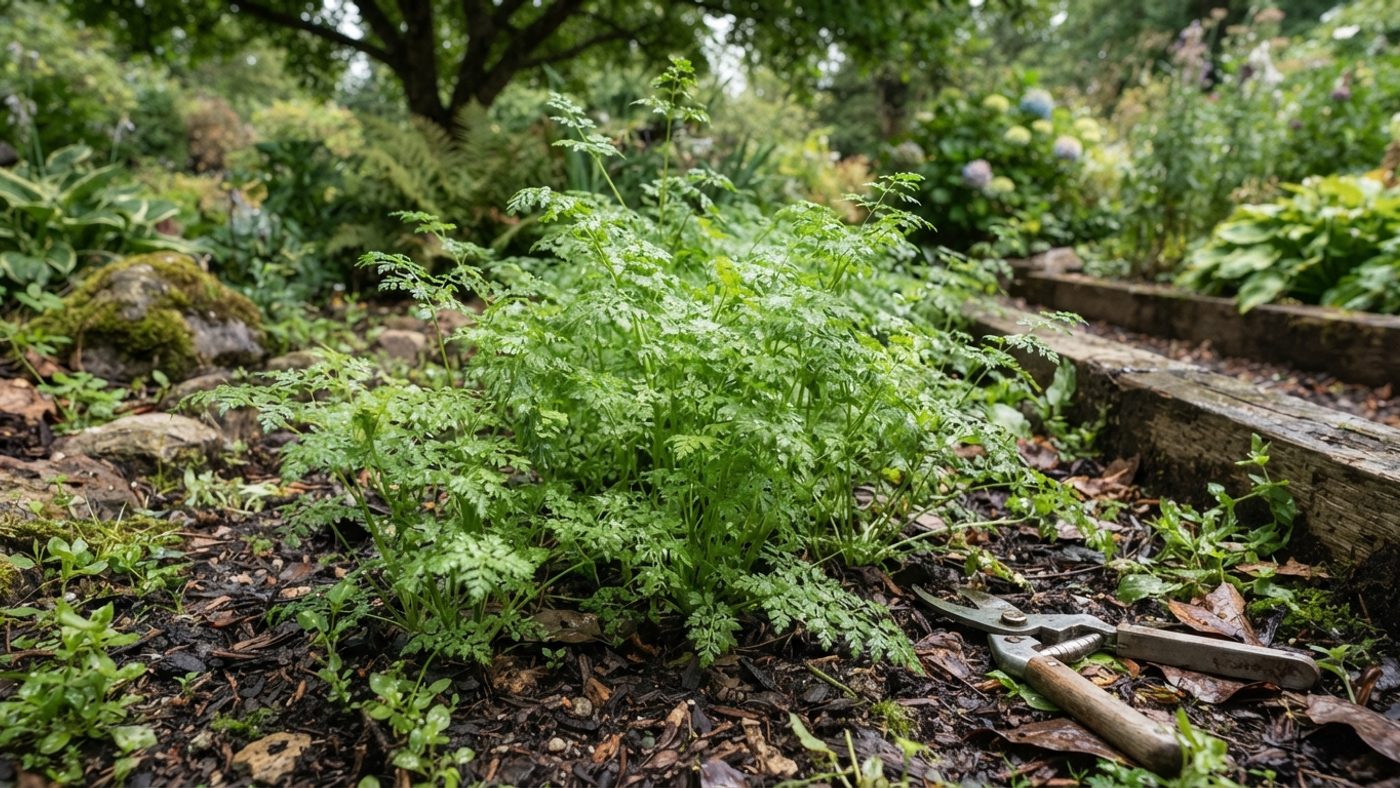
Chervil is worth a place for anyone whose damp corner also gets some shade through the day, since it's a soft, short-lived salad herb that bolts fast in hot, dry conditions. RHS's own care guidance for it is direct: "aim to keep the soil/compost consistently moist but not waterlogged," the same damp-not-boggy line as rhubarb, on a much smaller, faster-cropping plant. It won't fill a damp bed the way rhubarb, land cress, or celery will on their own, but as a second or third planting alongside one of the larger picks here, it makes good use of ground that would otherwise need extra watering to keep a drier-loving herb happy. Sow direct outdoors from April to August, 1cm deep in rows 30cm apart, thinning seedlings to 15cm; it dislikes being transplanted, so direct sowing suits it better than raising plants elsewhere first.
What didn't make the list, and why
Ordinary culinary mint has a strong reputation as a damp-tolerant plant, but the published guidance for it says only that "most mints can tolerate a range of soil types," with no explicit moisture or pH statement for standard mint. That's a tolerance claim, not a damp-loving one. Its wetland relative, water mint, genuinely does carry an explicit poorly-drained tolerance from RHS, and grows well in the wettest corner of a garden, see the heavy clay soil picks for how it's grown and contained.
Watercress is the most obvious damp-loving crop by reputation, and humus-rich, reliably wet soil is listed as suitable for it, but the plant is classified under RHS's Aquatic and Bog Plants category, not among ordinary vegetables, and the wider guidance around it consistently points toward a bog garden or pond margin rather than an open bed. A garden that's merely damp, in the sense this article is about, isn't the same growing environment as a bog garden, and watercress grown in an ordinary damp bed rather than moving or standing water isn't the crop RHS is actually describing.
Slugs and snails are worth a general word too, not just against land cress and celery above: damp ground is good slug territory regardless of what's planted in it, so any soft, leafy seedling on a damp bed is worth protecting early rather than after the first ravaged planting.
| Crop | Real damp-soil claim | Plant/sow, spacing | Real caveat |
|---|---|---|---|
| Rhubarb | RHS: "fertile, moisture-retentive soil that doesn't get waterlogged" | Bare-root crown Nov–March, or potted any time; 75-90cm apart | Genuinely waterlogged ground causes crown/root rot; needs a raised bed or container instead |
| Land cress | RHS: tolerates "moist but well-drained or poorly-drained" soil; H7 | No published figures | No RHS grow-your-own guide exists; no sourced sowing depth, spacing, or harvest-window figures |
| Celery | RHS: "the soil should never be allowed to dry out"; moisture-retentive soil | Sow indoors mid-March–early April, plant out late May–June; 23cm apart | A genuinely harder crop; stringy, bitter stalks if it ever dries out |
| Sorrel | RHS: "grows well in fertile, moisture-retentive soil" | Sow spring (indoors or direct); 20-30cm apart | Free-draining or poor soil needs added organic matter to suit it |
| Chervil | RHS: "keep the soil/compost consistently moist but not waterlogged" | Direct sow April–August; 15cm apart | Short-lived and bolts fast if it does dry out; won't fill a bed on its own |
Common questions
Is a damp garden the same problem as heavy clay?
Often, but not always. Clay holds water and also compacts hard, which is a separate structural problem on top of the moisture, and that's what the heavy clay picks are chosen around. A damp spot on free-draining loam near a downpipe or in a natural hollow is wet without that compaction problem, which is a genuinely easier site to work with, and this list's picks don't require the clay-specific tolerance that article's do.
How do I tell "damp" from "waterlogged"?
Dig a hole about 30cm deep, fill it with water, and watch what happens. If the ground around it stays moist to the touch a day or two after rain but the surface itself dries out within that time, it's damp. If water is still visibly standing in the hole a day later, or you can see water sitting on the surface well after rain has stopped, that's waterlogged, and none of the five picks above are suited to it: see recovering a sodden garden after heavy rain for what waterlogging actually does to roots and what to do about it.
Can I grow ordinary vegetables like cabbage or potatoes in a damp bed?
Not well, and there's a specific reason beyond general fussiness: potatoes are prone to rotting in waterlogged ground, and cabbage and other brassicas carry a real clubrootA soil-borne fungal disease of the brassica family that swells and distorts roots, and survives in soil for years. Full definition → risk that's worse on wet, poorly-drained, acidic soil, exactly the conditions a damp bed tends toward. Working in organic matter helps some crops cope a little better on ground that's damp but not waterlogged, but it won't turn a genuinely damp corner into a free-draining one, which is why this list leans on rhubarb, land cress, celery, sorrel, and chervil instead.
Is mint a good choice for a damp garden?
It has the reputation, but RHS's own growing guide for ordinary culinary mint makes no explicit claim about moisture or pH tolerance, only that it tolerates "a range of soil types." Its relative water mint does carry an explicit tolerance for poorly-drained ground; see the heavy clay soil picks for how it's grown and, importantly, contained.
My damp patch is also shaded, which list should I follow?
Check both, since they're answering different questions. This list is built around moisture tolerance; the shaded garden list is built around light tolerance. Chervil here also tolerates some shade, and rhubarb gets an honourable mention on the shade side too, but most of the picks on each list are chosen for one condition specifically, not both.
Sources
10 sources, recorded with what each was used for
- RHS: Rhubarb — grow your own: Soil/moisture requirement, waterlogging/drainage caution, raised bed and container advice, bare-root/potted planting timing, spacing
- RHS: Barbarea verna (land cress) plant record: Soil moisture tolerance, soil type, pH tolerance, H7 hardiness, sun/shade preference
- RHS: Celery — grow your own: Moisture requirement, soil preparation advice, sowing/planting-out timing, spacing
- RHS: Sorrel — grow your own: Moisture-retentive soil preference, poor/free-draining soil correction advice, H7 hardiness, sowing timing and method, spacing
- RHS: Chervil — grow your own: Soil moisture care instruction, direct-sow timing and transplant-sensitivity, spacing
- RHS: Mint — grow your own: Soil tolerance statement for ordinary culinary mint, used to show the absence of a specific moisture claim
- RHS: Nasturtium officinale (watercress) plant record: Aquatic/Bog classification, wet-soil growing guidance, used to explain why watercress was set aside for this list
- Met Office: UK and Global Extreme Events — Heavy Rainfall and Floods: Scotland's rainfall-increase trend relative to the rest of the UK
- Met Office: Eastern Scotland climate: Eastern Scotland rainfall totals
- Met Office: Western Scotland climate: Western Scotland/Highland rainfall totals