
ClubrootA soil-borne fungal disease of the brassica family that swells and distorts roots, and survives in soil for years. Full definition → is a serious disease that affects kale, broccoli and cabbage in Scotland. Here is what it looks like, the conditions it needs, and the controls that actually work.
What does it look like?
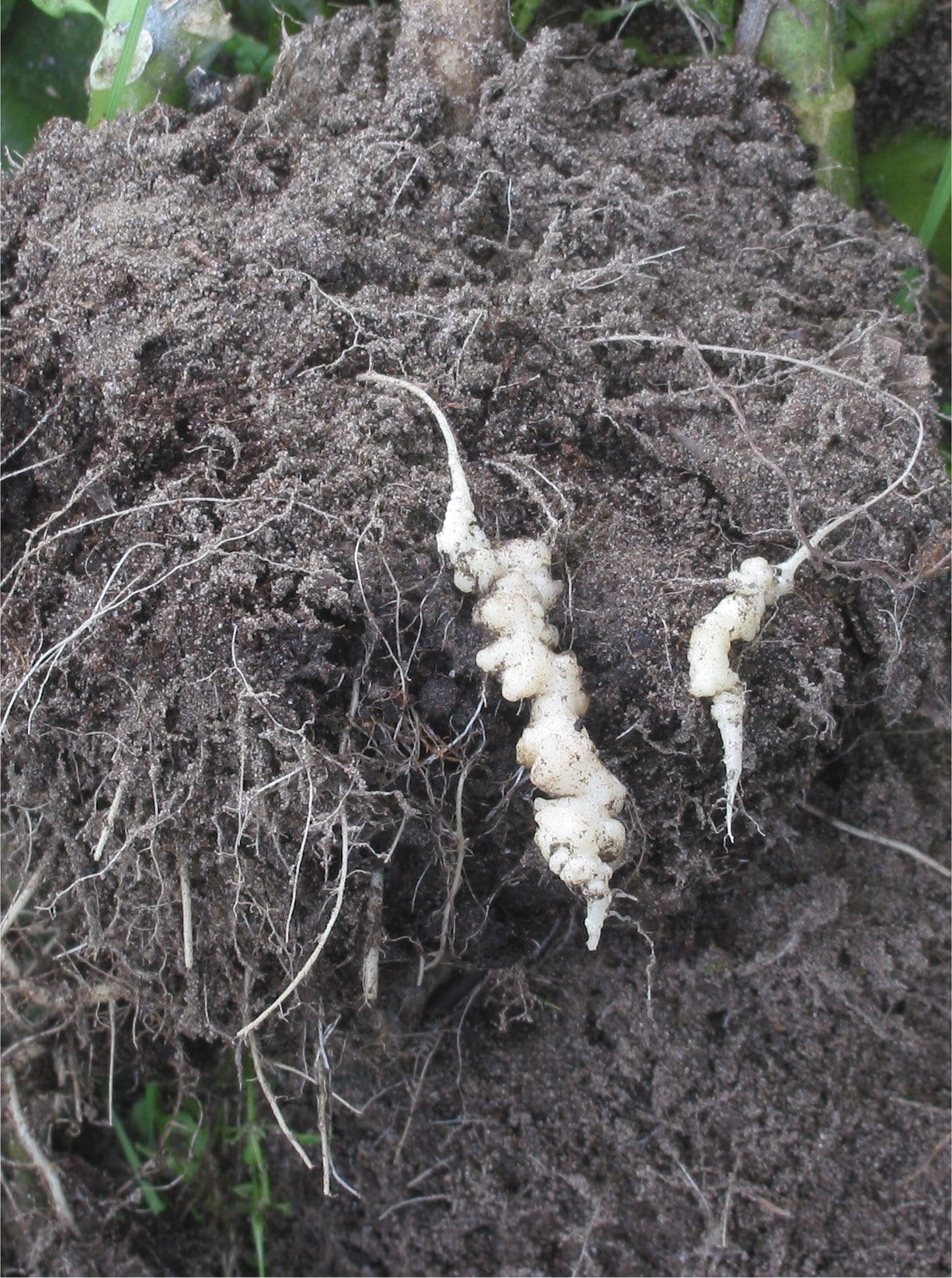
Roots lifted from the ground show massive swelling and distortion in place of the normal fine root structure, with growth severely retarded and the fine roots needed to take up water and nutrients largely lost. Above ground, affected plants are stunted, leaves can take on a purplish discolouration, and plants wilt in hot weather, sometimes recovering temporarily once it cools. Badly affected plants can die outright.
What causes it
Acidic soil favours the disease, and raising soil pH through liming reduces it, though doesn't eliminate it outright. Poor drainage makes it worse. New infections happen from midsummer through late autumn, while the soil stays moist and warm, exactly the conditions the resting spores need to germinateA seed sprouting: breaking dormancy and putting out its first root and shoot, given the right warmth and moisture. Full definition → and infect root hairs.
This pest lives in the soil and lies dormant until a host is planted. A seasonal calendar would be misleading.
🌱 Plants at risk
Clubroot also affects these crops:
Symptoms
The root damage is what actually does the harm: a plant with swollen, distorted roots and no fine root system can't take up enough water or nutrients to grow or crop properly, which is why yield loss is severe and, in bad cases, the plant dies rather than just underperforming.
Life cycle
⚠ Soil contamination: Spores survive for up to 20 years in the soil. Once a bed is infected, it stays infected for the rest of your gardening lifetime.
Why this matters in Scotland
Arguably Scotland's most consequential brassicaThe cabbage family: cabbage, kale, broccoli, cauliflower, Brussels sprouts, kohlrabi, swede, turnip and more, sharing the same pests, diseases and rotation rules. Full definition → disease, because our soils supply exactly the two conditions it wants.
Clubroot is less prevalent in alkaline soil, and better drainage holds it back. Scotland gives it the opposite of both: naturally acidic soils and a wet climate. The resting spores then contaminate soil for up to 20 years, so this is not a season’s problem. Infect a bed and it is effectively permanent within a gardening lifetime. That combination makes prevention disproportionately valuable here.
Controls: what actually works
All the methods below are backed by real evidence, not just repeated folklore.
Lime acid soil to raise pH
On acid soils apply lime at 500g per sq m, with lighter dressings of 270g per sq m in future years. Clubroot is less prevalent in alkaline soil. The target is to lime anything below pH 6.3, working toward pH 7: broccoli 6 to 7, Brussels sprouts at least 6.5, cabbage above 6.
Improve drainage: e.g. raised beds
Grow clubroot-resistant cultivarsA plant variety that arose or was bred under cultivation and is kept true by deliberate propagation, rather than a naturally occurring wild species. Full definition →
Cultivars with useful resistance include Brussels sprouts 'Cryptus F1The first-generation offspring of two specific, deliberately chosen parent plants, bred for a predictable, uniform result but not worth saving seed from. Full definition →' and 'Crispus F1'; calabrese 'Komodo F1' and 'Monclano F1'; cauliflower 'Clapton F1' and 'Clarify F1'; cabbages 'Cordesa F1' (savoy), 'Kalibro F1', 'Kilastor F1', 'Kilaton F1', 'Kilaxy F1', 'Kilazol F1' and 'Lodero F1' (red); and swedes 'Gowrie' and 'Marian'. All show 'some degree of resistance', not immunity.
Keep down susceptible weeds — shepherd's purse, charlock, wild radish
These are brassica-family weeds that host the disease, so they sustain spore loads between crops.
Raise your own transplants in healthy, disease-free soil or compost to a larger size before planting out, and buy in transplants only from a source guaranteed club root-free
Given the disease spreads through infected soil and can persist in it for up to 20 years, keeping it out of a clean bed in the first place is worth as much as any of the in-ground measures. A larger, more established transplant is also better placed to withstand some root damage than a small one planted straight into infected ground.
Clean soil off tools and footwear between beds, especially if one bed is known or suspected to carry the disease
Spores travel in soil, so a spade or boot carrying infected soil from one bed to another is a genuine transmission route, not just a hygiene nicety.
Scottish grower notes
In Scotland, clubroot risk is highest in wet ground with a low (acidic) pH, exactly the conditions common here. Improving drainage, and testing and raising soil pH, are the levers that matter most; flooding can spread it between areas.
FAS Scotland guidance (written with oilseed rape in mind, but clubroot affects all brassicas the same way).
Frequently asked questions
What should I do first if I find clubroot in my garden?
Start with lime acid soil to raise ph. After that, improve drainage. Work through the rest in order of how well-evidenced they are if the first two aren’t enough on their own.
Is there a spray that works?
No. There are no amateur chemical treatments available for clubroot. The controls that work are cultural: the measures listed above.
How much of this advice is actually proven?
Every control listed above is evidence-based, not just repeated folklore. None of it is a guess.
Sources
4 sources, recorded with what each was used for
- RHS1: identification, symptoms, causal organism description, conditions and infection timing, 20-year spore survival, lime rates, alkalinity link, resistant cultivar list, drainage, susceptible weeds, clean transplants, tool and footwear hygiene, absence of a chemical control
- RHS1: brassica liming toward pH 7 and the clubroot/alkalinity link
- RHS1: independent corroboration of 'Crispus' clubroot resistance
- FAS Scotland14: clubroot risk highest in wet, low-pH Scottish ground; drainage and pH management as key levers; flooding spreads it