
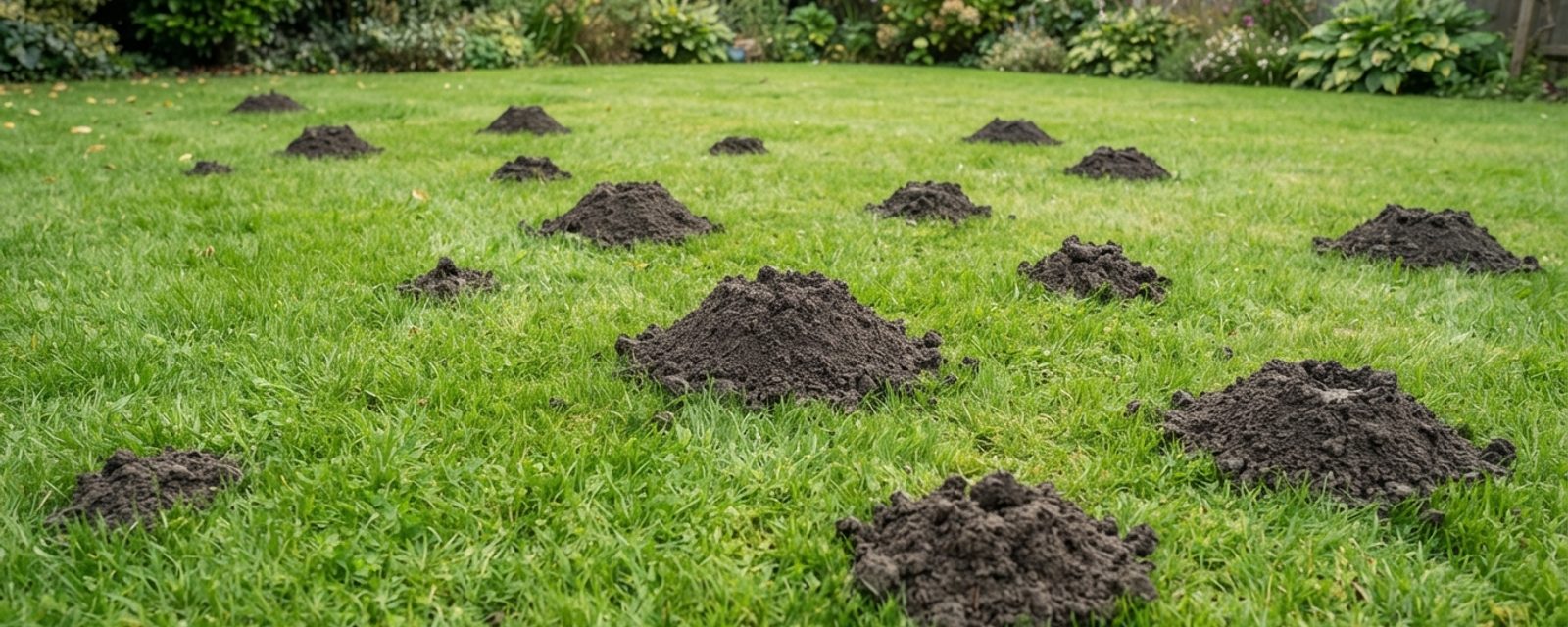
A molehill isn't the mole trying to reach your plants. It's spoil. Moles feed on earthworms and other soil-dwelling invertebrates, not on plant roots, and they hunt by tunnelling: digging out a permanent network of tunnels and chambers that intercepts worms and grubs as they move through the soil, then digging further as the local supply thins out. Every metre of new tunnel has to go somewhere, and since a mole can't carry soil out through the tunnel walls, it pushes the loose earth straight up to the surface at intervals along the run. The hill is the excavation waste from a feeding structure, not a mark left by an animal going after your border.
Earthworms aren't a minor part of that diet, they're most of it: a mole weighing around 80g needs roughly 50g of earthworms a day to sustain itself, and worms recovered in feeding chambers have been found stored alive in numbers up to 470 in a single cache, immobilised by a bite to the head end and kept as a larder for leaner periods. A mole's tunnel network exists because that's where the worms are, and a lawn or bed with a strong worm population, the same population responsible for the casts covered in worm casts in lawns, is from a mole's perspective worth digging into.
What moles actually damage, and what they don't
The damage is physical, not dietary. Moles don't feed on plant roots or any other part of the plant. Tunnelling close to the surface can still dislodge or expose the roots of seedlings and other small, shallow-rooted plants in a flower bed or vegetable plot, enough to check their growth or topple them, and a network of tunnels running through a lawn leaves a scatter of raised soil heaps across the grass surface. That's a cosmetic and structural nuisance on a lawn, and a genuine root-disturbance risk in a bed of small plants, but it isn't the mole eating anything.
Young carrots or potato sets going into a vegetable plot are exactly the kind of planting where surface tunnelling can unsettle roots before they've anchored properly; the full growing guides for carrots and potatoes cover root establishment.
When mole hills appear, and how many moles you're dealing with
Mole activity is usually at its most visible in late winter and early spring, when hills come up fastest and in the greatest numbers. That window overlaps with the breeding season, which runs from February to June: young moles disperse to establish their own territories during this period, which is when a garden that's never had a mole problem before can suddenly get one, and when an existing mole's tunnel network tends to expand fastest.
It's also worth knowing that a whole garden's worth of hills is usually the work of one animal. Moles are strongly territorial, and outside the breeding season they live largely solitary lives, so in most gardens all the mole activity seen is down to a single mole defending and extending its own tunnel network, not a colony.
Mole hills, chafer grub damage, and worm casts: telling them apart
Three different things disturb a Scottish lawn's surface, and they're easy to muddle at a glance.
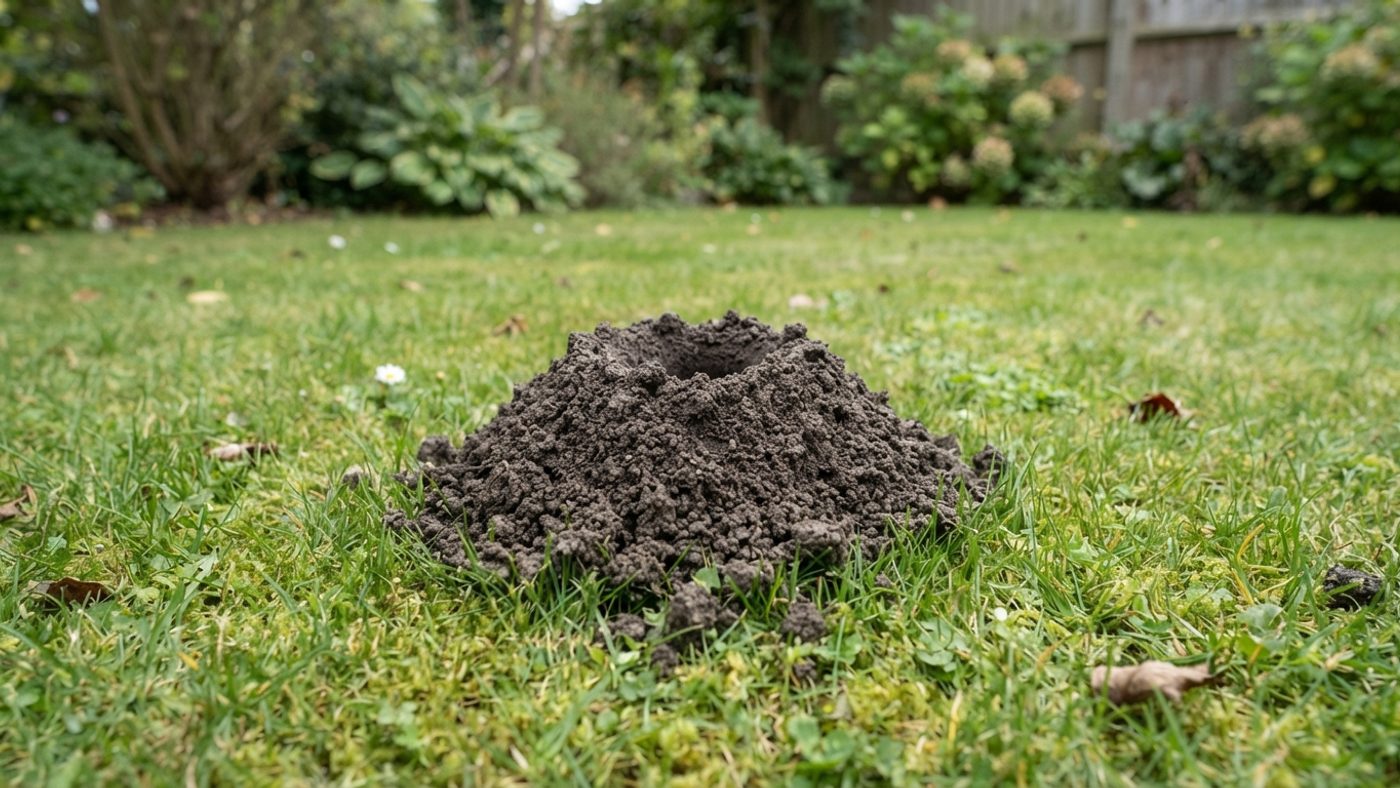
A mole hill is a neat, cone-shaped mound of loose, crumbled soil, often 20-30cm across at the base, sitting on top of otherwise undamaged grass. There's no dead or torn turf in between the hills, because the mole isn't damaging the grass itself, it's what's underneath that's been disturbed.Chafer grub damage looks nothing like this: irregular, spreading brown or dead patches where grub feeding has severed the grass roots, often with turf torn up by birds, badgers, or foxes hunting the grubs underneath. A pull test tells the two apart immediately, turf over chafer damage lifts away like loose carpet with no roots holding it; grass around a mole hill stays rooted and green, it's the mound itself that's the damage, not the surrounding lawn.
Worm casts are a smaller, closer look-alike: a loose, fine, muddy heap a few centimetres across, sitting flush on the grass with no hole underneath. A mole hill is bigger, coarser, and covers a real excavated tunnel, usually with a clear entrance hole once the heap is brushed aside. The two are also connected mechanically, not just visually, since moles are tunnelling toward earthworms in the first place, so a lawn that casts heavily, a sign of a healthy earthworm population, is also the kind of lawn a mole has good reason to move into.
Where moles are, and aren't, in Scotland
Moles are found throughout mainland Britain, but the picture within Scotland is patchier and less well-recorded than the rest-of-UK story suggests. Distribution data for the species in Scotland is sparse, but what records do exist point to more sightings in the east of the country than the west, a pattern that may reflect patchier recording in remoter western areas as much as a genuine difference in numbers. Distribution tracks earthworm abundance directly, and moles occur at low density even in habitats such as coniferous forest, moorland, and sand dune systems, where earthworm prey is scarce, rather than being absent from those habitats outright.
What's legal: trapping, glue traps, and snares in Scotland
Moles have no legal protection in the UK. They can be trapped or otherwise controlled as a garden pest without a licence for that reason alone, but which methods are lawful has changed in Scotland specifically, most recently with the Wildlife Management and Muirburn (Scotland) Act 2024.
| Method | Legal in Scotland? | Why |
|---|---|---|
| Spring-loaded "break-back" mole trap | Yes, unlicensed | Exempted by the Small Ground Vermin Traps Order 1958; the 2024 Act kept that exemption for rats, mice and moles specifically |
| Glue trap | No | Banned outright by the 2024 Act, with only a narrow public-health exception that doesn’t extend to moles |
| Snare | No | Banned outright by the same Act |
| Poison (strychnine) | No | Illegal for decades, well before the 2024 Act |
Whether trapping is humane is a separate question from whether it's legal. Trapping can be cruel if not done correctly. Anyone setting a trap should follow the manufacturer's instructions on tunnel-setting and check frequency closely, or use a pest control professional instead.
Deterrents: what's evidenced, and what's folklore
Genuine physical exclusion sits at one end; unproven folklore sits at the other, and most of what's marketed as a mole deterrent falls somewhere in between:
| Method | What it does | Evidence |
|---|---|---|
| Netting laid under new turf or soil | Physically blocks moles reaching the surface | Genuine exclusion, but only works if installed before turfing or sowing; no retrofit for an established lawn |
| Trapping (legal spring/break-back traps) | Physically removes the mole from the tunnel | Removes the individual mole present, but the vacated tunnel is often reoccupied later |
| Electronic/sonic devices | Buzzing vibration meant to drive moles off | May only push the mole to another part of the same garden; weak evidence of any lasting effect |
| Castor oil-based repellents | Fumes meant to make the soil unappealing | A hungry mole may simply move elsewhere in the garden; weak evidence |
| Euphorbia lathyris ("mole plant") | Root exudates claimed to repel moles | Folklore rather than a demonstrated deterrent; the plant self-seeds aggressively if left unchecked |
| Allium moly bulbs | Planted as a claimed deterrent | "Of doubtful value" |
| Mothballs, human hair, flooding tunnels | Long-standing home remedies | No verifiable evidence either way |
The pattern across the evidenced methods is consistent: nothing tested reliably gets rid of a mole for good, short of exclusion netting installed before the ground is turfed, or physically removing the individual animal by trapping. Everything else on the list either moves the problem sideways within the same garden or has no real evidence behind the claim at all.
Dealing with a different lawn problem?
See moss in your lawn, mushrooms and fairy rings, red thread, chafer grubs, drought or the dog, worm casts, and iron sulphate overuse.
Common questions
Are moles protected in Scotland, or can I get rid of one?
No, moles have no legal protection in the UK, including Scotland, and can be controlled as a garden pest. What’s restricted is the method: glue traps, snares and poison are all banned, but traditional spring/break-back mole traps remain a lawful, unlicensed method under a long-standing exemption the Wildlife Management and Muirburn (Scotland) Act 2024 kept in place.
Will a mole eat my vegetables or flowers?
No. Moles are carnivorous and feed on earthworms and soil invertebrates, not plant material. The real risk to a bed or border is root disturbance from tunnelling near the surface, which can dislodge or expose the roots of seedlings and other small plants, not the mole eating anything.
How do I tell a mole hill apart from chafer grub damage or worm casts?
A mole hill is a cone-shaped mound of loose soil sitting on undamaged grass, with a tunnel and often a visible entrance hole underneath once the heap is brushed aside. Chafer grub damage looks completely different: irregular dead or brown patches where turf lifts away like loose carpet with no roots holding it. A worm cast is smaller and finer than a mole hill, a flush heap of worked soil a few centimetres across with no hole underneath at all.
Do sonic or vibrating mole deterrent spikes actually work?
The evidence is weak. Electronic devices produce a buzzing vibration that may only push a mole to another part of the same garden rather than driving it off the property altogether, so a spike that seems to work in one bed may just have relocated the problem a few metres away.
Am I dealing with one mole or several?
Almost certainly one. Moles are strongly territorial and, outside the February-to-June breeding season, live solitary lives, so a whole garden’s worth of hills is typically the work of a single animal extending its own tunnel network rather than a colony.
Sources
6 sources, recorded with what each was used for
- RHS: Moles: Mechanism (tunnel/chamber excavation, hills as spoil disposal), diet (earthworms and soil invertebrates, not plant roots), the root-disturbance-not-feeding damage distinction, seasonal timing (late winter/early spring peak, February-June breeding season), territoriality, and verdicts on netting, electronic devices, castor oil repellents, Euphorbia lathyris and Allium moly bulbs
- Mammal Society: Mole: Diet quantities (50g of earthworms/day for an 80g mole), worm caching behaviour, tunnel network structure, UK legal protection status, and that trapping can be cruel if done incorrectly
- Wildlife Management and Muirburn (Scotland) Act 2024, Explanatory Notes: The Small Ground Vermin Traps Order 1958 exemption for rat/mouse/mole traps, and the Act’s ban on glue traps and snares
- RHS: Chafer grubs in lawns: The diagnostic contrast between chafer grub damage and mole hill damage
- RHS: Worm Casts in Lawns: The diagnostic contrast between worm casts and mole hills
- NatureScot: Other small mammals: Scottish distribution (sparse recording data, more records in the east), low-density occurrence in coniferous forest, moorland and sand dune habitat, and the link between distribution and earthworm abundance