
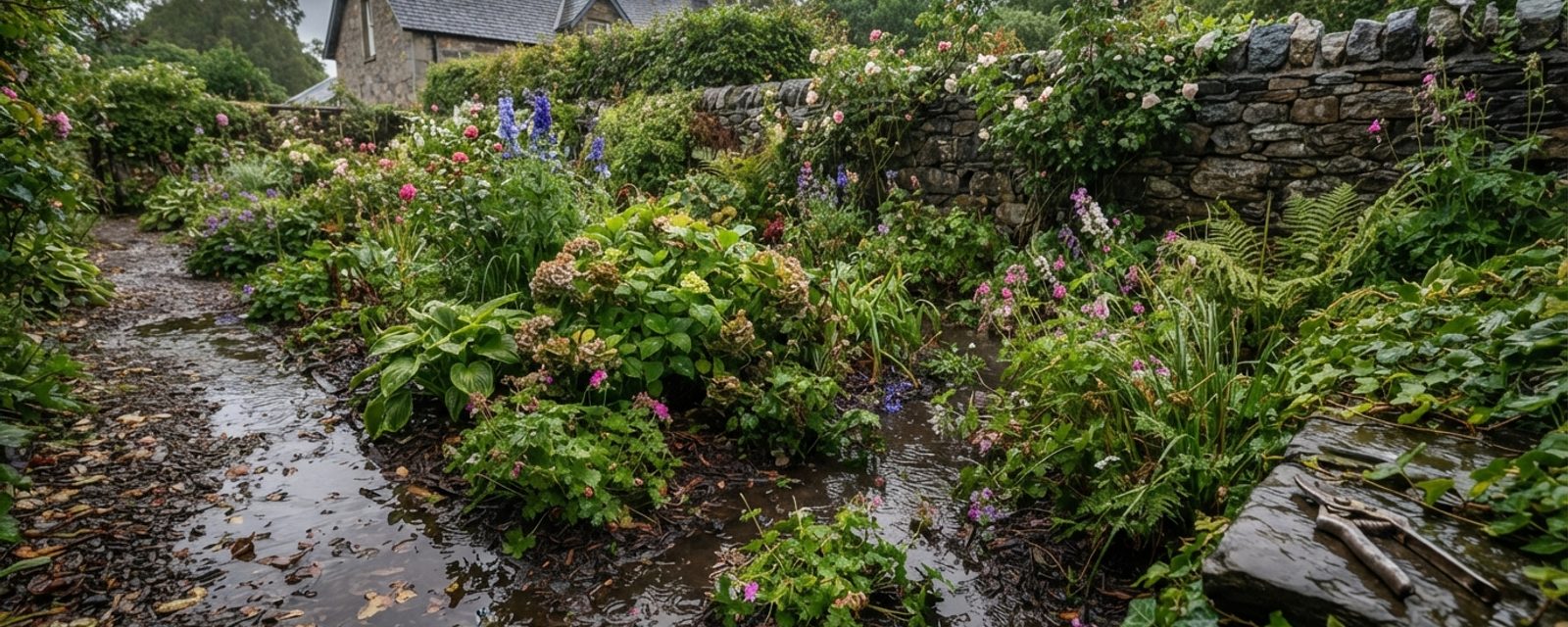
A week of relentless rain leaves borders, beds and paths waterlogged. First things first, before the detail below: stay off the wet soil, don't dig or plant yet, and don't assume a wilting or yellowing plant is dead. Skip straight to "What to salvage, what to replace" if that's the question you actually came here with.
Why standing water actually harms your plants
Soil is not solid ground from a root's point of view; it's roughly half solid particles and half pore space, and that pore space is normally shared between air and water. Roots, like every other living part of a plant, need oxygen to respire, and most of that oxygen reaches them through air held in those pores. When rain saturates the soil faster than it can drain, water floods every pore and pushes the air out. Root function is reduced or stops and the roots start to die off, allowing rots and decay organisms to invade. The plant isn't drowning in the everyday sense, it's suffocating, and the dead root tissue then becomes an open door for rot fungi and water moulds that would otherwise struggle to get a foothold.
Two things decide how much damage this does: how long the soil stays saturated, and how warm it is while that's happening. In cold winter soil, roots and the microbes around them are barely active, so a few sodden days do comparatively little harm. In spring and summer, when roots are respiring hard and soil organisms are active, the same period of waterlogging is far more damaging. That's worth remembering after a summer downpour: the clock on root damage is running faster than it would after an equivalent November soaking.
Duration is the variable that hits hardest in western Scotland specifically: heavy rain there often builds over two or three days rather than falling as a single downpour, which is exactly the "how long" half of the equation that does the most damage to roots. That same duration also drives how much soluble nutrient, particularly nitrogen, gets washed straight out of the root zone before a plant can use it, a longer soaking leaches more than a short, sharp one, on top of whatever oxygen damage it's already causing.
First: don't make it worse by working wet soil
The single most damaging thing you can do to a sodden garden is walk on it, dig it, or fork it while it's still saturated. Wet soil particles slide past each other and pack down under weight instead of springing back, and once that structure is compacted the pore space that should hold air is gone for good until it's mechanically or biologically rebuilt, a process that takes seasons, not days. Short-term advice after flooding starts with exactly this: keep off the soil until it's workable, to avoid compacting it further.
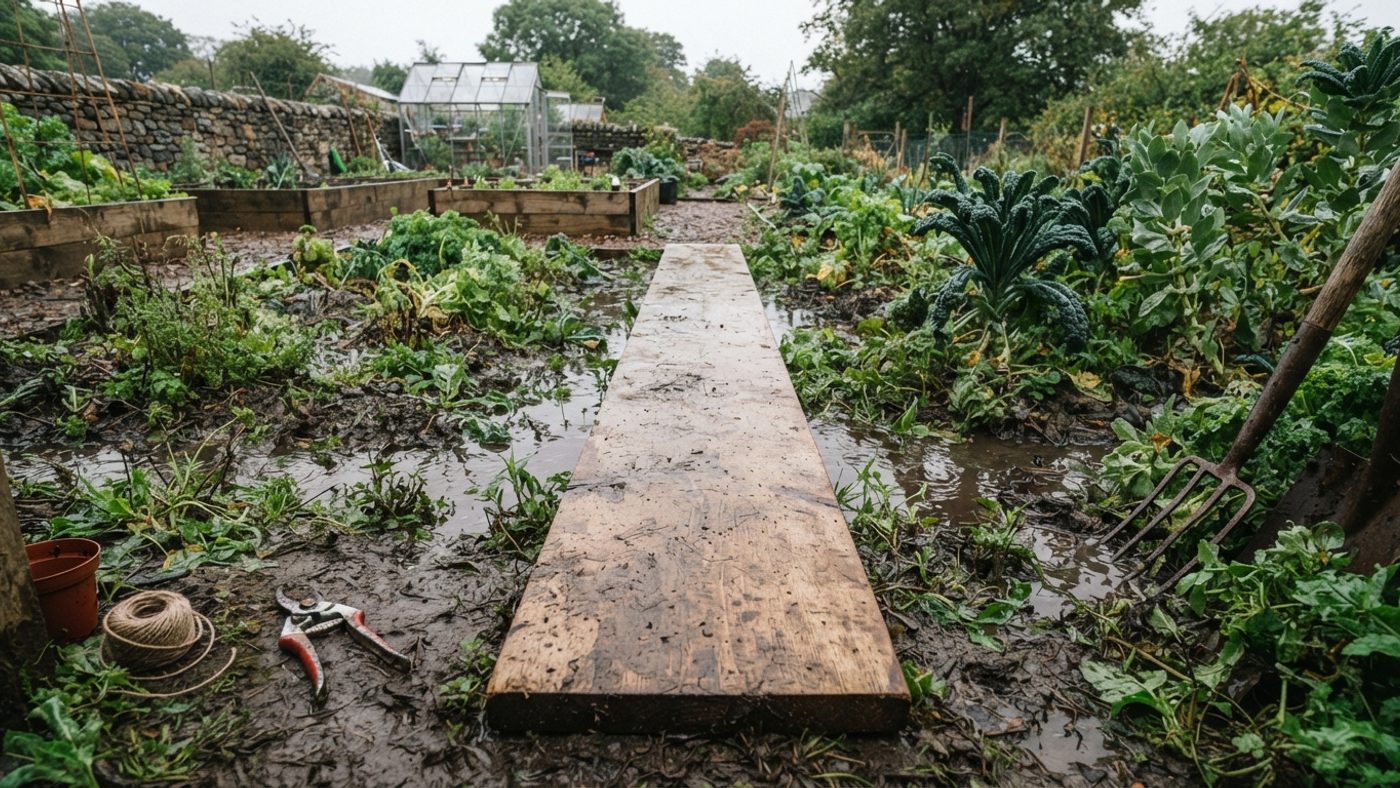
In practice: lay a wide board or plank down as a temporary path if you must cross a bed, so your weight spreads across it rather than pressing into one footprint, and stay off borders and the vegetable patch entirely until water has drained from the surface and the ground has firmed up underfoot. Postpone any digging, forking, planting or harvesting until then. If you need to move around the garden regularly while it dries out, route yourself across paving or gravel rather than soil.
Assessing the damage, plant by plant
Once it's safe to walk the garden, work through it methodically rather than assuming the worst everywhere: flooding damage is often patchy, following the low points and drainage lines of the site rather than hitting every bed evenly.
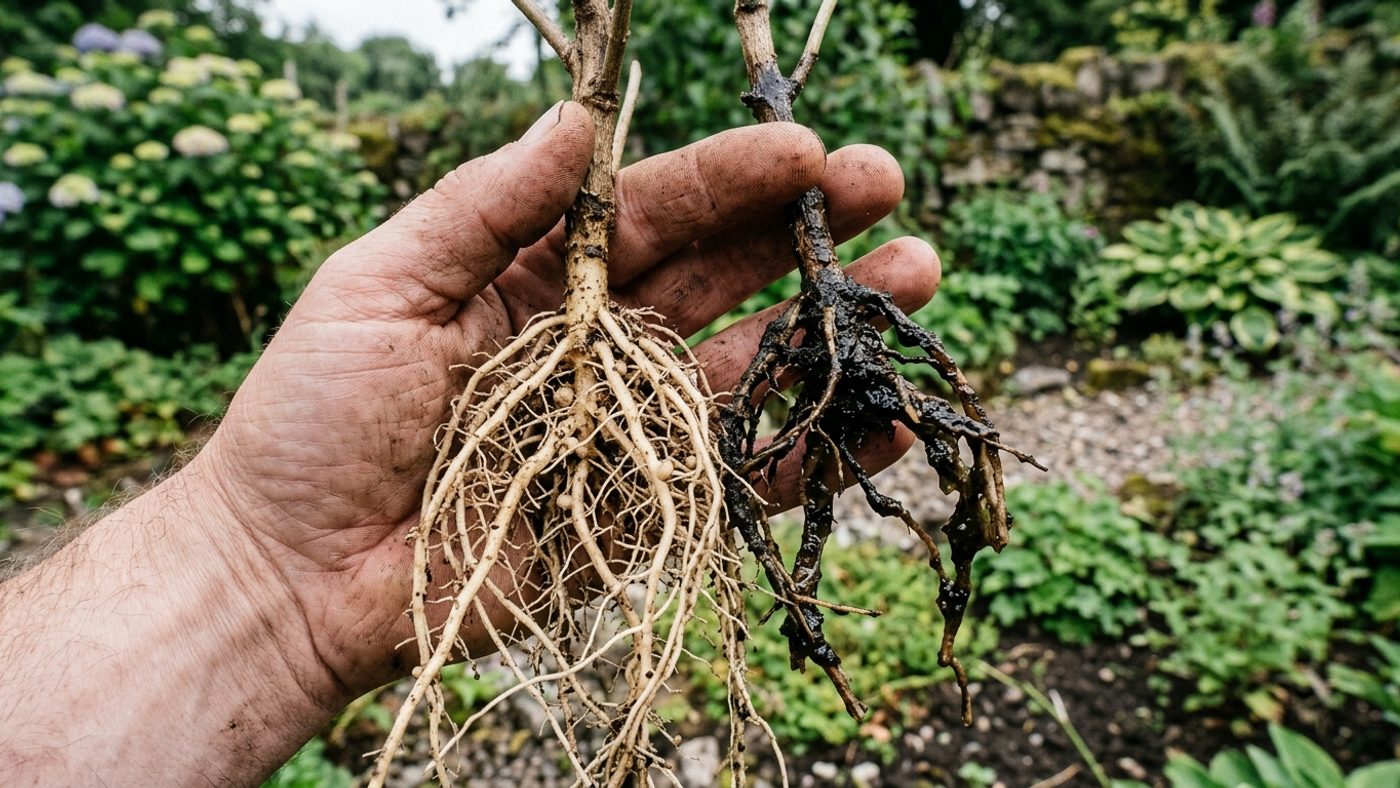
Symptoms to look for: yellowing or a soft, water-soaked patch between the leaf veins; wilting despite obviously wet soil (a genuine red flag, since it means the roots can no longer take up water even though there's plenty around); and, below ground, roots that have turned blue-black or grey and have a sour, rotten smell rather than the clean earthy smell of healthy roots. Gently ease a trowel into the root zone of a few representative plants in each bed, checking for firm, pale roots versus mushy, dark, easily- snapped ones.
Newly planted or shallow-rooted perennials and vegetables are usually hit hardest and fastest. Established shrubs and trees have more root reserve and can often sit in wet soil for several days without lasting harm, though repeated flooding over a season will wear even these down, worth knowing in a west-coast or Highland garden specifically, where several days of standing water is a real recurring scenario rather than a rare worst case.
Waterlogged ground also loosens a tree's grip on the soil, not just its roots' access to oxygen: saturated soil gives far less anchorage than firm ground, so a spell of standing water is also the point to check larger or newly planted trees for any new lean or rocking at the base, since a windy spell on top of already- saturated ground is what actually brings a weakened tree down. A tree that's developed a lean should be firmed back in and staked once the ground allows it, rather than left to settle further while still waterlogged.
What to salvage, what to replace
Don't pull anything the moment it looks sorry for itself; many plants recover from a short flood once air gets back into the soil. As a working rule:
- Leave in place and monitor: plants with intact, pale roots and only cosmetic leaf damage. Remove damaged foliage and shoots to reduce stress and disease entry points, but let the root system recover on its own.
- Lift and assess: plants that are wilting despite wet soil, or where a quick trowel-check shows roots turning dark and soft. If more than half the root mass is still firm, cut back the worst of the top growth, replant slightly proud of the surrounding soil once it's dried, and give it time.
- Write off: anything with a fully collapsed, foul-smelling root system, and any young or shallow-rooted plant that's been fully submerged for more than a couple of days in warm weather.
Where a spot has flooded once, it's worth assuming it can flood again and choosing replacements accordingly: moisture-tolerant plants for the wettest corners rather than fighting the site indefinitely.
Slugs and snails also surge as soon as wet weather breaks, right when your recovering plants are at their most vulnerable: soft new growth on a stressed plant is exactly what they go for first. It's worth checking recovering plants for slug damage alongside the root-and-leaf checks above, rather than assuming any further decline is still down to the flood itself.
Soil recovery after a flood: three problems, not one
"Improve the drainage" is the standard long-term advice, and it's right, but a flood typically leaves three distinct problems behind: silt and sediment, compaction, and possible contamination.
Silt and sediment. Floodwater that has crossed paths, driveways or neighbouring land often deposits a layer of fine silt over beds and lawn edges as it recedes. A thin skim can be worked into the surface once the soil has dried enough to handle without compacting it, but a thick crust should be scraped off and composted or disposed of separately; left in place it can seal the surface and make the compaction problem worse rather than better.
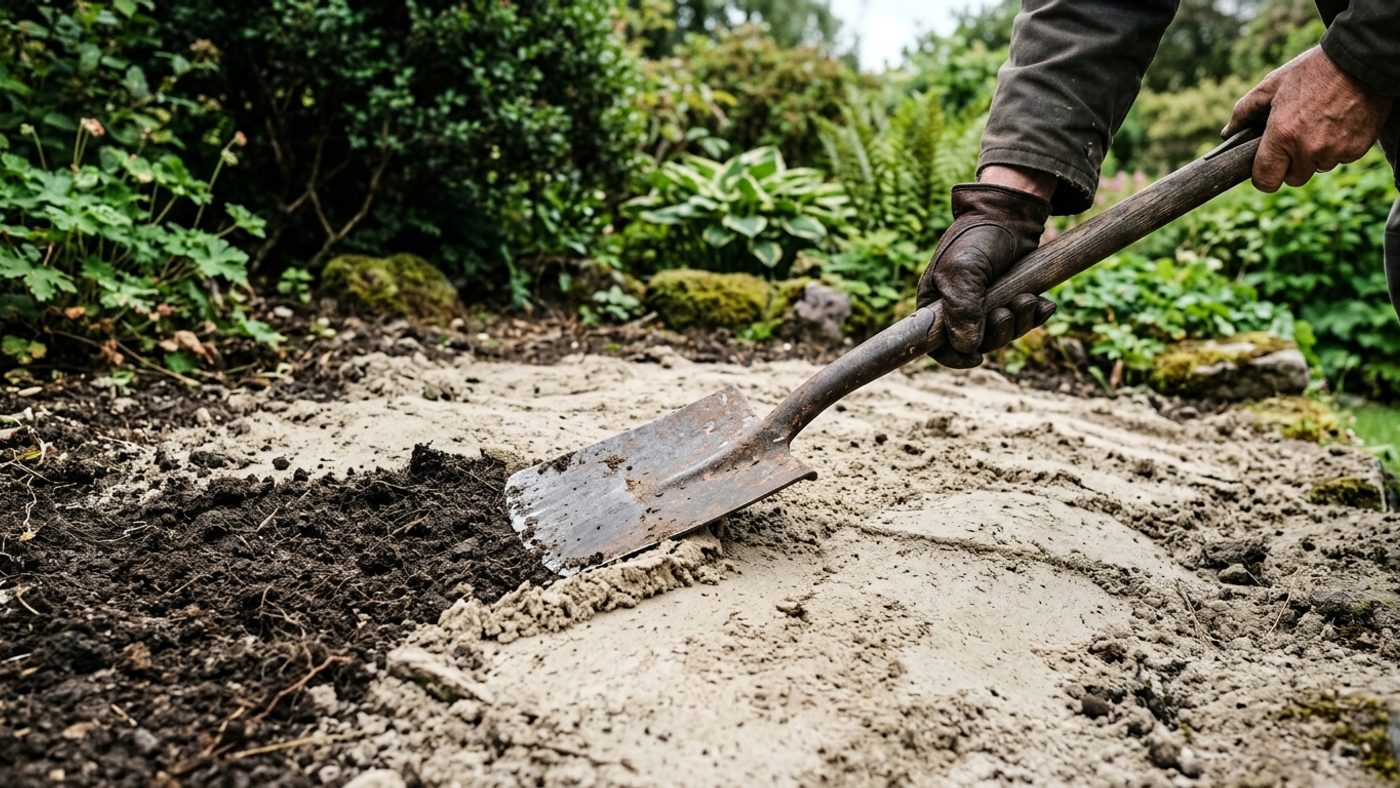
Compaction. Even without deliberate digging, the sheer weight of standing water compresses soil structure, and any foot traffic on top of that compounds it. The fix is not to jump straight back to cultivation but to rebuild structure gradually. Once the soil is dry enough to be worked without smearing, incorporating well-rotted compost, manure or leafmould is the standard longer-term approach to rebuilding soil structure after flooding. A no-digA growing method that avoids turning the soil over, building fertility instead by adding organic matter on the surface. Full definition → approach, mulchingA layer of material spread over the soil around plants to suppress weeds, retain moisture, and improve soil structure as it breaks down. Full definition → on the surface and letting worms and soil organisms do the incorporation, is a reasonable lower-disturbance alternative on a bed that's already stressed.
A word on soil type here: this fix isn't universal. Peaty and peaty-gley soils, common on the west coast, the islands and through much of the Highlands, don't respond to compaction the same way ordinary mineral clay does; they can turn anaerobic and hold onto acidity when saturated for long periods, and take noticeably longer to recover their structure than a Central Belt clay bed treated the same way. Organic matter still helps, but expect it to take longer to show a result on peaty ground, and don't assume a fix that worked fast on a friend's Lothian clay border will work as fast on a west Highland peat-based one.
For a border or bed that floods the same way every time there's heavy rain, rebuilding soil structure alone may not be enough: a spot with genuinely nowhere for water to go needs the same kind of engineered fix a waterlogged lawn does, a shallow drainage channel or a soakaway sited away from the problem area, or raising the bed itself so the root zone simply sits above the water table. That's more digging and more cost than a seasonal soil rebuild, so it's worth trying the organic-matter route for a season or two first and reserving it for a spot that keeps flooding regardless.
Contamination. Floodwater that has picked up road runoff, agricultural slurry from neighbouring land, or sewage overflow can leave more than mud behind. If you have any reason to suspect contaminated water reached a bed, proximity to a road, a farm, or a combined sewer overflow, that's a reason to prioritise that bed for a full organic-matter refresh rather than a light touch-up, and it changes what's safe to eat from it: see "The vegetable patch: what's safe to eat after flooding" below for the specific rules.
Nutrient loss. Heavy rain doesn't just physically batter a garden, it washes soluble nutrients, particularly nitrogen, straight out of the root zone before plants can use them, on top of whatever oxygen and structural damage has already happened. A plant that's otherwise recovering well from a flood, greening back up and pushing new growth, is a reasonable candidate for a general-purpose feed once that new growth actually appears; feeding too early, while roots are still stressed and not yet functioning normally, wastes the feed and risks scorching what's left of a damaged root system.
This is a different set of problems from lawn waterlogging, which usually comes down to compaction or a naturally heavy clay subsoil rather than a one-off contamination or silt event. For aeration, sand top-dressingAdding fresh compost, feed or grit to the soil surface around an established plant, rather than digging it in. Full definition → and the rest of the lawn-specific toolkit, see fixing a waterlogged lawn on clay soil.
If flooding has been severe enough to affect the house or garden significantly, national flood-recovery guidance points toward practical support beyond the garden itself: the Scottish Flood Forum offers free, independent advice to people whose homes or gardens have flooded, and Ready Scotland publishes wider preparedness and recovery information, worth knowing about even though neither is gardening-specific.
A flooded compost heap or a bag of bark mulch that's been sitting in standing water is worth a moment's thought too: an open heap that's simply waterlogged is fine once it's drained and turned, since composting is a wet process by nature, but treat it the same as the beds above if there's a real reason to suspect road or sewage contamination reached it, and don't spread suspect material anywhere near edible crops.
Paths, patios and hardscape drainage
Hard surfaces are often what turns a heavy-rain event into standing water in the first place, since they shed rain rather than absorbing it and can direct it straight toward beds or the house. After a flood, check that gullies, drains and the gaps between paving units haven't silted up; clearing them is often the single most effective thing you can do to stop the same low spot flooding again. Where a path or patio consistently sends water into a border, look at whether its fall (the slope) is actually directing water away from planted areas, and whether a permeable alternative, gravel, resin-bound surfacing, or paving laid with open joints, would let more water soak in locally rather than concentrating it downstream. Washing down hard surfaces and clearing away flood debris also matters for hygiene, particularly if there's any chance floodwater carried contamination across them.
Containers
Pots and containers flood differently from open ground because they have nowhere for excess water to go once their drainage holes are blocked or overwhelmed. Check every container after heavy rain: clear compost, leaves or silt from drainage holes, and tip out any saucer or tray that's holding standing water underneath the pot, since a well-drained container sitting in its own reservoir is functionally waterlogged regardless of what's happening in the compost above. If a container plant has been standing in water for more than a day or two, knock it out of its pot, check the roots using the same firm-versus-mushy test as for open ground, trim away any collapsed roots, and repot into fresh, peat-freeCompost made without peat, which is harvested from a slow-forming, carbon-storing wetland habitat that peat extraction damages. Full definition → compost with generous drainage material or a raised pot foot to keep the base clear of puddling inFilling a planting hole with water and letting it drain away before or after planting, to settle soil firmly around the roots and remove air pockets. Full definition → future.
Trees and shrubs standing in water
Established woody plants are more resilient than most border perennials, but standing water around the root collar, the point where trunk meets root, is a particular risk because that tissue is far less tolerant of prolonged saturation than the roots below it. If water has been standing against the trunk rather than just around the root zone, that's worth addressing specifically: clearing a shallow channel to let it drain away from the stem, even if the wider bed is still wet, protects the collar from rot while the rest of the root system recovers in its own time. Watch newly planted trees and shrubs particularly closely, since they haven't yet built the extensive root system that lets an established specimen shrug off a few sodden days.
Disease risk: root rots and waterlogging look alike
Waterlogged soil doesn't just starve roots of oxygen directly, it also creates exactly the conditions that water-mould pathogens like Phytophthora need to spread, since their spores travel through the thin films of water between soil particles. The frustrating part is that the disease produces very similar root symptoms to prolonged waterlogging: wilting, yellowing or sparse foliage, dieback, and rotted, blackened roots, to the point that telling the two apart often needs laboratory examination rather than a garden inspection. Acer, box, yew, rhododendron, and other woody ornamentals are among the more susceptible plants.
In practice this means two things. First, don't assume a plant that fails to recover after the soil has visibly drained is still just dealing with waterlogging; if healthy-looking neighbours in the same bed are fine but one particular shrub keeps declining, root rot infection rather than lingering waterlogging becomes the more likely explanation. Second, since there's no chemical control available to gardeners, prevention is about the same soil-structure work already covered above: better drainage and organic matter reduce how long soil stays saturated, and therefore how hospitable it is to the pathogen in the first place. Where a plant is lost to confirmed or suspected root rot, replacing the soil in that spot and avoiding susceptible species there again is the standard advice, since the organism can persist in soil for years.
The vegetable patch: what's safe to eat after flooding
This is the one place where the guidance is unambiguous rather than general, and it's worth following to the letter rather than judging by how a vegetable looks. Because floodwater can carry contamination from roads, land runoff or sewage, no assurance can be given that root crops that were under floodwater are safe to eat, so they should be discarded outright. The same caution applies to anything normally eaten raw: salad crops in particular should be avoided from that ground for two years, since disease organisms can persist in the soil that long. Crops that will be cooked are considered safe to grow again the year after flooding, once that first cautious year has passed.
That two-year wait for raw crops stings more against Scotland's already-shorter growing season than it would further south: there's less slack to simply grow it somewhere else this year and come back to this bed later, when the usable outdoor season is tighter to begin with. It's a real reason to treat a flood-affected vegetable patch's out-of-action spell seriously when planning next year's rotationMoving each crop family to different ground each year, on a multi-year cycle, so pests and diseases that build up in soil don't get a repeat host. Full definition →, rather than assuming a single skipped season covers it.
How much of this is a distinctly Scottish problem?
Scotland's rainfall trend genuinely does stand out from the rest of the UK, but the picture is far more regional than a single national label suggests, and it's worth being precise about which claim the evidence actually supports.
On trend, Scotland has seen the greatest increase in rainfall of any UK nation, while most southern and eastern areas of England have seen the least change, set against a UK-wide picture where 2011-2020 was 9% wetter than 1961-1990, extremely wet days are now roughly 20% more frequent than the 1961-1990 baseline, and days with 50mm-plus rainfall have become more common. The direction of travel is real, and Scotland is genuinely the sharpest end of it within the UK.
On totals, the picture is much more regional than "Scotland" as a single label suggests (our general watering technique guide has the full regional range):
| Region | Average annual rainfall |
|---|---|
| East Lothian, Fife, Moray Firth coasts | Under 700mm |
| Comparable driest parts of eastern England | Around 500mm |
| Western Highlands (higher ground) | Over 3,500mm |
A garden in Fife and a garden in Argyll are not facing the same flood-recovery risk by default.
Both regional Met Office climate summaries also record specific historical flood events tied to prolonged rainfall on saturated soil, the same mechanism covered at the start of this guide:
| Event | Date | What happened |
|---|---|---|
| Tay valley flooding | 14-17 January 1993 | 115mm of rain over three days onto melting snow; River Tay at Perth reached its highest level since 1814 |
| Borders, Lothians, Tayside | Late October 2002 | A deep depression brought 70-80mm of rain, disrupting road and rail transport |
| North-east Scotland | November 2002 | About 75mm of rain in 48 hours; the River Lossie burst its banks at Elgin |
| Glasgow-Irvine area | 10-11 December 1994 | 133mm over two days from a slow-moving front; flooding in the River Irvine catchment |
On property-level flood risk more broadly, SEPA's National Flood Risk Assessment (published December 2025) puts around 400,000 Scottish properties, about 1 in 8, at medium flood risk today, up from 284,000 in the 2018 assessment, with that figure projected to keep rising with climate change. That's a real and rising number, but SEPA's assessment doesn't make a comparison against the rest of the UK, so it can't be used to support "Scotland is disproportionately at risk of flooding" specifically, only that Scottish flood risk is significant and increasing on its own terms.
So the honest answer is a qualified one. The rainfall trend genuinely is sharper here than in most of the UK, and that much is well evidenced above. But calling garden flood recovery a defining Scottish problem overstates it for large parts of the country: a Fife or Lothian gardener is working with rainfall totals closer to eastern England than to the west Highlands, and none of the techniques in this guide, reading root damage, rebuilding soil, choosing what to salvage, are unique to Scotland. Where the label fits best is the west and the Highlands specifically, and for a practical reason worth carrying into how you plan a garden there: build in the assumption that any low-lying bed will see genuine standing water more than once in a typical decade, and choose what goes in it, and how far you're willing to fight the site, with that in mind from the start rather than after the first flood.
Common questions
Does it take longer to dry out on clay than on sandy soil?
Considerably longer. Heavy clay holds onto water far longer than a free-drainingSoil that lets water pass through quickly rather than pooling, so roots aren't sitting in wet ground after rain. Full definition → sandy or loam soil in the same weather, so the 'stay off it' period after heavy rain can genuinely stretch to a week or more on clay-heavy ground, against a couple of days on lighter soil. If you're not sure which you've got, digging up a handful and rolling it between your fingers is a quick test: clay stays smooth and sticky when wet, sand falls apart.
Do I need to report a badly flooded garden to anyone, or just deal with it myself?
For most garden flooding, no, it's a job for you and your fork, not officialdom. If flooding has been severe enough to affect the house as well as the garden, or you suspect sewage contamination reached growing areas, the Scottish Flood Forum offers free independent advice and is worth contacting: it's a charity set up specifically to support people through exactly this.
A shrub's leaves are wilting even though the soil around it is soaked: is that just waterlogging?
It could be simple waterlogging, but it's also the classic presentation of Phytophthora root rot, which produces very similar symptoms and often needs a look at the roots (or lab testing) to tell apart. If nearby plants in the same wet bed are unaffected while one keeps declining, root rot becomes the more likely explanation, and there's no chemical treatment available: improving drainage and, if it's confirmed, avoiding replanting the same susceptible species in that spot are the practical responses.
Can a tree or established shrub survive standing in water for several days?
Often yes: established woody plants have more root reserve than young plants or perennials and can tolerate a few sodden days without lasting harm, especially in cool weather. The main thing to watch is water standing directly against the trunk or root collar rather than just around the wider root zone, since that tissue is more vulnerable, and it's worth digging a shallow channel to clear it even while the rest of the bed is still drying out.
Is this the same advice as recovering a waterlogged lawn?
No. Lawns typically waterlog because of compaction or a heavy clay subsoil rather than a flood event, and the fix (aeration, sand top-dressing, scarifying, French drains) is quite different from what a border, vegetable bed or shrub needs. See our guide to fixing a waterlogged lawn on clay soil for the lawn-specific approach.
Sources
7 sources, recorded with what each was used for
- RHS: Waterlogging and Flooding Solutions: The mechanism of root damage, symptoms, short-term and long-term fixes, and edible-crop safety guidance after flooding
- RHS: Phytophthora Root Rot: Root rot disease mechanism, symptoms, and how it is distinguished from ordinary waterlogging damage
- Met Office: Eastern Scotland climate: Eastern Scotland rainfall totals and the 1993 Tay valley and 2002 flood events
- Met Office: Western Scotland climate: Western Scotland rainfall totals, the 1994 Glasgow-Irvine flood event, and the driest-parts-of-eastern-England comparison figure
- Met Office: UK and Global Extreme Events - Heavy Rainfall and Floods: Scotland's rainfall-increase trend relative to the rest of the UK, and UK-wide extreme rainfall frequency data
- SEPA: National Flood Risk Assessment: Current and projected proportion of Scottish properties at flood risk
- gov.scot: Managing flood risk: National flood risk policy context and homeowner support services (Scottish Flood Forum, Ready Scotland)