
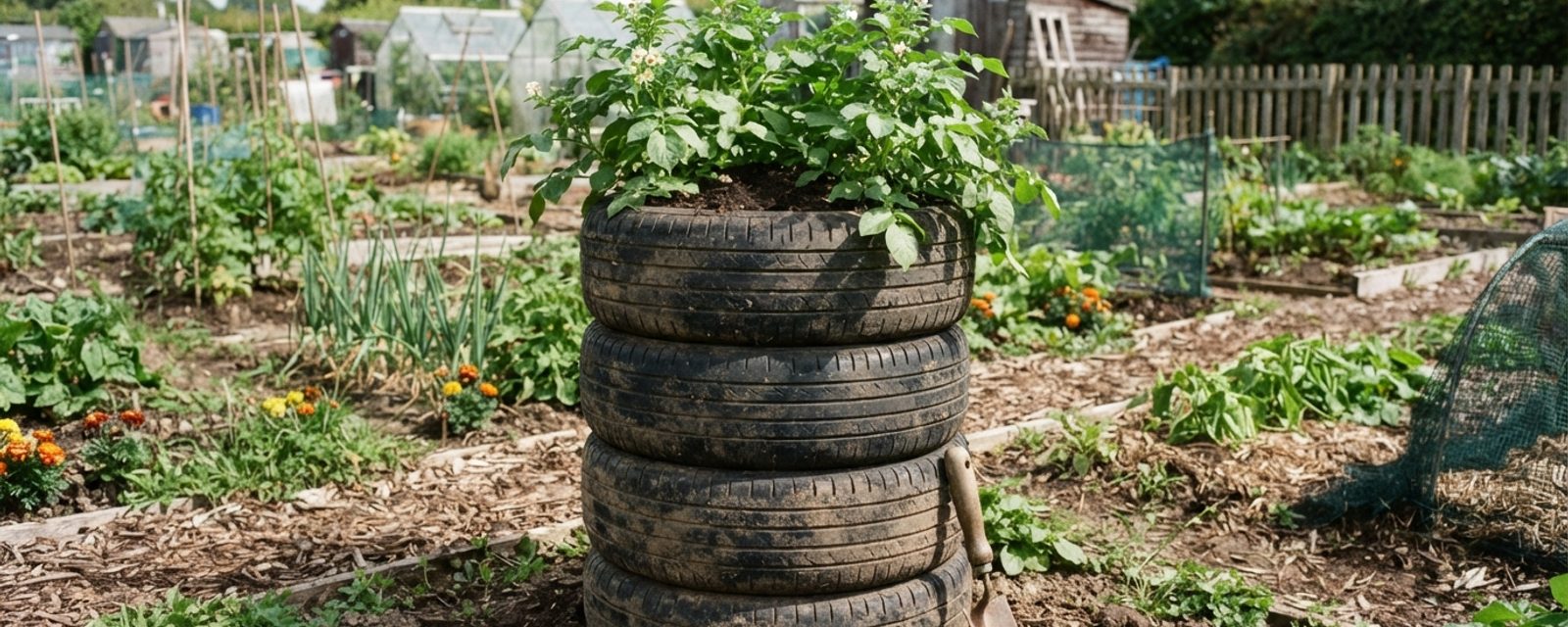
A car tyre is not a lump of inert rubber. It's an engineered composite: a synthetic and natural rubber matrix reinforced with steel belting and fabric cord, bulked out with carbon black, there to add strength and abrasion resistance, and bound together through vulcanisation, a process that uses sulphur and zinc oxide to cross-link the rubber polymers into a durable solid. Beyond that, the rubber compound carries antioxidants and antiozonants (to stop the tyre perishing in sunlight and ozone), plasticisers and processing oils (to keep the compound workable), and residual polycyclic aromatic hydrocarbons (PAHs) left over from the oils used in manufacture.
None of that is a problem while the tyre is doing its job on a car, sealed and dry. It becomes a different question the moment you fill the same object with moist soil, plant food crops in it, and leave it outdoors in a Scottish garden for years. Every one of the additives above exists in the rubber precisely so it can migrate to the surface and do something, that's what an antioxidant or a vulcanising agent is for. The question worth asking isn't "does tyre rubber contain anything nasty," it clearly does, but "does enough of it move into the soil, and then into an edible plant, to matter."
What actually leaches, and how fast
The clearest peer-reviewed picture comes from research into tyre crumb rubber, the shredded rubber used in artificial sports pitches and playgrounds, which has been studied far more than solid tyre carcasses because it's used at scale near children. A 2022 review in the journal Polymers on rubber crumb's soil and water impact found that zinc is the dominant metal released, and that leaching is progressive rather than a one-off event: in soaking trials, dissolved zinc rose from 0.273 mg/L after 24 hours to 7.041 mg/L after 21 days, a roughly 25-fold increase over three weeks with no sign of levelling off. Lead, copper and cadmium were not detected in that study's crumb samples, which the researchers attributed to EU restrictions on those metals in tyre manufacture. The same review measured total PAHs in rubber crumb at just over 58 mg/kg, and noted that the rate of both zinc and PAH release depends heavily on pH, particle size, and how long the rubber sits in contact with water, smaller particles and more acidic, wetter conditions release more, faster.
That last point has a direct Scotland angle, though it needs stating carefully. A solid tyre carcass has far less exposed surface area than shredded crumb, so it leaches more slowly than the crumb-rubber studies suggest, but the same rule about moisture applies in the other direction: more time with wet soil against the rubber means more leaching, not less. A tyre bedded permanently in wet compost for several growing seasons is a more persistent leaching setup than the short soak tests most studies use, which cuts against the "it's only in contact for one growing season" reassurance you'll see elsewhere. Three Scottish conditions bear on that mechanism, and they don't all point the same way:
| Scottish condition | Effect on leaching | Direction |
|---|---|---|
| Frequent rainfall (under 700mm/year on the Fife/East Lothian coast, considerably more in the wetter west and uplands) | Keeps compost against the rubber damp for more of the year than a drier climate would | Worse |
| Naturally acidic soil, common in western and upland gardens and allotments | Acidic conditions release more zinc, faster, per the cited leachate research | Worse |
| Comparatively low sunshine hours | Less UV exposure means slower surface weathering, and weathering itself increases zinc release | Better |
None of these have been tested on an actual tyre planter in a Scottish garden, they're general climate and soil-chemistry factors applied to what the leachate research shows, not a Scotland-specific tyre study. The honest summary is that Scotland's rainfall and soil acidity plausibly push risk up, while the low-sunshine climate plausibly slows the worst-case weathering effect down; nothing here nets those factors out to a single number.
Everything above is about car tyres specifically. Tractor and lorry tyres, sometimes used for larger raised beds, are a different rubber compound and construction, and none of the sourcing here has been checked against them.
There's also a second contamination pathway that's easy to overlook, given the focus so far is entirely on the rubber compound itself: a tyre described as "old" has usually spent years on a road first, not just years outdoors as a planter. Road use leaves brake-dust metals, oily grime, and, in Scotland especially, given how much road salt and grit gets used each winter, de-icing salt residue embedded in the tread and sidewall. None of the sourcing above measures that road-use residue; it's a separate, additional pathway on top of the rubber-compound leaching this article focuses on, not one this piece can quantify.
The Polymers review's plant data comes from standard ecotoxicology assays, root growth inhibition in mustard and lettuce seedlings exposed to leachate, not vegetables grown in tyres and eaten, showing 31-44% root elongation inhibition at the concentrations tested. That shows the leachate is bioactive enough to affect a plant's roots; it doesn't show how much zinc or PAH residue ends up in a tomato or a potato grown in a tyre for one Scottish summer, and no study has measured that directly.
Does the plant type change the risk?
With no direct study to rank crops by, the most defensible way to assess risk is by how each crop type physically interacts with the soil, root crops sit in direct, sustained contact with the rubber and soak up water-soluble metals through their tissue; leafy crops take up less zinc but grow fast and get eaten whole and raw; fruiting crops are furthest from the rubber and the edible part develops away from the point of contact.
| Crop type | Contact with tyre/soil | Main risk pathway | Relative risk |
|---|---|---|---|
| Root crops (potatoes, carrots, beetroot) | Direct — edible part grows in the contaminated zone | Water-soluble metal salts (zinc) taken up through root tissue | Higher |
| Leafy crops (lettuce, spinach, chard) | Indirect via roots, but eaten raw and unwashed leaf surfaces | Metal uptake into leaf tissue; no cooking step to reduce exposure | Moderate |
| Fruiting crops (tomatoes, peppers, courgettes) | Indirect — fruit develops above soil, away from the tyre wall | Uptake is diluted by the distance any metals travel from root to fruit | Lower |
This ranking is inference from plant physiology and the leachate-uptake literature, not a study that tested tyre-grown vegetables directly.
What actually reduces the risk
| Mitigation | What it does | Limitation |
|---|---|---|
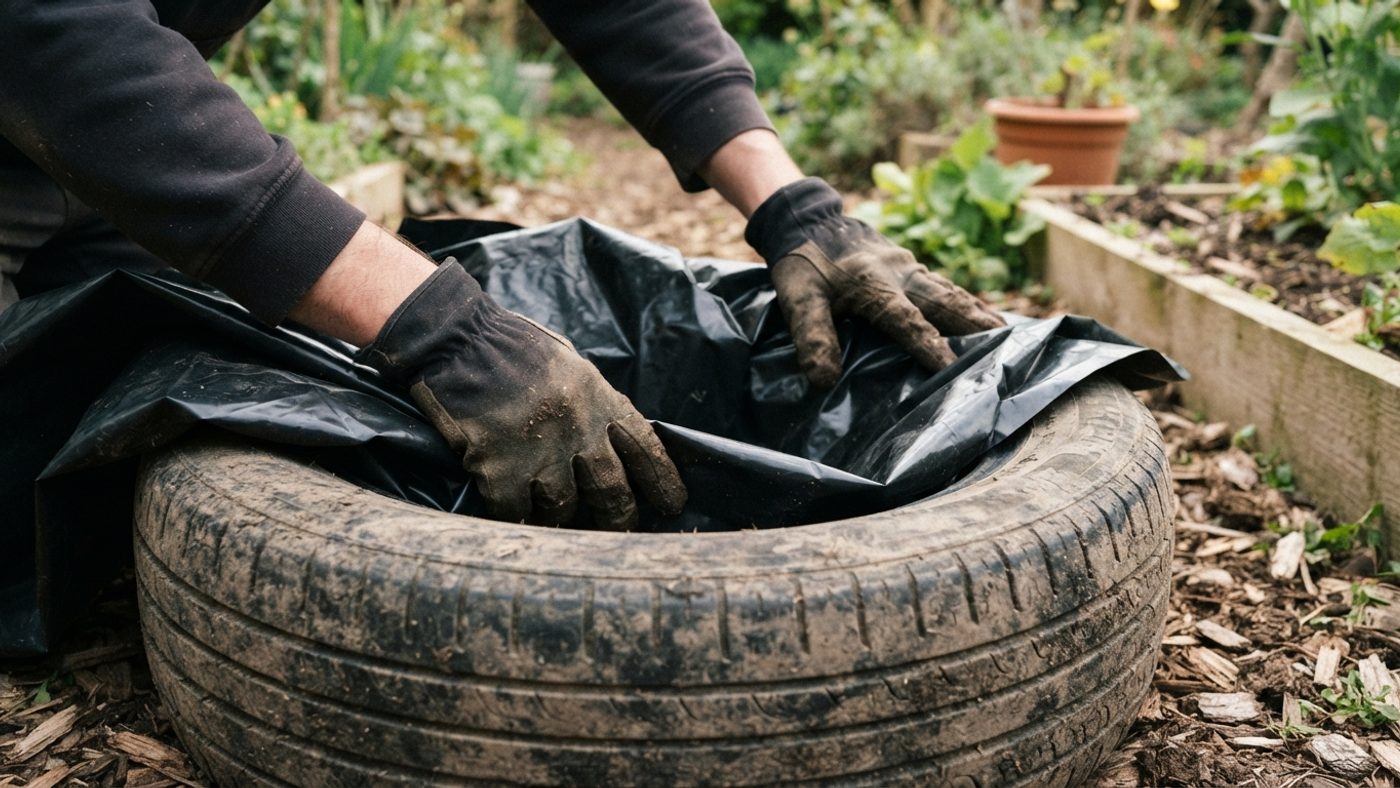
| Line the tyre with heavy-duty plastic sheeting before filling with soil | Physically blocks soil-to-rubber contact | Plastic itself can leach plasticisers, especially in sun and heat, a different, generally milder risk |
| Use tyres only for ornamental or flowering plants, not edibles | Removes the ingestion pathway entirely | Doesn't solve the problem if you specifically want tyre planters for vegetables |
| Choose fruiting crops over root or leafy crops if using tyres for food | Puts more physical distance between the contamination source and the edible tissue | Reduces, does not eliminate, exposure |
| Replace tyres used for edibles every 1-2 seasons rather than leaving them for years | Limits cumulative leaching time in one growing bed | Doesn't address that some leaching starts quickly, not just after years |
| Use painted or coated tyres | Marginally slows surface weathering | Most exterior paints aren't a real vapour/moisture barrier long-term, and paint itself can flake into soil |
The verdict
Tyres do have a genuine, widely-practised growing advantage behind their popularity: black rubber absorbs heat, and stacking tyres around early potatoes to warm cold Scottish soil in spring is a long-standing allotment technique, for that reason. That benefit is real, even though, like most long-standing gardening techniques, unlike the leaching chemistry above, it rests on practical experience rather than a cited study. But it has to be weighed against a source of leachable zinc and PAHs that is also real, not hypothetical, well established by the crumb-rubber literature, and not eliminated just because a solid tyre carcass leaches more slowly than shredded rubber. What's missing is any study that has actually measured how much of that leachate ends up in a vegetable grown in a tyre, so nobody can give a hard number for how much zinc or PAH residue is in a tyre-grown carrot.
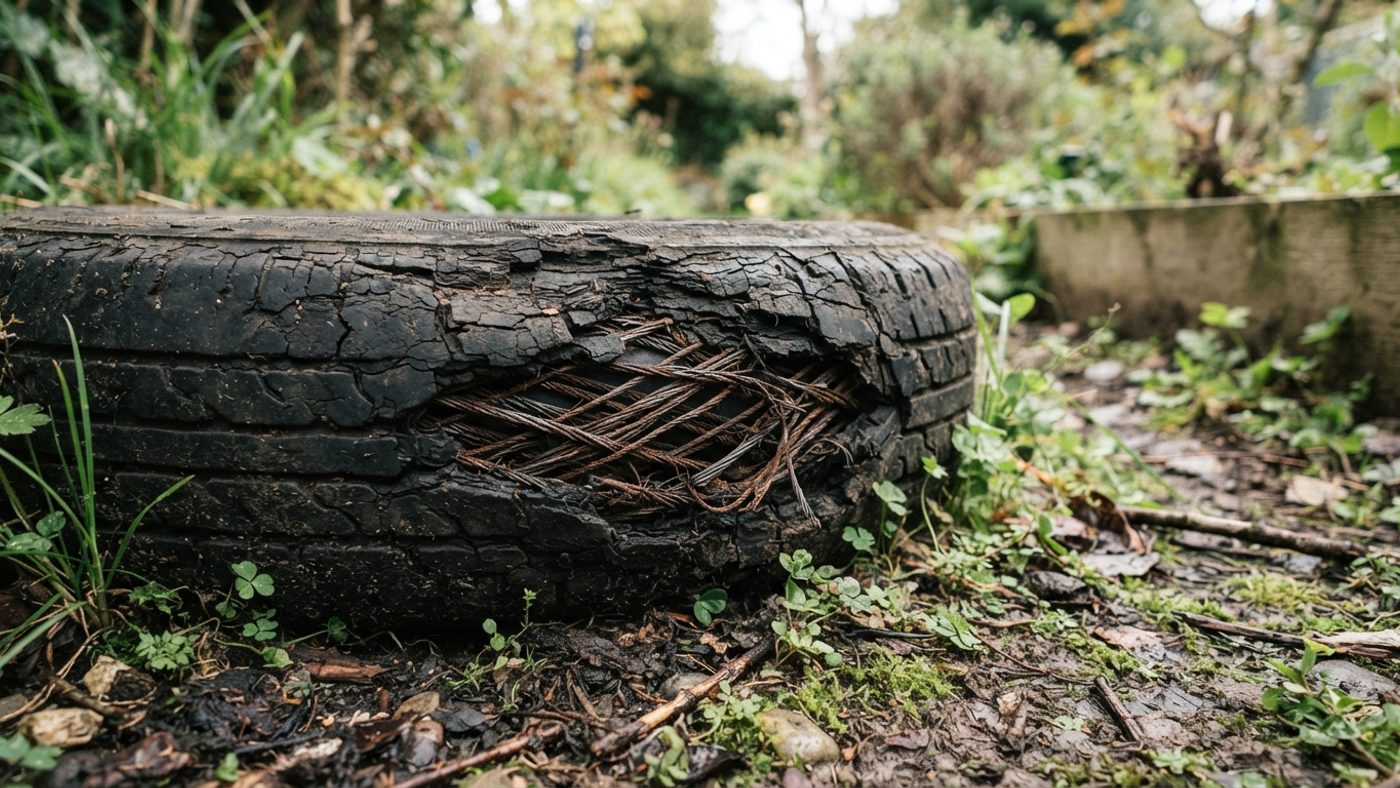
Weighed against that gap, the honest position is caution rather than reassurance: for a single ornamental planter, or a fruiting crop grown for one season, the risk is plausibly low, and the heat benefit may be worth it. For potatoes, carrots or other root vegetables grown in the same tyre year after year in Scotland's wet, often acidic soil, the mechanism for meaningful zinc uptake is real, and the thing that would settle it either way, an actual crop-testing study, doesn't exist. If you've been growing root vegetables in tyres for years without testing the soil or the harvest, that's a genuine unknown, not a settled "probably fine," a commercial soil-testing lab can test for heavy metals directly, which is the concrete way to find out rather than guess. A raised bed built from timber, brick, or a food-safe container removes the question altogether and costs little more than tyres you'd otherwise be disposing of anyway. A cracked, weathered tyre also exposes its steel belting at the sidewall, a real cut hazard worth checking for regardless of the chemical question, especially with children around the bed. That matters beyond the average back garden: tyre stacks are a common starter project for school and community-garden vegetable beds in Scotland, which is exactly the setting where both the chemical caution above and the physical check for exposed steel matter most.
Common questions
Are new tyres worse than old, weathered ones?
The available leaching data points the other way for some compounds, UV and weathering age PAHs down over time as surface layers break down and blow away, but the cited leachate review found the opposite effect for zinc: UV-aged rubber released roughly 24 times more zinc in leachate than unweathered samples, because photodegradation lowers the leachate's pH and acidic conditions dissolve zinc oxide faster. An old tyre that's spent years outdoors isn't automatically the safer choice.
Is it illegal to dispose of tyres by using them as planters?
No, reusing a tyre as a planter is not disposal, and using your own tyres this way isn't regulated. SEPA, which regulates Scotland's tyre sector from manufacture through to recovery, tracks roughly 100 tyres becoming waste every 15 minutes across the country, that regulation covers dumping, burying, burning, or landfilling tyres in bulk, not a domestic gardener reusing a handful of them in their own garden.
Does painting the tyre make it safe?
Painting slows surface weathering slightly but does not create a real barrier against zinc or PAH migration into soil, since the rubber underneath is still in contact with wet compost through cracks, the tyre's inner rim, and any point where the paint fails. Lining with plastic sheeting is a more effective physical barrier than paint, though it introduces its own minor leaching from the plastic itself.
What's actually safer than a tyre for a raised bed?
Untreated or naturally rot-resistant timber (larch, oak, or reclaimed scaffold boards), brick, or purpose-made food-safe raised bed kits avoid the question entirely. Avoid old railway sleepers unless confirmed creosote-free, since creosote carries its own well-documented PAH contamination risk.
If I get my soil tested, will that tell me it's safe?
Only partly. A standard commercial soil-metals test will show elevated zinc if it's present, which answers half the question. Routine soil tests don't typically screen for PAHs at all, since that needs a different, more specialist and more expensive lab analysis, so a clean metals result doesn't rule out the PAH side of the concern. There's also no published "safe zinc-in-soil-for-vegetables" threshold specific to this scenario to compare a result against, a soil test narrows the uncertainty, it doesn't remove it.
Sources
4 sources, recorded with what each was used for
- SEPA: Tyre Sector Plan consultation page: Scotland's waste tyre volume (approximately 100 tyres turned into waste every 15 minutes) and confirmation SEPA regulates the tyre sector across manufacture, use, and recovery
- Environmental Consequences of Rubber Crumb Application: Soil and Water Pollution, Polymers 14(7):1416, 2022: Zinc and PAH leaching concentrations and timeframes, the effect of UV weathering on zinc release, factors affecting leaching rate (pH, particle size, exposure time), and plant/organism ecotoxicity findings
- Met Office: Eastern Scotland climate (regional rainfall data): The under-700mm/year figure for the Fife/East Lothian coast
- HSE: Rubber industry guidance hub: Checked directly — HSE's published rubber-industry material is occupational (worker exposure, storage, fire risk) rather than environmental-leaching guidance, so no HSE claim on soil contamination is made in this article
Note on sourcing gaps: the RHS has no published position on tyre or rubber planters specifically, as of this writing. No peer-reviewed study tests vegetables grown in tyre planters, as opposed to tyre crumb rubber, for contaminant uptake.