
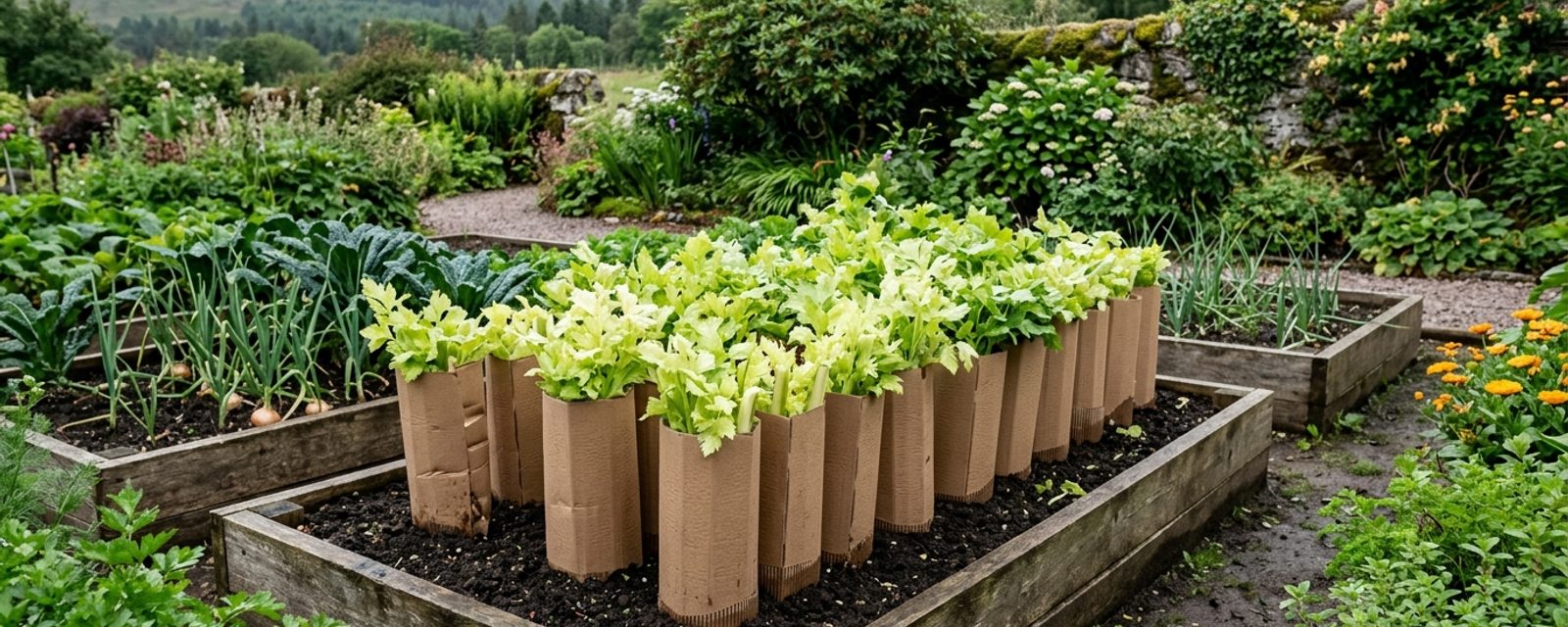
Celery didn't start out as a garden vegetable. Its wild ancestor grows in boggy, brackish ground around European coastlines and marshes, permanently wet, low in oxygen, never short of water. Everything about the cultivated plant still carries that inheritance. Celery has no mechanism for coping with dry soil the way a bean or a beetroot does; it simply stops growing well and turns stringy. And because it germinatesA seed sprouting: breaking dormancy and putting out its first root and shoot, given the right warmth and moisture. Full definition → and grows on as a small, exposed seedling for weeks before it goes into open ground, that early stage is also its most vulnerable to cold, a chill held for long enough tells the plant it has already lived through a winter, and it responds by boltingA plant switching early into flowering and seed production, usually triggered by stress, after which leaves, roots or bulbs turn bitter or unusable. Full page →: throwing up a flower stem instead of building the stalks you want to eat. Choosing a celery variety for Scotland is really about managing those two inherited weaknesses, moisture dependency and cold-triggered bolting, against a climate that stresses both.
Quick answer
Tango is the best all-round choice for most Scottish gardens: it blanches itself in a block without earthing upDrawing soil up around a plant's base as it grows, most often potatoes, to keep light off developing tubers and support tall stems. Full definition →, grows fast, and is specifically noted for good bolting tolerance, which matters most where a late, unreliable spring keeps young plants exposed to marginal night temperatures. Where celery leaf spot is a recurring problem in cool, damp summers, Granada's disease tolerance makes it the better pick. Victoria suits anyone who wants the strongest flavour and doesn't mind a longer, later-maturing plant grown in a trench.
Why bolting is the central risk here
Young celery bolts, throws up a flower stem instead of building stalks, once night temperatures drop below 10°C for more than 12 hours at a stretch, a threshold a late, unsettled spring can dip below even after the standard late-May planting-out date, which is why bolt-resistance as a named varietal trait is worth weighing rather than assuming any variety copes equally. Germination is a second cold-weather hurdle: celery seed needs at least 15°C to germinate at all, and can take up to three weeks even at that temperature, so a windowsill or heated propagator makes a real difference to a Scottish sowing in March. See the full growing guide for exact sowing steps and the blanchingExcluding light from part of a growing plant, usually by earthing up, wrapping or covering, so it grows pale, tender and less bitter. Full definition → method.
Celery is also sensitive to soil acidity: growth becomes increasingly restricted below pH 6, and the preferred range is 6.5–6.8. Test the bed before sowing, and raise it with garden lime if it comes back too acidic.
The five varieties compared
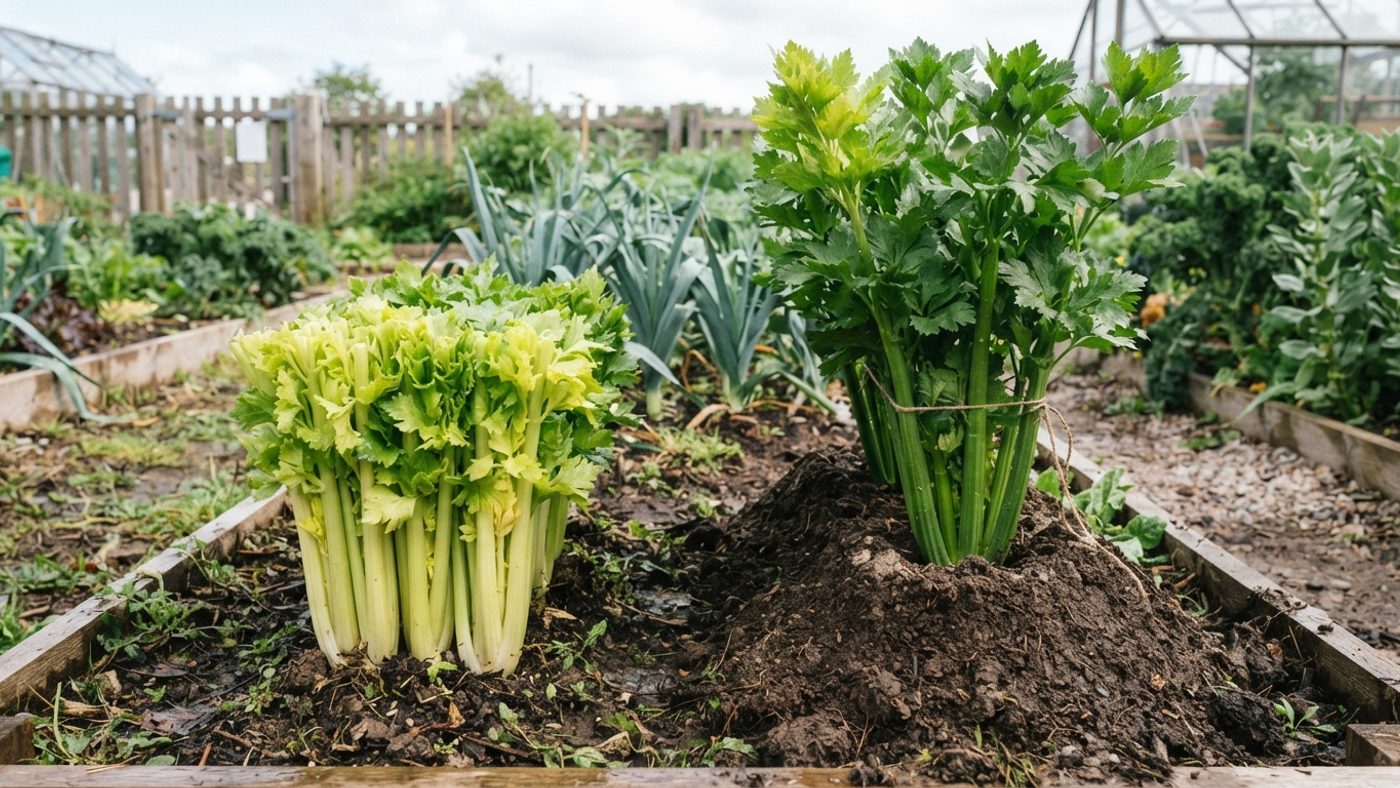
Five celery varieties carry individual descriptions: Tango, Victoria, Granada, Tall Utah 52/70 and Loretta. Each has its own individual plant page, and, as the section after the table explains, those pages don't always agree with the general summary page on AGMThe RHS's Award of Garden Merit: a UK-wide trials award for reliable performance, not a Scotland-specific recommendation. Full definition → status. All five share the same hardiness ratingThe RHS's H1a–H7 scale for how much cold a plant can survive outdoors, H1a being tender indoor-only and H7 hardy anywhere in the UK. Full definition →, H2: tolerant of low temperatures but not frost, so whichever is grown needs to come indoors or under cover before the ground freezes.
| Variety | Type | Height/spread | Disease notes | Other named traits |
|---|---|---|---|---|
| Tango | Self-blanching | 0.1–0.5m | — | Good bolting tolerance, no side shoots, tolerates less-than-ideal conditions |
| Victoria | Upright, needs earthing up or a trench | 0.5–1m | Celery leaf spot, celery heart rot, celery fly, slugs, snails, bolting, split stalks | Best-flavoured, good standing ability, slow to bolt |
| Granada | Self-blanching | 0.1–0.5m | Good disease tolerance; generally disease-free | Strong, high-yielding, tightly-bunched stalks |
| Tall Utah 52/70 | Self-blanching, no earthing up needed | 0.1–0.5m | Celery leaf-mining fly, slugs, snails, celery leaf spot | Tightly folded hearts, thick, crisp, stringless stems, high yield |
| Loretta | Self-blanching (plant in blocks) | 0.1–0.5m | Slugs, snails, celery leaf spot | Tolerates full sun to partial shade; smooth, thick, fleshy, sweet stems |
A few things the table can't show cleanly. Victoria is the tallest of the five and the only one not self-blanching on its own page, it needs earthing up or a trench. It's also the only variety with celery heart rot explicitly named as a susceptibility, alongside celery leaf spot. Loretta is the only one of the five with any tolerance for shade named on its own page; the other four are listed as full-sun plants. Granada's "good disease tolerance" and "generally disease-free" wording is the strongest disease-resistance language of the five, the rest either don't mention disease tolerance at all or carry named susceptibilities, mostly to celery leaf spot.
The AGM discrepancy
The general grow-your-own summary page marks Tango, Victoria and Tall Utah 52/70 with the AGM symbol, and two of those three even carry "-agm" in their own plant-page web address. Yet none of the three individual plant pages themselves display an AGM badge or the words "Award of Garden Merit" anywhere on the page. Granada and Loretta aren't marked AGM on either page, so there's no disagreement for those two, take Tango, Victoria and Tall Utah's AGM status as contested rather than settled.
Tall Utah 52/70
Tall Utah's tightly folded hearts blanch themselves without earthing up, and produce thick, crisp, stringless stems at a high yield, the only one of the five with that specific combination. It's also the variety Gardener's World features in its step-by-step sowing demonstration, an ordinary, widely-grown choice rather than a niche one. Best suited to anyone prioritising stem texture and straightforward blanching over Tango's bolt-resistance specifically.
Loretta
Loretta's one distinguishing trait against the other four is tolerance of partial shade, genuinely useful in a garden with overhanging trees, a north-facing bed, or a wall casting afternoon shade, all common enough constraints in smaller Scottish gardens. It carries no disease-tolerance language and no bolt-resistance claim to offset that, so it's a niche pick: choose it specifically because the plot has shade to work around, not as a general alternative to Tango or Granada.
Best pick by situation
- Most gardens, most years: Tango, for the combination of bolt-tolerance and self-blanching, the simplest route to a reliable crop.
- Recurring leaf spot problems: Granada, for its stated disease tolerance, worth foregrounding specifically because cool, damp Scottish summers let celery leaf spot run longer than in a drier climate.
- Best flavour, willing to trench or earth up: Victoria, with the caveat that it's the tallest and slowest of the five and needs blanching by hand.
- Thick, stringless stems without earthing up: Tall Utah 52/70.
- A shaded or partly-shaded bed: Loretta, chosen specifically for its light tolerance rather than any disease or bolting advantage.
Gardener's World also names Celebrity, a self-blanching variety, in its general celery coverage, worth knowing about as another option if none of the five above suit, though it has no individual RHS plant page behind it.
Spacing, timing and season length
| Self-blanching (Tango, Granada, Tall Utah, Loretta) | Trench (Victoria) | |
|---|---|---|
| Spacing | 23cm each way in a block | 30–45cm in single rows |
| Sow | Mid-March–early April | Mid-March–early April |
| Plant out | Late May–June, once nights hold above 10°C | Same |
| Ready to harvest | About 25 weeks from sowing | About 40 weeks from sowing |
| Harvest window | Mid-summer to autumn, before first frost | Late autumn to early winter, hardier to frost with fleeceA lightweight, breathable fabric laid or draped over plants to trap a little warmth and keep off frost, wind and some flying pests. Full definition → |
Victoria's 40-week season runs well into the second half of the year, so its later, harder frosts need covering with clochesA small, portable clear cover placed over an individual plant or short row to trap warmth and keep off wind, rain and pests. Full definition → or fleece to keep the crop going. Check regional frost timing before committing to it for that reason; the self-blanching varieties all finish before the first frost regardless. Growing it in the traditional trench also means backfillingThe soil (sometimes improved with grit or compost) used to fill the gap around a plant's roots after it's placed in its planting hole. Full definition → with well-rotted manure or compost before planting, since celery is a hungry crop and the trench is the one method here that needs feeding built in from the start rather than added later. In containers, use the same 23cm spacing in a large pot sited somewhere sunny and sheltered, pots dry out faster than open ground, so water more often, not less.
Slugs and snails are a named risk on four of the five varieties and a genuine, common problem in damp Scottish gardens, protect young plants at planting time, when they're most vulnerable. Tall Utah and Victoria both carry celery leaf mining fly or celery fly as a named susceptibility; fine insect mesh over young plants is the practical defence.
Celery is roughly 95% water and turns stringy fast on a missed watering, more sensitive to this than most vegetables, keep the soil consistently moist through the season whichever variety is grown. A plant that's already bolted won't recover: the stalks turn bitter and woody once the flower stem takes over, so it's worth pulling and starting again rather than waiting for it to improve.
Common questions
Do I need to water Tall Utah less than Tango since it doesn't need earthing up?
No, earthing up and watering are separate needs. All five varieties are equally sensitive to a dry spell; choose between Tango and Tall Utah on bolt-resistance versus stem texture, and keep the same watering routine either way.
Does an AGM award mean a variety performs better in Scotland?
Not specifically. The Award of Garden Merit reflects general UK garden performance rather than a Scottish trial, and in celery's case the award status itself is disputed between two RHS-published pages for three of the five varieties. Named traits like bolt-tolerance or disease tolerance are more useful for a Scottish garden than AGM status.
Does growing celeriac affect which celery variety I should choose?
Celeriac is the same species as celery, bred for a swollen root rather than stalks, and growing either where the other has recently grown raises celery leaf spot risk. Rotate them as one crop regardless of which celery variety is chosen.
Which variety is least likely to bolt if the spring stays cold?
Tango is the only one of the five with bolting tolerance stated directly on its own plant page. Victoria is described as slow to bolt and good in difficult spring conditions, a related but softer claim.
Sources
10 sources, recorded with what each was used for
- Apium graveolens var. dulce 'Tango': Variety description, hardiness, height/spread, bolting tolerance, no AGM badge on its own page
- Apium graveolens var. dulce 'Victoria': Variety description, hardiness, height/spread, named susceptibilities, no AGM badge on its own page
- Apium graveolens var. dulce 'Granada': Variety description, disease tolerance, spacing, hardiness
- Apium graveolens var. dulce 'Tall Utah 52/70': Variety description, named susceptibilities, no-earthing-up trait, no AGM badge on its own page
- Apium graveolens var. dulce 'Loretta': Variety description, shade tolerance, susceptibilities
- Celery: Grow Your Own: AGM listings on the summary page, planting-out timing and bolting threshold context
- How to Grow Celery: Self-blanching spacing corroboration, harvest timing figures
- Celery Technical Note (2020): Soil pH requirement
- How to Sow Celery: Tall Utah as the featured sowing-demonstration variety
- Apium graveolens: Moisture requirement wording, 'Celebrity' variety mention