
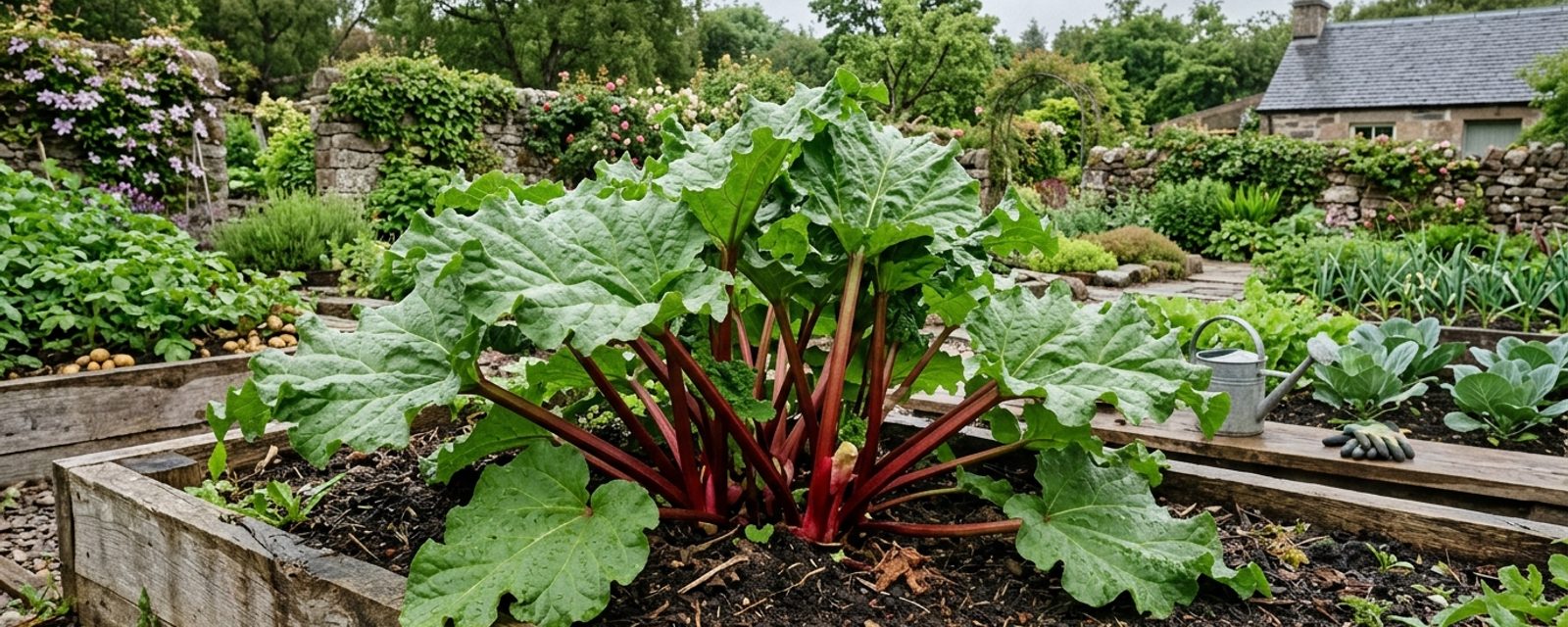
A rhubarb crown spends its whole first two years underground doing almost nothing visible: building up the root reserves it will spend, in one concentrated burst, the moment the soil warms in spring. Which variety you plant decides how that burst is timed and shaped, whether it happens weeks early under a forcingCovering plants to exclude light and speed early, tender growth in the dark, most associated with rhubarb and sea kale in late winter. Full definition → pot, arrives as a heavy hands-off crop from April with no extra work, or, unusually, comes round again in autumn instead of stopping in midsummer like every other variety does. That timing decision matters more for rhubarb than for almost any other crop on this site. Rhubarb needs several weeks of proper winter cold to break its crownsThe base of a perennial plant where roots and shoots meet, often sold and planted as a ready-made dormant plant rather than grown from seed. Full definition → out of dormancy before it will grow at all, deliberately chilling crowns for about two weeks before forcing is standard practice for exactly this reason, and an ordinary Scottish winter supplies that cold outdoors without any effort. The choice of variety is what decides whether you get a March harvest or a July one, not whether you get a harvest at all.
Quick answer
Timperley Early is still the strongest all-round pick for Scotland: it forces reliably for a February crop and copes well grown normally outdoors too. If space is tight, Fulton's Strawberry Surprise is the most compact AGMThe RHS's Award of Garden Merit: a UK-wide trials award for reliable performance, not a Scotland-specific recommendation. Full definition → variety and suits a raised bed or large container. If you want a second harvest window later in the year rather than an earlier one, Livingstone is the only variety here that keeps cropping into autumn instead of going dormant in midsummer.
Recap: the three varieties this site already grows in depth
The full rhubarb growing guide covers three varieties in depth already:
- Timperley Early (AGM), the forcing specialist, ready in around February under cover, or from March grown normally.
- Raspberry Red (AGM on the general growing page), a heavy cropper from April without any forcing needed at all.
- Victoria (no AGM), an old, reliable, high-yielding variety with greenish stems flushed red.
"AGM" is the Award of Garden Merit, RHS's long-running badge for plants it judges to perform reliably in an ordinary UK garden. It's a UK-wide award, not a Scotland-specific one, a variety without it isn't necessarily worse, only untested or unentered for the award, as several varieties below show.
Raspberry Red's own dedicated plant page doesn't show the AGM symbol, even though the general rhubarb growing-guide page lists it as an AGM variety. That's a discrepancy between two of RHS's own pages, not something resolvable from outside, worth knowing before treating "AGM" as a settled fact for this particular variety.
The other four varieties
The growing guide names one more variety beyond the three above, Fulton's Strawberry Surprise, without giving it the same early-cropping or forcing credit as Timperley Early and Raspberry Red. Gardener's World separately names three more: Stockbridge Arrow, Cawood Delight and Livingstone. Variety by variety, each has real traits worth knowing.
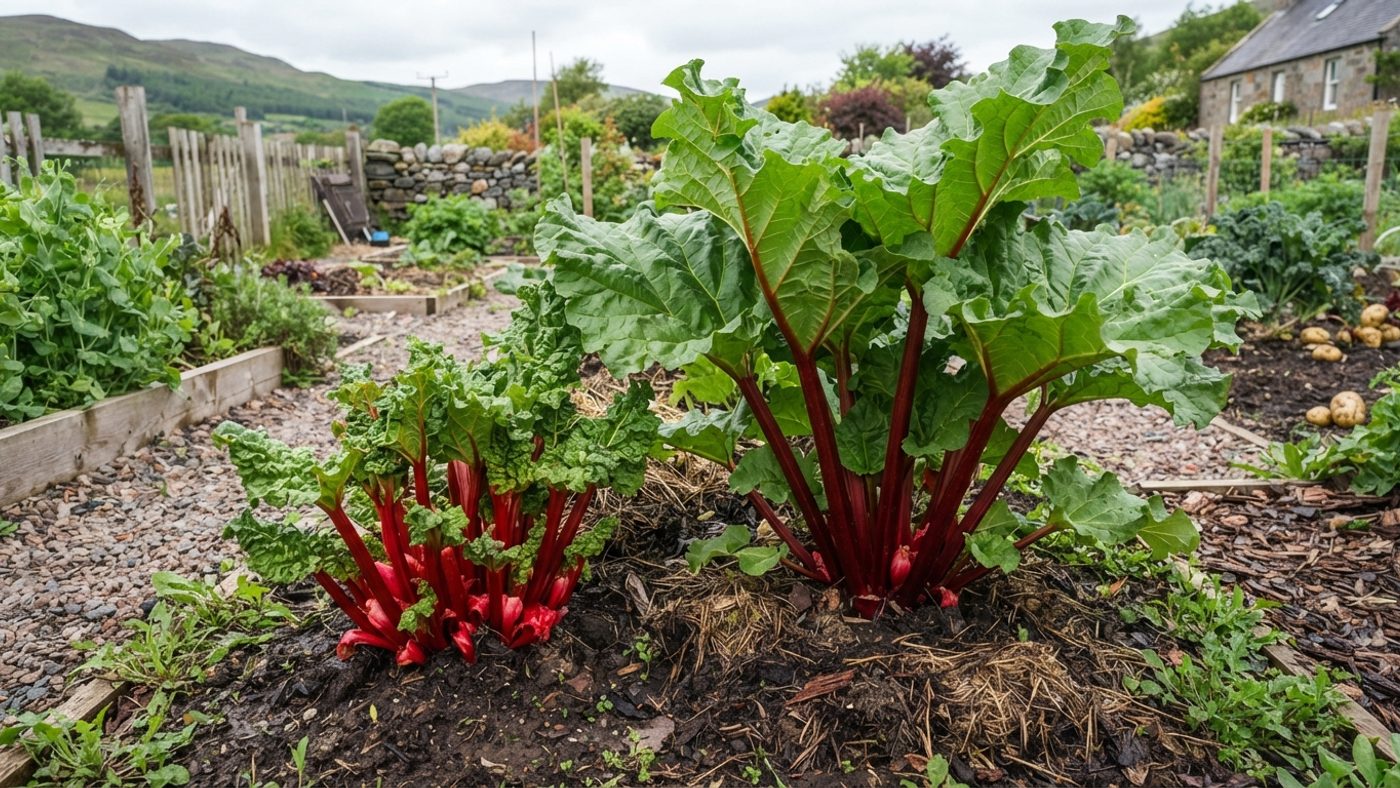
Fulton's Strawberry Surprise — the compact AGM pick
Fulton's Strawberry Surprise holds the AGM on both its own individual plant page and the general growing guide. It's a vigorous maincropThe main, usually latest-sown and longest-growing type of a crop, grown for bulk and storage rather than an early harvest. Full definition → variety (meaning it crops through its normal outdoor season rather than being forced or grown for an early flush) with bright red stems and a good, balanced flavour, ready to harvest in May and June, tolerant of both full sun and partial shade. It doesn't offer an early-cropping or forcing trait beyond what Timperley Early and Raspberry Red already cover.
What its own page does show, though, is size, a genuine difference from the other picks (see the table below for the full comparison). At a maximum height and spread of only 0.5–1m, against Timperley Early's 1.5–2.5m spread or Victoria's 2.5m height, it's noticeably more compact. For a raised bed, a large container, or any plot where a full-sized rhubarb clump genuinely won't fit, that's a real reason to pick Fulton's Strawberry Surprise over the usual two picks.
Stockbridge Arrow — an early, forcing-capable alternative, not a Scottish one
Stockbridge Arrow is suitable for forcing and ready to harvest from late April as an early maincrop, with thick, bright red stalks and distinctively triangular, arrow-shaped leaves. It carries no AGM, its own plant page confirms this directly, matching Gardener's World's separate note that none of its three named varieties has AGM confirmation.
Worth stating plainly, since the name invites the wrong assumption: Stockbridge Arrow isn't Scottish-bred, despite Stockbridge also being the name of an Edinburgh neighbourhood. Multiple independent nursery sources credit it as one of the varieties bred at Stockbridge House Experimental Horticultural Station in Cawood, North Yorkshire, run by the old Ministry of Agriculture, the same station credited with breeding Cawood Delight below. Both varieties are named after that Yorkshire site, not Scotland. That doesn't make either variety worse for a Scottish garden, but it's a real fact worth stating rather than leaving the name to imply otherwise.
As a forcing variety, Stockbridge Arrow is a genuine alternative to Timperley Early for anyone whose supplier or garden centre carries one but not the other, both share the same core value (an early, forced crop), without Timperley Early's AGM label attached.
Cawood Delight — quality over yield, and not for forcing
Also bred at Stockbridge House, Cawood Delight produces thick, deep pinky-red stems with good shine and flavour, but a smaller yield than higher-cropping varieties, it trades quantity for stem quality and colour. No AGM. Unlike Stockbridge Arrow, it's explicitly not suited to forcing, so it isn't a substitute for Timperley Early's early-crop role; it's a straightforward outdoor maincrop variety for a grower who wants fewer, better-looking stems rather than the heaviest possible harvest.
Livingstone — the one variety with a genuinely different season
Livingstone is the real find among the four. Every other named variety here follows the same pattern: crop through spring and into early summer, then the plant goes dormant until the following year. Livingstone's own plant page describes it differently, it doesn't carry AGM, but its main cropping period runs from early to late autumn, and it can also be harvested in summer if wanted, rather than sitting dormant through those months. It's also the most compact of all seven varieties covered across this article and the growing guide (see the table below).
That's a genuinely different value proposition from anything else here: not an earlier spring crop, but a second cropping window later in the year, on a plant small enough to suit a limited space too. If the main appeal of rhubarb is having fresh stems in hand, Livingstone is worth considering specifically for stretching that season into autumn rather than compressing it earlier.
Which one for your situation
| Variety | AGM | Max height / spread | Suitable for forcing | Harvest window | Best for |
|---|---|---|---|---|---|
| Timperley Early | Yes | 1–1.5m / 1.5–2.5m | Yes, the pick for it | Feb (forced) / from March | Earliest possible spring crop |
| Raspberry Red | Yes on general page; not shown on its own page | 0.5–1m / 0.5–1m | Yes, but crops heavily without it too | April–June | A heavy crop from April with no forcing effort |
| Victoria | No | up to 2.5m / 1.5m | Not stated | From late May | A reliable, high-yielding traditional variety |
| Fulton's Strawberry Surprise | Yes | 0.5–1m / 0.5–1m | Not stated | May–June | Small gardens, raised beds, containers |
| Stockbridge Arrow | No | 0.6m / 1.2m | Yes | From late April | An early, forcing-capable alternative to Timperley Early |
| Cawood Delight | No | 1.4m / 1.4m | Not suitable | Outdoor maincrop | Stem quality and colour over yield |
| Livingstone | No | 0.1–0.5m / 0.5–1m | Not applicable, doesn't go properly dormant | Mainly autumn, can crop in summer | A second harvest window later in the year |
All seven need the same growing conditions regardless of which one you choose: space plants 75–90cm apart, in an open, sunny site (light shade is tolerated) with fertile, moisture-retentive soil that doesn't waterlog. Below a soil pH of about 5.4, growth is restricted, so on naturally acidic ground it's worth testing before planting rather than after. None of the four varieties in this article change any of that, the full rhubarb growing guide covers planting, forcing method and timing, and harvesting rules in full, and applies equally to whichever variety you choose here; forcing rhubarb in Scotland covers the forcing technique itself in more depth. As with any rhubarb, only the stalks are eaten; the leaves are poisonous and shouldn't be, see the growing guide for the full food-safety note.
Forcing timelines like Timperley Early's "around February" are general UK figures, not specific to any one Scottish region, a plant forced in a colder, later spring further north or at altitude may run a little behind that. Pale, forced stems are also tender and can be damaged by a late cold snap if left uncovered once the forcing jar comes off; the growing guide covers protecting young shoots from frost. For the wider picture of how frost timing itself varies across Scotland, see the regional frost dates page.
Young shoots on any of these varieties, especially ones growing pale and tender under a forcing jar, are vulnerable to slugs and snails. Established clumps of any variety can also be lost to honey fungus, which has no effective treatment once it takes hold, remove and destroy an affected plant rather than trying to save it.
Common questions
Is Stockbridge Arrow as good for forcing as Timperley Early?
Both are genuinely suitable for forcing and both crop early, Stockbridge Arrow from late April even unforced, Timperley Early as early as February under cover. Timperley Early carries the Award of Garden Merit and Stockbridge Arrow doesn't, but that's a UK-wide garden-merit award, not a verdict on which forces better in a Scottish garden specifically; treat Stockbridge Arrow as a genuine alternative where it's the one actually available, not a downgrade.
Which rhubarb variety suits a small garden or container best?
Fulton's Strawberry Surprise is the most compact of the AGM varieties, with a maximum height and spread of only 0.5–1m against Timperley Early's 1.5–2.5m spread. Livingstone is smaller still, reaching only 0.1–0.5m, but its main value is its later, autumn cropping pattern rather than size on its own.
Can I get rhubarb from the same plant in spring and autumn?
Not with most varieties, normal rhubarb goes dormant through summer and crops again only the following spring. Livingstone is the exception: it doesn't follow that same dormancy pattern, and its main cropping period runs through autumn instead, with some summer harvest possible too.
Why do garden centres mostly stock AGM varieties like Timperley Early?
The AGM is a well-known label buyers recognise, so it's an easy default for a supplier to stock. That's worth knowing if a garden centre or online supplier doesn't carry Stockbridge Arrow, Cawood Delight or Livingstone, their absence reflects how retailers stock varieties, not a verdict on whether they're worth growing; specialist rhubarb nurseries and mail order are the more likely source for any of the three.
Sources
11 sources, recorded with what each was used for
- How to Grow Rhubarb: The four named varieties and their AGM status as presented on the general growing page, spacing, soil pH context, and general planting/growing conditions
- Rheum × hybridum 'Timperley Early': Individual-page AGM confirmation, hardiness, height/spread, bred-for-forcing note
- Rheum × hybridum 'Raspberry Red': Individual plant page does not display the AGM symbol, hardiness, height/spread, harvest window, forcing suitability
- Rheum × hybridum 'Victoria': AGM status (none), hardiness, height/spread, harvest from late May
- Rheum × hybridum 'Fulton's Strawberry Surprise': AGM confirmation, hardiness, compact height/spread, harvest window, position, no forcing or early-cropping trait stated
- Rheum × hybridum 'Stockbridge Arrow': No AGM shown, hardiness, height/spread, harvest from late April as early maincrop, suitable for forcing, distinctive triangular leaves
- Rheum × hybridum 'Livingstone': No AGM shown, hardiness, compact height/spread, autumn-led cropping pattern with no full summer dormancy
- How to Grow Rhubarb (Gardener's World): Corroborates spacing and general growing method, and names Stockbridge Arrow, Cawood Delight and Livingstone as further varieties
- Rheum x hybridum 'Stockbridge Arrow': Corroborates forcing suitability, early-April harvest, arrow-shaped leaves, height/spread
- Rheum x hybridum 'Cawood Delight': Not suitable for forcing, lower yield traded for stem quality and colour, height/spread
- A Guide to Vegetable Growing (9th Edition): Soil pH threshold of 5.4 below which rhubarb growth is restricted