

Every close in Glasgow's tenement belt has one. A back green with a padlocked gate, three raised beds gone to bindweed, and an unofficial rule that everyone knows and nobody wrote down: it's Mrs McKay's patch, has been since 1994, and the rest of the stair just cuts the grass around it. Two doors up, a first-floor flat has a Juliet balcony with three plastic pots that were thriving in May and dead by the August bank holiday, because nobody was home to water them for a fortnight and there's no outdoor tap within forty feet.
These are the two default states of growing food in flatted Scotland: shared ground nobody quite owns the use of, and private space nobody can easily water. Neither problem gets solved by choosing better crops, it gets solved by sorting out permission, weight, water and access first. For what to actually plant once those are sorted, see the shaded-garden and container growing guides linked throughout.
Who actually owns the back green, and who can say yes
The padlock is usually a symptom, not a rule. Most communal back greens attached to a tenement are governed, whether the residents know it or not, by the Tenements (Scotland) Act 2004. Where a title deed is silent on who owns a specific bit of ground, the Act's default rules, set out in Schedule 1, the Tenement Management Scheme, step in and typically assign ownership of a back green to the ground-floor (or nearest) flats, but with a shared duty to maintain it and a shared say in what happens to it.
That matters because it means two things can both be true at once: someone technically owns the grass, and everyone else in the stair still has a legitimate interest in what's built on it.
Real burdens can restrict use even for the owner. A real burden is a condition written into a title deed that runs with the property, it binds whoever owns the flat, not just the original owner who agreed to it, and it can restrict things like building on shared ground or changing how it's used. Many tenement titles carry conditions of this kind, enforceable by the other owners in the building, not just by a factor or the council. Where ground is owned partly by another flat or held in common, an owner needs express consent from the other owners before altering it. A raised bed, a greenhouse, or even permanently fencing off a section counts as an alteration in this sense.
A factor doesn't grant permission, they administer what's already agreed. This is the point most people get backwards. A property factor's job is to manage existing common arrangements: organising repairs, holding contracts and insurance, billing owners for shared costs. A factor can tell you what's already been agreed, invoice for a fence repair, or arrange contractors, but approving a new use of shared ground isn't the factor's decision to make. That approval has to come from the co-owners under the 2004 Act's procedures, not from whoever answers the factor's phone line.
It's also worth being clear that the Property Factors (Scotland) Act 2011 isn't the right rulebook for "can I plant here" questions at all. That Act regulates how factors behave, a public register of factors, a Code of Conduct covering service standards and complaint-handling, not what an owner or co-owner is allowed to build on shared ground. Asking a factor to invoke it in a planting dispute is asking the wrong body the wrong question.
So the practical chain, in order, is:
- Check the title deeds for real burdens affecting the specific patch of ground.
- Get consent from co-owners, following the 2004 Act's scheme-property procedures if the deeds are silent.
- Only then does a factor administer whatever's been agreed, contracts, access arrangements, cost-sharing.
The exact procedure for step 2 depends on the type of decision and what the title deeds already say, so it isn't the same in every stair. In practice, that step is often much less formal than it sounds, raising it directly with the neighbours, in writing, before anything gets called a vote, rather than starting from a legal process.
Once agreement in principle exists, the guide to setting up a raised bed on a shared tenement back green covers the actual build: placement, drainage on paved ground, and getting the fill delivered and split between households.
For anyone facing an outright no from co-owners, or with no back-green access at all, a plot at a local allotment site is a realistic alternative, though it's a separate route rather than a quick fallback, check the waiting list with the relevant council or allotment association first, since it can run long in the larger cities.
If you're renting
The chain is shorter but the answer is the same shape: ask first, in writing.
Under a Private Residential Tenancy, there's no blanket statutory right for a tenant to change a garden, balcony, or shared outdoor space, what's allowed is currently down to the tenancy agreement itself, sometimes called "contractual freedom" for this reason. Both Shelter Scotland and the Scottish Government's tenant's guide point to the same practical outcome: many tenancy agreements include a clause requiring written landlord consent before any alteration, and a balcony or garden counts.
A change is coming, but it isn't law yet. The Housing (Scotland) Act 2025 is set to give tenants, after six months in a tenancy, stronger rights to personalise and decorate their home, with landlords limited in how they can refuse reasonable requests. That's a direction of travel the Scottish Government has confirmed, not something a renter can rely on today.
The practical bottom line for a renter right now: ask the landlord in writing before putting anything on a balcony or into outdoor space, and keep the reply.
Weight: the question nobody has a straight number for
No published figure gives a safe weight-per-square-metre for a balcony or a shared back green.
No published load figure exists for a balcony or roof. The practical advice instead is to establish what weight the structure can actually take and to bring in a chartered structural engineer or surveyor before loading a balcony or roof with containers. Suspended balconies in particular carry strict weight restrictions, and heavy containers belong near load-bearing walls or directly over a load-bearing beam or joist, never on unsupported areas or resting on outer railings.
What is worth doing:
| Choice | Lighter option | Heavier option |
|---|---|---|
| Pot material | Plastic, metal, fibreglass | Terracotta, stone |
| Growing medium | Peat-substitute/lightweight mix | Soil-based compost (e.g. John Innes) |
| Container strategy | Several smaller pots near load-bearing walls | One large container |
| Before anything heavy goes up | Ask the factor, landlord, or co-owners; a structural engineer for real doubt | Guessing |
Terracotta and stone cut both ways: heavier to lift and heavier on a structure, but also more prone to cracking in a hard Scottish frost than plastic, metal, or fibreglass, another reason the lighter materials tend to win out on a Scottish balcony specifically, not just for the weight.
Wind is worth building into the same decision as weight, since the two often point the same way: an upper-floor balcony is typically more exposed than a ground-level garden, which both dries pots out faster and makes a tall or top-heavy container more likely to blow over, a reason to favour several smaller, stable pots positioned against a wall over one tall one on an open rail. For the crops genuinely suited to that exposure, see best crops for a windy Scottish balcony.
The same honesty applies to a shared back green. Some are simply grass or soil, but others sit on old paving over drainage that was never designed to carry raised beds full of wet compost, water butts, or paving slabs. There's no sourced weight figure for that surface either, the practical trigger for asking first is scale: a couple of pots is a non-issue anywhere, but several large raised beds, a full-size water butt, or anything involving paving slabs is worth raising with the co-owners or factor before it goes in, and a genuinely uncertain case (an older back court, visible cracking or subsidence) is worth a structural engineer's opinion rather than a guess, costs for that vary enough by property that it's worth getting more than one quote rather than assuming a figure.
No outdoor tap: what actually works
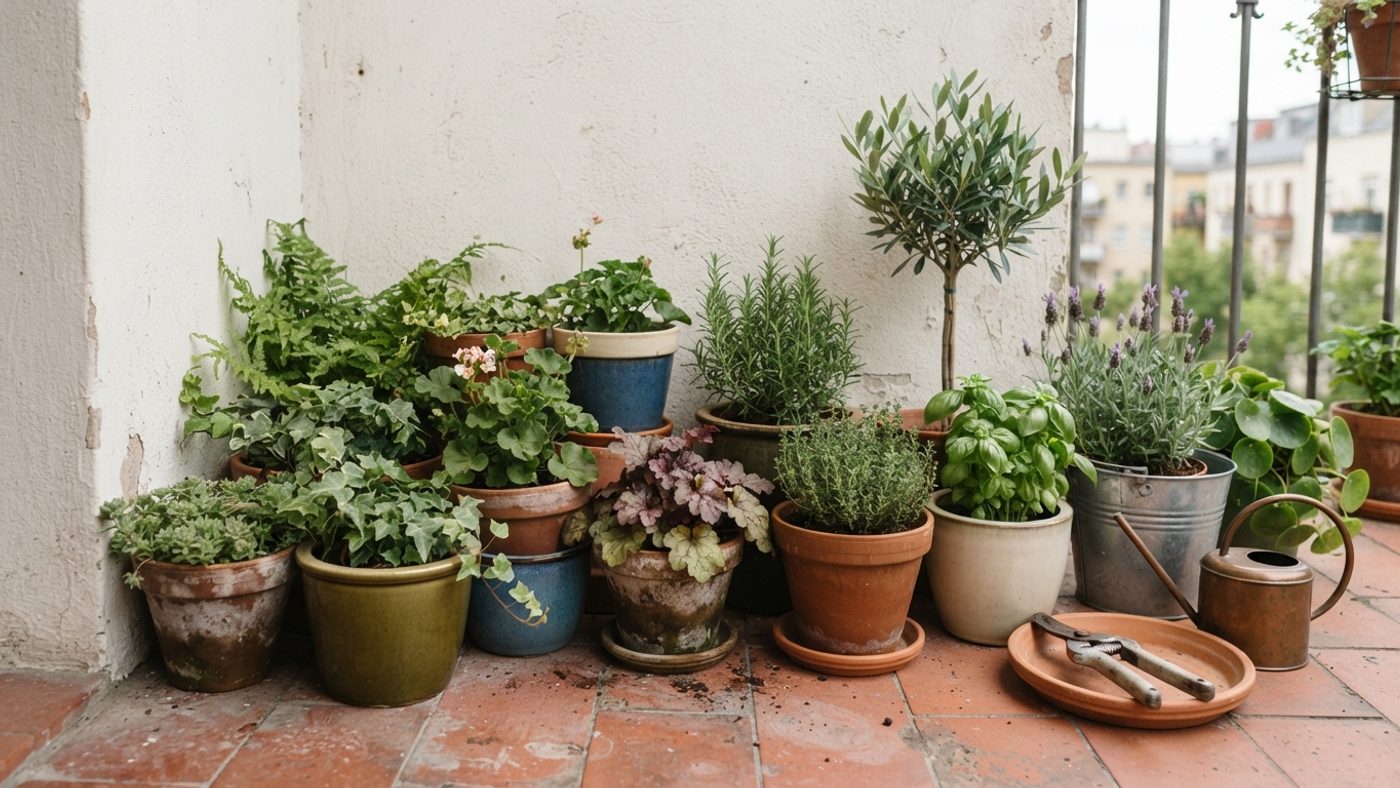
Rainwater harvesting assumes a gutter feeding a downpipe. Where that genuinely isn't there, a common situation on an upper floor, it isn't viable, and an indoor tap and a watering can does the job instead. Carrying water out from a kitchen sink is how a lot of above-ground-level container growing in Scotland actually gets watered.
Where a downpipe is accessible, a ground-floor flat, or a balcony genuinely plumbed into one, slimline water butts small enough for a balcony exist and fit standard round downpipes, worth checking against the specific fitting before buying.
None of this assumes floor space, either. A Juliet balcony, a rail with no floor to stand a pot onMoving a plant into a larger pot as its roots fill the current one, giving it more room and fresh compost before it becomes pot-bound. Full definition →, rules out most of the above, and the honest answer there is rail-mounted planters, hanging baskets, or a windowsill box just inside the glass, all of which carry far less weight than a floor-standing container and sidestep the structural question almost entirely.
Two things genuinely cut down how often watering has to happen at all, which matters most for exactly the case that opened this article: a balcony nobody can get to for a week or two.
- Self-watering containers. These contain a reservoir in the base that reduces how often watering is needed, a real, useful option for a balcony with no daily access to water.
- MulchingA layer of material spread over the soil around plants to suppress weeds, retain moisture, and improve soil structure as it breaks down. Full definition →. A layer of mulch over the compost surface reduces evaporation and stretches the interval between waterings, a smaller thing on its own, but it adds real slack to exactly the gap between visits that kills unwatered balcony pots by August.
Water-retaining granules mixed into compost are also an option, though worth trying other techniques first before relying on granules.
If a communal outdoor tap does exist on a shared back green, it's worth agreeing with the other flats up front how any water use gets split, rather than leaving it as an assumption.
For which crops actually cope best with an occasional missed watering day, see the guide to crops for containers and patios.
Shared-space etiquette
A back green or a shared stair is used by everyone in the building, and growing food there changes how it's used whether or not that was the intention.
The basics that keep a project welcome rather than resented:
- Don't block shared access. Paths to bin stores, washing lines, or the back gate need to stay clear, a raised bed that narrows a path to single-file, or containers left in a fire escape route, cause a problem for every other flat, not just an aesthetic one.
- Watch drainage. A container or bed that drains onto a neighbour's ground-floor window, a shared path, or someone else's washing is the kind of thing that generates a complaint fast, regardless of how the ownership question above gets resolved.
- Secure anything at height. A pot or window box that can be knocked or blown off a balcony rail lands on whatever's below, a shared path, a neighbour's window, the street. Fix containers rather than balancing them on an edge, and treat this as a safety question, not just a tidiness one.
- Manage smell and mess. An overflowing water butt or a badly managed compost heap is exactly the kind of visible, smellable problem that turns a whole stair against a back-green growing project, not the growing itself, but the mess around it, and the same mismanagement is what draws rats to a shared back court. Composting specifically, including wormeries and council food-waste collection as flat-friendly alternatives to an outdoor heap, is covered in full in the guide to composting in a flat.
- Check listed-building or conservation-area status if anything permanent is planned. A tenement in a conservation area, or one that's itself a listed building, can face restrictions on what's allowed to go up in a back green, a greenhouse or a fixed structure is worth a check with the local authority before it's built, separately from getting the co-owners' consent covered above.
Getting materials up a stair
A ground-floor or garden grower rarely has to think about this at all: for anyone above the ground floor, everything, compost, pots, canes, a bag of grit, has to go up a common stair, possibly several flights, by hand.
Two ordinary workarounds cover most of it: buying smaller bags more often instead of one heavy sack, and splitting a larger order with neighbours who are also growing in containers, so both the cost and the carrying get shared.
On lightening the load itself, perlite plays a general role in lightening growing mixes, though it carries a real environmental cost, and grit or gravel are increasingly preferred as alternatives. A perlite- or coir-based mix is generally lighter to carry than a heavier soil-based compost, even setting aside the environmental question.
Common questions
Do I need permission to put a raised bed on a shared tenement back green?
Generally yes. Check the title deeds first for real burdens affecting that ground, then get consent from the other owners under the Tenements (Scotland) Act 2004's scheme-property rules if the deeds are silent. A factor can administer an agreed decision but doesn't have the authority to grant permission itself.
Can my property factor approve or refuse a planting project?
Not on their own authority. A factor manages existing common arrangements, repairs, contracts, insurance, billing, rather than deciding whether a new use of shared ground goes ahead. That decision sits with the co-owners.
Is there a safe weight limit for a balcony full of pots?
No single authoritative figure exists for this. Check what your specific structure can bear and consult a chartered structural engineer or surveyor before loading a balcony or roof, rather than relying on a general number.
What can I do if I have no outdoor tap or downpipe?
Carry water from an indoor tap with a watering can, a completely normal solution, not a lesser one. Self-watering containers and mulching both reduce how often you need to water in the first place.
As a renter, can my landlord stop me from using a balcony for pots?
Under a Private Residential Tenancy, Scotland currently runs on contractual freedom for alterations, so the tenancy agreement sets the rule, and many include a clause requiring written consent before any alteration, balconies included. Always ask in writing first.
What can I grow if my only space is shaded by the tenement above?
That's a crop-selection question rather than a logistics one, see the guide to the top crops for a shaded garden for shade-tolerance categories and specific varieties that cope with a north-facing back green.
Sources
15 sources, recorded with what each was used for
- Tenements (Scotland) Act 2004, Schedule 1 (Tenement Management Scheme): Default ownership and maintenance rules for shared tenement ground
- Under One Roof: Alterations and improvements: Requirement for co-owner consent before altering shared or jointly-owned ground
- Under One Roof: Garden maintenance: Shared responsibility for back green upkeep
- Under One Roof: Property factors (managers): Scope of a factor's role in managing common property
- mygov.scot: Using a property factor: What a factor does and does not have authority over
- mygov.scot: Appointing or dismissing a property factor: Factor conduct regulation distinct from alteration permissions
- gov.scot: Code of Conduct for Property Factors 2021: Confirms the Property Factors (Scotland) Act 2011 governs factor conduct, not alteration rights
- Shelter Scotland: Your rights in a private residential tenancy: Renters' alteration rights under a Private Residential Tenancy
- gov.scot: Private Residential Tenancies: tenant's guide: Contractual freedom on alterations under current PRT rules
- gov.scot: Private Tenancy Reform policy page: Upcoming Housing (Scotland) Act 2025 changes to personalisation rights
- RHS: Roof gardens and balconies: Absence of a published weight figure, structural-engineer/surveyor recommendation, pot material and positioning advice
- RHS: Water — collecting, storing and using: Rainwater harvesting assuming downpipe access
- RHS: Water-retaining granules: Self-watering containers and caveats on granules
- RHS: Perlite (advice profile): Perlite's role in lightening growing mixes and its environmental cost
- University of Illinois Extension: 6 tips for watering container gardens: Mulching reducing evaporation in containers