
You've heard it enough times that it stopped sounding like a claim and started sounding like a fact: plant marigolds next to your tomatoes. Onions keep carrot fly off your carrots. Basil makes tomatoes taste better. Nasturtiums pull blackfly away from your beans. Companion planting charts repeat these pairings so consistently, in so many gardening books and blog posts, that most gardeners never stop to ask where the evidence actually is.
What the RHS, Garden Organic and published research actually show is a small number of pairings with real evidence behind them, a larger number that are plausible but genuinely untested, and a handful that have been tested and found false, including two where the companion made things measurably worse, not just failed to help.
Most of this folklore also has a geography problem. A lot of it originated in the US, through university-run advisory services for local farmers and gardeners and older herbals written for warmer, drier growing conditions, or gets tested in English trial gardens with a longer season and different pest pressure than Scotland's. A finding from a Californian trial or a Warwick research station doesn't automatically transfer to a cool, wet Scottish plot with its own mix of pests, and each claim below names where its evidence actually comes from.
The short version: two pairings have real evidence behind them and are worth doing on purpose, borage next to strawberries, and marigolds next to tomatoes planted from the start of the season. Flowers grown among your crops generally, for the predator insects they feed, is the one broad principle that holds up. Almost everything else, onions protecting carrots, nasturtiums as a blackfly or caterpillar trap, herbs repelling cabbage white, basil improving tomato flavour, beans feeding their neighbours, is either unproven or has been tested and found false. Two pairings are worse than false: chard next to leeks, and a herb border relied on instead of netting against cabbage white, have both been shown to actively make things worse.
What actually holds up
Two pairings have genuine research support, and they share a mechanism worth understanding, because it explains why almost everything else here fails.
Flowers feeding pest predators. Hoverflies and lacewings eat aphids only at the larval stage, as adults, they live on nectar and pollen. A bed with nothing in flower gives the adults nothing to feed on, so they don't stick around to lay the eggs that become aphid-eating larvae. UC IPM's research confirms this works, but with real limits: the effect fades with distance from the flowers, and it won't always translate into visibly fewer pests. The trial itself is Californian, but the mechanism it's testing, adult predators needing nectar and pollen to survive between meals of prey, is basic insect biology, not a climate-dependent effect, and RHS reaches the same conclusion independently for alyssum and lettuce in a UK setting below. The same logic applies to parasitoid wasps, only their larvae are parasitic, feeding inside aphids or caterpillars, while the adults need nectar and pollen just like hoverflies do. Alyssum grown with lettuce has been shown to reduce aphid populations by drawing in these predators, and Garden Organic separately recommends coriander, fennel, Californian poppy, poached-egg plant and calendula for the same season-long nectar supply, more on growing calendula in the veg patch itself is covered separately. The practical upshot: plant flowers close among your crops, not as a border at the far end of the plot, and aim for something in flower across the whole growing season.
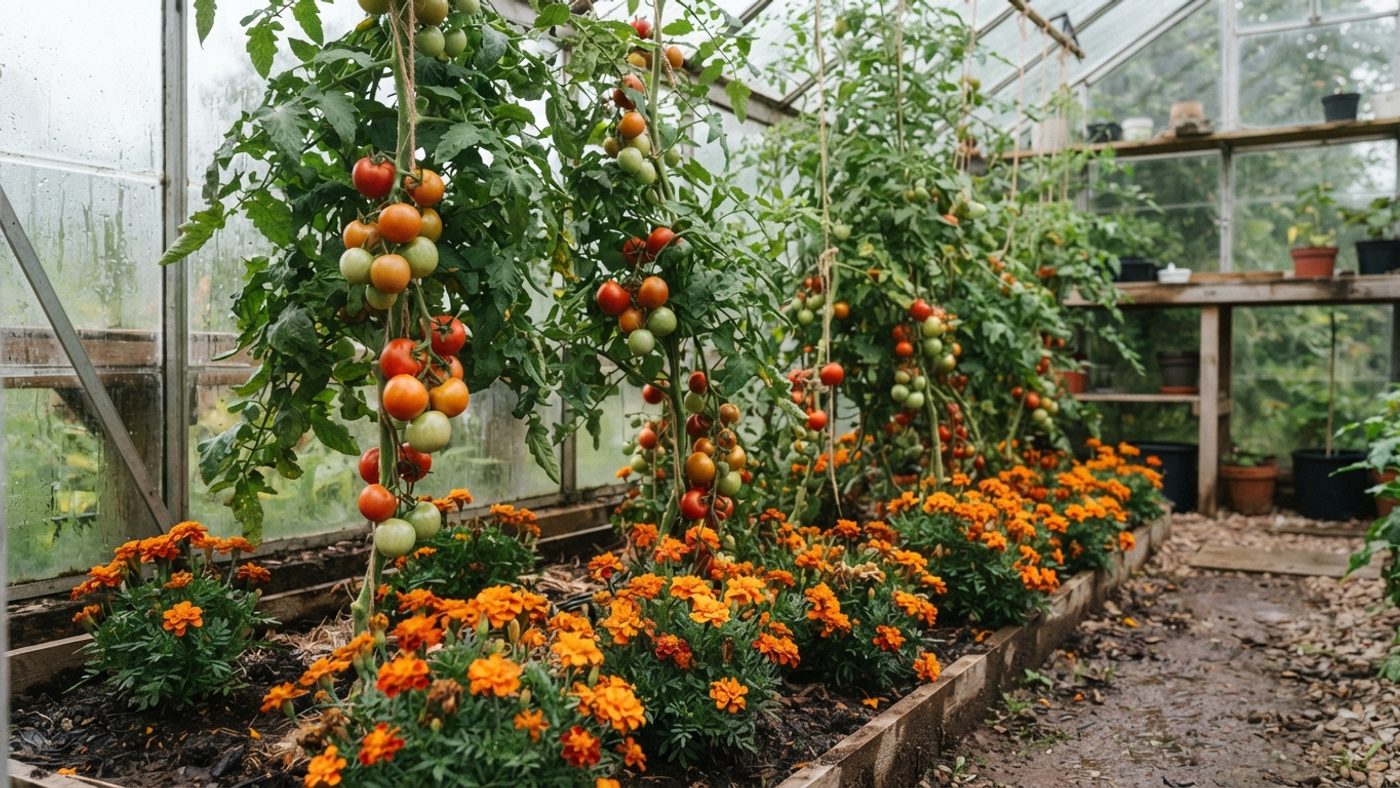
Marigolds against whitefly, but only if you're early. Controlled glasshouse trials run by Newcastle University with Stockbridge Technology Centre and Northumbria University found French marigolds slow whitefly build-up on tomatoes, and identified the active compound: limonene. Timing is everything here. Planted alongside tomatoes from the start of the season, marigolds work. Introduced after whitefly has already established, the effect was minimal. This one is worth taking seriously here specifically: outdoor tomato cropping is marginal across much of Scotland, and a polytunnel or greenhouse is the more usual way to grow them, which is exactly the sheltered, whitefly-friendly environment the trials were testing in.
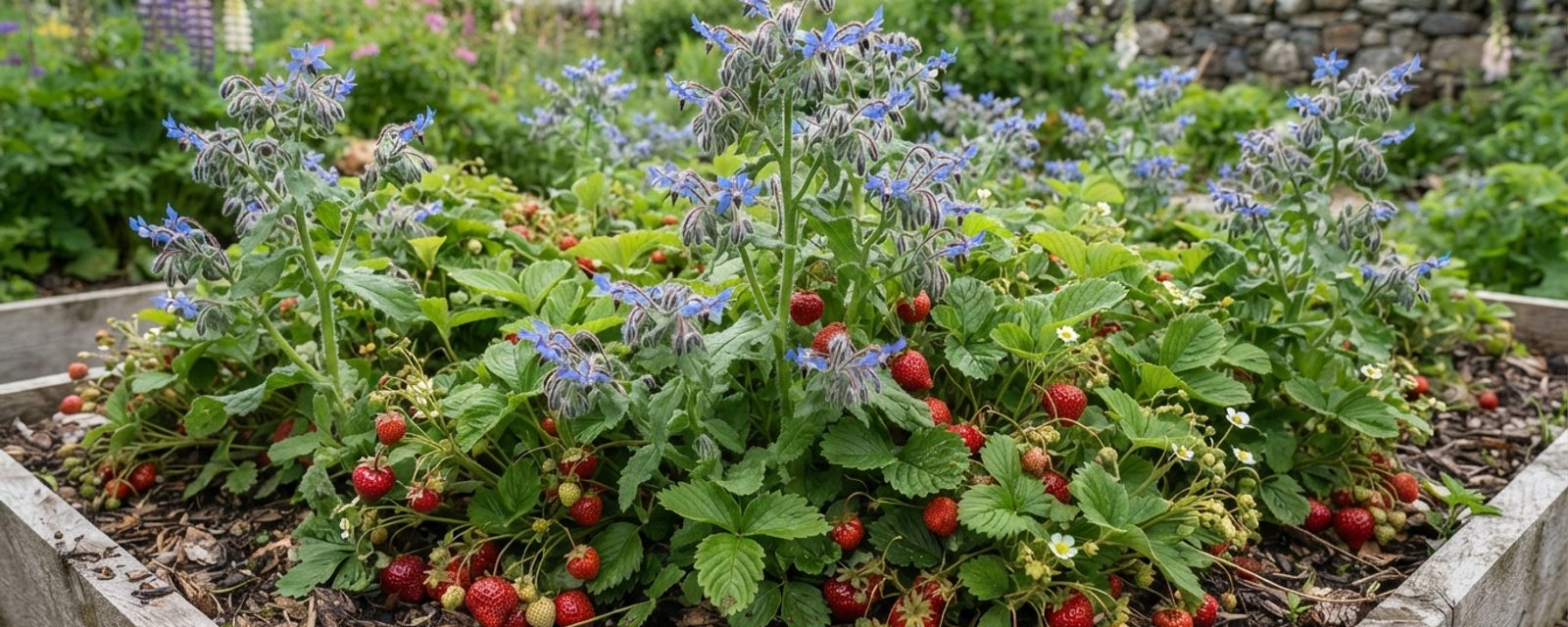
Borage and strawberries, the strongest evidence in the whole set. A peer-reviewed UK field study (Griffiths-Lee, Nicholls and Goulson, published in Ecological Entomology in 2020) compared strawberry plots grown with and without a neighbouring borage plant, run both as controlled trials and as a nationwide citizen-science project across gardens and allotments. Strawberries grown near borage produced around a third more fruit by weight, with better-formed berries. The mechanism isn't soil chemistry, borage's flowers pulled in significantly more flies, alongside bees, to visit the strawberry flowers too, and more visits meant more fruit set. This is genuine UK peer-reviewed field data at real scale, which is rare in this whole field of claims, worth doing for that reason alone, wherever in Scotland strawberries are grown.
Radish as a genuine catch cropA fast-maturing crop sown into a gap between two main crops, to use ground that would otherwise sit empty. Full definition →. A catch crop is a fast one tucked into ground another, slower crop hasn't grown into yet, different from a trap crop, which is planted to pull pests onto itself and away from the main crop. Sown into gaps between slower-maturing vegetables like Brussels sprouts or sweetcorn, radish is harvested and gone before the bigger plants need the space or start shading it out. RHS and Gardener's World both describe this independently. It's timing-dependent, like most of what follows, but radish is fast enough, three to four weeks from sowing to pulling in most conditions, that it clears the ground well inside a Scottish growing window too, which is why it's one of the few claims here that doesn't need a seasonal caveat attached.
Where marigolds don't help. The same French marigolds proven against whitefly get credited with repelling aphids too, and that's a step too far. Limonene's effect is specifically on whitefly and thrips, and RHS's own companion-planting page, which names those two pests explicitly, says nothing about aphids at all. That silence is telling: a page that's happy to name the specific pests marigolds do work against, and stays quiet on aphids, is exactly where you'd expect the effect to be stated if it held up.
Where the mechanism itself falls apart
Half of every companion-planting chart rests on one idea: strong- smelling plants confuse pests and hide your crop underneath the scent. Research at Warwick Crop Centre (Wellesbourne), Britain's long-standing centre for brassicaThe cabbage family: cabbage, kale, broccoli, cauliflower, Brussels sprouts, kohlrabi, swede, turnip and more, sharing the same pests, diseases and rotation rules. Full definition → and carrot pest research, tested this directly and found it's wrong. Insects hunting a host plant land on green and avoid bare brown soil, colour, size and shape decide where they settle, not scent. Artificial green plants, and even green paper releasing no scent at all, disrupted pests just as well as living companion plants did, and aromatic plants performed no better than bland ones.
That single finding undercuts a lot of what follows. If scent isn't the mechanism, claims built entirely on "strong smell confuses the pest" need a different kind of evidence to stand up, and mostly, they don't have it.
Two other well-known claims fail for a different reason: they were never really about pest control at all. Basil next to tomatoes is usually justified as improving the tomatoes' flavour. Doctoral research at West Virginia University ran double-blind taste tests over three years and found no consistent preference either way. But the same study found tomatoes and basil grown together yielded around a fifth more than either grown alone, once planted at higher density than a single token basil plant tucked in the corner, the exact spacing wasn't part of what the study published, but the finding holds at closer planting, not wide-spaced token pairing. That's a genuinely useful result for the same growers who benefit most from the marigold/whitefly finding above, most Scottish tomatoes are already grown under cover, where bed space is at a premium and getting more out of the same square footage matters more than it would in an open field. The pairing is worth making, just not for the reason usually given. And beans and peas fixing nitrogen for the crop growing next to them is only half right: legumes genuinely fix nitrogen, but they don't hand much of it to a living neighbour in the same season, the transfer between two growing plants is small and hard to measure. The real nitrogen, tens of kilos per hectare, arrives when the legume dies and its roots break down. Follow peas or beans with a hungry crop the next season rather than expecting this year's cabbage to benefit from beans growing next to it now.
The pairings sitting in limbo
Several well-known claims turn out to have a real biological basis but no test of whether the specific effect claimed actually happens. These aren't folklore invented from nothing, but they're not proven either.
Nasturtiums and blackfly on beans. Nasturtium is a confirmed host plant for black bean aphid, alongside broad, French and runner beans, so the basic premise, that aphids will feed on nasturtium, is real. What's untested is whether that shared appetite actually diverts aphids away from a nearby bean crop, or simply gives them a second food source. RHS describes gardeners planting nasturtiums near beans "in the hope of attracting beneficial insects," without claiming a tested trap-crop effect for this aphid. Garden Organic presents the same pairing as practice rather than trial data, worth noting, since Garden Organic's own broader position is that companion planting claims "often have unproven benefits." Even taken at face value, a trap crop that works is still concentrating blackfly somewhere in your garden, not eliminating it.
Nasturtiums and cabbage white caterpillars is the most genuinely two-sided claim of all of them. Nasturtium is an acceptable host for cabbage white (Pieris rapae), adults will lay eggs on it and the larvae develop normally. But caterpillars already feeding on cabbage refuse to switch onto nasturtium and will starve rather than eat it, because nasturtium leaves contain a strong antifeedant compound, chlorogenic acid, their gut isn't primed for. So nasturtium can pull in egg-laying adults, but won't rescue a bed that already has caterpillars established, and no field trial confirms a nasturtium border actually reduces damage on nearby brassicas. Growing nasturtiums for their own sake, as a genuinely useful edible companion rather than a pest-control claim, is covered separately in Nasturtiums as an Edible-Garden Companion.
Onions and carrot fly. The theory is that onion scent masks the smell of carrots. Garden Organic tested it and got inconsistent results. Tellingly, while RHS repeats the claim in its companion-planting feature, its own carrot growing guide never mentions onions at all, it recommends covering the crop instead. When a source making a claim quietly omits it from its own growing guide for that crop, that's a real signal of how much weight the claim carries. Carrot fly is also a patchy pest by reputation rather than a guaranteed one, plenty of Scottish gardeners never see it at all in a given year, so an absence of damage isn't proof any companion planting worked, and a bad year isn't proof it didn't.
Savory and blackfly. Both summer and winter savory show up repeatedly as blackfly deterrents for broad beans, but RHS's dedicated blackfly page doesn't mention companion planting or any herb, and its savory growing guide is silent on any pest-deterrent effect. The winter-savory version of this claim traces almost entirely to summer savory in older herbals, the two are being conflated. Savory's volatile oils could plausibly interfere with aphid scent cues, but no trial isolating that effect exists.
Mint and onion fly, and chervil with radish both rest on a single secondary source, Gardener's World in the mint case, general listicle repetition in the chervil case, with no RHS or Garden Organic corroboration at all. Mint also spreads aggressively by runnersLong, trailing stems a plant sends out that root where they touch soil, producing a genetically identical new plant for free. Full definition →, so planting it anywhere carries a real cost whether or not the blackfly benefit is real.
Where companion planting actively backfires
Two of these claims aren't just unproven, they're documented as causing harm.
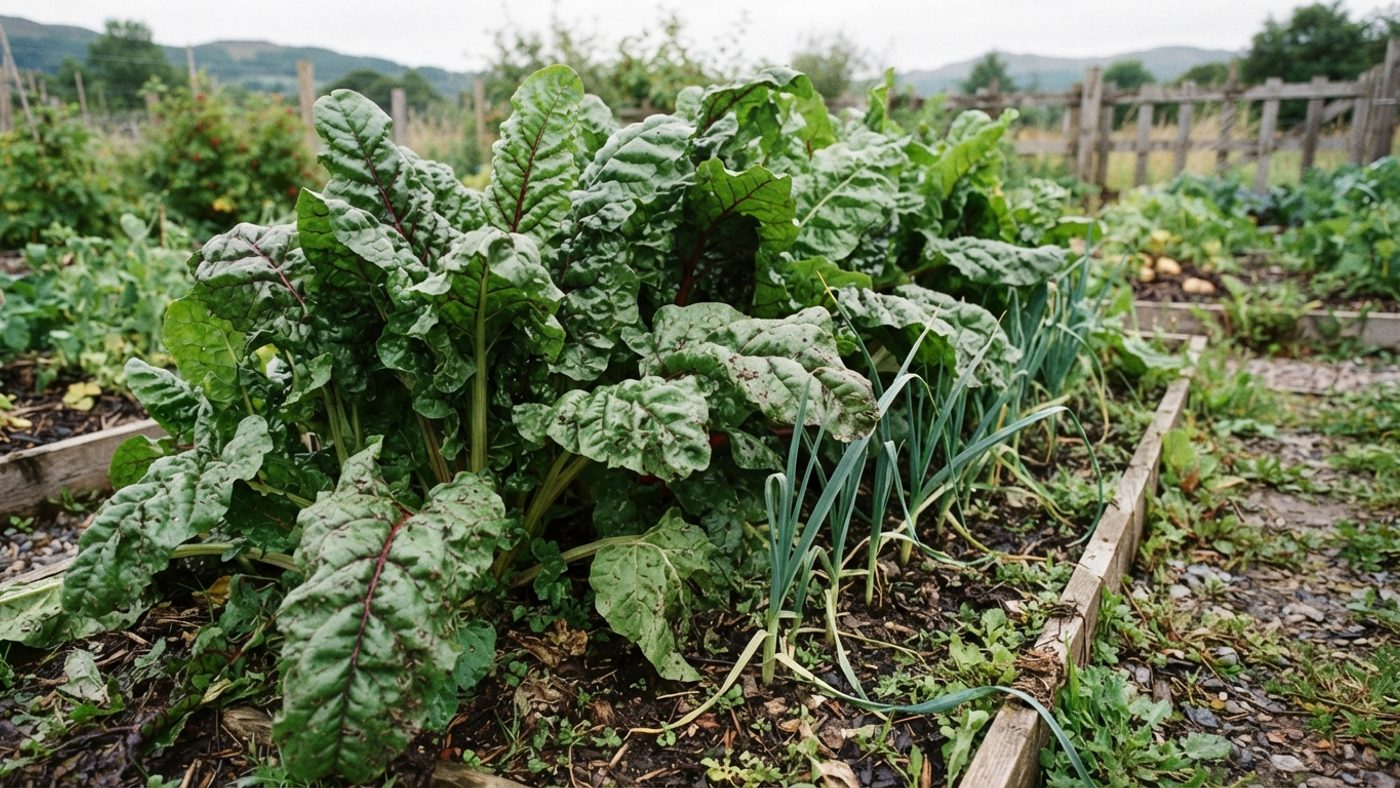
Garden Organic's own 2024 members' trial interplanted chard with leeks specifically to test whether it would protect against allium leaf miner. It cut marketable leek yield by 69%, an effect that dwarfed any pest reduction. The trial doesn't spell out why, competition between the two for light, water and root space in a shared bed is the likely explanation, since chard is a bulky, fast-growing leaf crop planted directly among slender, slow-growing leeks, but the number itself is what matters here: this is real trial data, not folklore, showing a plausible-sounding pairing doing serious net harm.
Separately, a field trial interplanting collards with a mixture of companion herbs, testing the "strong scent repels cabbage white" theory directly, found the opposite of the intended effect. Egg numbers went up, not down, laid in denser clusters. Sage performed worst of all, drawing significantly more eggs onto nearby collards than plots without it.
The clearest lesson from both: don't assume a companion pairing is neutral just because it isn't proven harmful. Sometimes it's tested, and it's actively worse, and of the two, chard next to leeks is the single pairing here worth remembering as one to actively avoid, not just leave untried.
Two more common claims are worth flagging as genuine open gaps rather than covered here: mustard or Chinese cabbage grown as a flea-beetle trap crop for brassicas and salad leaves, and plants said to deter slugs by scent or texture. Neither RHS nor Garden Organic makes a tested claim about either in the sources checked for this piece, so they're left ungraded rather than repeated as either fact or folklore.
The reliable alternative for blackfly
If nasturtiums and savory are both unproven for blackfly on beans, what actually works? Pinching outRemoving the soft growing tip of a stem to stop upward growth and make the plant branch out sideways instead. Full definition → the growing tips. Shoot tips are where black bean aphid colonies build up first, on soft young growth, and removing them once the lowest flowers have set small pods takes out most of an existing colony in one move. RHS and Garden Organic give the same instruction independently, timed the same way. Scottish springs stay cool longer than further south, so pods often set later here, push the pinch-out window back accordingly rather than following an English calendar date.
What about the three sisters?
The three sisters, corn, beans and squash grown together, is probably the most famous companion-planting system there is, and readers will expect it addressed. No RHS or Garden Organic entry makes a tested claim about it either way, a real gap worth stating plainly rather than papering over. It's also a different kind of claim from everything else here, an Indigenous American agricultural system developed over generations for a specific climate and growing season, not a pest-deterrent pairing being tested in a UK trial garden. It doesn't get a verdict here because there's nothing in the evidence to grade it against, one way or the other. Worth knowing if you're tempted to try it anyway: sweetcorn is already a marginal, short-season crop on its own in most of Scotland, which is a real practical reason it's a harder system to run here than the climate it was developed for, whatever the eventual verdict on the pest-and-yield claims turns out to be.
Summary: what the evidence actually shows
| Pairing | Verdict | Basis |
|---|---|---|
| Flowers near crops for pest predators | Proven | UC IPM; adult hoverflies/wasps need nectar and pollen |
| Marigolds + tomatoes (whitefly, planted early) | Proven | Newcastle/Stockbridge/Northumbria glasshouse trials |
| Borage + strawberries | Proven | Griffiths-Lee, Nicholls & Goulson, Ecological Entomology 2020 |
| Radish as catch crop between slow crops | Proven | RHS; Gardener's World |
| Marigolds against aphids specifically | Busted | RHS names whitefly/thrips, not aphids; no institutional source claims an aphid effect |
| Strong scent as pest-confusion mechanism | Busted | Warwick Crop Centre — colour/shape drives pest landing, not smell |
| Basil improving tomato flavour | Busted | WVU doctoral research, blind taste tests, no preference found |
| Beans/peas feeding neighbouring crops same season | Busted | Same-season transfer minor; benefit comes a season later, from residue |
| Chard interplanted with leeks | Busted — harmful | Garden Organic 2024 members' trial, 69% yield loss |
| Herb borders against cabbage white | Busted — harmful | Sage increased egg-laying in trial |
| Onions protecting carrots from carrot fly | Disputed | Garden Organic inconsistent trials; RHS carrot guide omits it |
| Nasturtiums as blackfly trap crop | Unproven | Host relationship real; diversion effect untested |
| Nasturtiums against cabbage white | Disputed | Attracts egg-laying but won't stop established caterpillars |
| Savory (summer or winter) against blackfly | Unproven | RHS silent on companion effect for this herb |
| Mint against onion fly | Unproven | Single uncorroborated source (Gardener's World) |
| Chervil + radish | Unproven | No RHS/Garden Organic mention either way |
Common questions
Do I need to remove marigolds if I already planted them near my tomatoes after whitefly showed up?
There's no evidence it will help at that point, the trials found the benefit only when marigolds were planted from the start of the season, not introduced once whitefly had already established. Leave them for the pollinators, but don't count on them for control now.
Will interplanting flowers or herbs through my vegetable beds do any harm, even where the pest-control claim is unproven?
Mostly no, an unproven pairing is usually just a pairing that hasn't been tested, not one that's been tested and found harmful, and most of the herbs and flowers named here are worth growing anyway. The two genuine exceptions are chard next to leeks and relying on a herb border in place of netting against cabbage white, both have been tested and shown to make things worse, not just fail to help, so treat those two specifically as pairings to avoid rather than merely unproven ones to shrug off.
My carrots were fine last year with onions next to them, doesn't that prove it works?
Not on its own. Carrot fly is a patchy pest that plenty of gardeners never see in a given year regardless of what's growing nearby, so one good year with onions next to your carrots doesn't rule out that you'd have been fine anyway. That's exactly the kind of result that makes this claim hard to test cleanly, which is why Garden Organic's own trials came back inconsistent.
If chard next to leeks is actively harmful, are there other "obvious" pairings I should be wary of?
The chard-leek result is the clearest documented case of harm here, but it's a reminder that "seems plausible" isn't the same as "tested safe." An untested pairing isn't automatically a safe one, it's simply one nobody has checked yet.
What should I actually do about blackfly on my broad beans, since nasturtiums and savory are both unproven?
Pinch out the shoot tips once the lowest flowers have set pods, this is independently confirmed by both the RHS and Garden Organic and is the one blackfly measure here with genuine evidence behind it. In Scotland, expect that timing to fall a little later than English guidance suggests, since pods typically set later in a cooler spring.
Sources
18 sources, recorded with what each was used for
- RHS: Three ways to use companion planting: RHS's own stated position on anecdotal/unverified claims, onion-carrot claim, marigold/limonene mechanism (whitefly and thrips named, aphids not), alyssum-lettuce aphid predator evidence, nasturtium-bean framing, chervil/radish absence
- RHS: How to grow carrots: Confirming onions are not mentioned as carrot fly protection; covering the crop as the recommended method
- RHS: Blackfly: Pinching out shoot tips as a control; nasturtium listed as a black bean aphid host plant; absence of companion-herb mention
- RHS: Cabbage caterpillars: Nasturtium listed among plants cabbage caterpillars feed on
- RHS: Savory growing guide: Confirming no pest-deterrent effect is mentioned
- Garden Organic: Companion or mixed planting: Nasturtium/blackfly trap-crop claim, Garden Organic's "often have unproven benefits" position, flower recommendations for predatory insects
- Garden Organic: How to grow broad beans: Pinching out growing tips as blackfly control
- Garden Organic: Members' experiment archive, companion planting 2024: Chard/leek trial, 69% yield loss finding
- UC IPM: Insectary plants: Flowers feeding adult predatory insects, distance-dependent benefit
- Warwick Crop Centre: companion planting research: Scent-confusion mechanism tested and found false; colour/shape as the real driver
- Griffiths-Lee, Nicholls & Goulson, "Companion planting with borage attracts pollinators and increases strawberry yield", Ecological Entomology (2020): Borage-strawberry yield increase and mechanism
- Glasshouse marigold/whitefly trial (Newcastle University, Stockbridge Technology Centre, Northumbria University): Marigold-whitefly timing effect and limonene identification
- West Virginia University doctoral research, companion planting study: Basil/tomato taste test and yield findings
- Legume nitrogen transfer review, Frontiers in Sustainable Food Systems: Same-season nitrogen transfer between living plants being minor
- Renwick et al., Journal of Chemical Ecology, cabbage white/nasturtium feeding study: Chlorogenic acid antifeedant finding, egg-laying vs. established-larvae distinction
- Gardener's World: Spring onion growing guide: Mint/onion fly claim (flagged as single-source, uncorroborated)
- Gardener's World: Radish growing guide: Radish as catch crop between slow-growing crops
- The Canadian Entomologist: companion herbs and Pieris rapae egg distribution on collards: Herb borders increasing rather than reducing egg-laying, sage performing worst