
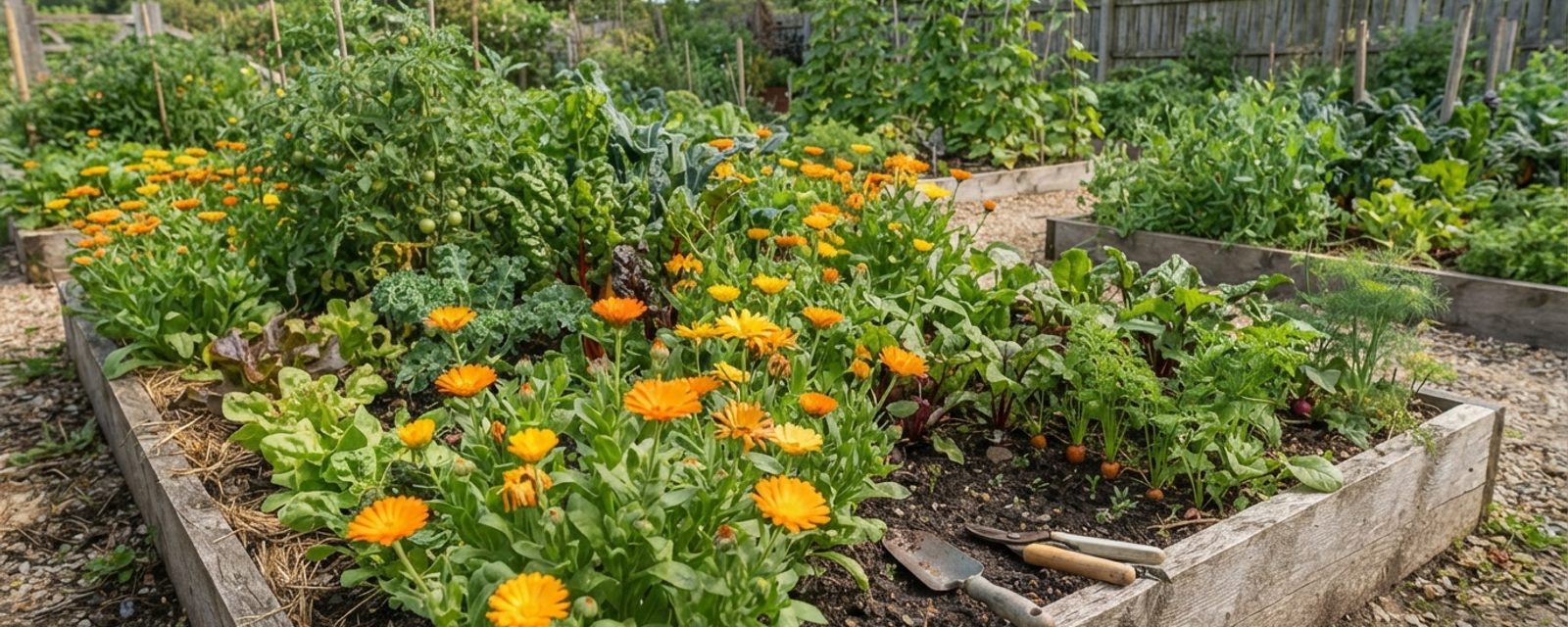
No study or trial has ever shown Calendula officinalis repelling a pest. What it does, genuinely, is feed the insects that eat the things you'd rather not have on your vegetables. A 2017 study found that calendula flowers sustain a tiny predatory insect called Orius sauteri, sometimes known as a minute pirate bug, by giving it pollen to eat when prey is scarce, and a better-fed population of that predator then knocked back aphid and thrips numbers under greenhouse conditions. That's the real, evidenced mechanism behind calendula's reputation as a "useful" plant in a vegetable garden: it's a food source for predators, not a shield against pests.
Everything else attached to calendula's companion-planting reputation, that it deters aphids by scent, that it acts as a sticky trap crop, that it confuses pests into missing your tomatoes, has no institutional backing. Gardeners have planted it next to tomatoes and beans for generations "in the hope of" a protective effect, as RHS's own companion-planting page puts it, but hope isn't a trial result.
Confusingly, there is a real, well-evidenced marigold pest-deterrence story, it's just about a different plant. Tagetes patula (French marigold) has been shown in a controlled trial to slow whitefly on tomatoes via the compound limonene, covered in full in the companion planting article. That's Tagetes, not Calendula. The two get conflated constantly.
Calendula is not Tagetes, and that distinction matters
"Marigold" is a common name shared by two unrelated genera, and the companion-planting advice for one does not transfer to the other. Calendula officinalis (pot marigold) is the plant this article covers: an edible-flowered hardy annual in the daisy family, with simple orange or yellow daisy-like flowers, native to southern Europe and grown mainly for its flowers and its garden-predator value.
Tagetes patula and Tagetes erecta (French and African marigold) are a separate genus entirely. A controlled glasshouse trial found that Tagetes patula slows whitefly on tomatoes, via limonene, a compound the plant secretes and which is also found in citrus peel. RHS's own companion-planting page notes that mixing tomatoes with a range of other plants, not Tagetes specifically, produced a similar effect in the research it cites, meaning even the Tagetes finding may be partly a general effect of growing tomatoes among mixed planting rather than something unique to marigolds. None of that limonene/whitefly evidence involves calendula. No RHS, Garden Organic, or peer-reviewed source attributes a scent-based pest-deterrent compound to Calendula officinalis.
The genuine pollinator and predator value
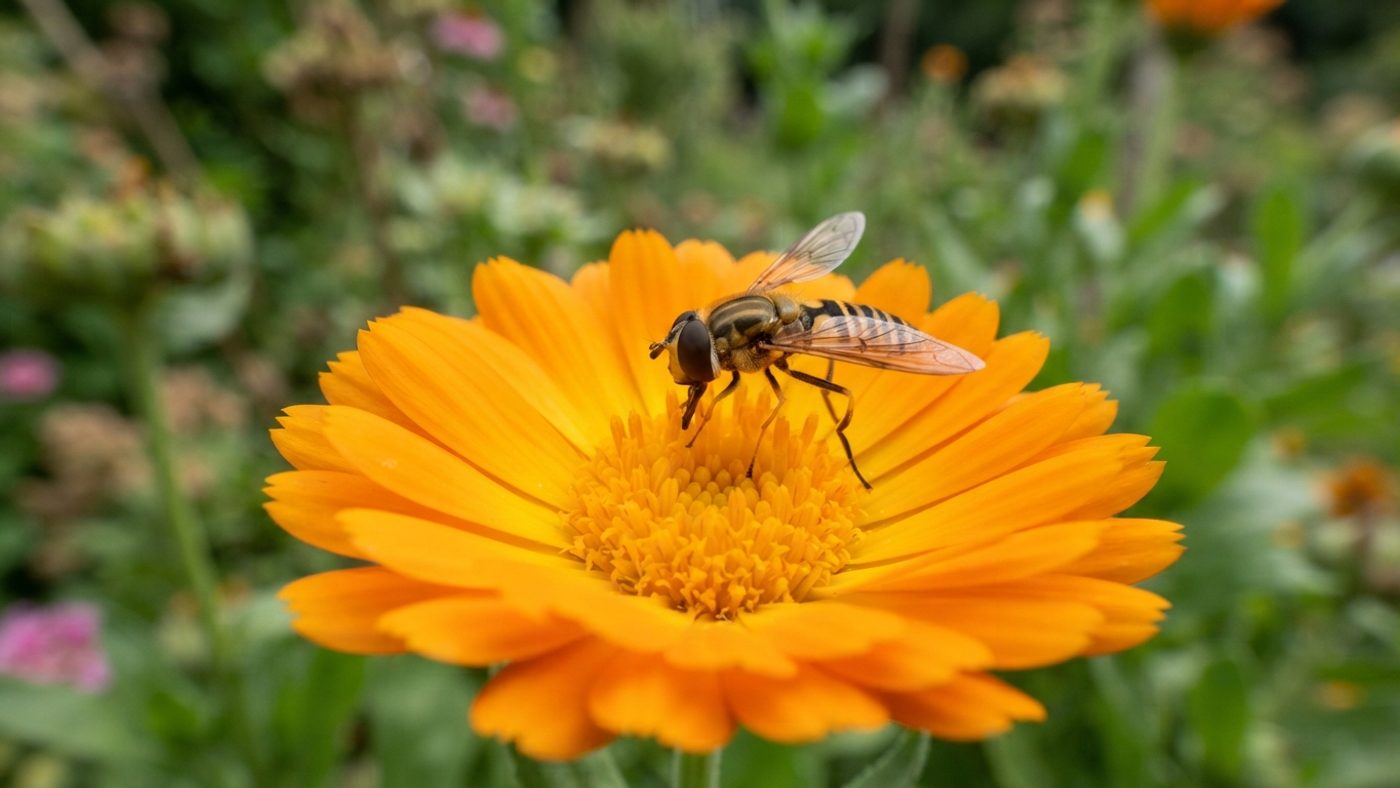
Calendula's real contribution to a vegetable garden is as a food source for beneficial insects, pollinators and predators alike, not as a pest repellent. RHS's plant page for Calendula officinalis tags the plant for "Plants for Pollinators" and "Cut flowers" use, a UK-wide RHS designation, not a Scotland-specific finding.
Garden Organic's guide to companion or mixed planting names calendula specifically as a flower worth mixing among vegetables to attract predatory insects, a predator-attraction recommendation, not a claim that calendula repels pests directly. Garden Organic's own growing guide for English marigold separately notes the plant is "loved by lacewings and ladybirds," again a predator-attraction observation, not a deterrent one.
The most precise evidence comes from a peer-reviewed study: Zhao et al. (2017), published in Pest Management Science, examined Calendula officinalis specifically, not Tagetes, as a floral resource for Orius sauteri. The mechanism is indirect: calendula flowers supply pollen that sustains and grows the Orius sauteri population under laboratory and greenhouse conditions, and that larger predator population then suppressed aphids (Myzus persicae) and thrips (Frankliniella occidentalis) as a secondary effect. Calendula isn't attacking or repelling the pests here, it's feeding their predator, which does the work. It's also worth being precise about scope: this is a greenhouse study of one predatory species, not a field trial in a mixed vegetable bed.
Set against that supportive role, RHS's plant page for Calendula officinalis lists the plant as itself "may be susceptible to aphids," along with powdery mildews and a virus. Calendula is a host for the pest it's grown to help control as much as it is a food source for that pest's predators, which cuts against any simple plant-it-and-your-other-crops-are-protected narrative.
The companion-planting folklore, examined honestly
RHS's companion-planting feature page states, verbatim, that "gardeners often plant insect-friendly flowers such as Calendula (pot marigolds) and nasturtiums near runner beans and tomatoes in the hope of similar effects" as the Tagetes/whitefly finding described above. That phrase, "in the hope of," is doing real work: it's RHS describing common gardener practice, not reporting a tested result, and no pest, mechanism, or citation is attached to the sentence.
Three specific folklore claims circulate about calendula as a companion plant, and none of them hold up. Calendula deters aphids or whitefly by scent: no RHS, Garden Organic, or peer-reviewed source attributes a scent-deterrent compound to calendula, that mechanism is documented only for Tagetes. Garden Organic's own page on companion planting adds a further complication for the whole "scent confuses pests" idea in general: "it was thought that odour was the key factor, but the evidence for this is conflicting," with visual signals, colour and shape, now thought more important than scent in muddling pests. Calendula is a trap crop with sticky sap that catches pests: no institutional source makes this claim, and RHS's own listing of calendula as itself susceptible to aphids works against a simple protects-your-other- plants story. Calendula confuses pests or masks the scent of neighbouring crops: not supported by any RHS, Garden Organic, or peer-reviewed source.
| Claim | Verdict | Basis |
|---|---|---|
| Deters aphids/whitefly by scent | Unsupported | No RHS, Garden Organic, or peer-reviewed source attributes a scent-deterrent compound to calendula |
| Acts as a sticky trap crop | Unsupported | No institutional source makes this claim; RHS lists calendula as itself susceptible to aphids |
| Attracts pollinators and predatory insects | Supported | RHS tags it "Plants for Pollinators"; Garden Organic recommends it to attract predatory insects |
| Sustains Orius sauteri, which suppresses aphids/thrips | Supported, but indirect | Zhao et al. 2017, Pest Management Science — a greenhouse study; the effect runs through the predator, not calendula acting on pests directly |
| Tagetes (a different plant) deters whitefly via limonene | Supported, but wrong genus | A real finding, but for Tagetes patula, not Calendula officinalis — the two are often confused |
Growing calendula well in Scotland
Calendula's hardiness is its biggest practical advantage for Scottish gardens: rated H5The RHS's H1a–H7 scale for how much cold a plant can survive outdoors, H1a being tender indoor-only and H7 hardy anywhere in the UK. Full definition →, hardy in most places throughout the UK even in severe winters, with broad site tolerance, full sun or partial shade, exposed or sheltered aspects, and a wide range of soils. That combination of cold-hardiness and site flexibility makes calendula one of the more forgiving hardy annuals available, next to more tender bedding plants that need coddling.
No source gives a Scotland-specific sowing date. Rather than following a fixed calendar date written for further south, sow once the local frost risk has genuinely passed. A sowing delayed to wait out local frost risk pushes that roughly-10-week-to-harvest window later too, not just the sowing date.
| Attribute | RHS | Garden Organic |
|---|---|---|
| Hardiness | H5, hardy throughout the UK even in severe winters (-15 to -10°C) | Not stated |
| Sowing | Seed sown in situ, spring or autumn | 0.5cm deep, in pots or rows, March–May |
| Spacing | Not stated | Thin or transplant to around 20cm apart |
| Soil/site | Light, poor, free-drainingSoil that lets water pass through quickly rather than pooling, so roots aren't sitting in wet ground after rain. Full definition →; full sun or partial shade | Sunny site, reasonably well-drained soil |
| Size | 0.1–0.5m height and spread | 30–60cm tall and wide |
DeadheadingRemoving spent flowers before they set seed, which redirects a plant's energy into further flowering rather than seed production. Full definition → serves two purposes here, not one: it prolongs flowering, and pinching outRemoving the soft growing tip of a stem to stop upward growth and make the plant branch out sideways instead. Full definition → terminal shoots encourages bushier growth, while cutting off the seed heads also stops calendula self-seeding excessively, which it otherwise does freely once established, expect it to spread and come back on its own in later years if seed heads are left on the plant.
Slugs aren't flagged specifically for calendula, but its seedlings are soft, unprotected growth of exactly the kind RHS's general slug and snail advice identifies as the most vulnerable stage for any plant. Treat calendula seedlings with the same targeted protection as any other vulnerable transplant.
Garden Organic groups calendula with lettuce and chicory under the Asteraceae plant family for crop-rotationMoving each crop family to different ground each year, on a multi-year cycle, so pests and diseases that build up in soil don't get a repeat host. Full definition → purposes: growing the same plant family in the same ground repeatedly lets any pest or disease that targets that family build up in the soil, so the point of the grouping is to avoid following calendula with another Asteraceae crop in the same spot the following year, not just calendula with calendula.

Eating calendula
Calendula's petals are genuinely edible, and this is arguably its best-evidenced value in a food garden: "intense colour and a peppery taste useful in soups, stews and puddings," with petals that can be dried, pickled in vinegar, or added to oil or butter.
The flavour range runs spicy, bitter, tangy, or peppery, used as decoration on soups, pasta, salads, and rice. Dried and powdered petals are sometimes called "poor man's saffron," a reference to the golden colour they lend to food rather than to flavour, since true saffron is far more expensive and tastes nothing like calendula; the powder suits that same golden tint in herb butter, spreads, soups, and scrambled egg. Young leaves are edible too.
The same general caution that applies to any edible flower applies here: avoid flowers grown at the roadside, remove any insects before eating, and take care if you have pollen allergies.
Calendula also carries a long history of use in traditional and folk herbalism, part of why it's commonly called "pot marigold." No RHS or comparable institutional source confirms specific medicinal effects, so that history is worth mentioning only as reputation, not as a verified benefit.
Verdict
Calendula earns its place in a Scottish vegetable garden on real merits: an unusually cold-hardy, site-tolerant hardy annual with genuinely edible petals that feeds the pollinators and predatory insects doing useful work nearby. Grow it for those reasons, deadhead it to keep it flowering and stop it seeding everywhere, and don't expect it to stand guard over your tomatoes or brassicasThe cabbage family: cabbage, kale, broccoli, cauliflower, Brussels sprouts, kohlrabi, swede, turnip and more, sharing the same pests, diseases and rotation rules. Full definition →, that job still belongs to netting, fleeceA lightweight, breathable fabric laid or draped over plants to trap a little warmth and keep off frost, wind and some flying pests. Full definition →, or a resistant variety, not a flower planted nearby in hope.
Common questions
Is calendula the same as marigold?
"Marigold" is used as a common name for two different genera. Calendula officinalis is called pot marigold or English marigold. Tagetes patula and Tagetes erecta are called French and African marigold. They’re unrelated plants with different properties, the pest-deterrence evidence that exists, for Tagetes and whitefly, does not apply to calendula.
Will planting calendula near my tomatoes protect them from pests?
Treat it as a nice-to-have, not a defence. If you want an actual reduction in whitefly on tomatoes, Tagetes patula is the plant with a trial behind it, not calendula. Calendula earns its spot in the same bed for other reasons: cut flowers, edible petals, and feeding the predatory insects that do some of the pest-control work indirectly.
Is calendula safe to grow around pets?
Yes, the ASPCA lists Calendula officinalis as non-toxic to both dogs and cats. That’s a genuinely different answer from Tagetes marigolds, whose sap can cause mild skin or stomach irritation in pets, one more reason to be sure which plant you actually have before assuming the two behave the same way.
Can I eat calendula petals from my garden?
Yes, RHS and Garden Organic both describe calendula petals as edible, with a peppery, spicy, or tangy flavour, used fresh in salads or dried and powdered for colour in butter, spreads, and eggs. As with any edible flower, avoid roadside plants, remove insects before eating, and take care if you have pollen allergies.
Is calendula hardy enough for a Scottish garden?
Yes. RHS rates it H5, hardy throughout the UK even in severe winters down to -15°C, and it tolerates a wide range of soils, full sun or partial shade, and exposed or sheltered sites. That combination makes it one of the easier hardy annuals for Scotland’s climate compared with more tender bedding plants.
Does calendula spread on its own once planted?
Yes. Garden Organic notes it self-seeds freely enough that its own growing advice is to cut off the seed heads if you want to stop it spreading. Left alone, expect it to come back and spread on its own in following years.
Sources
8 sources, recorded with what each was used for
- RHS: Calendula officinalis plant page: Hardiness (H5), soil/site tolerance, sowing method, deadheading, size, aphid/mildew/virus susceptibility, Plants for Pollinators and Cut Flowers tags
- RHS: Three ways to use companion planting: The calendula "in the hope of similar effects" framing; the Tagetes/limonene/whitefly finding, cited for contrast only
- RHS: Edible flowers: Calendula's edible-petal description and flavour, and general caution on eating flowers
- RHS: Slugs and snails: Seedlings as the most vulnerable growth stage
- Garden Organic: How to grow English marigold: Sowing depth, spacing, growing/harvest period, size, predator-attraction note, culinary uses, self-seeding, crop-rotation family grouping
- Garden Organic: Companion or mixed planting: Calendula's predator-attraction recommendation and the conflicting evidence on scent-based pest confusion
- Zhao et al. (2017), Pest Management Science: Peer-reviewed evidence for the calendula–Orius sauteri predator-support mechanism
- ASPCA: Toxic and Non-Toxic Plants — Pot Marigold: Confirmation that Calendula officinalis is non-toxic to dogs and cats