
Allium Leaf Miner is a minor pest that affects leeks, onions and garlic in Scotland. Here is what it looks like, how to spot the damage, and which controls have been tested.
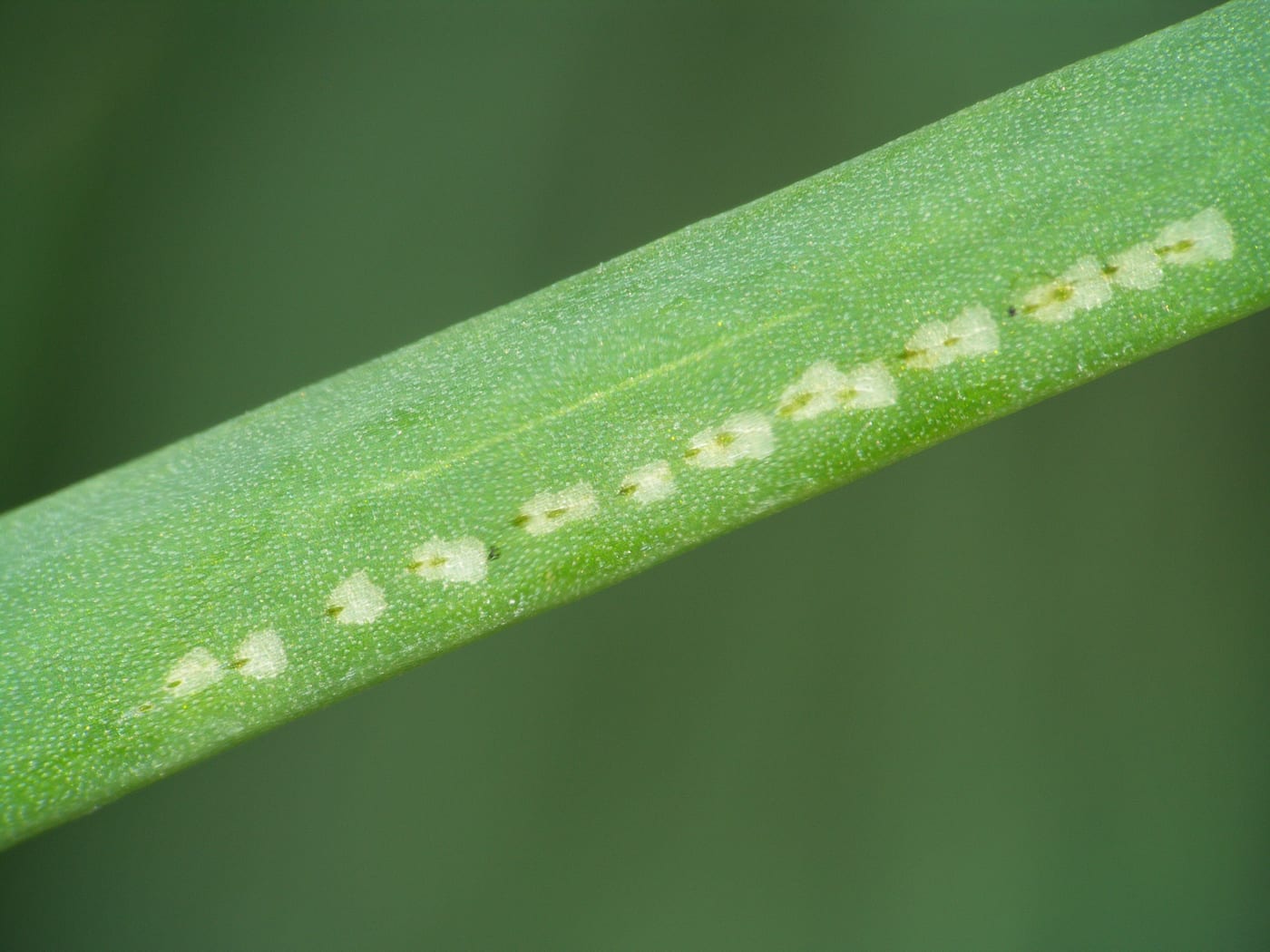
What does it look like?
Adults are greyish-brown flies, about 3mm long, easily mistaken for many other small flies on their own. Females puncture leaves to feed before laying eggs, leaving lines of white dots on the foliage as the first visible sign. The larvae are white, legless, headless maggots that tunnel through the plant, eventually forming cylindrical brown pupae, also around 3mm, embedded in the stems and bulbs.
Is this pest active now?
March to April: First generation, egg laying on stems or leaf bases
Late summer to autumn: Second generation, usually the most damaging
These are UK-generic timings. Scottish onset may differ. Use the Frost Date Calculator to adjust for your region.
Symptoms
Larvae bore into the stems and bulbs of leeks, onions, chives and garlic. Affected plants often develop secondary infections and rot.
Life cycle
Two generations a year. First-generation females lay eggs on the stems or base of leaves during March and April. The second generation repeats in late summer and autumn, and is usually the more damaging.
Why this matters in Scotland
First detected in Britain in 2002, this fly has become widespread in England and parts of Wales. Scotland isn't mentioned as part of that range.
That's not proof it's absent here, only that it hasn't been reported as established yet, and it's a recent arrival that's still spreading, so worth revisiting rather than treating as settled. What is worth noting for a Scottish leek grower specifically: the insect pests that dominate English leek advice, this one and leek moth alike, are largely someone else's problem right now, while leek rust, a genuine wet-summer disease, is squarely a Scottish one. The threat profile here looks different from the UK-generic picture for exactly that reason.
Controls: what actually works
Not every method here works equally well: some are backed by real evidence, and one has been tested and shown not to help despite how often it gets repeated.
Insect-proof fine mesh (0.8mm) while adult flies are active and laying
Cover plants with insect-proof mesh while adult flies are active and laying eggs. Aperture matters: fine mesh (0.8mm) is good against leaf miners including allium leaf miner, while standard mesh (1.3-1.4mm) cannot be relied on for this pest.
⚠ Important: The wrong purchase here means no protection at all. A grower who buys 'insect-proof mesh' off the shelf most likely buys standard 1.3-1.4mm, which does not reliably exclude allium leaf miner. The mesh goes on, the crop still fails, and the conclusion drawn is that mesh does not work.
Crop rotationMoving each crop family to different ground each year, on a multi-year cycle, so pests and diseases that build up in soil don't get a repeat host. Full definition →: essential alongside mesh
Crop rotation is essential, because adult flies can emerge from pupae underneath the covering if susceptible plants are grown in the same ground in successive years.
Mesh without rotation can be worse than no mesh at all: it traps emerging adults in with the crop rather than keeping them out.
Companion planting — chard interplanted with leeks
Garden Organic's 2024 members' experiment tested chard (taller) and clover (lower) as companions against allium leaf miner in leeks. Chard cut marketable leek yield by 69% — the competitive effects far outweighed any reduction in pest damage.
Frequently asked questions
What should I do first if I find allium leaf miner in my garden?
Start with insect-proof fine mesh (0.8mm) while adult flies are active and laying. After that, crop rotation. Work through the rest in order of how well-evidenced they are if the first two aren’t enough on their own.
Will allium leaf miner kill my plants?
They rarely kill established plants. The damage is usually cosmetic on outer leaves, and natural predators often bring numbers under control without you doing anything.
When are allium leaf miner most active in Scotland?
Check the seasonal activity section above. Scottish timings can run a few weeks behind the UK-generic figures.
Sources
3 sources, recorded with what each was used for
- RHS1: Phytomyza gymnostoma, first detected in Britain 2002, widespread in England and parts of Wales, boring into stems and bulbs of leeks/onions/chives/garlic, secondary rots, two generations with March-April and late summer/autumn timings, mesh timed to adult flight, rotation requirement
- RHS1: fine 0.8mm mesh good for allium leaf miner; standard 1.3-1.4mm unreliable
- Garden Organic8: 2024 trial: chard companion cut marketable leek yield 69% while targeting this pest