
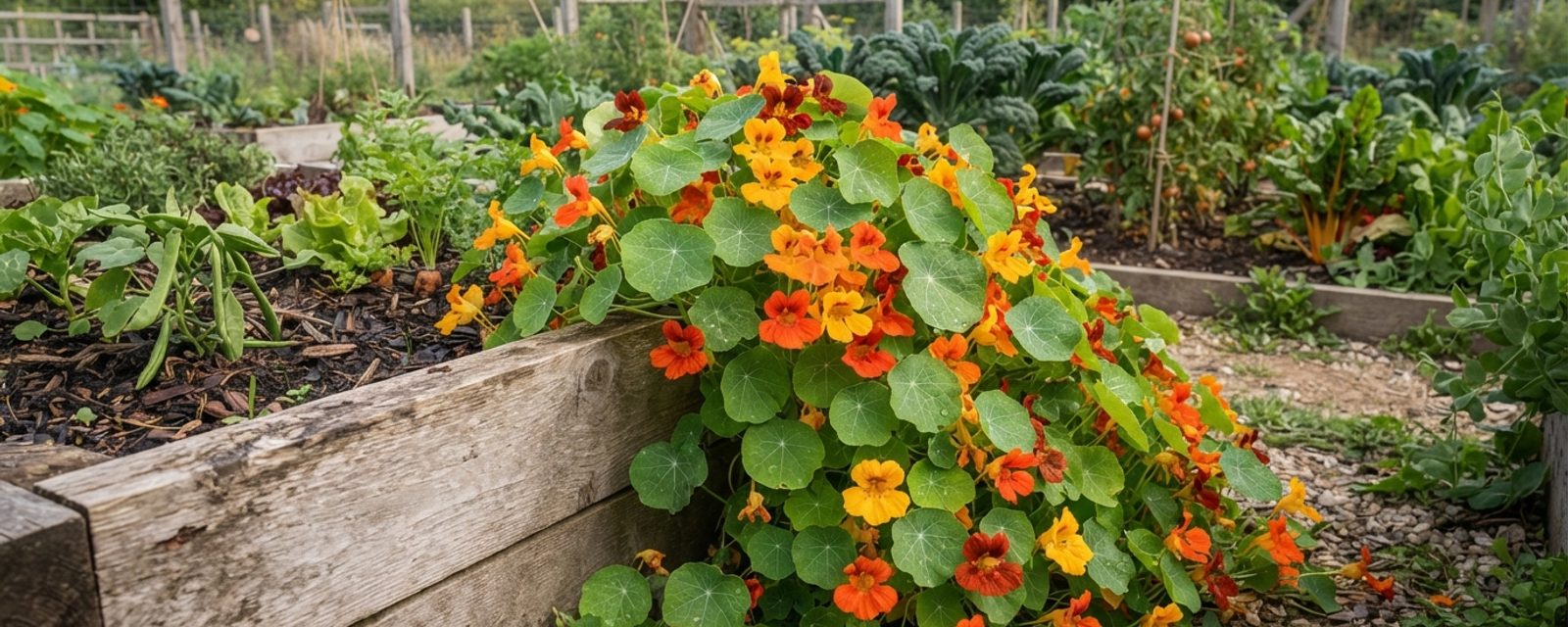
Nasturtiums earn their reputation as a "trap crop", a sacrificial plant grown to pull a pest onto itself and away from the crop you actually care about, for a real, biological reason: aphids and cabbage white butterflies genuinely prefer them. Black bean aphid (blackfly) is documented as feeding on nasturtium alongside broad, French and runner beans, and large and small white butterflies lay eggs on nasturtium leaves in the same way they do on brassicasThe cabbage family: cabbage, kale, broccoli, cauliflower, Brussels sprouts, kohlrabi, swede, turnip and more, sharing the same pests, diseases and rotation rules. Full definition →. That much is settled biology, not garden folklore. What's far less settled is whether planting nasturtiums near your beans or cabbages actually pulls pest pressure away from the crop you're trying to protect.
Nasturtiums are also one of the easiest, most rewarding dual-purpose plants available: fully edible from leaf to seed pod, thriving on neglect, and best in exactly the poor soil most gardeners are trying to improve.
The mechanism: a genuine host plant, not an invented one
Nasturtium (Tropaeolum majus) is listed by the RHS as a host plant that black bean aphid will colonise, appearing in its plant list alongside broad beans, French beans and runner beans as a species the aphid actually infests over summer. It is not a decoy the aphid merely tolerates, it's a plant the aphid will settle and breed on in its own right. The RHS also explains where those aphids come from each spring: black bean aphid overwinters as eggs on shrubs such as common spindle (Euonymus europaeus), viburnum and philadelphus, before winged adults migrate in summer to "suitable summer host plants, such as beans, nasturtium, poppies and dahlia." Nasturtium isn't the aphid's starting point, it's one of several summer destinations the aphid flies to once it's already active.
The same is true on the caterpillar side, and here there's no protective angle to argue about at all: the RHS lists nasturtium alongside cabbage, broccoli, sprouts and other brassicas as a plant that cabbage white caterpillars actually feed on, not merely visit. Adult butterflies lay eggs on it in the same way they do on brassicas. Whatever benefit nasturtium offers here, it isn't diverting caterpillars away from a food source they dislike, nasturtium is a food source they're happy to eat.
What the evidence actually supports, and what it doesn't
The RHS's own advice page on companion planting is carefully hedged on this exact point. It groups nasturtiums with pot marigolds as flowers gardeners plant near runner beans and tomatoes "in the hope of similar effects" to other attractant plantings, language that describes a common practice, not a demonstrated outcome. Its dedicated blackfly page doesn't mention nasturtium as a management strategy at all; it appears there purely as one of the plants blackfly is known to infest. Its cabbage caterpillar page treats nasturtium the same way, as an affected plant, not a countermeasure.
Garden Organic's own page is similarly neutral: it names attracting "a whole host of beneficial insects" as a genuine benefit, but its pest-management advice for nasturtium is simply to wash off aphids and pick off caterpillars by hand, not to rely on the plant to pull pests away from anything else. Garden Organic's broader position on companion planting elsewhere on its own site is more cautious still: it states plainly that companion planting "can often have unproven benefits," and cites carrot fly control by companion planting as a case where "trials have shown inconsistent results," recommending mesh or fleeceA lightweight, breathable fabric laid or draped over plants to trap a little warmth and keep off frost, wind and some flying pests. Full definition → instead for reliable control.
No institutional trial isolating a measurable pest-diversion effect from nasturtium plantings has been published by either the RHS or Garden Organic, the two horticultural charities with the closest thing to trial evidence on this subject; Gardeners' World states the diversion effect more confidently, as straightforward practice, with no trial behind that either. What exists overall is a real, mechanistically plausible host-plant relationship, a long tradition of gardener practice built on it, and no controlled data confirming it works as protection rather than just as attraction.
| Source | Claim | Evidence level |
|---|---|---|
| RHS — blackfly page | Nasturtium is a summer host, not a stated trap crop | Host relationship confirmed; no protective claim made |
| RHS — cabbage caterpillars page | Nasturtium is a feeding host, not a stated trap crop | Host relationship confirmed; no protective claim made |
| RHS — companion planting page | Planted near beans "in the hope of" an effect | Described as common practice, not tested |
| Garden Organic — nasturtium page | Attracts beneficial insects; aphids/caterpillars washed or picked off as needed | Neutral — attraction noted, no diversion benefit stated |
| Gardeners' World | Lures aphids away from the crop | Stated as practice, not trial-backed |
Treat nasturtium as a plant that will reliably draw in aphids and cabbage white activity, and as a plausible, low-cost addition to a pest-management routine, but not as a substitute for direct controls like fleece, netting, or hosing off aphids, which is what the RHS and Garden Organic both point to when they want something that actually works consistently.
Growing nasturtiums well
The growing advice from the RHS and Garden Organic agrees closely, and it runs opposite to most vegetable-growing instinct: nasturtiums do best when you don't feed them.
- Soil. Skip the compost and fertiliser. The RHS is explicit that nasturtium is "best grown in poor, well-drained soil in full sun" and that overly rich ground produces "foliage... at the expense of flowers." Garden Organic repeats this: plants "grown in very fertile soil are likely to grow lots of leaves but not many flowers."
- Sowing. Garden Organic advises sowing seed 1.5-2cm deep in pots or rows, thinning seedlings to roughly 20-30cm apart. A late sowing extends flowering through to the first autumn frosts.
- Site. Full sun; the RHS notes it tolerates chalk, loam and sandy soils across a neutral, acid or alkaline pH range. It also grows well trailing from containers or climbing a support if you choose a climbing variety.
- Hardiness. The RHS gives nasturtium a hardiness ratingThe RHS's H1a–H7 scale for how much cold a plant can survive outdoors, H1a being tender indoor-only and H7 hardy anywhere in the UK. Full definition → of H3, hardy in coastal and relatively mild parts of the UK, tolerant down to roughly -5°C to 1°C but not to being frozen through, and it is an annual that does not survive winter frost. Much of inland and northern Scotland sits outside the "relatively mild" band that rating describes, so sowing and planting-out timing needs adjusting for that, covered next.
- Pests. The RHS notes nasturtium can be affected by glasshouse whitefly, glasshouse red spider mite and virus diseases, on top of the aphids and caterpillars covered above. Garden Organic's own advice for both is straightforward, wash off aphids and pick off caterpillars by hand, cutting plants back hard if an attack is severe. Young seedlings are also a genuine slug and snail target, worse in Scotland's damper climate than a drier southern garden, the RHS's own general advice is to give seedlings and soft young shoots targeted protection (transplanting sturdy young plants rather than tiny seedlings, or a clocheA small, portable clear cover placed over an individual plant or short row to trap warmth and keep off wind, rain and pests. Full definition →) rather than relying on pellets.
Scotland-specific timing
Neither the RHS, Garden Organic nor Gardeners' World gives country-specific sowing dates, but the H3 hardiness rating above still points to a real, practical difference for a Scottish garden: sowing or planting out needs to wait until the local risk of frost has genuinely passed, which falls later in the year across most of Scotland than a rating written around "relatively mild parts of the UK" implies. In practice that means favouring the later end of any UK-wide sowing window, or starting seed under cover and hardening plants off, rather than treating a single national calendar date as the target.
The same later-spring pattern is worth factoring in if you're planting nasturtium specifically to draw blackfly away from beans. Black bean aphid overwinters on shrubs, not on beans or nasturtium, and only moves onto summer hosts once winged adults start migrating as the season warms. A garden that warms up later in spring can expect that migration to arrive later too, which argues for getting nasturtiums established well ahead of when blackfly is expected on the beans, rather than copying a sowing date written for a milder part of the UK. Spindle, viburnum and philadelphus growing near a bean bed give blackfly eggs somewhere to spend the winter close to next year's crop, so keeping those shrubs out of, or well away from, a vegetable plot removes one of the aphid's local starting points.
Eating nasturtiums
Every above-ground part of the plant is edible, which is a large part of why it earns a place in a vegetable bed even before the pest-management question is settled.
- Leaves. Peppery, with Garden Organic comparing the flavour to cress. Good raw in salads or as a garnish.
- Flowers. Garden Organic describes the petals as carrying a "spicy-peppery" flavour, and they're a standard edible-flower garnish for salads and plated dishes.
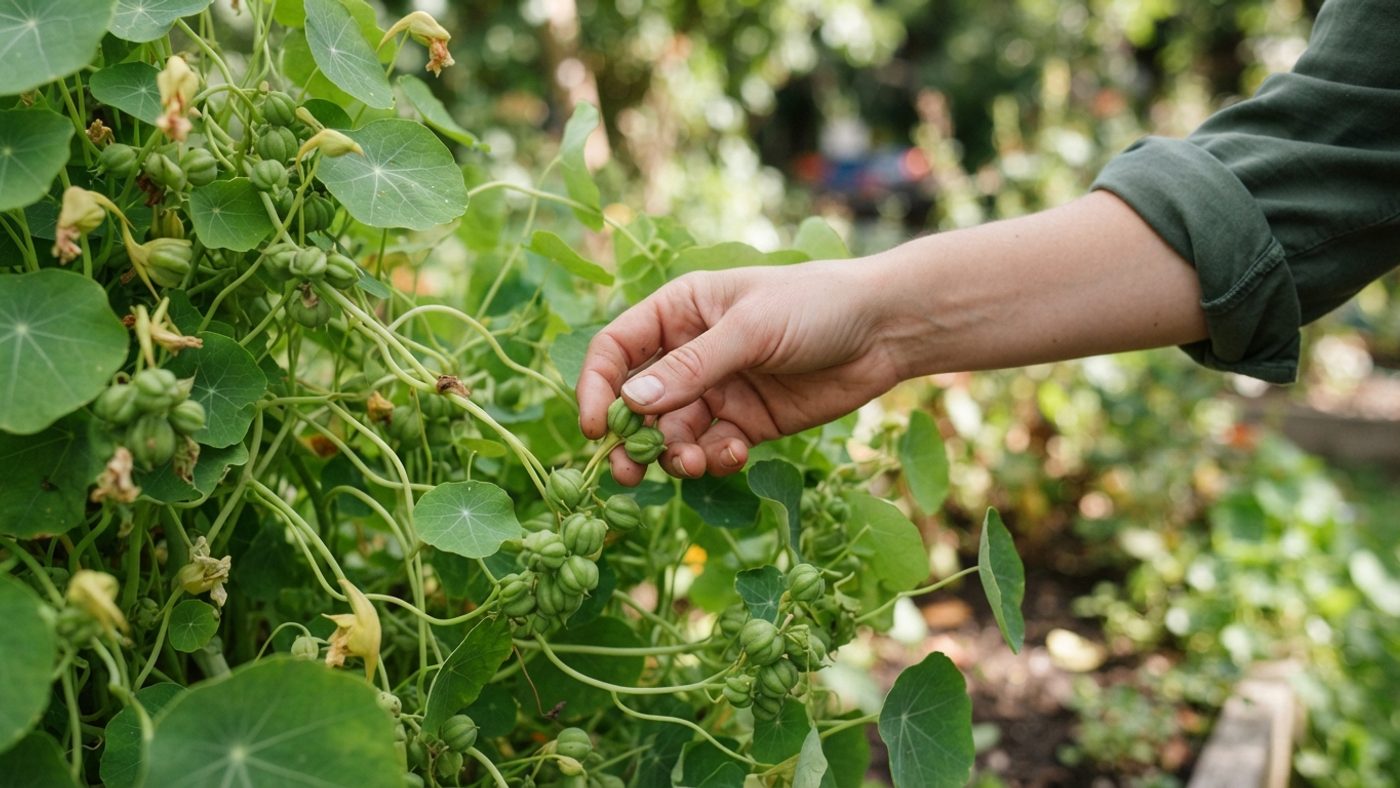
- Seed pods. Picked while still green and unripe, the pods can be pickled and used as a caper substitute, commonly called "poor man's capers."
Verdict
Grow nasturtium for what's actually certain about it: an easy, self-sufficient annual that asks for neglect rather than feeding, and delivers a genuinely useful three-part harvest of leaves, flowers and pickled pods for almost no effort. Any pest-diversion benefit is a plausible bonus worth having, not a guarantee worth relying on, keep fleece, netting or hand-picking as the actual line of defence for beans and brassicas that matter.
Common questions
Do nasturtiums actually stop blackfly on beans?
Not reliably, or at least not in any way a trial has confirmed. Blackfly genuinely will colonise nasturtium, and gardeners have long planted it near beans hoping to draw aphids away, but the RHS describes this as something gardeners do "in the hope of" an effect rather than a proven result, and no controlled trial isolating a measurable diversion effect has been published by the RHS or Garden Organic.
Can nasturtium leaves and flowers be eaten raw?
Yes. Both the leaves and flowers have a peppery flavour, and are commonly eaten raw in salads or as a garnish.
What are nasturtium seed pods used for?
The unripe green seed pods can be pickled and used in place of capers, and are often called "poor man’s capers."
Why won’t my nasturtiums flower even though the plants look healthy?
Overly rich or well-fertilised soil pushes nasturtiums into producing lots of leafy growth at the expense of flowers. They flower best in poor, well-drained soil that hasn’t been fed.
When should nasturtiums be sown or planted out in Scotland?
Nasturtium is frost-tender (RHS hardiness rating H3) and is killed by the first frost, so sowing or planting out should wait until the local risk of frost has passed, which in most of Scotland falls later than the general UK sowing window these guides describe. Starting seed under cover and hardening offGradually getting young plants raised indoors used to outdoor conditions over 7–14 days before planting out, so cold, wind and direct sun don't shock or damage them. Full definition →, or sowing later outdoors, is a safer approach than following a southern England calendar.
Sources
8 sources, recorded with what each was used for
- RHS: Blackfly: Nasturtium as a genuine summer host plant, and the overwinteringKeeping a plant alive and intact through the cold months, whether left outdoors, moved under cover, or stored dormant. Full definition → hosts (spindle, viburnum, philadelphus) that blackfly migrates from
- RHS: Cabbage caterpillars: Nasturtium listed as an actual feeding host for cabbage white caterpillars, alongside brassicas
- RHS: Companion planting: The "in the hope of similar effects" framing for nasturtiums planted near beans and tomatoes
- RHS: Tropaeolum majus (garden nasturtium): The H3 hardiness rating
- Garden Organic: How to grow nasturtium: Growing conditions (poor soil, sowing depth and spacing), edible uses, flavour, and pest-management advice
- Garden Organic: Companion or mixed planting: The caution that companion planting "can often have unproven benefits," and the carrot-fly example of inconsistent trial results
- Gardeners' World: How to grow and care for nasturtium: The stated aphid-luring practice, for comparison against the more cautious institutional sources
- RHS: Slugs and Snails: Targeted seedling protection as the recommended approach over pellets