
Carrot Fly is a serious pest that affects carrots, parsnips and parsley in Scotland. Here is what it looks like, how to spot the damage, and which controls have been tested.
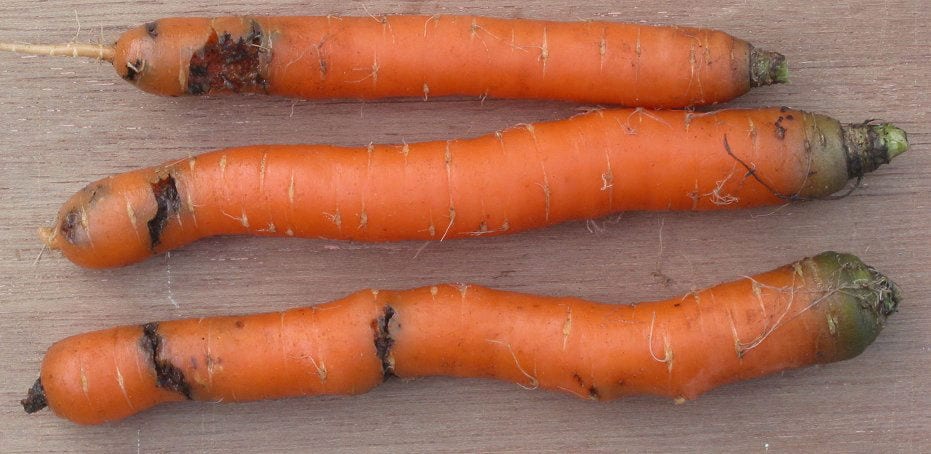
What does it look like?
The adult is a small, black-bodied fly, easy to overlook in the garden. The damage is done by the larvae: slender, creamy-yellow maggots up to 9mm long that tunnel into the root.
Symptoms
Rusty brown scars ring the tap rootA single, thick, dominant root growing straight down from a plant, storing energy and anchoring it, as opposed to a spreading mass of fine roots. Full definition → where larvae have tunnelled through it, leaving the carrot inedible and more prone to secondary rots setting in through the damaged tissue.
Life cycle
Two to three generations a year in the UK generally: the first lays eggs in late May and June, the second in August and September, and the fly overwinters as larvae or pupae in the soil to start the cycle again the following spring. This is the biology behind the sowing-and-harvest timing controls below, though the Scottish calendar for these generations specifically hasn't been confirmed (see the timing control's own caveat).
Controls: what actually works
All the methods below are backed by real evidence, not just repeated folklore.
Cover the crop entirely with insect-proof mesh
The most effective prevention is to cover the crop entirely with insect-proof mesh.
This is the control that the carrot+onion companion folklore displaces. Garden Organic's trials found the onion claim inconsistent, and a grower who plants onions instead of meshing gets a maggoty crop.
Timing: sow after mid-May to miss the first generation; harvest before late August to miss the second
Both levers are documented: sowing after mid-May misses the first generation, and lifting before late August misses the second.
Crop rotationMoving each crop family to different ground each year, on a multi-year cycle, so pests and diseases that build up in soil don't get a repeat host. Full definition →: avoid beds previously used for carrots
Grow resistant varieties
Carrot 'Flyaway' (AGMThe RHS's Award of Garden Merit: a UK-wide trials award for reliable performance, not a Scotland-specific recommendation. Full definition →) is resistant to carrot fly.
Companion planting: onions to mask carrot scent
There is a three-way conflict here. RHS's companion feature asserts it as tradition; Garden Organic's trials found inconsistent results and dispute the odour mechanism; and RHS's own carrot growing guide is silent on onions and recommends mesh.
Scottish grower notes
Carrot fly is patchy across Scotland. Long-established carrot-growing areas can carry damaging populations, while other areas are still carrot fly-free and need no precautions, though growing carrots in the same ground year after year will eventually build a population where there was none. Yellow sticky traps show whether flies are active near you, and catching them early lets you bring harvest forward to limit damage.
From SAC/SRUC field-scale organic guidance dated 2000; the geographic pattern and the monitoring method still hold, but it is not a live distribution map, so check locally rather than assume.
Frequently asked questions
What should I do first if I find carrot fly in my garden?
Start with cover the crop entirely with insect-proof mesh. After that, timing. Work through the rest in order of how well-evidenced they are if the first two aren’t enough on their own.
Will carrot fly kill my plants?
They can cause serious damage if left unchecked. Start with the research-supported controls above and you will get a crop.
How much of this advice is actually proven?
4 of the 5 controls above are evidence-based, not just repeated folklore. Start with the evidence-based ones and treat anything lower down the list as worth trying, not worth relying on.
Sources
3 sources, recorded with what each was used for
- RHS1: mesh as most effective prevention, generation timing levers, rotation, 'Flyaway' resistance
- RHS1: Latin name, identification, symptoms, life cycle and generation timing
- SAC/SRUC13: Scottish carrot fly distribution (patchy: absent from some areas, damaging in traditional carrot-growing areas, builds with repeated cropping), late-sowing avoidance strategy, yellow-sticky-trap monitoring