
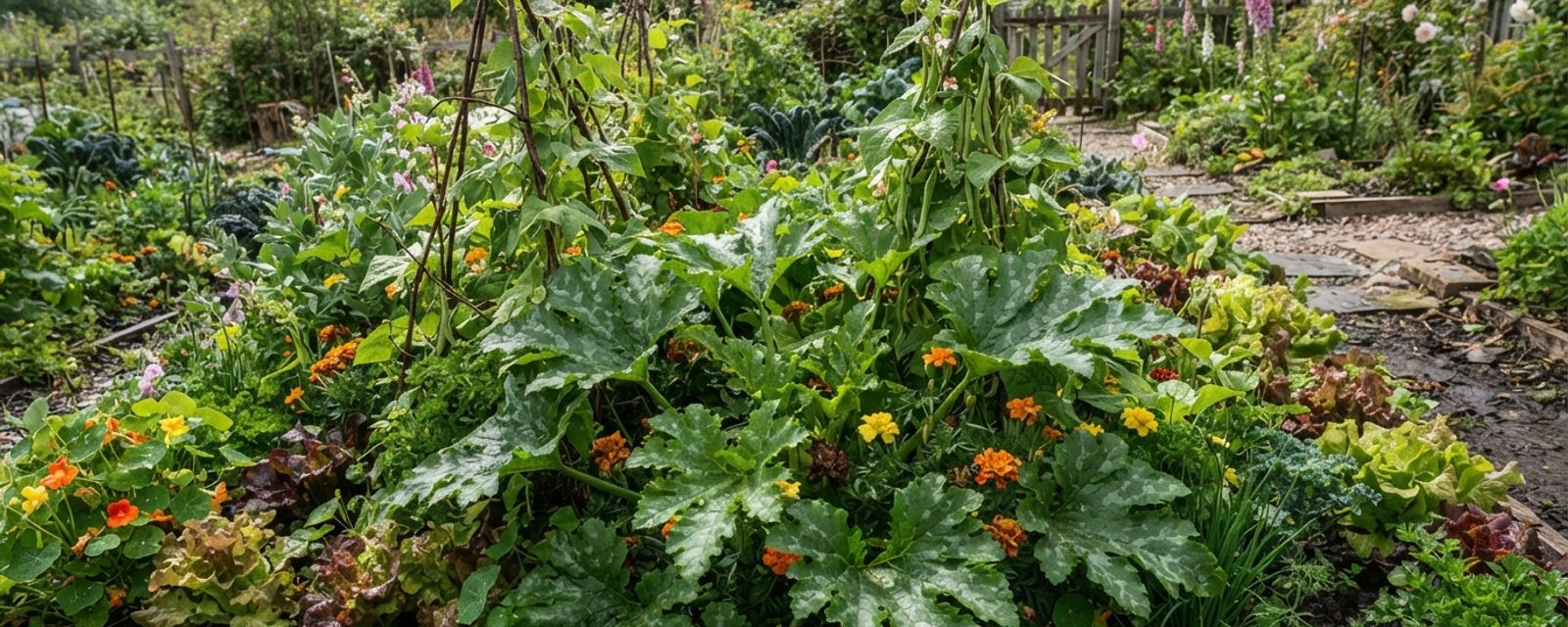
By mid-July the bed is a green tangle. Courgette leaves the size of dinner plates are shading out something underneath that might be beetroot. A sunflower has bent sideways over what was meant to be a row of carrots. Somewhere in there are three or four squash plants nobody remembers sowing, and the calendula has seeded itself into every gap. It looks, from a distance, wildly abundant. Up close, half of it is straining for light, the courgette is the only thing anyone can actually find to harvest, and the carrots, assuming they're still alive under there, were never going to size up in that shade.
This is chaos gardening: scatter a mix of leftover, mismatched, past-date seed across a bed, skip the spacing and the planning, and let whatever comes up, come up. It's a genuine trend, largely grown on TikTok and Instagram, presented as a rebellion against fussy, rule-bound gardening, and it photographs well in June, before the crowding catches up with it. The question worth answering properly, rather than assuming either way, is what it does to actual yield, particularly here, where the growing season doesn't leave much room for a bed to recover from a rough start.
What "chaos gardening" actually is
There's no formal definition, but the practice as it's usually described has three consistent features: a mixed batch of seed (often whatever's left in a seed tin, sometimes including flowers, vegetables and herbs together), no attempt at spacing individual seeds or plants apart, and no companion-planting logic, nothing is placed deliberately next to anything else, favourable or otherwise. It's the opposite of a bed plan. Whatever germinatesA seed sprouting: breaking dormancy and putting out its first root and shoot, given the right warmth and moisture. Full definition →, stays, and whatever thrives, wins.
A wildflower meadow sown from a mixed perennial seed blend is also "unplanned" in the sense that individual plant positions aren't chosen, but it's a recognised, deliberately low-intervention method for a specific outcome (ground cover and pollinator forage, not a harvest), sown at an appropriate density for that outcome. Chaos gardening, as the trend describes it, applies the same "just scatter it" logic to edible crops that are being grown for yield, where plant size, root competition and harvest access all matter in a way they don't in a meadow.
The upsides that are genuinely real
It would be a mistake to treat this as nothing but a bad idea, and the trend does have some real defensible ground.
Using up seed that would otherwise be binned. Seed packets accumulate, a few years of half-used packets, some past their stated date, and most seed doesn't die on a specific day; germination rates decline gradually rather than falling off a cliff. Scattering a mixed batch to see what still comes up is a reasonable way to find out, and it beats throwing the packets away unused.
A genuine biodiversity and pollinator benefit from mixed, unplanned planting. A bed with a wide mix of flowering plants blooming at different points across the season is closer to what pollinators need than a single monoculture crop. NatureScot's pollinator advice specifically identifies March to October as the period gardens need to stay in bloom, since spring and autumn are the hardest stretches for emerging and pre-hibernation pollinators, and recommends mixed, less-tidy planting, including reduced mowing and wildflower strips, as a way to meet that. A chaotic mixed bed, even an unplanned one, tends to produce more of that continuous bloom than a single block of one vegetable.
A low-effort, forgiving entry point for a total beginner or a child's first growing experience. For someone who wants to see seeds turn into plants without absorbing spacing charts and sowing calendars first, scattering a mixed packet and watching what happens is a real, low-stakes way in. Nobody's yield depends on it going well.
But none of that is really an argument about vegetable yield, it's an argument about seed disposal, pollinators, and accessibility. The yield question is separate, and it's where the method runs into real trouble.
Why crowding costs yield, the actual mechanism
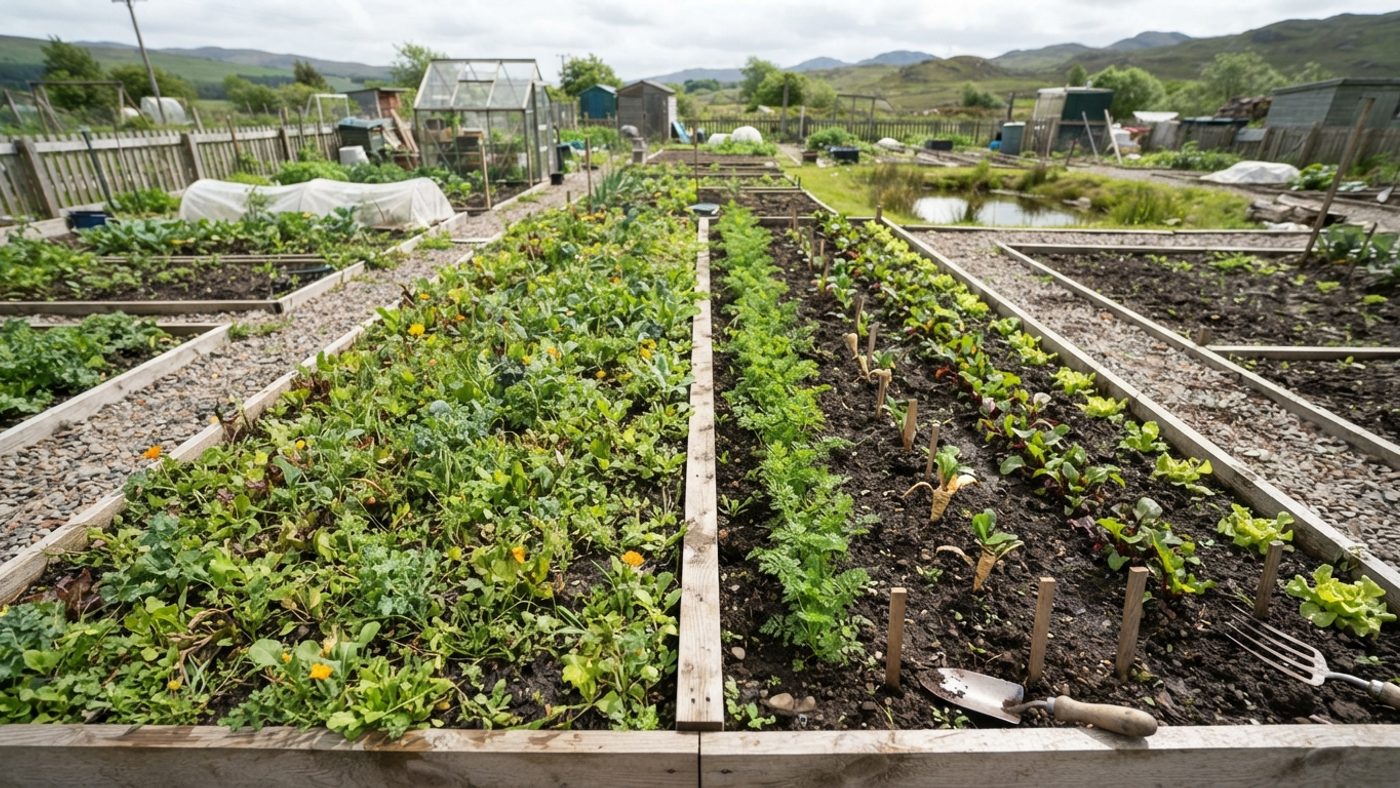
Three plants sown close together don't each get a third of the resources a single plant would get. They compete for light, water and nutrients simultaneously, and the effects compound rather than divide neatly.
Light. A fast-growing, large-leaved plant, courgette, squash, sunflower, will shade out anything sown underneath or beside it within weeks. A shaded seedling doesn't just grow slower; it puts energy into stretching toward light instead of into roots or the crop itself, at the expense of the yield it eventually produces, if it produces one at all.
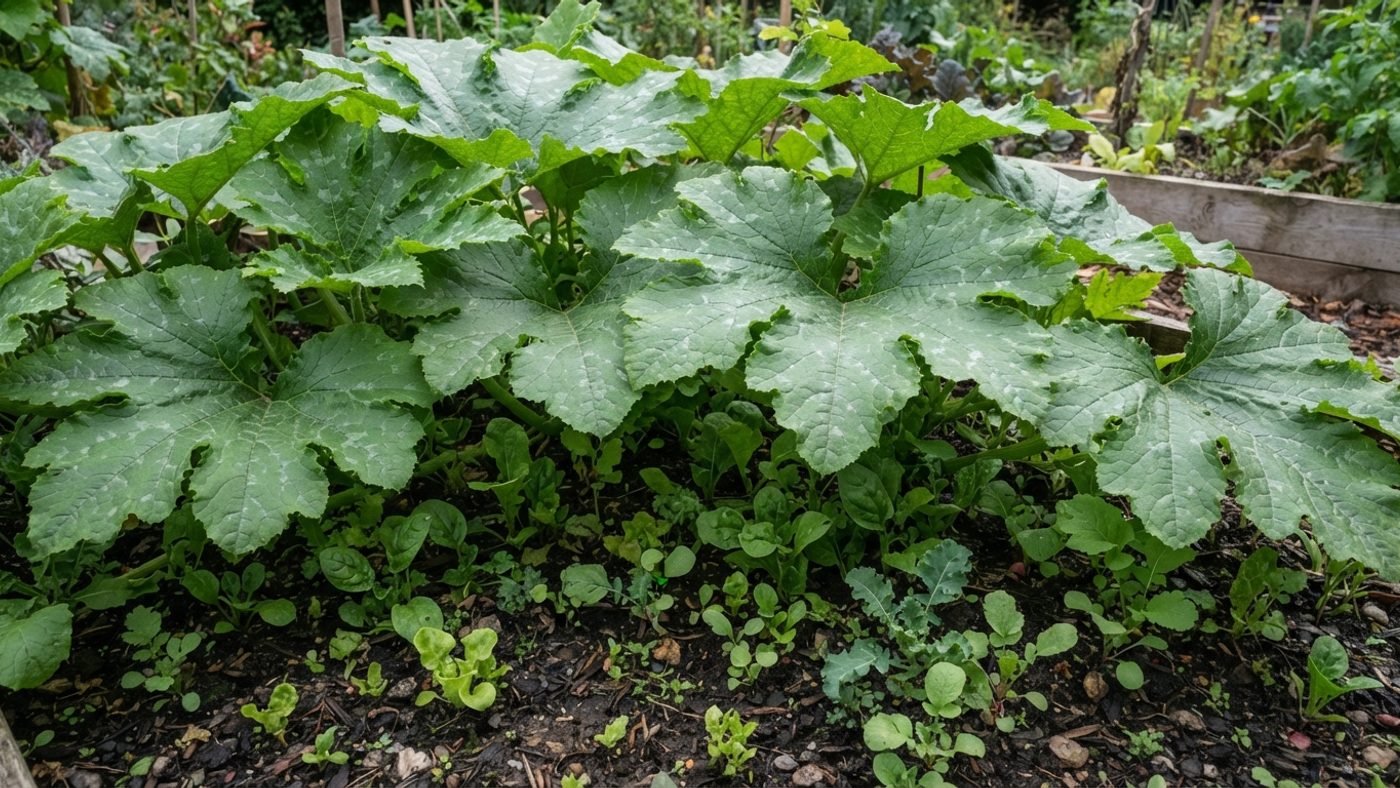
Water and nutrients. Roots compete underground just as leaves compete above it. Where a spaced planting has enough soil volume per plant to draw on, an unplanned dense cluster of same-aged seedlings is asking the same patch of soil to feed several root systems at once. In Scotland's wetter growing conditions that competition shows up as smaller, weaker plants rather than outright failure, a state that doesn't announce itself as clearly as wilting does, so it can go unnoticed until harvest.
Crowding is also a direct disease and pest risk, not just a growth-rate one. Ample spacing between plants and good air circulation are standard preventative practice against fungal and pest problems, and damping offA fungal disease that kills seedlings at soil level, usually caused by overwatering, poor airflow, or reused unsterilised compost or trays. Full definition →, a fungal disease that kills seedlings at soil level, is worse under conditions of high humidity, poor air circulation, and where seed is sown too thickly, especially where the seedlings are crowded. The standard advice for avoiding it is to sow thinly rather than densely, and to thin overcrowded seedlings out afterwards, since overcrowding can hinder growth and make seedlings more susceptible to disease. A chaos-gardened bed, by design, skips the first step, and a scatter-sown bed left to its own devices usually skips the second one too, since there's no plan telling anyone which seedlings are "extra."
Slugs and snails add to that pest pressure specifically. They're already the single most common pest enquiry the RHS receives, and are well suited to the damp, mild climate of the UK, a climate Scotland sits on the wetter end of. Dense, unthinned, low-lying foliage gives them more cover and more damp micro-shelter to move through than a bed with visible soil and airflow between plants, on top of the fungal-disease risk crowding already raises.
A mixed packet also mixes sowing windows, not just spacing. Different seeds have different recommended sowing times, checked on each packet individually rather than assumed, "when the soil is warm enough" is a real, checkable condition, not a formality. Scattering a whole tin of accumulated packets in one go, in one session, skips that check for everything in the mix. That's a real risk anywhere, but it bites harder in a Scottish spring specifically: with roughly ten air-frost days in a typical March against about six in England, Scottish soil stays cold for longer, so more of a mixed batch is likely to sit ungerminated or fail outright than the same tin scattered on the same date further south.
No spacing means no harvest access. This is easy to overlook because it isn't about plant health at all, it's about whether a mature crop can actually be picked. Root vegetables sown at random density can't be lifted without disturbing their neighbours. A courgette plant that's grown into a tangle of other unplanned self-seeded volunteers is hard to reach without trampling something. Yield isn't just about how much biomass a bed produces; it's about how much of that biomass a gardener can actually get out of the ground intact.
The RHS's own spacing guidance for vegetable beds exists precisely to manage this: its rule of thumb for row spacing is to add the two adjacent crops' recommended spacing and divide by two, specifically so there's enough space for weeding along and between rows, to create good air circulation and to allow each crop to grow to its determined size. That's not an arbitrary tidiness rule, it's a working figure derived from how much room each type of plant needs to reach a usable size without starving its neighbour.
Where mixed planting genuinely does work, and why that's different
Garden Organic, the UK organic-growing charity that runs its own member trials, distinguishes between companion-planting claims that don't hold up under trial and genuine ecosystem-level benefits from diversity. It notes that some traditional companion-planting claims are weaker than reputation suggests, onions next to carrots to confuse carrot root fly, for instance, has produced inconsistent results in trials, while broader diversification (mixing flowers and vegetables together to draw in pollinators and pest predators, rather than pairing specific plants for a specific claimed effect) does have real, observable value. The RHS's own reporting on companion-planting research found something similar: mixing tomatoes with a range of other plants reduced pest problems by a similar margin to the specific marigold pairing usually credited with the effect, suggesting general plant diversity, not any particular pairing, is doing the work.
The distinction that matters for chaos gardening is this: deliberate mixed planting still respects density. A gardener interplanting flowers between vegetable rows for pollinator benefit is still leaving each crop plant room to reach its mature size, the diversity is in what's planted, not in how tightly it's packed. Chaos gardening, as the trend is actually practised, drops both the planning and the spacing at once. The biodiversity upside survives that; the yield does not.
The Scottish season makes crowding more expensive, not less
A plant that gets a slow, competitive start in a long growing season sometimes has time to recover, it can catch up once a neighbour is harvested or thinned out, or simply grow on through a long autumn. Scotland's growing season is shorter than most of England's, so there's less of that margin to begin with. At the spring end specifically, checked against the region's own last-frost timing, it's also cooler and considerably wetter:
| Metric | Scotland | England |
|---|---|---|
| Air frost days, March (typical) | ~10 | ~6 |
| Rainfall, March | More than double England’s figure | — |
Wetter, cooler conditions are also exactly the conditions that raise fungal disease risk in crowded plantings, so the same crowding produces a worse outcome here than it would somewhere drier.
The practical effect: a crop that loses several weeks to competition for light and water in a Scottish bed is losing weeks it likely won't get back before a shorter season closes. A slow-to-size root vegetable, or a crop that needed the full frost-free window to mature, doesn't get a long autumn to make up the difference. It just runs out of time.
There's a physical dimension to this too. The windiest parts of the UK are, in general, the north and west, since the prevailing south-westerlies leave those areas more exposed than the south and east, which covers most of Scotland. A tall, unsupported plant grown without its usual spacing, a sunflower with nothing to lean into, a squash vine without room to run along the ground, has less to anchor it and more incentive to stretch for light, which is exactly the combination that ends with something toppled after a windy spell.
What a spacing-based approach gets you that scattering doesn't
| Factor | Chaos-scattered bed | Spaced/planned planting |
|---|---|---|
| Light per plant | Competed for; larger plants shade smaller ones | Each plant sized to reach its mature spread |
| Air circulation | Poor once canopy closes | Maintained by row/plant gaps |
| Disease risk (damping off, fungal) | Higher -- RHS links both to crowding | Lower, standard prevention |
| Harvest access | Often blocked by neighbouring growth | Planned for at sowing |
| Pollinator/biodiversity value | Genuinely good if flowers included | Achievable too, with intercropping |
| Use of leftover/expiring seed | Good use case | Less relevant to this factor |
The honest verdict
Chaos gardening isn't a scam. But it isn't a shortcut to the same results as planned planting either, and the fix isn't necessarily full formality: a mixed, flower-and-vegetable bed sown with the same care about spacing as a single-crop row keeps the biodiversity upside and drops the yield cost. What doesn't survive contact with a Scottish growing season is the "just scatter it and leave it" version, applied to crops anyone actually plans to eat and pick.
Which crops it costs most also varies. Quick, cut-and-come-again salad leaves and radish can still put in a usable crop from a late, competitive start, because they were never asking for much time or space in the first place. MaincropThe main, usually latest-sown and longest-growing type of a crop, grown for bulk and storage rather than an early harvest. Full definition → squash, sweetcorn and anything else that needs the full length of the season to size up have the least room to absorb weeks lost to crowding, those are the crops where a chaos-sown result is most likely to disappoint. Structures that buy back some of that lost time, a clocheA small, portable clear cover placed over an individual plant or short row to trap warmth and keep off wind, rain and pests. Full definition →, a cold frame, a polytunnel, help more than they would in a well-spaced bed, simply because there's more lost ground to make up. And on the heavy, slow-draining clay common across lowland Scotland, the same root competition for water described above tends to show up as worse waterlogging around crowded root systems rather than drought stress, since there's less free-drainingSoil that lets water pass through quickly rather than pooling, so roots aren't sitting in wet ground after rain. Full definition → soil for excess water to move through in the first place.
If the bed's already a jungle
The earlier the intervention, the more it recovers, but a crowded bed isn't a lost cause at any stage of the season. At the seedling stage, a few true leaves, still small enough to pull by hand, thin ruthlessly: pull every second or third seedling along any obviously crowded patch, keeping the strongest and best-spaced of each type rather than trying to save everything. By midsummer, with plants already sized up and tangled together, the same principle still applies but the tools change: it becomes selective removal rather than thinning, take out whole plants that are clearly shading or crowding a neighbour with more promise (an excess squash or courgette is the usual culprit), rather than trying to rescue everything in the bed at once. It's genuinely too late for a shaded, stunted plant to catch up to where it would have been with proper spacing from the start, but removing what's crowding it still gives the survivors a better second half of the season than leaving the tangle as it is.
Common questions
Does chaos gardening actually reduce vegetable yield?
Not automatically, but crowding, the practical result of scattering seed without spacing, does. Competition for light, water and nutrients between densely, randomly placed plants reduces the size and health of each one, and makes some crops physically hard to harvest even where they’ve grown reasonably well.
Is chaos gardening the same as a wildflower meadow?
No. A wildflower meadow is sown at an appropriate density for ground cover and pollinator forage, not for individual plant yield, and that’s the outcome it’s judged against. Chaos gardening applies the same unplanned-scatter approach to edible crops being grown for a harvest, where plant size and spacing directly affect the result.
Is there any real benefit to chaos gardening?
Yes, it’s a reasonable way to use up old or expiring seed rather than binning it, it can add real flowering diversity that benefits pollinators, and it’s a low-pressure way for a beginner or a child to start growing. Those benefits don’t extend to vegetable yield specifically.
Which crops cope worst with a chaos-gardened start in Scotland?
Maincrop squash, sweetcorn and anything else that needs the full length of the season to size up have the least room to absorb weeks lost to crowding. Quick, cut-and-come-again crops like salad leaves and radish tend to still put in a usable harvest even from a competitive start, since they were never asking for much time in the first place.
What's a middle ground between chaos gardening and a fully planned bed?
Keep the mixed, diverse planting, vegetables and flowers together, but still respect spacing for each individual plant’s mature size. That keeps the pollinator and biodiversity benefit while avoiding the light, water and disease costs of unplanned crowding. If a bed’s already been scattered, thinning the seedlings out once they’re up, removing the weaker, more crowded ones, recovers much of what spacing from the start would have given.
Weighing up other alternative growing systems for a Scottish garden? See square foot gardening: a Scottish verdict, hugelkultur: where it actually works and fails, hydroponics for beginners, and hotbed gardening: free winter heat from manure.
Sources
11 sources, recorded with what each was used for
- RHS: Preventing pest and disease problems: Guidance on spacing and air circulation as standard disease-prevention practice
- RHS: Damping off: The specific link between crowded, thickly sown seedlings, poor air circulation and fungal disease risk
- RHS: Three ways to use companion planting: The research finding that general plant diversity, not just specific pairings, reduces pest problems
- RHS: Vegetable crop planner: The spacing calculation method and the stated reasons spacing is needed (weeding access, air circulation, mature plant size)
- RHS: Successional sowing: Context on sowing thinly and managing continuous harvests deliberately, as a contrast to unplanned scattering
- RHS: How to sow seeds outdoors: Guidance on thinning overcrowded seedlings, why overcrowding raises disease susceptibility, and checking individual seed packets for sowing timing
- RHS: Slugs and snails: Slugs and snails being the RHS's most common pest enquiry and their being well suited to the UK's damp, mild climate
- Garden Organic: Companion or mixed planting: The distinction between unproven specific companion-planting claims and genuine benefits from broader plant diversification
- NatureScot: Planting for Pollinators: The March-October flowering window pollinators need and the value of mixed, less formal planting
- Met Office: 5 gardening tips for March: The comparative air frost day and rainfall figures for Scotland versus England in March
- Met Office: Where are the windiest parts of the UK?: The north/west of the UK, which covers most of Scotland, being more wind-exposed than the south and east