

Stand in front of the fertiliser shelf at any garden centre and you'll find the same wall of options: a sack of pellets that smells faintly of the farmyard, a tub of blue crystals promising instant results, a bottle of murky brown liquid labelled "seaweed extract," and half a dozen boxes stamped with three numbers separated by dashes, 7-7-7, 5-5-6, 4-3-2. None of it is labelled "for tomatoes" or "for your veg bed in Fife." You're left guessing, and the guess usually comes down to whichever bag is nearest the till.
The three numbers are the place to start, because everything else, organic or synthetic, granular or liquid, when to reach for which, follows from what they mean and how fast each type releases what it promises.
What the NPK numbers actually mean
Every fertiliser packet carries three numbers in a fixed order: N-P-K, for nitrogen, phosphorus and potassium. They state the percentage, by weight, of each nutrient in the product. A bag marked 7-7-7 is 7% nitrogen, 7% phosphorus and 7% potassium by weight; the rest is filler, carrier or, in organic products, the other organic matter the nutrients are bound up in.
Each nutrient does a distinct job:
- Nitrogen (N) drives leafy, vegetative growth, stems and foliage. It's the nutrient plants use fastest and, because it's so water-soluble, the one most often washed out of Scottish soil before a plant gets the chance to use it (more on that below).
- Phosphorus (P) supports root and shoot development, particularly useful when plants are establishing.
- Potassium (K) governs flowering and fruiting.
A high first number pushes leaf growth, good for salad crops and lawns, less useful for anything you want to flower or fruit. A high third number does the opposite: it's why tomato and fruit feeds lean potassium-heavy. A balanced ratio like 7-7-7 doesn't specialise in anything; it's a general maintenance feed rather than a tool for a specific job.
If growth still looks weak despite feeding correctly, the nutrients may be locked out by soil pH rather than absent, that's a separate question, covered in the soil type and liming articles. One deficiency NPK numbers don't cover at all is magnesium, a common problem in tomatoes and raspberries specifically, corrected with a diluted Epsom salts spray rather than more of a standard N-P-K feed.
Organic vs synthetic: not just a lifestyle choice
The organic/synthetic split matters less for ideology than for release speed, and release speed is where Scotland's climate actually changes the calculation.
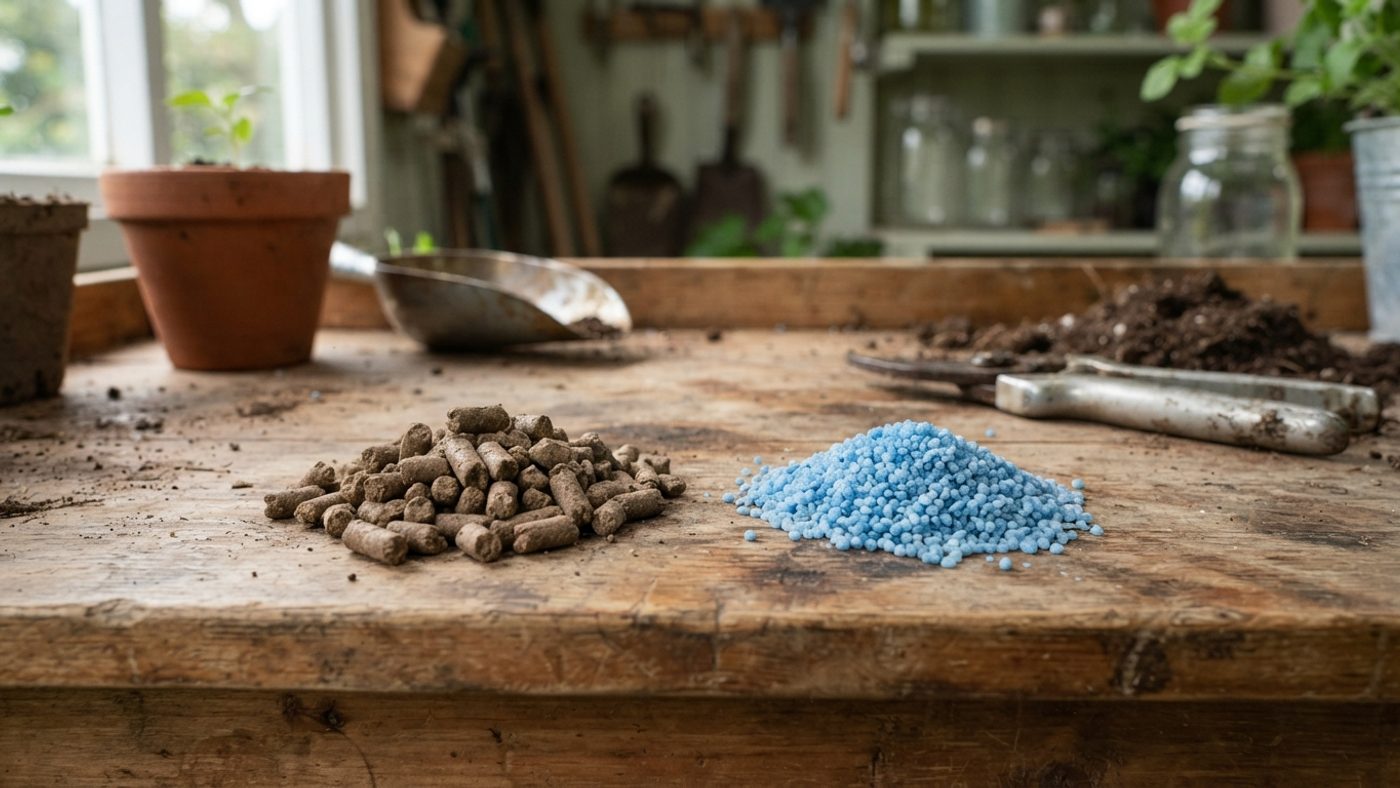
Organic fertilisers, chicken manure pellets, blood fish and bone, well-rotted manure, comfrey feed, release nutrients as soil organisms break down the organic material. That process is gradual, temperature-dependent, and roughly tracks what a growing plant can use week to week. Little of the nutrient content is instantly water-soluble at the moment of application.
Synthetic (inorganic) fertilisers, Growmore, sulphate of potash, most blue crystalline "instant" feeds, are manufactured to be immediately soluble. Applied to soil or dissolved in a watering can, most of the nutrient content is available to plant roots within days, sometimes hours.
That speed is exactly the problem on Scotland's wetter, free-drainingSoil that lets water pass through quickly rather than pooling, so roots aren't sitting in wet ground after rain. Full definition → sites. Nitrogen in particular is highly water-soluble, and Scotland's rainfall runs well above the driest parts of England, the Met Office's own regional rainfall figures put parts of western Scotland above 2,000mm a year against under 700mm on parts of England's eastern coast, the same west-to-east Atlantic weather pattern that shapes rainfall right across the UK. Apply a fast-acting synthetic feed to a sandy or light soil during a wet spell, and a meaningful share of that nitrogen leaches, gets washed down through the soil by rain, past the plant's roots and out of reach, before the plant has taken it up: money and nutrient lost to the drain, not the crop. A slow-release organic feed sidesteps this because it never dumps a large soluble dose at once: it trickles nutrient out at roughly the pace roots absorb it, so there's less to lose even when the ground is sodden.
This isn't a blanket case for organic-only gardening. Heavy clay is made of much finer particles than sand, with a larger surface area that holds onto dissolved nutrients rather than letting rain carry them straight through, so a clay-soil garden in a wet part of Scotland doesn't face the same leaching risk as a sandy one. The real variable is soil type combined with rainfall, not rainfall alone, free-draining soil in a wet climate is the specific combination where fast-release synthetic feeds lose the most to leaching, and where organic or genuinely slow-release products earn their keep.
There's a separate timing trade-off worth knowing, on the opposite kind of ground to the free-draining soil above. Organic feeds rely on soil organisms to break the material down, and those organisms slow down in cold, wet soil, which describes heavy clay or poorly-drained ground more than it does light, free-draining soil: waterlogged ground holds onto winter cold and takes longer to warm in spring than soil that sheds water freely. On heavy, slow-to-warm ground, an organic feed can sit largely inert for longer than the label suggests, releasing little just when new growth wants it most. A synthetic starter feed at planting, applied a little earlier than the packet's general guidance suggests, closes that gap without abandoning organic feeds for the rest of the season.
Granular, liquid or slow-release: matching format to the job
| Format | How it works | Best for | Watch out for |
|---|---|---|---|
| Granular (dry) | Scattered on soil or worked in; breaks down over weeks | Base feeding at planting, top-dressingAdding fresh compost, feed or grit to the soil surface around an established plant, rather than digging it in. Full definition → beds, borders and veg plots | Can scorch roots or foliage if over-applied dry; slower to correct an acute deficiency |
| Liquid | Diluted in water, absorbed quickly through roots, or sprayed onto leaves for even faster uptake (foliar feedingA liquid fertiliser applied directly onto a plant's leaves rather than the soil, absorbed faster than a root feed. Full definition →) | Containers and pots, quick correction of visible deficiency, regular fortnightly feeding through the growing season | Effect is short-lived, needs repeat applications; easy to overdose containers because there's no soil reserve to buffer excess |
| Slow-release (organic or coated synthetic) | Nutrient locked in a form (organic matter, or a coated pellet) that releases gradually | Base dressing at bed prep, hungry perennials, situations where you can't feed weekly | Slower to show results; timing needs to be earlier in the season so release lines up with peak plant demand |
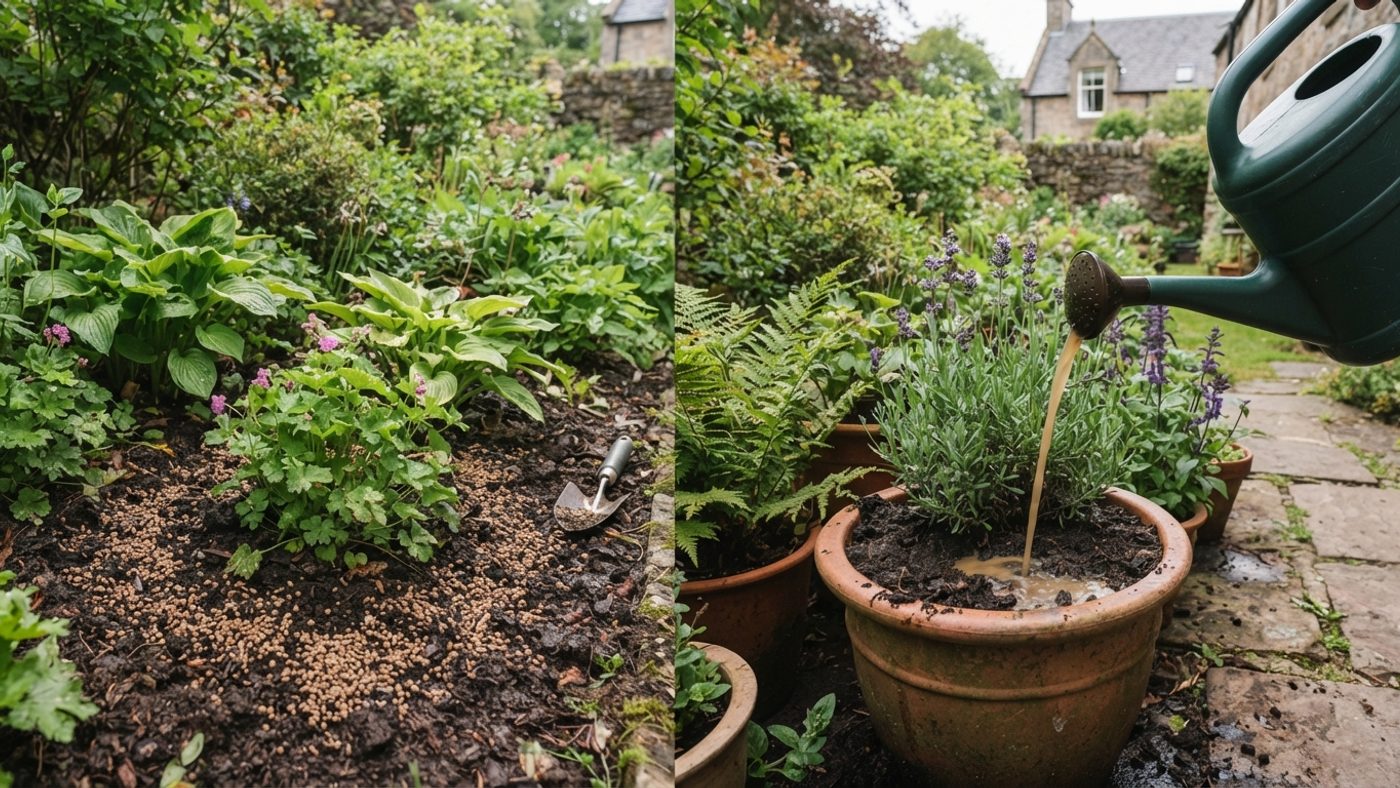
Gardener's World notes that liquid feeds are the safer choice for pots and containers specifically because solid granular feed applied to the compost surface is easy to over-apply and can scorch roots, whereas containers also have no soil reservoir to dilute or buffer an excess the way open ground does.
Granular feeds don't come with a universal "how much" figure the way the table above might suggest, the right rate depends entirely on the specific product's strength, so follow the rate printed on the bag rather than a general rule, and re-apply only at the interval it states (typically once at planting, then again every 6-8 weeks through the growing season for most granular organic feeds). Chicken pellets, blood fish and bone, Growmore, comfrey and seaweed feed are all sold and commonly used on edible crops as well as ornamentals, though fresh, un-composted manure (not the same as pelleted chicken manure) should be kept off crops close to harvest.
There's also a straightforward application-method vocabulary worth knowing: top dressing (scattering fertiliser on the surface around an established plant) and base dressing (working fertiliser into the soil or compost before planting).
Five common feeds, compared
This is where the packet numbers get concrete, actual ratios vary by brand and batch, so treat the figures below as a guide and check the bag for the exact one you've bought.
| Feed | Type | Approx. NPK | What it's for |
|---|---|---|---|
| Blood, fish and bone | Organic, granular, slow-release | Roughly balanced across N-P-K; exact ratio varies by brand, check the bag | General-purpose base feed at planting; balanced enough for most beds and borders |
| Pelleted chicken manure | Organic, granular, slow-release | Around 4.5-1.5-2.5 (Westland Organic Chicken Pellets, RHS-cited figure) | Nitrogen-led bed conditioning at prep time; also improves soil structure as it breaks down |
| Growmore | Synthetic, granular, fast-acting | RHS's own worked example for one branded product gives 7-3.1-5.8; sold generally as an all-purpose "balanced" feed | Quick general top-up when soil needs a fast, even boost across all three nutrients, best on soil that won't leach it away before uptake |
| Comfrey feed (home-brewed) | Organic, liquid, fast-acting | Not precisely quantified, Garden Organic's own member trials found nutrient content "similar to a commercial tomato feed," used undiluted, with potassium levels suited to fruiting crops | Fortnightly liquid feed for tomatoes, peppers, cucumbers and other heavy fruiters through summer |
| Seaweed feed | Organic (marine-derived), liquid or granular | Variable and often not a guaranteed NPK ratio unless fortified, one commercial tomato feed example (Maxicrop) gives roughly 4-0.8-4.9 | Trace-element and micronutrient top-up (iron, manganese, zinc, boron) alongside modest N-P-K, plus claimed growth-stimulant compounds; a supplement to, not a replacement for, a base feed |
Coastal gardeners have a sixth option the table above doesn't cover: fresh seaweed gathered from the shore, dug straight into soil over winter or spring at a spade or two deep without needing to rot down first, much as manure would be worked in. There's no automatic right to take it, though, check with the landowner and local council before gathering, since not every beach permits it.
Comfrey feed's exact nutrient content is genuinely variable, Garden Organic's own trials found meaningful differences between growing sites, leaf age, and even whether the leaves were soaked or compressed, so treat any precise percentage quoted online with scepticism; what's consistent is that it behaves like a potassium-rich liquid tomato feed once brewed for around a month, and that letting it brew longer than 30 days doesn't add anything. Seaweed products, meanwhile, are valued less for their NPK numbers, which are modest and inconsistent across brands, than for the trace elements they supply that Growmore and blood fish and bone typically lack.
Putting it together for a Scottish plot
None of these compete head-to-head; gardeners typically layer them through the season rather than picking just one.
| When | What to reach for | Why |
|---|---|---|
| At planting / bed prep | Pelleted chicken manure or blood fish and bone | Slow, steady base feed that won't leach away before roots are established |
| Mid-season top-up, on soil that drains moderately | Growmore or another fast synthetic | Quick, even boost, best reserved for ground less prone to washing it straight through |
| Once fruiting crops are established, fortnightly | Comfrey or seaweed liquid feed | A liquid's speed suits a hungry, actively fruiting plant, and there's little time in the soil for it to leach away regardless |
| Pots and raised beds, especially under some cover | Any of the above, fast synthetics included | Nutrients aren't washing through a container the way they can an open, free-draining border, so a fast feed is less of a gamble here |
The same leaching that can waste a fast feed on light soil has a knock-on downstream: excess nitrogen that isn't taken up by plant roots doesn't just vanish, it leaches into groundwater or runs off the land into rivers, lochs and burns, harming water quality. Scotland's Nitrate Vulnerable Zone rules on keeping fertiliser and manure away from watercourses are written for farms rather than back gardens, but the same principle is worth keeping in a domestic plot: don't apply granular or liquid feed right at the edge of a garden pond or a burn running through the ground, and clean up any spill on a hard surface rather than hosing it toward a drain.
Nitrogen feeding also has a cut-off point worth building into the calendar rather than feeding right up to autumn. Nitrogen applied too late in the season pushes soft, sappy new growth that hasn't had time to harden offGradually getting young plants raised indoors used to outdoor conditions over 7–14 days before planting out, so cold, wind and direct sun don't shock or damage them. Full definition → before the first frost, worth building extra margin into on a plot with an early first frost date (check your own area against the frost dates page). Stop nitrogen-heavy feeding by mid-to-late summer on shrubs, perennials and fruiting crops, switching to a potassium-led feed if anything, rather than continuing a balanced or nitrogen-heavy feed into autumn.
Common questions
Is a higher NPK number always a stronger fertiliser?
Higher numbers mean a higher concentration of that nutrient by weight, not necessarily a "stronger" or better product, a lawn feed with a high first number (nitrogen) would be the wrong choice for a fruiting tomato plant that needs potassium instead. Match the ratio to what the plant is doing, not the size of the numbers.
Can I use Growmore instead of a specific tomato feed?
Growmore's roughly balanced ratio will support a tomato plant's general growth but won't push flowering and fruiting the way a potassium-heavy feed (a proper tomato feed, comfrey feed or seaweed tomato feed) will. It's a reasonable base feed, not a substitute for a fruiting-stage feed.
Does the "organic feeds are slower" rule mean they're weaker?
No, total nutrient content can be just as high as a synthetic feed, it's only the release speed that differs. The exception worth knowing: on heavy clay or in a container, where leaching isn't the main risk either way, a fast synthetic feed's speed is a genuine advantage rather than a trade-off, since there's nothing to counterbalance it with.
Do I need to worry about over-feeding with organic fertilisers the way I would with synthetic ones?
Less so, because the nutrient isn't immediately soluble, but it's still possible, fresh, un-composted manure or over-applied pelleted feeds can still cause root scorch or excess nitrogen. Follow the stated application rate rather than assuming "organic" means unlimited.
Is seaweed feed worth using if its NPK numbers are so low?
Its value isn't really the N-P-K line, it's the trace elements (iron, manganese, zinc, boron) that general-purpose fertilisers like Growmore or blood fish and bone typically don't supply, plus compounds some products claim act as growth stimulants. Treat it as a supplement alongside a proper base feed, not a replacement for one.
Sources
7 sources, recorded with what each was used for
- RHS: Fertilisers, types and uses: NPK definition, nitrogen/phosphorus/potassium functions, organic vs inorganic fertiliser categories, application methods, specific NPK figures for Westland Organic Chicken Pellets, Growmore and Maxicrop Seaweed Tomato Growth Stimulant & Feed, and magnesium deficiency in tomatoes/raspberries corrected with diluted Epsom salts
- RHS: Seaweed products for gardening: Seaweed feed's nutrient and trace-element content, application methods, the note that trace elements are often lacking in Growmore and fish, blood & bone, and fresh shore-gathered seaweed as a traditional coastal soil improver
- Garden Organic: Comfrey (Symphytum): Comfrey's general role as a plant feed and compost activator
- Garden Organic: Does comfrey liquid feed live up to its claims?: Comfrey liquid feed's nutrient variability, comparison to commercial tomato feed, brewing time findings, and potassium suitability for fruiting crops
- Gardeners' World: Feeding plants, what's the best fertiliser to use?: The liquid-vs-granular container feeding distinction and scorch risk from over-applied granular feed
- Met Office: How much does it rain in the UK?: The west-to-east UK rainfall gradient and regional rainfall figures
- gov.scot: Nitrate Vulnerable Zones: The fact that excess nitrate not taken up by plants leaches into groundwater or runs off into waterways, and the existence of Scotland's Nitrate Vulnerable Zone rules