
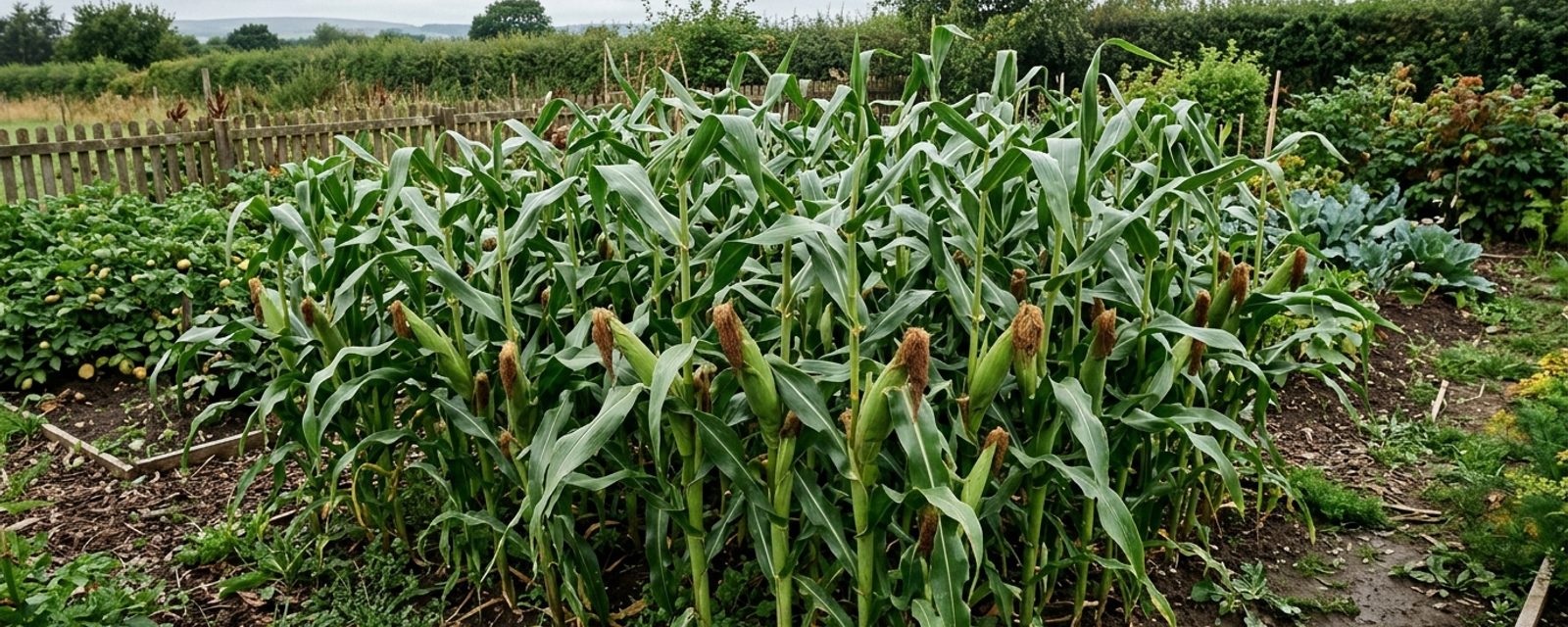
Zea mays
Sweetcorn is an honestly marginal crop here, and one planting decision decides whether you get a real harvest at all.
There's no pretending this is an easy crop in Scotland. Sweetcorn wants a long, hot summer, and Scotland rarely gives it one. That doesn't rule it out, but it does mean the choices below, an early variety, a warm sheltered spot, and getting the planting pattern right, matter more than they would further south.
Preparing the ground
Choose the warmest, sunniest site available, sheltered from wind, with fertile soil: full sun matters more here than on most vegetables, so avoid a spot that taller neighbouring crops will shade later in the season. Dig in two bucketfuls of well-rotted organic matter per square metre before planting, worked in a few weeks ahead if you can, or mulchedA layer of material spread over the soil around plants to suppress weeds, retain moisture, and improve soil structure as it breaks down. Full definition → on the surface for a no-digA growing method that avoids turning the soil over, building fertility instead by adding organic matter on the surface. Full definition → bed.
Plan the shape of the bed with pollination in mind from the start: sweetcorn needs a block, not a row, so mark out a roughly square area rather than a long strip before you dig.
Unlike some of the other crops in this group, a greenhouse or polytunnel isn't the usual fix for a poor summer here. Sweetcorn is wind-pollinated, and a sheltered, still-air structure works against the very thing pollination depends on: open outdoor ground, chosen as warm and sheltered as you can manage, is the better bet.
Sowing
Sow indoors mid-to-late spring, one seed per deep pot or moduleA tray divided into small individual cells, each sown with its own seed or seedling, so each plant grows undisturbed roots until it's ready to plant out. Full definition →, 2.5cm deep, at 18-21°C. GerminationA seed sprouting: breaking dormancy and putting out its first root and shoot, given the right warmth and moisture. Full definition → takes about two weeks. Sweetcorn doesn't transplant well bare-rootA plant, usually a fruit tree or hedging, sold with its roots exposed rather than in a pot, and only available while dormant. Full definition →, so always raise it in pots or modules rather than a seedbed, and move the whole rootballThe mass of roots and the soil or compost clinging to them, as it comes out of a pot or out of the ground when a plant is lifted. Full definition → at planting time.
Direct outdoor sowing is only reliable in the warmest parts of the UK, once soil is consistently above 10°C, sown 2.5cm deep in a grid rather than a row. For most of Scotland, raising plants under cover first is the more reliable route. A layer of clear plastic mulch over the soil raises its temperature by 2-4°C, genuinely useful for an early sowing in a cool spring.
Planting out
Plant out once all frost risk has passed, late May or early June, when seedlings are 8-15cm tall.
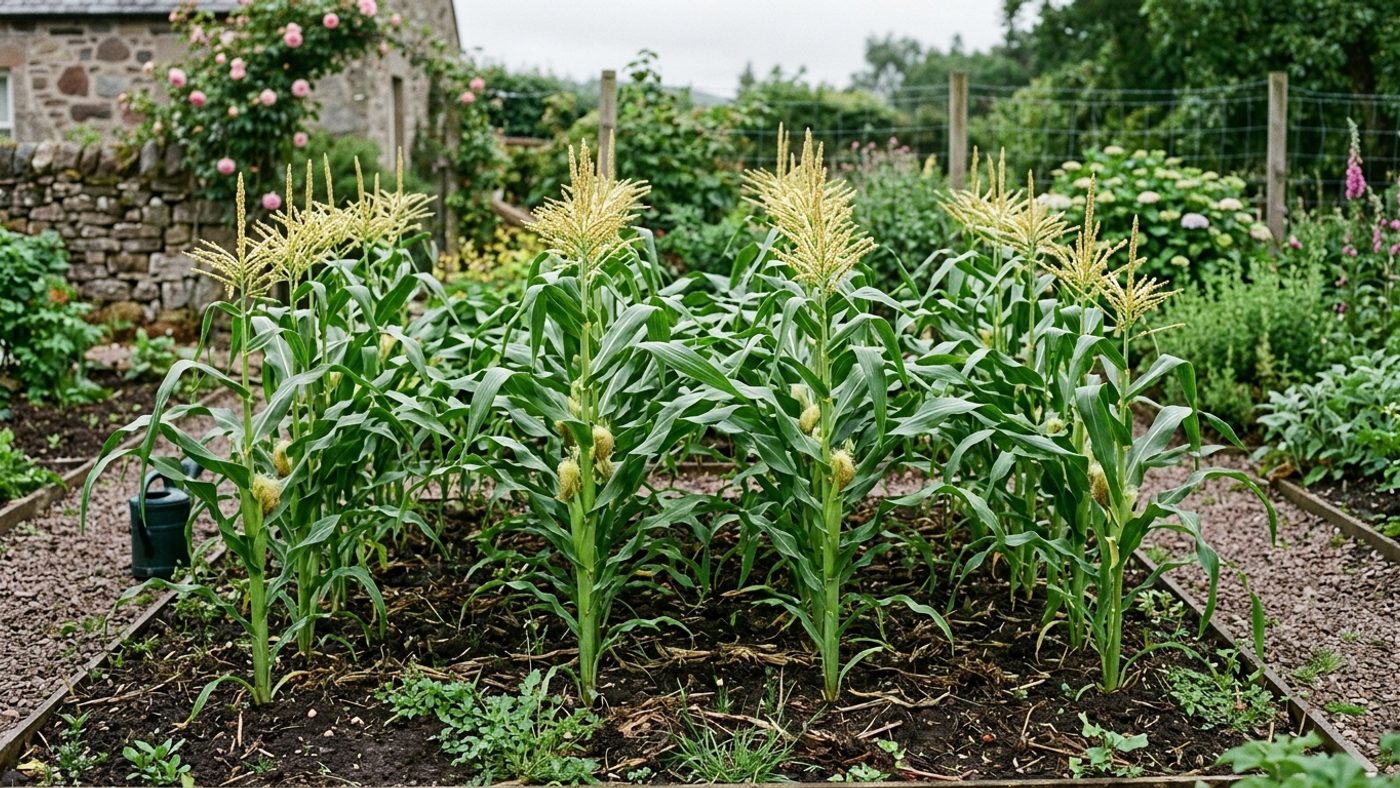
In containers, use the biggest pot practical, filled with peat-freeCompost made without peat, which is harvested from a slow-forming, carbon-storing wetland habitat that peat extraction damages. Full definition → multi-purpose compost, in the most sheltered spot you have, and be ready to water regularly.
Varieties
All three varieties below carry the RHS Award of Garden Merit, a UK-wide award rather than a Scottish one.
RHS also lists 'Ovation' and 'Mirai Picnic' (both AGMThe RHS's Award of Garden Merit: a UK-wide trials award for reliable performance, not a Scotland-specific recommendation. Full definition →), neither carrying a cooler-climate or speed trait beyond Earlibird, Lark and Swift. Teagasc separately names 'Northern Xtra Sweet F1The first-generation offspring of two specific, deliberately chosen parent plants, bred for a predictable, uniform result but not worth saving seed from. Full definition →' for cold areas, but it carries no RHS AGM confirmation, so it's noted rather than picked.
★ Our pick for Scotland
EarlibirdAGM
Supersweet, early, one or two 20cm cobs per plant
RHS names it specifically for British summers.
Why this one: RHS names this variety in its own description as 'great for British summers' specifically because it's early, which is as close to an RHS admission of this crop's marginality as a variety note gets. Earliness is the single trait that matters most for sweetcorn in Scotland, where the long, hot summer RHS says the crop actually wants rarely arrives.
Also worth considering
LarkAGM
Extra tendersweet, early, germinates well even in cooler sites
The one RHS-named variety with cooler-site germination stated as its own trait, directly relevant given sweetcorn's minimum 18-21C indoor germination requirement and the marginal outdoor temperatures much of Scotland offers.
SwiftAGM
Extra tendersweet, swift-growing, one or two 20cm cobs per plant
Named by RHS specifically for growing speed, which matters directly on a crop that needs its full season to ripen before an early autumn frost cuts it short.
Best Sweetcorn Varieties for Scotland → compares all named sweetcorn varieties head-to-head, with the practical detail that doesn't fit in a summary card.
Care
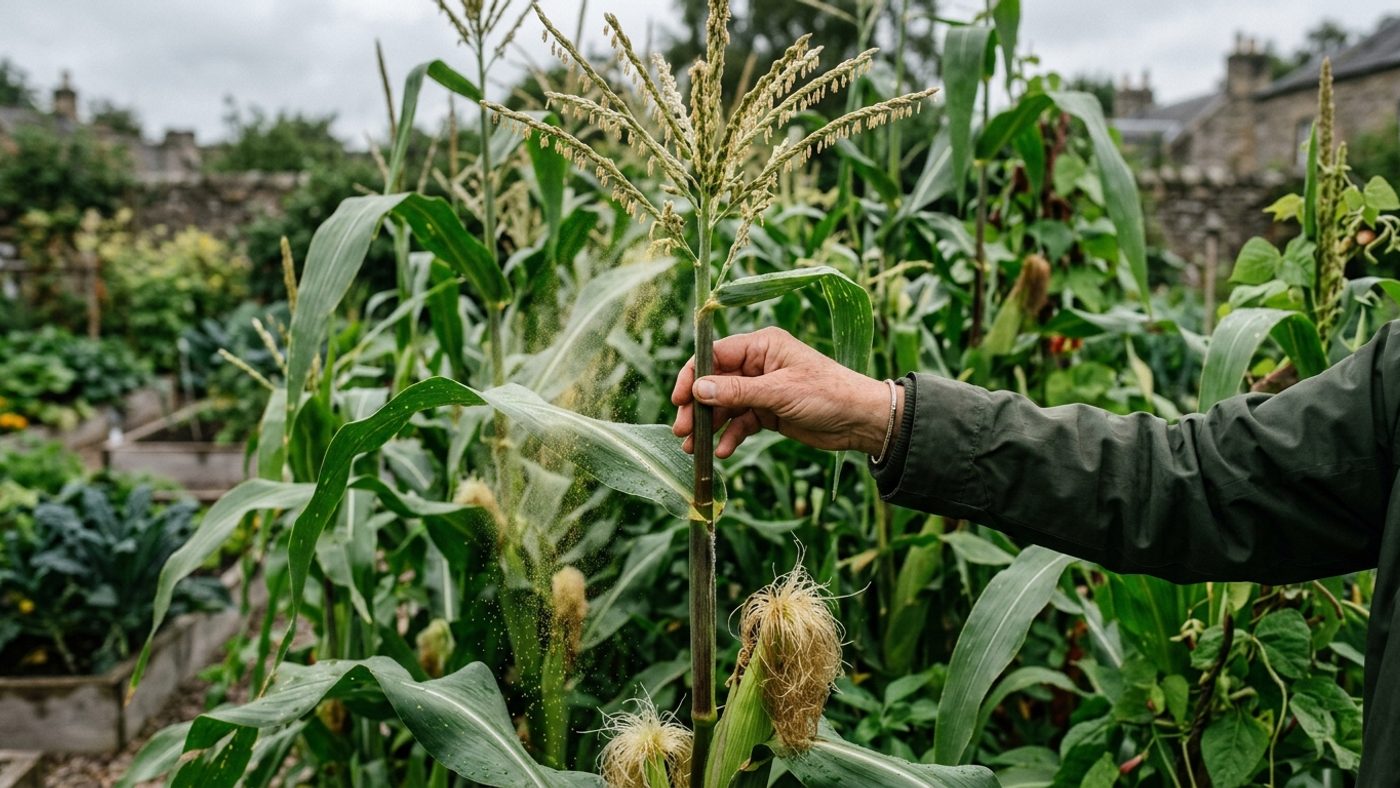
Water during dry spells, and especially when flowering starts and again as the cobs begin to swell: both stages matter more than routine watering the rest of the time. Mulch to retain moisture and suppress weeds, and weed carefully by hand near the plants, since sweetcorn's roots sit shallow and are easily damaged by hoeing. Plants can reach 2m tall, so stake them with bamboo canes and twine on exposed sites, and earth upDrawing soil up around a plant's base as it grows, most often potatoes, to keep light off developing tubers and support tall stems. Full definition → around the base to improve stability. Once the male tassels open, gently tap the stems on a still day to help shake pollen loose onto the female flowers below.
Never grow supersweet and standard sweetcorn varieties near each other, or near maize of any kind: cross-pollinationPollen moving from one plant to a different, compatible variety, needed for fruit to set on any variety that isn't self-fertile. Full definition → produces starchy kernels with poor flavour, since the starchy trait dominates. Grow only one type per plot in a given year where you can.
Harvesting
Ready from August to October. Cobs are ready once the silks have browned; test by piercing a kernel with a thumbnail, watery liquid means unripe, milky or creamy means ready, paste-like means over-mature. Twist and pull the ripe cob free from the stem. Expect about two cobs per plant, roughly six to nine per square metre of ground. The sugars start converting to starch the moment a cob is picked, so cook or freeze as soon as you can; supersweet varieties hold their sweetness longer than standard types, but the clock starts immediately either way. To freeze, blanch whole cobs in boiling water for four minutes, drain, then wrap and freeze.
Common problems
- Birds, mice, squirrels, rats and badgers all target ripening cobs. Net plants once cobs form, or cover individual cobs with bags or cut plastic bottles.
- Slugs and snails damage young plants.
- Aphids are a genuine risk on this crop.
See more problems
- Smut is a disease that can affect sweetcorn.
- Cross-pollination between supersweet and standard types, or with maize, produces starchy, poorly flavoured kernels. Grow only one type per plot in a given year where you can.
Common questions
Why did my sweetcorn cobs come out sparsely filled?
Almost always poor pollination from planting in a row: sweetcorn is wind-pollinated and needs a block of at least four plants by four for the pollen to reach every plant. Full sourced breakdown: <a href='/tools/garden-myths/sweetcorn/'>Sweetcorn Myths →</a>
Is Scotland actually a realistic place to grow sweetcorn?
Genuinely marginal: sweetcorn wants a long, hot summer that most of Scotland doesn't reliably supply, so stick to an early variety, the warmest sheltered spot you have, and plastic mulch to warm the soil. Full sourced breakdown: <a href='/tools/garden-myths/sweetcorn/'>Sweetcorn Myths →</a>
Can I grow two different sweetcorn varieties side by side?
Not without a cost: cross-pollination between supersweet and standard varieties (or nearby maize) produces starchy, poor-flavoured kernels, so grow one type per plot or keep them well separated. Full sourced breakdown: <a href='/tools/garden-myths/sweetcorn/'>Sweetcorn Myths →</a>
How quickly do I need to cook or store sweetcorn after picking?
As soon as possible: sugars start converting to starch the minute a cob is harvested, so cook or freeze it straight away, or refrigerate and use within a few days if you must store it. Full sourced breakdown: <a href='/tools/garden-myths/sweetcorn/'>Sweetcorn Myths →</a>
Sources
3 sources, and what each was used for
- RHS: soil prep, sowing method and temperature for indoor/outdoor routes, the critical block/grid spacing requirement for wind pollination, planting timing, container growing, watering at flowering and cob-swell, mulching, supporting tall plants, tapping stems to aid pollination, the fingernail ripeness test, five named AGM varieties, cross-pollination risk between supersweet and standard types, bird/rodent/slug pest list, smut disease
- Teagasc: independently corroborates germination temperature, block-pollination requirement and spacing; adds the plastic-mulch technique for warming soil 2-4C, specifically recommended for cooler areas; gives a nitrogen feeding rate and a 75m isolation distance from forage maize that RHS doesn't state; recommends 'Northern Xtra Sweet' by name for cold areas; corroborates aphid and rust as problems
- gardenersworld.com: independently corroborates spacing (45cm), block-pollination requirement and the ripeness test; gives a storage method RHS doesn't cover (blanch 4 minutes, freeze); suggests courgettes as a companion, a single uncorroborated claim not used as an evidenced pairing