
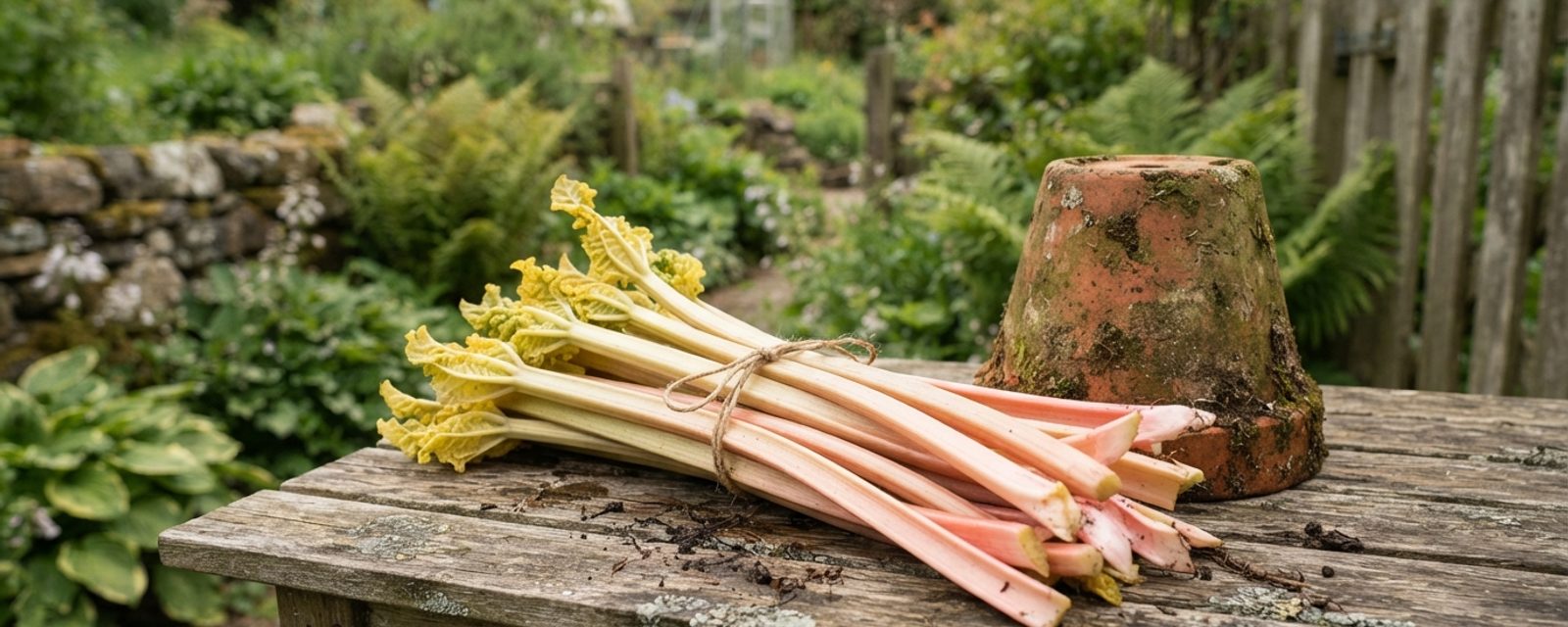
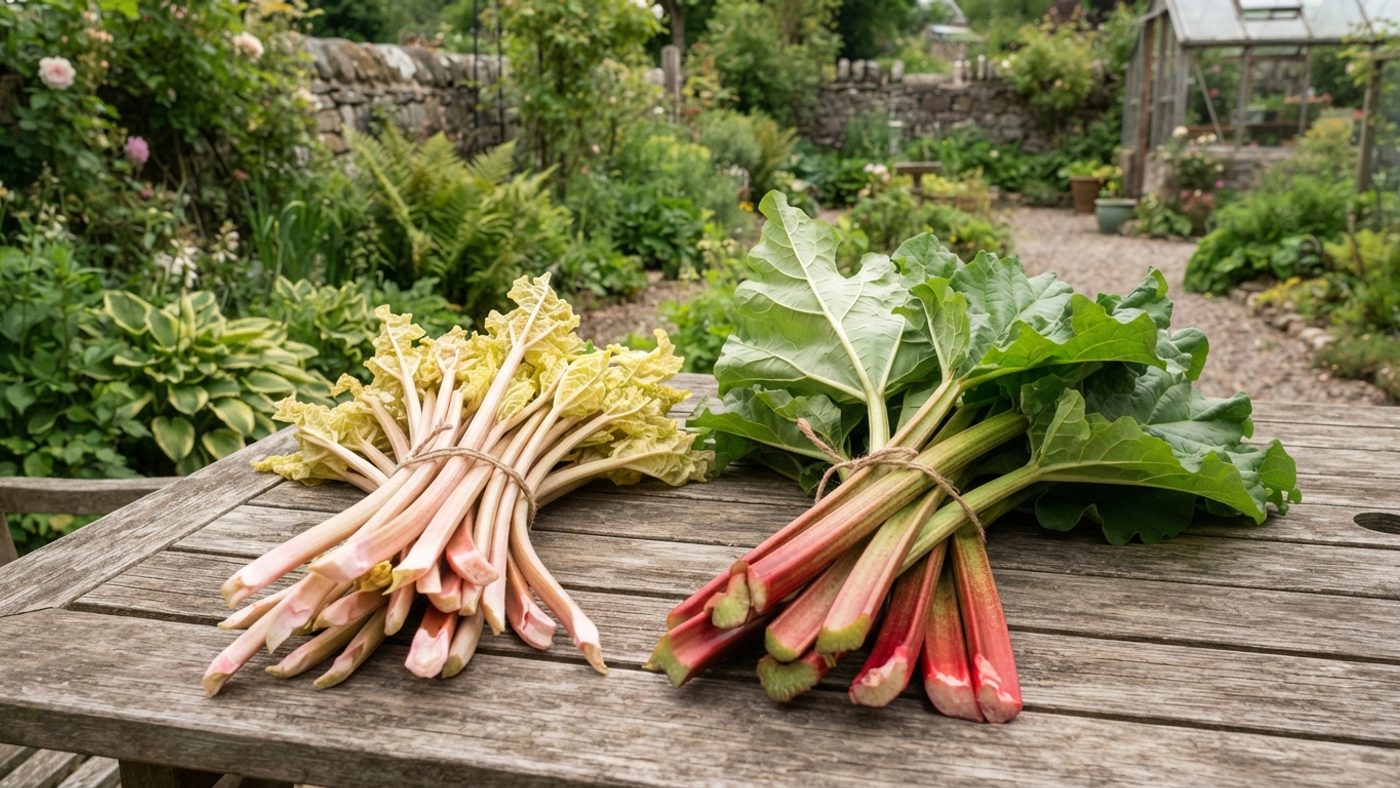
A rhubarb crownThe base of a perennial plant where roots and shoots meet, often sold and planted as a ready-made dormant plant rather than grown from seed. Full definition → left to grow normally in spring does what most plants do: it puts up leaves, greens them with chlorophyll, and uses that chlorophyll to photosynthesise sunlight into the sugars it needs to grow. ForcingCovering plants to exclude light and speed early, tender growth in the dark, most associated with rhubarb and sea kale in late winter. Full definition → works by removing the one input that process depends on. Cover a crown so no light reaches it, and the plant can't make chlorophyll, so the stems that emerge stay pale pink to yellow instead of green. Denied the option of building leaf tissue for photosynthesis, the crown instead draws on the sugars and starches it stored in its roots the previous summer and pushes them straight into stem elongation, reaching for light that never arrives. The result is a stalk that grew faster, stayed more tender, and tastes noticeably sweeter than anything cropped in the open. Growing a plant in the dark like this is called etiolation, the same process behind blanchedExcluding light from part of a growing plant, usually by earthing up, wrapping or covering, so it grows pale, tender and less bitter. Full definition → leeks or forced sea kale, just easier to see in rhubarb's dramatic pink stems.
Quick answer: cover an established crown (three years or older) with a forcing pot, bucket, or bin where it already grows in December or January, and expect to pull the first pale stems roughly eight weeks later, well before the normal outdoor harvest starts in April. Lifting a crown into a dark shed or greenhouse instead gets you stems in around five weeks, but usually costs the crown, which is typically exhausted and discarded afterwards. Either way, forcing gives one flush of stems to pull, not the several weeks of repeat picking a maincropThe main, usually latest-sown and longest-growing type of a crop, grown for bulk and storage rather than an early harvest. Full definition → plant gives later in spring.
Why darkness makes the stems sweeter, not just paler
Etiolation isn't only about colour. The energy a normal stem would spend building leaf and photosynthetic tissue instead goes entirely into reaching for light that never arrives, and less structural, fibrous tissue develops as a result, which is why forced stems are noticeably more tender to eat than maincrop stems pulled later in the season. And because the plant isn't manufacturing the compounds tied to fully green, sun-grown stalks, forced rhubarb also carries less of the sharp acidity of an outdoor crop, gardeners and cooks alike describe it as sweeter, even though no sugar has been added to the plant at any point. All of this comes at a cost: the crown is spending stored energy it built up over the previous growing season, with nothing coming back in through photosynthesis to replace it while it's covered.
Two ways to force a crown
Both methods work by excluding light; they differ in whether the crown stays in the ground.
Method 1: Cover it where it grows
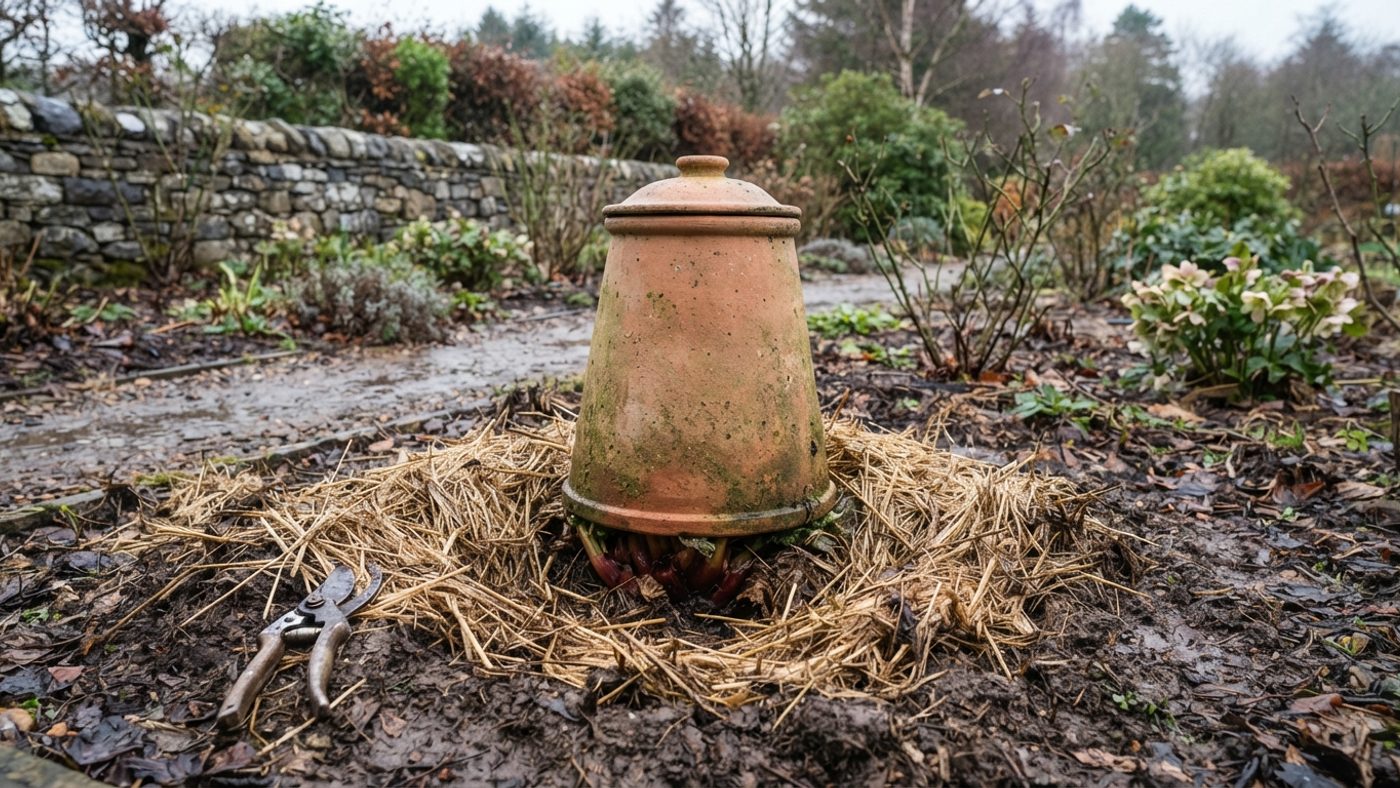
This is the simpler of the two. In December or January, clear away old leaves and mulchA layer of material spread over the soil around plants to suppress weeds, retain moisture, and improve soil structure as it breaks down. Full definition → around an established crown, then place a forcing pot, bucket, bin, or any container that fully excludes light over the top, packing straw or compost around the base in a cold garden for extra insulation. The crown is still rooted in the soil it grew in, drawing on reserves it built there, and once the cover comes off it can return to ordinary growth. Extra watering usually isn't needed over the covering period, just check a covered crown isn't standing in waterlogged ground. Timperley Early is the variety usually recommended for this method, since it's bred specifically to force well and crop early, a useful match for a Scottish garden already getting the earliest possible start from the season's cold. One practical risk worth checking for: the dark, sheltered space under a forcing pot is also an easy hiding spot for slugs, so lift the cover and check the tender young stems every so often rather than leaving it undisturbed for weeks. A heavy snow load can also crush a lightweight cover, so a sturdier bucket or bin copes better through a hard Scottish winter than a flimsy one.
Method 2: Lift it into a dark shed or greenhouse
This is the scaled-down version of the traditional Yorkshire forcing-shed technique. Lift a crown in November, leave it sitting on the soil surface outdoors for around two weeks to expose it to more cold, this breaks the plant's dormancy, then pot it into compost and move it into a dark, frost-free shed or greenhouse kept at roughly 7-16°C. Excluding light entirely and keeping the compost only slightly moist produces stalks in around five weeks, faster than the in-ground method, because a lifted, potted crown in a warmer, sheltered spot pushes growth harder than one still sitting in cold garden soil. An unheated outbuilding in a Scottish winter can easily sit below that range, so check it stays frost-free and add insulation or low-level heat if needed, rather than assume any dark shed will do.
| In-ground covering | Lift-and-force indoors | |
|---|---|---|
| Start | December–January, crown stays put | Lift in November, chill outdoors ~2 weeks, then pot and move indoors |
| Ready to harvest | About 8 weeks after covering | About 5 weeks after moving indoors |
| Equipment | Forcing pot, bucket, or bin; straw/compost for insulation optional | Pot of compost, dark frost-free shed or greenhouse, light-excluding cover |
| Effort | Low — done in place | Higher — digging, potting, and moving the crown |
| What happens to the crown | Usually recovers; needs a rest before forcing again | Usually exhausted; commonly discarded after harvest |
The trade-off is straightforward: the shed method is faster and gives you the earliest possible rhubarb, but it's harder on the plant. The in-ground method takes a little longer but lets the same crown go on producing in future seasons, provided it's rested properly in between.
Timing it in a Scottish garden
Rhubarb needs a sustained spell of winter cold to break dormancy before it will grow at all, which is where rhubarb differs from most other vegetables grown here: their real limiting factor is a Scottish summer that never gets warm enough, while rhubarb's dormancy-breaking cold is exactly what an ordinary Scottish winter supplies without any effort. Forcing here isn't fighting an unsuitable climate, then; it's taking a technique that already suits the local winter and using it to jump the queue: a forced crop is commonly ready before the end of February, months ahead of the normal outdoor cropping window of April to June.
Which crowns are suitable
A crown needs a few ordinary seasons to build up reserves before it's ready for this — see the full rhubarb growing guide for planting and establishing one from scratch. Only force a crown that's been established in the ground for three years or more; younger, smaller crowns don't have the stored energy reserves to sustain forced growth and forcing them can compromise their future growth too, so a young crown shouldn't even be lightly harvested in its first couple of years, let alone forced. Forcing draws hard on a crown's reserves regardless of method, so a covered crown needs its forcing removed as soon as harvesting finishes, with no further stems taken from it that year, let it grow on completely unchecked through the rest of the season so it can rebuild the reserves forcing used up. RHS recommends resting a crown for at least three years before forcing it again. A lifted, potted crown is under even more strain and is usually too weakened to be worth replanting, most gardeners treat it as spent and discard it after harvest. Either way, never force the same crown in consecutive years: if you want forced rhubarb annually, you need more than one established crown so you can force them in rotationMoving each crop family to different ground each year, on a multi-year cycle, so pests and diseases that build up in soil don't get a repeat host. Full definition →.
A crown that's properly dormant and well-chilled going into forcing has more stored energy to spend than one forced too early, another reason Scotland's winters suit the technique rather than working against it.
What forcing looks like at its best: the Rhubarb Triangle
The area between Leeds, Wakefield, and Bradford, known as the Rhubarb Triangle, grows rhubarb forced entirely in heated sheds in darkness, and the product of that tradition, Yorkshire Forced Rhubarb, holds Protected Designation of Origin status, a UK-registered geographical food designation. That status is specific to rhubarb grown by a defined group of producers within that Yorkshire area, not a claim about rhubarb grown anywhere in Scotland, but it's a useful illustration of what shed-forcing can produce at scale: the same etiolation mechanism at work in a garden forcing pot, taken to its commercial extreme.
Pull forced stems the same way as any rhubarb: hold a stalk at the base and twist gently to free it, rather than cutting, which leaves a stump prone to rot. Once pulled, forced stems are used exactly like ordinary rhubarb, a crumble, a compote, or stewed with a little sugar, the paler colour and sweetness just mean less sugar is usually needed than for a tarter maincrop stalk.
Troubleshooting
- Stems come out green instead of pink or pale: light is getting in somewhere, check the cover for gaps, cracks, or a base that isn't seated flush against the soil.
- Crown doesn't sprout at all: it may be too young or too small to have the reserves to push growth in the dark, give it another year or two to establish before trying again, or the outdoor chill period may not have been long enough to break dormancy before covering or potting.
- Stems are thin and sparse: likely a crown that's been forced before without enough rest, or one that was undersized to start with.
Common questions
Can I force rhubarb every year from the same plant?
No — forcing draws heavily on a crown's stored reserves, and RHS guidance is to rest a forced crown for at least three years before forcing it again. Keep more than one established crown if you want forced rhubarb annually, and force them in rotation.
Do I need to buy a proper forcing pot?
No. A bucket, dustbin, or any container that fully excludes light works, provided it's tall enough to accommodate stems growing to around 30cm before harvest.
Is forced rhubarb safe to eat, given it hasn't seen light?
Yes. The stalks are edible in exactly the same way as ordinary rhubarb — pale colour and mild flavour are simply the result of the plant growing without producing chlorophyll, not a sign of anything being wrong with the stems. As always, only eat the stalks; rhubarb leaves are toxic and should go on the compost heap.
Which is better for a first attempt — covering in place, or lifting into a shed?
Covering an established crown in place is the lower-effort, lower-risk option for a first attempt: it needs no digging or moving, and the crown usually survives to be forced again after a rest. Lifting into a dark shed is faster but harder on the plant and usually ends with the crown discarded, so it suits a gardener with a crown to spare or one nearing the end of its productive life anyway.
Will slugs get at the stems while they're covered?
It's a real risk: a forcing pot creates a dark, sheltered space slugs like as much as the rhubarb does. Lift the cover every so often to check the young stems rather than leaving it undisturbed for the full forcing period, and clear any slugs found before they can strip the tender growth.
Sources
6 sources, recorded with what each was used for
- RHS: How to grow rhubarb: Chilling period for lifted roots, indoor forcing temperature range (7-16°C), harvest timelines (4-8 weeks covered, ~5 weeks indoor), advice against forcing the same plant in consecutive years, and note that container-forced crowns are usually discarded
- RHS: How to force rhubarb for early crops: In-ground covering method and equipment, timing (start before growth begins, i.e. January), ~8-week harvest timeline, minimum crown age of three years, and the recommendation to rest a crown at least three years before forcing it again
- BBC Gardener's World: How to force rhubarb: 8-week harvest timeline, equipment (bucket, dustbin, or decorative forcer), note that young plants lack the reserves to be forced, and advice to alternate crowns rather than force the same one two years running
- BBC Gardener's World: How to Grow Rhubarb: Timperley Early as a variety suited to forcing, ~5-week indoor forcing timeline, and the two-week outdoor chilling step used to break dormancy before potting
- Garden Organic: How to grow rhubarb: Confirms the basic light-exclusion method
- GOV.UK: Yorkshire Forced Rhubarb: Protected Designation of Origin status, originally registered with the EU in 2010 and re-registered under the UK scheme in December 2020, specific to the Rhubarb Triangle producers in Yorkshire