
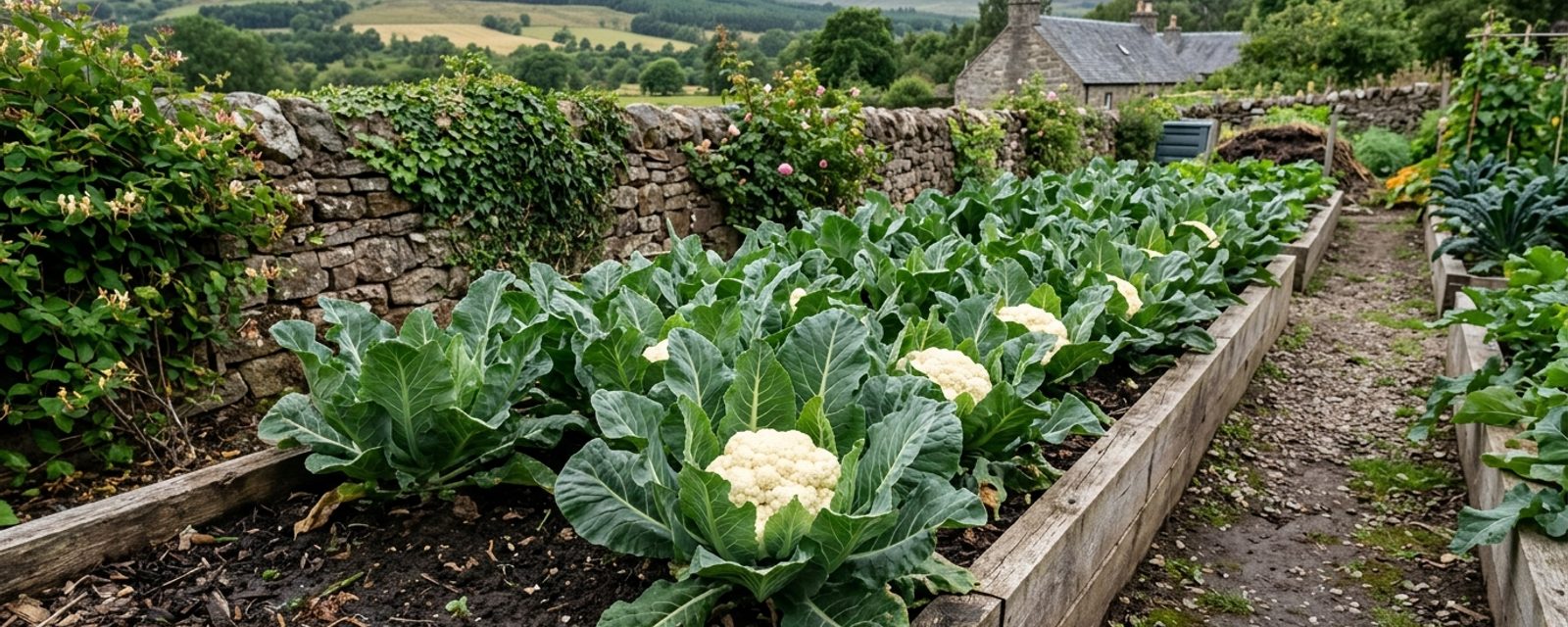
Cauliflower has a reputation for being the fussiest brassicaThe cabbage family: cabbage, kale, broccoli, cauliflower, Brussels sprouts, kohlrabi, swede, turnip and more, sharing the same pests, diseases and rotation rules. Full definition → in the plot, and the ten varieties that carry the RHS Award of Garden Merit don't all deserve that reputation equally. Some are bred to race through a mild summer; others are built to sit through a hard winter and still deliver a solid white head in spring. The difference between them isn't just timing, it's a formally rated difference in cold-hardiness, and that rating is the single most useful thing a Scottish grower can check before choosing seed.
Quick answer
For most Scottish gardens, Clapton (autumn, club-root resistant) is the safest all-rounder, and Jerome (spring) carries the highest official hardiness ratingThe RHS's H1a–H7 scale for how much cold a plant can survive outdoors, H1a being tender indoor-only and H7 hardy anywhere in the UK. Full definition → of any AGMThe RHS's Award of Garden Merit: a UK-wide trials award for reliable performance, not a Scotland-specific recommendation. Full definition → cauliflower, H5, hardy through severe UK winters, versus H3 for most of the others. If your ground has a history of clubrootA soil-borne fungal disease of the brassica family that swells and distorts roots, and survives in soil for years. Full definition →, Clapton's resistance matters more than any hardiness figure. If you want the earliest possible crop, Tirza is sown as early as October and stands under glass over winter. Skip fast summer varieties unless you can guarantee steady watering through a warm spell, they have the least tolerance for the unsettled weather that causes buttoning in a Scottish spring or summer.
The full growing guide covers buttoning, the three sowing-type windows, and day-to-day care in depth. What follows is the ten AGM varieties compared head to head, plus a handful of genuinely useful varieties outside that list, so you can pick the one that actually suits your ground and your winter.
The ten AGM varieties, compared
The Award of Garden Merit for cauliflower currently covers ten varieties spanning all three sowing types, plus two colour types. The award itself is a UK-wide garden-merit assessment, not a Scottish recommendation, but each variety's own RHS plant page also carries a formal hardiness rating, RHS's scale for how much cold the plant itself tolerates. H3 means hardy in coastal and relatively mild parts of the UK, roughly -5°C to 1°C, milder than many Scottish gardens see in a typical winter. H4 means hardy through most of the UK, -10°C to -5°C, closer to what most lowland Scottish gardens experience in an average winter. H5 means hardy in most UK locations even during a severe winter, the band worth having if your ground sees the sharpest frosts. That rating varies more between these ten varieties than almost any other trait on the list, and it splits cleanly by sowing type: summer and autumn varieties sit at H3, the one winter variety steps up to H4, and the two spring varieties reach H5.
| Variety | Type | Sow | Harvest | Hardiness | What its own page says |
|---|---|---|---|---|---|
| Tirza | Early-summer | Indoors, October | March-April | H3 | "The earliest cauliflower of the season, heavy cropping and shows some disease resistance." OverwinteredKeeping a plant alive and intact through the cold months, whether left outdoors, moved under cover, or stored dormant. Full definition → under glass. |
| Raleigh | Summer | Direct, April-June | July-September | H3 | "Copes well in stressful conditions and is resistant to 'pinking'." |
| Candid Charm | Summer | — | — | H3 | "Vigorous, quick-maturing cultivarA plant variety that arose or was bred under cultivation and is kept true by deliberate propagation, rather than a naturally occurring wild species. Full definition →, good for growing at close spacing", the mini-cauli, container-friendly pick. |
| Nautilus | Summer/autumn | — | Summer-autumn | H3 | "Pure white, solid heavy curdsThe tight, edible white (or coloured) head of a cauliflower, made up of undeveloped flower buds packed closely together. Full definition →" that stay white for a long time rather than yellowing. |
| Graffiti | Summer/autumn | Indoors Mar-Apr, or direct Apr-May | August-October | H3 | "Dense, rich, deep purple curds which become darker the more they are exposed to sunlight." |
| Veronica | Summer/autumn | — | Midsummer-autumn | H3 | Romanesco: "large, deep green leaves and an edible head of pointed, lime-green floretsThe individual small flower-bud clusters that make up a broccoli, cauliflower or romanesco head. Full definition → densely arranged in whorls." |
| Clapton | Autumn | Direct, April-June | Late summer-autumn | H3 | "Shows excellent resistance to club root," with "large, uniform, solid, deep white heads." |
| Moby Dick | Autumn/winter | Indoors Mar-Apr, or direct Mar-May | September-December | H3 | "Crisp and sweet tasting, dense white curds on robust plants that stand well until harvest." |
| Triomphant | Winter | Direct, May-June | December-January | H4 | "Pure white curds, protected by semi-erect, green foliage." |
| Jerome | Spring | Indoors or direct, May-June | Late March-April | H5 | "A vigorous Spring cauliflower variety producing medium sized, deep white heads that stand well through Winter." |
Triomphant appears on the general AGM list, but its own individual plant page doesn't display the AGM mark. The general growing page also credits Jerome with "coping well with cold weather," a phrase Jerome's own individual page doesn't use, that page states the harder, more checkable version of the same claim instead: the H5 rating itself.
Two more entries didn't make the RHS's own AGM list but are worth knowing about anyway. Aalsmeer, a spring type, carries the same H5 hardiness rating as Jerome and is described on its own page as having "outstanding Winter hardiness," with harvest also running March-April, a genuine second option in the one slot where cold-hardiness matters most, though it hasn't been awarded the AGM. Gardener's World separately names Walcheren Winter Pilgrim, "winter hardy with creamy white compact heads," and Depurple, a purple variety, as varieties worth growing outside the RHS AGM list.
Picking by trait, not just by hardiness
Hardiness only decides the choice outright at the coldest end of the calendar. If your plot has lost brassicas to a hard winter before, or sits somewhere colder than the mild, coastal fringe the H3 band describes, Jerome (or the non-AGM Aalsmeer) is the one choice on this list with a rating built for that. For every other slot in the calendar, summer, autumn, autumn/winter, hardiness doesn't separate the field, so the deciding factor is a different named trait: club root resistance for Clapton, "stands well until harvest" foliage protection for Moby Dick, pinking resistance for Raleigh, or simply which harvest window you need filled.
Pinking: a second cold-stress defect, distinct from buttoning
The growing guide covers buttoning, a check in growth that produces a small, premature head, in detail, since it's the crop's best-known failure. Raleigh's own page names a second, different curd defect: "pinking," a discolouration of the curd surface, and states plainly that Raleigh "copes well in stressful conditions and is resistant to" it. Where buttoning ruins the head's size, pinking is a cosmetic defect that shows up as the head is otherwise developing normally, but both are provoked by the same underlying conditions: cold and stress during curd formation, exactly what a Scottish spring or an unsettled summer supplies. Raleigh's stated resistance to it is a genuine, named trait none of the other summer varieties here claim.
Coloured and romanesco types: same crop, same rules
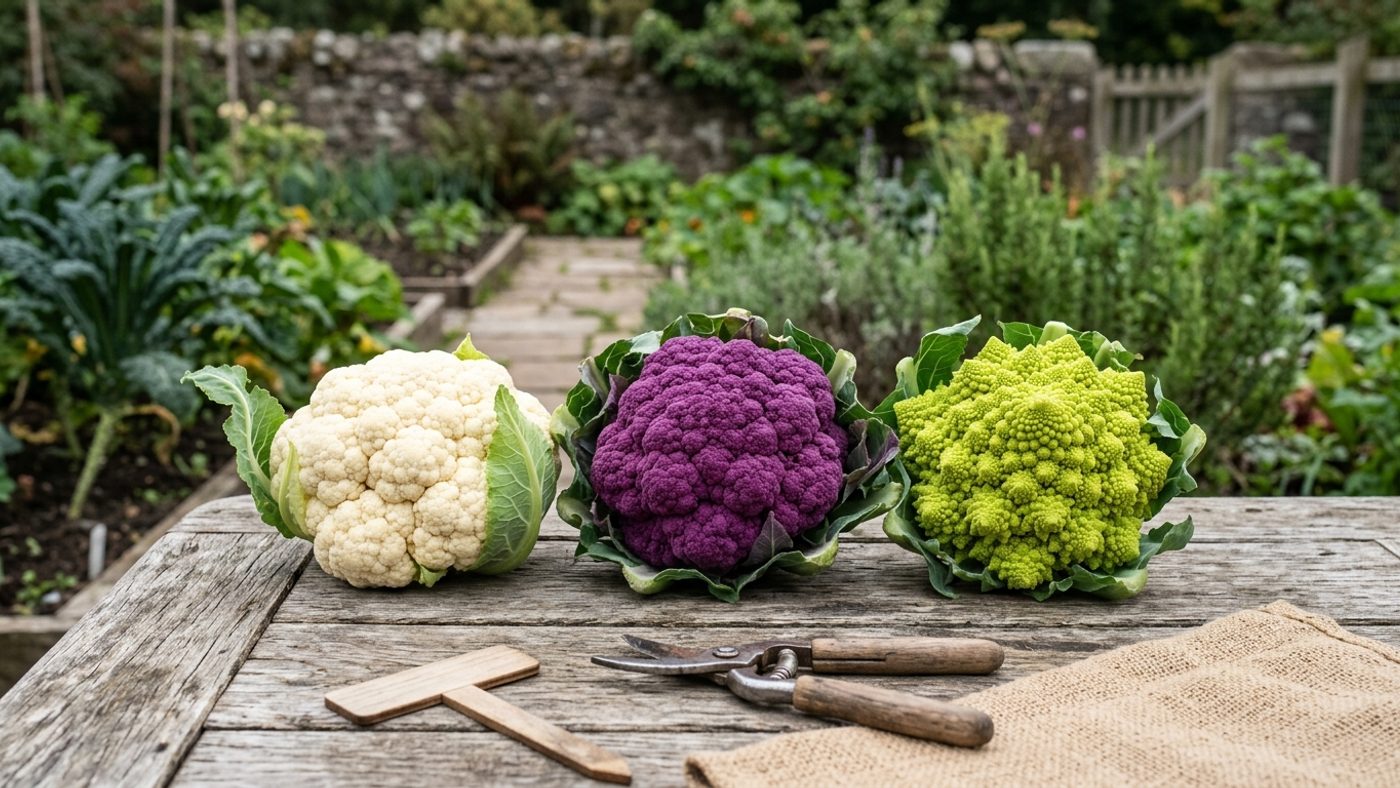
Graffiti and Veronica both carry the AGM and both grow exactly like white cauliflower, same sowing windows, same spacing, same care, the colour is bred in, not a sign of a different or more delicate plant. Graffiti's own page is specific about one point worth knowing before choosing it: the purple curd "become[s] darker the more they are exposed to sunlight," so a shadier plot will produce a paler head, worth weighing against a north-facing or overcast Scottish site before choosing it for colour alone. Veronica's romanesco florets are described on its own page as "densely arranged in whorls," and its page lists spacing slightly tighter than the standard range at 40-50cm between plants and 50-60cm between rows, worth checking against seed-packet instructions rather than assuming the crop's general spacing figures apply unchanged.
Both pages flag the same disease vulnerability as most of the white varieties here: Graffiti's own page lists susceptibility to black rot, club root, downy mildew, foot and root rot, leaf spot and white blister, and Veronica's notes it "may be susceptible to club root." Neither colour type is described anywhere as more resistant than the white AGM varieties, the colour is a cosmetic and flavour difference, not a hardiness or disease advantage.
Soil, and the one thing every variety on this list shares
None of the ten AGM varieties are described anywhere as more or less demanding on soil pH, that's a crop-wide figure, not a variety one. Cauliflower prefers a soil pH around 6.5, and liming very acidic ground both raises the pH and helps deter club root directly, the single most consequential brassica disease on Scotland's naturally acidic soils; the growing guide covers the timing and rotationMoving each crop family to different ground each year, on a multi-year cycle, so pests and diseases that build up in soil don't get a repeat host. Full definition → detail behind that. Clapton's named club-root resistance is worth more on ground that's already acidic and hard to lime fully than on ground where the pH is already close to 6.5, the variety and the soil treatment work on the same problem from two directions, not as alternatives to each other.
Scotland isn't one climate, either, and the split isn't simply north versus south: it's elevation. An upland garden sees harder, later frosts than a lowland one nearby, whatever region it's in, which is exactly where Jerome's H5 rating earns its keep more directly than it would in a milder lowland garden.
Which one for your situation
| Your situation | Variety | Why |
|---|---|---|
| Ground with a history of club root | Clapton | Only variety here with a named resistance to the disease, not just a susceptibility note. |
| Plot that's lost crops to a hard winter, or sits well inland or upland | Jerome (or non-AGM Aalsmeer) | H5 hardiness rating, the only AGM variety rated for severe UK winters. |
| Earliest possible harvest, with glasshouse or cold-frame space to overwinter | Tirza | Sown as early as October, the earliest-cropping AGM type. |
| An unsettled summer, want the least fussy summer type | Raleigh | Named tolerance of "stressful conditions" and resistance to pinking, though still exposed to the general summer-type buttoning risk. |
| Small space or containers | Candid Charm or Tirza | Both named as suited to close spacing and mini-cauli growing. |
| Something different for the plate, not just the plot | Graffiti (purple) or Veronica (romanesco) | Same growing rules as white cauliflower, genuinely different result. |
Building a near-year-round spread from this table means sowing several types in succession rather than picking one: Tirza first, a summer or autumn type for the main crop, and Jerome to finish through the coldest months, each with its own sowing date and its own space, not one planting stretched across the calendar.
Seed availability varies by supplier and by year, check current stock before committing to a specific variety, especially the less common ones like Aalsmeer or Walcheren Winter Pilgrim, which aren't on the RHS AGM list and are correspondingly less widely stocked.
Watch for these pests and diseases whatever you grow
Every variety checked here shares the same brassica pest and disease exposure: club root, cabbage caterpillars, flea beetle, cabbage root fly, slugs, pigeons, and, named specifically on several of these varieties' own pages, downy mildew. None of the AGM varieties above claim resistance to more than one of these; Clapton's club-root resistance is the single named exception across the whole list.
The harvest windows above are UK-wide figures. Scotland's shorter, lower-light winter and spring days can push a hardy spring type like Jerome or Aalsmeer later than the stated window, since curd formation slows with the light rather than stopping outright, worth treating "late March-April" as an earliest-case estimate for a Scottish garden rather than a guarantee.
Common questions
Does Jerome's H5 rating mean it needs no winter protection at all?
No. RHS's own advice for Jerome is to fold the plant's outer leaves over the developing head for winter protection, the same practical step recommended for other overwintering types. The H5 rating means the plant itself tolerates severe cold better than the H3 varieties on this list, it doesn't remove the value of protecting the curd directly as the cold sets in.
Is pinking the same thing as buttoning?
No. Buttoning is a small, premature head caused by a check in growth. Pinking is a discolouration of the curd surface on an otherwise normally developing head. Both are provoked by cold or stress during curd formation, but they're different defects with different symptoms.
Are purple and romanesco cauliflowers grown any differently from white ones?
No. Graffiti (purple) and Veronica (romanesco) follow the same sowing windows, spacing and care as white AGM varieties. The one practical note is that Graffiti's purple colour deepens with more sun exposure, so a shadier spot produces a paler head.
Is Aalsmeer worth growing instead of Jerome?
Both carry the same H5 hardiness rating and a similar March-April harvest window, but Aalsmeer doesn't carry the RHS AGM, meaning it hasn't been through the same trial comparison against other cauliflowers. Where seed of both is available, Jerome's AGM is the better-evidenced choice; Aalsmeer is a reasonable second option if Jerome isn't in stock.
If I grow several varieties near each other, will they cross-pollinatePollen moving from one plant to a different, compatible variety, needed for fruit to set on any variety that isn't self-fertile. Full definition → and spoil the harvest?
Not the crop you're eating that year. Cauliflower is cut and eaten as an unopened flower head, well before any plant would flower and cross with another, cross-pollination only becomes relevant if you're saving your own seed for next year, not for the head on the plant this season.
Sources
13 sources, recorded with what each was used for
- How to grow Cauliflower: The full AGM variety list with type and one-line trait for each, general sowing/pH/harvest guidance
- Brassica oleracea 'Clapton': AGM status, hardiness rating, club root resistance, type, harvest window
- Brassica oleracea 'Jerome': Hardiness rating (H5), type, harvest window, winter protection note; confirms no AGM badge or "copes well with cold weather" wording on this specific page
- Brassica oleracea 'Moby Dick': AGM status, hardiness rating, type, harvest window, container suitability
- Brassica oleracea 'Triomphant': Type, hardiness rating (H4), harvest window, description; confirms no AGM badge on this specific page
- Brassica oleracea 'Raleigh': Pinking resistance, stress tolerance, type, harvest window
- Brassica oleracea 'Tirza': Hardiness rating, early-season timing (October sowing, overwinter under glass), disease resistance note
- Brassica oleracea 'Candid Charm': Hardiness rating, close-spacing/mini-cauli suitability
- Brassica oleracea 'Nautilus': AGM status, hardiness rating, type, description
- Brassica oleracea 'Graffiti': AGM status, hardiness rating, colour-deepens-with-sun trait, disease susceptibility list, harvest window
- Brassica oleracea 'Veronica': AGM status, hardiness rating, romanesco description, spacing, club root susceptibility
- Brassica oleracea 'Aalsmeer': "Outstanding Winter hardiness" description, hardiness rating (H5), type, harvest window (non-AGM)
- How to Grow Cauliflowers: Walcheren Winter Pilgrim and Depurple named as additional varieties outside the RHS AGM list