
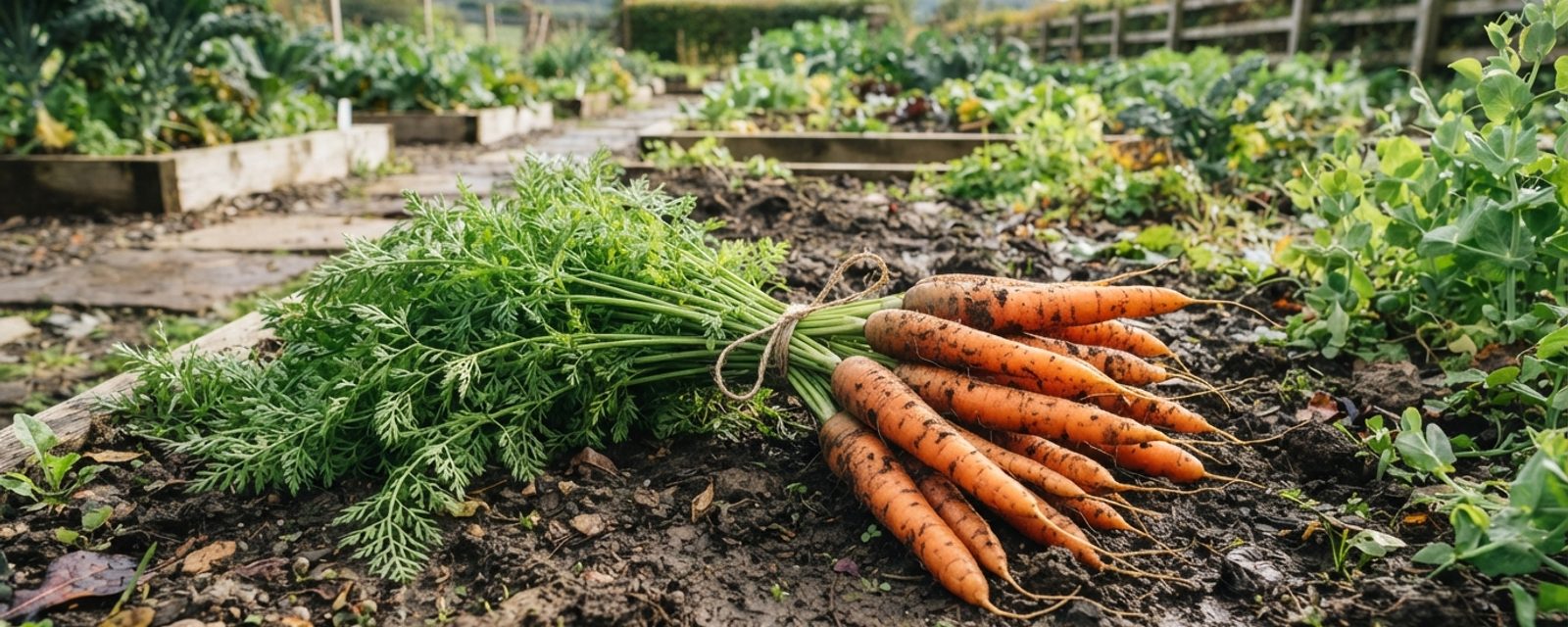
A carrot root only forks, twists, or splits because something got in its way, and it only survives to harvest if the fly that hunts it never finds it. Both outcomes are decided before the root has grown more than a centimetre, by which variety went into the ground, not by anything done afterwards. That's what makes carrots unusual among vegetables: the growing technique is genuinely simple (barely any watering, no feeding to speak of), so almost all of the difference between a good crop and a written-off one comes down to a choice made at sowing.
Quick answer
Flyaway is the best all-round pick for Scotland: it's the only one of the six RHS Award-winning varieties with a stated resistance to carrot fly, the pest that's the most common reason gardeners give up on carrots. On heavy, stony, or clay ground, choose a blunt or short-rooted type instead, Adelaide, Marion, or Flyaway itself, over a long-tapered variety like Sugarsnax 54 or Deep Purple, which are more prone to forking there. If you've confirmed carrot fly genuinely isn't a problem on your plot, you're free to pick on flavour, yield, or colour instead: Sweet Candle for yield, Sugarsnax 54 for sweetness, Deep Purple for colour.
What the award list doesn't tell you
Six carrot varieties currently hold the RHS Award of Garden Merit (AGMThe RHS's Award of Garden Merit: a UK-wide trials award for reliable performance, not a Scotland-specific recommendation. Full definition →): Flyaway, Adelaide, Sweet Candle, Sugarsnax 54, Deep Purple, and Marion. The award confirms all six perform reliably in UK garden conditions generally, it isn't a Scotland-specific recommendation, and it doesn't rank them against each other for the two things that actually decide a Scottish crop's fate: whether carrot fly is a problem where you garden, and whether your soil will let a root grow straight.
Only one of the six carries any carrot-fly resistance claim on its own listing. And the six break cleanly into two root shapes with opposite soil preferences, a distinction the growing guide makes in general terms ("choose a short round-rooted variety on stony or heavy ground") without naming which of the six award varieties actually fits that shape. No pH figure is published for carrots either, so treat a soil test as reassurance rather than a target range to aim for.
The six AGM varieties compared
| Variety | Carrot fly | Root shape | Soil fit | Best for |
|---|---|---|---|---|
| Flyaway | Resistant (RHS-stated) | Blunt-ended, smooth, up to 15cm | Clay, loam, sand | Fly-prone plots; best all-round pick |
| Adelaide | Susceptible | Small, finger-shaped (baby carrot) | Chalk, clay, loam, sand, widest range | Heavy/stony ground; earliest harvest, sowable from February under fleeceA lightweight, breathable fabric laid or draped over plants to trap a little warmth and keep off frost, wind and some flying pests. Full definition → |
| Marion | Susceptible | Blunt-tipped, ~15cm | Loam, sand (not listed for clay) | Longest storage, can stay in the ground August to March |
| Sweet Candle | Susceptible | Cylindrical, rounded tip, almost coreless | Clay, loam, sand | Yield, on ground that isn't heavily clay or stony |
| Sugarsnax 54 | Susceptible | Long, tapered | Clay, loam, sand (wants deep sandy soil) | Sweetness, on deep, loose ground |
| Deep Purple | Susceptible | Long, slender, purple skin | Chalk, clay, loam, sand | Colour, on deep, loose ground |
Five of the six list carrot fly only as something they "may be susceptible to," with no resistance trait mentioned anywhere on their own listing. Flyaway is the exception, and it's corroborated outside RHS too: Gardener's World's own list of fly-resistant varieties names Flyaway alongside several non-AGM cultivarsA plant variety that arose or was bred under cultivation and is kept true by deliberate propagation, rather than a naturally occurring wild species. Full definition →, Ibiza, Maestro, Parano, Resistafly, and Sytan, as "far less susceptible than others", while noting none of them are fully immune. Worth knowing about if Flyaway itself isn't in stock.
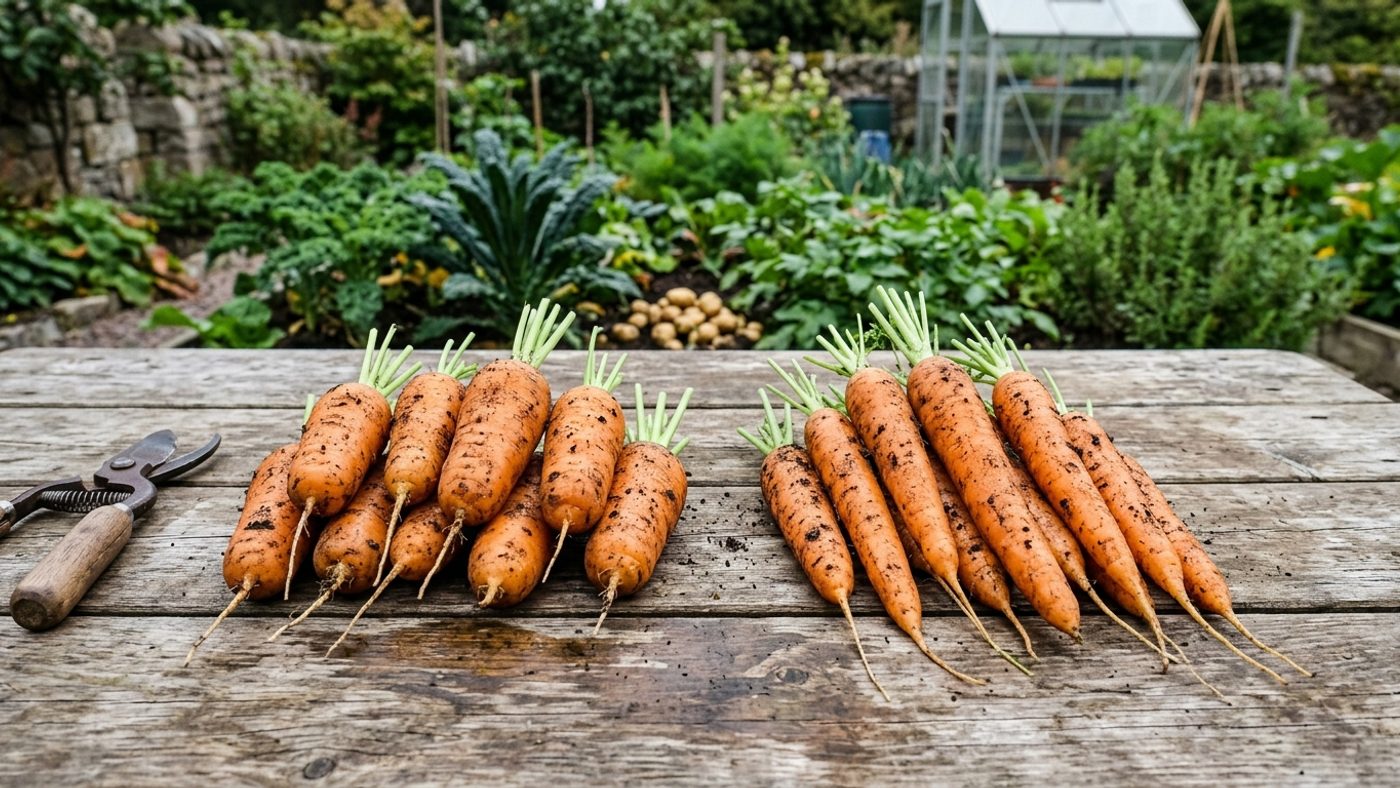
Root shape splits the same six a second way. Flyaway, Marion, and Adelaide are blunt-ended or finger-shaped, the type that copes better when a root meets a stone or a lump of clay. Sugarsnax 54 and Deep Purple are long and tapered, the shape most likely to fork on the same ground. Sweet Candle sits in between (cylindrical rather than long-tapered), but its own listing carries an explicit warning: heavily clay or stony soils may cause it to fork. Marion is also the only one of the six whose own listing doesn't list clay among its suited soils, which points the same direction as its blunt root shape.
Best overall pick, and situational picks
Flyaway. Carrot fly is patchy across Scotland rather than universal, some plots carry damaging populations year after year, others are effectively fly-free, but where it's confirmed present, Flyaway's resistance outweighs a small difference in sweetness or yield, because the alternative is losing the crop rather than just enjoying it slightly less.
On heavy, stony, or clay ground, Adelaide is the strongest pick, for the widest soil tolerance of the six (see table) plus an early root that bulks up before soil problems have time to compound.
If you've genuinely confirmed carrot fly isn't a local problem, the table above is free to decide on flavour, yield, or colour instead, the growing guide's own advice is to ask a neighbour or a nearby allotment before assuming the fly is present, since plenty of gardens don't need mesh at all.
Marion is worth a separate mention for storage. Its own listing states it can be left in the ground and lifted anywhere from August through to March in "milder UK regions", the longest harvest window of the six, and none of the others state anything close to it. The exact Scottish coverage of that isn't specified, so treat it as a genuine advantage rather than a guaranteed one, and fall back on the growing guide's usual advice: lift and store instead if the ground turns waterlogged over winter, whatever variety is in the ground.
On ground that's never going to prepare well, very stony, or a bed you can't rework, raised beds or a deep container sidestep the problem rather than solve it, and it's worth choosing a variety to match: Gardener's World names Parmex, a round-rooted variety, as suited to pots, for gardeners who want that option alongside the six above.
Carrot fly control
Variety choice only reduces the risk; it doesn't replace the mesh barrier, sealed to the ground, that works regardless of which variety is sown, or the two timing levers, sowing after mid-May and harvesting before late August, that avoid the fly's two generations. Those, and how to prepare stony or heavy ground before sowing, are covered on the growing guide and the site's dedicated carrot fly pest page.
Common questions
Does an RHS Award of Garden Merit mean a variety is proven for Scotland?
No. It's a UK-wide award for reliable garden performance, not a Scotland-specific recommendation. All six carrot varieties compared here hold it; which one actually suits a given Scottish garden still comes down to whether carrot fly is present locally and what the soil is like.
Is Flyaway really immune to carrot fly?
No variety is fully immune. Flyaway has "good resistance," and other resistant varieties are described as "far less susceptible than others," not immune. It significantly reduces the risk compared with the other five award varieties, but mesh is still the reliable control where the fly is confirmed present.
What's the best carrot variety for stony or clay Scottish soil?
Adelaide. It has the widest soil tolerance of the six (including chalk, which none of the others match), and its early, finger-shaped root bulks up before soil problems have time to compound. Marion and Flyaway, also blunt-rooted, are reasonable alternatives; Sugarsnax 54 and Deep Purple, both long and tapered, are the two most likely to fork on difficult ground.
Which carrot variety keeps best in the ground over winter?
Marion, by a clear margin among these six, its own listing states it can be harvested from August through to March in "milder UK regions" (the exact parts of Scotland this covers aren't specified). None of the other five state a comparable window. The growing guide's general winter-storage advice (cut the foliage, cover with straw or cardboard, lift instead if the ground gets waterlogged) still applies whichever variety is grown.
Do I need to check for carrot fly before choosing a variety at all?
Yes, if there's time before sowing, a ten-minute conversation with a neighbour or a local allotment can settle whether fly resistance should drive the choice at all, since a fly-free plot is free to pick on flavour, yield, or colour instead.
Sources
10 sources, recorded with what each was used for
- Carrots: grow your own: Soil/root-shape guidance, the mid-May/late-August carrot fly timing levers, and confirmation of the complete 6-variety AGM list
- Daucus carota 'Flyaway': Carrot fly resistance claim, root shape, soil tags, hardiness, sowing window
- Daucus carota 'Adelaide': Susceptibility to carrot fly, root shape, widest soil-tag range, early sowing window
- Daucus carota 'Sweet Candle': Susceptibility to carrot fly, root shape, clay/stony-soil forking warning
- Daucus carota 'Sugarsnax 54': Susceptibility to carrot fly, root shape, sowing/harvest window
- Daucus carota 'Deep Purple': Susceptibility to carrot fly, root shape, soil tags
- Daucus carota 'Marion': Susceptibility to carrot fly, root shape, soil tags (no clay listed), August–March storage window
- 10 Ways to Avoid Carrot Root Fly: Corroboration of Flyaway's fly resistance, the list of non-AGM fly-resistant varieties (Ibiza, Maestro, Parano, Resistafly, Sytan), mesh barrier specification
- How To Grow Carrots: Heavy/stony-soil guidance, Parmex as a container-suited round-rooted variety
- Organic Vegetable Production in Scotland (SAC/SRUC Technical Note T488): Carrot fly's patchy distribution across Scotland