
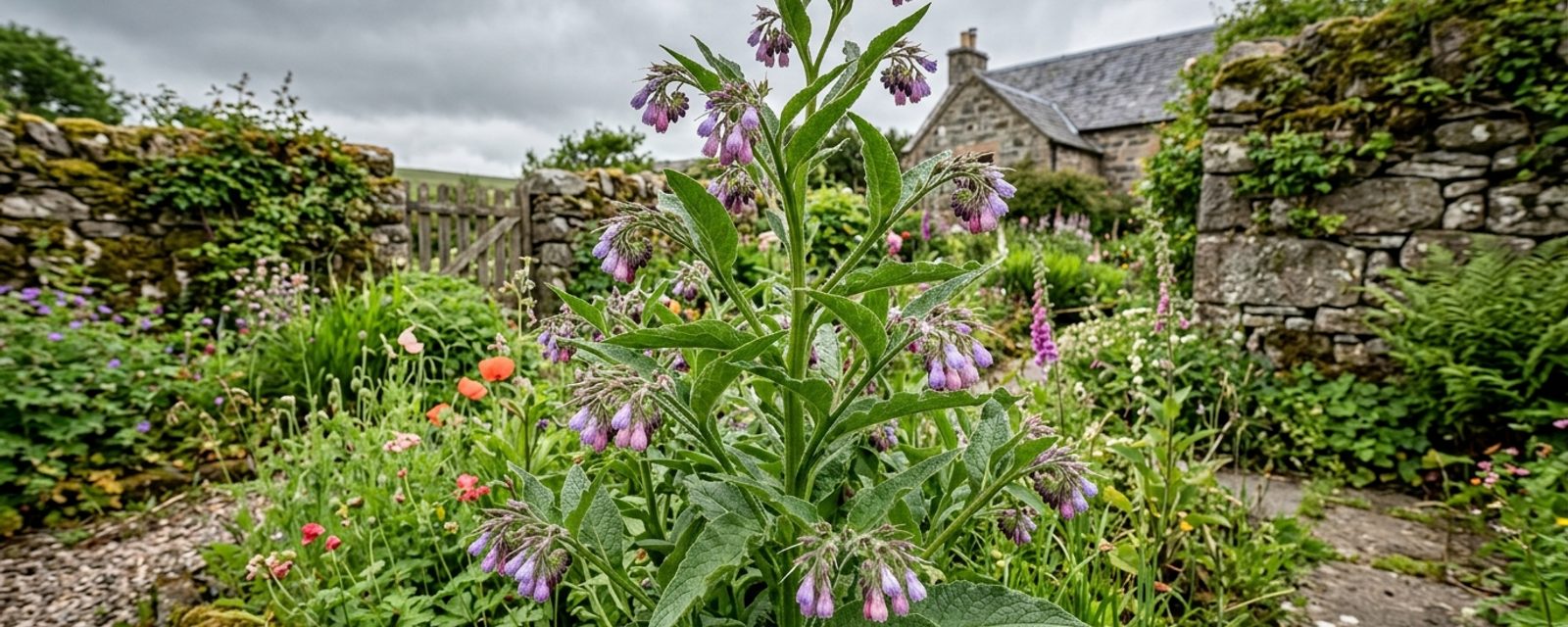
Comfrey isn't one plant with one job. Under a single common name sit several genuinely different Symphytum species and cultivarsA plant variety that arose or was bred under cultivation and is kept true by deliberate propagation, rather than a naturally occurring wild species. Full definition →, and they aren't interchangeable: one is a sterile hybrid bred purely to be cut for liquid feed, another is a native British wildflower that self-seeds through a border, and three more are garden forms selected for their flowers and foliage as ground cover rather than for the compost bucket. The real decision a Scottish gardener faces with comfrey isn't really about climate, every form here is rated H7The RHS's H1a–H7 scale for how much cold a plant can survive outdoors, H1a being tender indoor-only and H7 hardy anywhere in the UK. Full definition → (hardy in winters far colder than any UK site sees, below -20°C), and each dies back completely over winter and resprouts from the crownThe base of a perennial plant where roots and shoots meet, often sold and planted as a ready-made dormant plant rather than grown from seed. Full definition → in spring regardless of type, it's about matching the right Symphytum to the job you actually want it to do.
Quick answer
For a working feed patch, Bocking 14 is the right pick: sterile, non-invasive, and the cultivar named specifically for liquid feed. For ornamental ground cover, Symphytum 'Hidcote Blue' is the best all-rounder: it's the most compact of the three ornamental forms, tolerates any aspect, and carries some informal reputation for coping with dry shade. Creeping comfrey (S. grandiflorum) wins instead where the priority is dense, low, quick-spreading cover under shrubs, and tuberous comfrey (S. tuberosum) suits a wilder, informal planting where its slower spread and pendent yellow flowers can be left largely alone.
A cool, damp summer plays to comfrey's strengths rather than against it: every form here prefers consistently moist soil, rarely the limiting factor it is for drought-prone ornamentals. The same damp, sheltered growth that suits comfrey also suits slugs, so watch young spring shoots closely until the canopy closes over and outgrows the damage.
Feed versus foliage: two different jobs
None of the three ornamental forms below is grown for feed, and none of the five named forms carry an RHS Award of Garden Merit, the RHS's own mark of reliable garden performance. A feed patch is chosen for regrowth after repeated cutting; flowers and habit barely matter, since the plant rarely gets the chance to look established. Ground cover is chosen for the opposite reason, left largely uncut, judged on flower colour, season, height, and how well it suppresses weeds once it fills in. For the cutting schedule and feed-making method, see the full growing guide.
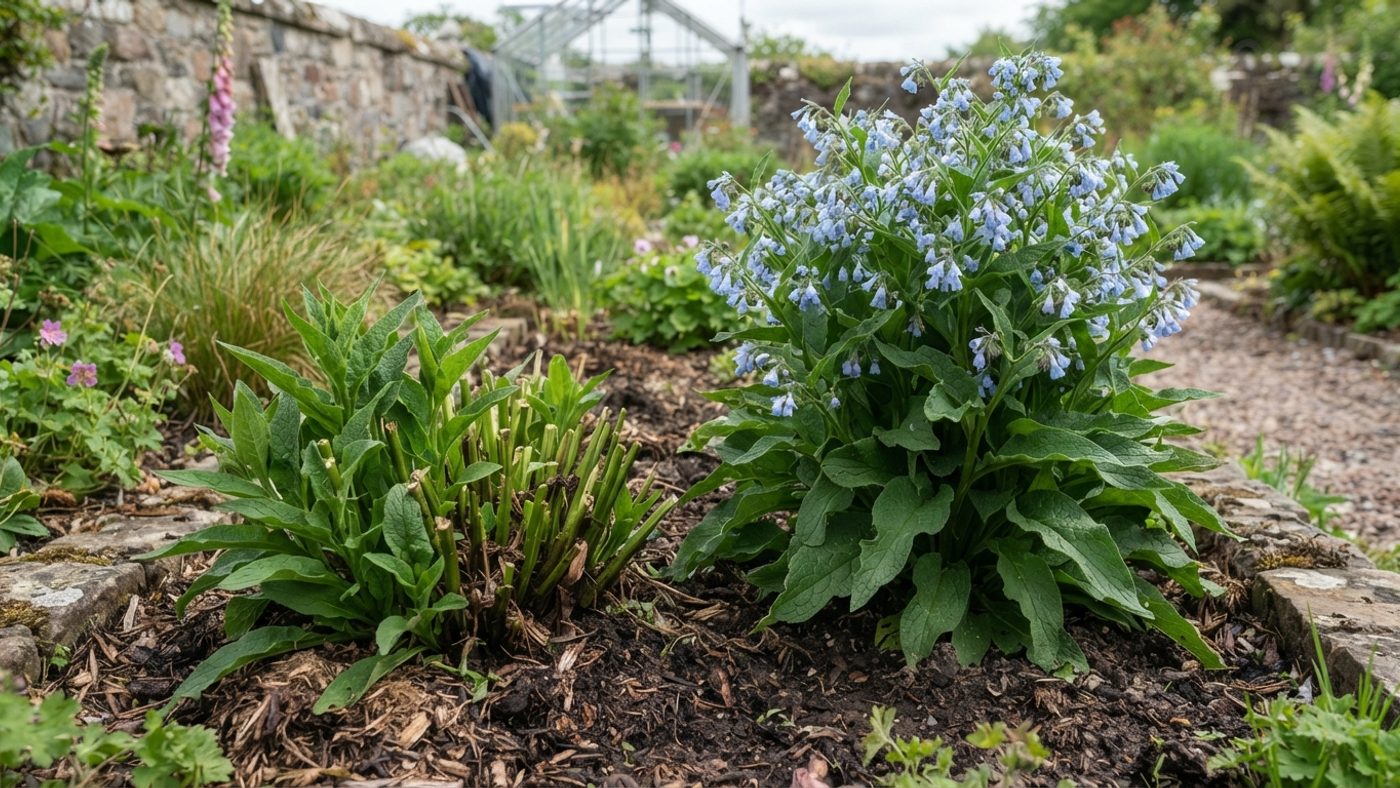
The five named forms, compared
| Variety | Primary use | Hardiness | Habit & spread | Flowers & season | Containment risk |
|---|---|---|---|---|---|
| Bocking 14 (S. x uplandicum) | Feed/liquid fertiliser | H7 | Clump-forming, non-invasive | Purple-blue, summer | Low, sterile, doesn't self-seed |
| Common comfrey (S. officinale) | Feed/liquid fertiliser | H7 | Clump-forming, self-seeds readily | Purple/pink/cream, summer | High, self-seeds and regrows from root left in soil |
| Creeping comfrey (S. grandiflorum) | Ground cover | H7 | Clump-forming, spread 0.5–1m, ~40cm tall | Cream from red-flushed buds, late spring/early summer | Moderate-high once established |
| Tuberous comfrey (S. tuberosum) | Ground cover / informal borders | H7 | Rhizomatous, 0.5–1m height and spread, 2–5 years to maturity | Pale creamy-yellow, pendent, early summer | Moderate-high once established |
| Hidcote Blue (S. 'Hidcote Blue') | Ground cover / borders | H7 | Upright, clump-forming, ~45cm | Pale blue from red buds, spring | Moderate once established |
The best ornamental pick, and where it loses
Hidcote Blue is the strongest general-purpose ornamental choice among the three ground-cover forms. It's the most compact of the three, suited to cottage gardens, wildlife gardens, borders, ground cover and banks or slopes, and it tolerates any aspect, north, south, east or west-facing. Non-RHS commentary also credits it with coping in dense, dry shade, worth trying, though that specific claim isn't confirmed on its own page. Like the other forms here, its long flowering season and open, tubular flowers are attractive to bumblebees, including long-tongued species that struggle with shorter flowers.
Creeping comfrey overtakes it where the goal is faster, lower, denser cover, its flowers open in distinctive one-sided hanging sprays, and it's the quickest of the three to knit together into a weed-suppressing mat. Tuberous comfrey is the right choice for a more relaxed, semi-wild planting instead: the slowest of the three to reach maturity, spreading by rhizome rather than seed, its small pendent flower clusters suit an informal cottage or wildlife-garden setting better than a tidy border edge.
All three ornamental forms propagate the same way as common comfrey, divisionPropagating a clump-forming perennial by digging it up and splitting it into several smaller pieces, each with roots and shoots attached. Full definition → of fleshy roots in spring, or root cuttings taken in early winter, rather than by seed, since none is typically sold or grown as a seed strain.
How many plants for a feed patch
A mature Bocking 14 crown, cut two to three times a season from its second year onward, produces a substantial armful of leaf per cut. For a domestic-scale liquid feed operation, enough for regular tomato and potted-plant feeding through a growing season, around 6 to 10 crowns, spaced roughly 60-75cm apart, is a reasonable working target; scale up for an allotment, or down if feed is only an occasional supplement. Treat this as a working estimate rather than a published figure.
Buying and propagating: seed isn't always an option
Bocking 14 is a sterile hybrid and cannot be grown from seed at all, it has to be bought as a young plant, or propagated vegetatively from root cuttings, crowns or division. That's a meaningful practical difference from common comfrey, which can be raised from seed sown in pots in a cold frame in autumn or spring. Anyone assuming they can save and sow seed to bulk up a Bocking 14 patch will be disappointed; it simply won't come true, because there's no viable seed to save. It isn't a mainstream seed-rack item either way, so expect to order it as a plant or root section from a herb or fruit-and-vegetable specialist rather than pick it up alongside bedding plants at a general garden centre.
Containment: the ornamental spreaders aren't hands-off either
Common comfrey's self-seeding and its habit of regrowing from any root section left in the ground is well known. The same underlying risk extends to two of the ornamental forms: both creeping comfrey and tuberous comfrey are described as having "the potential to become a nuisance" once established, requiring ongoing management to keep them within bounds. In practice that means treating them as you would any vigorous rhizomatous ground cover, dig out root sections thoroughly rather than assuming a single removal pass will finish the job, and think about where they're planted relative to less vigorous neighbours before putting them in. Comfrey of any kind is also described as harmful if eaten repeatedly, a caution that traces to the pyrrolizidine alkaloid compounds the whole genus contains; gloves are recommended when handling the foliage, since the hairy leaves and stems can also irritate skin.
Pest and disease pressure is otherwise low across the whole genus, comfrey is generally described as pest- and disease-free, slugs on young spring shoots aside (see above).
Common questions
Can I grow Bocking 14 from seed to save money on plants?
No. Bocking 14 is a sterile hybrid and produces no viable seed, so it has to be bought as a plant or propagated by root cuttings, crowns or division. Common comfrey, by contrast, can be raised from seed.
Is Hidcote Blue invasive in the same way as common comfrey?
It carries the same general caution as the other ornamental forms, the potential to become a nuisance once established and to need ongoing management, but it isn't described as self-seeding the way common comfrey is, since its spread comes from clump growth rather than seed dispersal.
Can I use flowers from creeping or tuberous comfrey to make liquid feed?
There's nothing preventing it botanically, but neither is grown or recommended for that purpose, Bocking 14 and common comfrey are the varieties actually named for feed production. The full growing guide covers the cutting schedule, both steeping methods, and dilution rate for making the feed itself.
Will ornamental comfrey cope in a shady border?
All three ornamental forms tolerate sun or partial shade. Hidcote Blue also has an informal reputation for coping with denser shade, though that specific claim isn't confirmed on its own plant page.
How long before tuberous or creeping comfrey fill out as ground cover?
Tuberous comfrey is stated to take two to five years to reach maturity. Creeping comfrey's timeline isn't given a specific figure, but its larger stated spread (up to a metre) suggests it fills in faster once established.
Sources
6 sources, recorded with what each was used for
- Symphytum x uplandicum 'Bocking 14': Sterility, non-invasiveness, hardiness, habit, feed use
- Symphytum officinale (common comfrey): Hardiness, self-seeding habit, flower colour, containment caution
- Symphytum 'Hidcote Blue': Habit, flowers, aspect tolerance, garden uses, nuisance/containment note
- Symphytum grandiflorum (creeping comfrey): Habit, spread, flowering, shade tolerance, nuisance/containment note
- Symphytum tuberosum (tuberous comfrey): Habit, spread, maturity timeline, flowering, nuisance/containment note
- How to grow comfrey: "Unsuitable for all except the largest gardens" caution, seed propagation of common comfrey, skin-irritation handling note