
Cabbage Root Fly is a common pest that affects broccoli, brussels sprouts and cabbage in Scotland. Here is what it looks like, how to spot the damage, and which controls have been tested.
What does it look like?
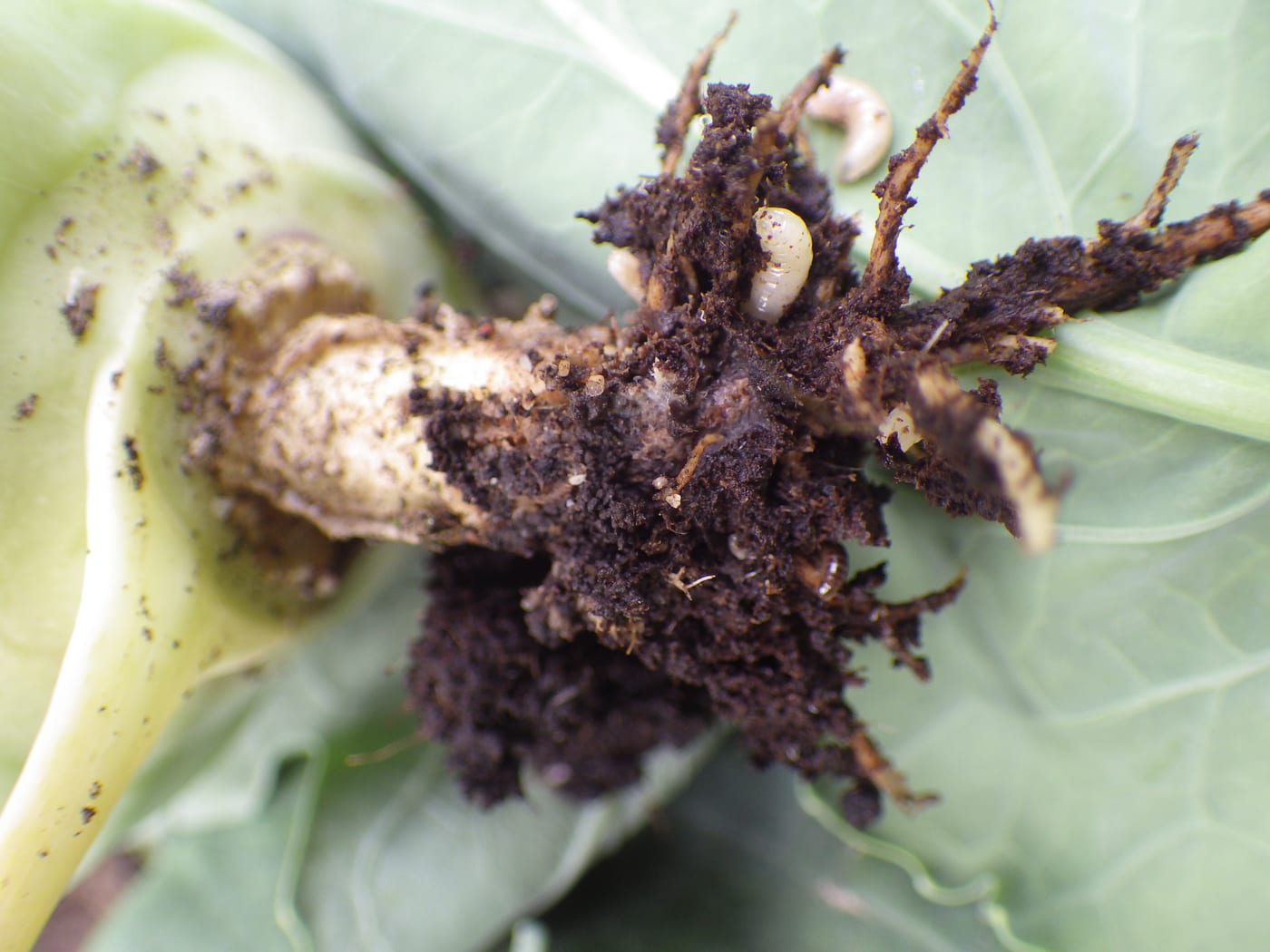
Adult flies resemble small house flies. The damage is done by the larvae: white, legless, headless maggots up to 9mm long that tunnel into roots. Affected plants show poor growth and wilt, and recent transplants can die outright. On root crops (swede, turnip, radish) the maggots tunnel directly into the edible root; on Brussels sprouts the buttons can be tunnelled individually.
What causes it
Not weather-driven. The real risk factor is plant age: younger plants are far more vulnerable than established ones, since they haven't yet built the root mass to shrug off maggot damage. More on the timing this creates below.
Is this pest active now?
Late spring to early summer: The highest-risk window. Make sure collars or mesh are already in place before this generation emerges, not after.
Through summer into early autumn (April to September overall): Two further generations follow, causing progressively less damage as the season goes on.
These are UK-generic timings. Scottish onset may differ. Use the Frost Date Calculator to adjust for your region.
🌱 Plants at risk
Cabbage Root Fly also affects these crops:
Life cycle
Three generations occur during the summer, but it is the first generation, in late spring to early summer, that is often the most damaging. Young transplants and seedlings have the smallest root systems and the least capacity to tolerate maggot damage. Later generations cause less damage as plants mature and build larger root systems. Fully-fed larvae pupate in the soil, either emerging as adult flies a few weeks later or remaining as pupae over winter.
Why this matters in Scotland
One of the two brassicaThe cabbage family: cabbage, kale, broccoli, cauliflower, Brussels sprouts, kohlrabi, swede, turnip and more, sharing the same pests, diseases and rotation rules. Full definition → pests Scotland's cool summers genuinely hold down, alongside cabbage aphid.
SAC/SRUC Technical Note T488 names cabbage root fly specifically, not brassica pests in general: 'the cool summers bring a lower incidence of the difficult brassica pests, cabbage aphid and cabbage root fly, than growers face further south.' That is a real, if partial, advantage: it lowers pressure, it does not remove the pest, and RHS's own three-generation model still applies once it is present. Mesh and collars remain the reliable defence regardless of the lower baseline pressure.
Controls: what actually works
All the methods below are backed by real evidence, not just repeated folklore.
Brassica collar: fit an 8-15cm circle of carpet underlay, roofing felt or cardboard around the base of the stem at transplanting
A collar around the base of a recent transplant stops adult flies laying eggs in the soil next to the stem, which is where the vulnerable early-life larvae need to reach the roots. This is specifically for moduleA tray divided into small individual cells, each sown with its own seed or seedling, so each plant grows undisturbed roots until it's ready to plant out. Full definition →-raised brassicas moved out as transplants (broccoli, brussels sprouts, cabbage, calabrese, cauliflower, kale, kohlrabi, pak choi). Radish, swede and turnip are usually sown direct, with no transplant moment for a collar to protect — mesh from sowing is the equivalent defence for those.
Insect-proof mesh: grow under it for the life of the crop
Covering the crop with insect-proof mesh excludes the adult fly entirely, so no eggs are laid near the plant in the first place.
Same logic as carrot fly and cabbage caterpillars: exclude the adult and there are no larvae. Mesh is the one control that works against most of Scotland's common brassica and root-crop insect pests at once.
Crop rotationMoving each crop family to different ground each year, on a multi-year cycle, so pests and diseases that build up in soil don't get a repeat host. Full definition →: do not grow brassicas in the same ground as the previous year
Rotation matters here specifically because pupae overwinterKeeping a plant alive and intact through the cold months, whether left outdoors, moved under cover, or stored dormant. Full definition → in the soil where the previous crop grew, so moving the bed puts next spring's emerging flies away from a host plant.
Biological control: pathogenic nematodes watered into the soil
A mixture of pathogenic nematode species, sold as a biological control, targets cabbage root fly larvae in the soil.
Nematodes can kill non-target species too, worth knowing before applying broadly and not just when targeting a single pest.
Encourage natural predators: birds, hedgehogs and ground beetles
Check susceptible plants frequently from spring onwards
Regular checks from spring let you act before a damaging population builds up, rather than discovering wilted transplants after the damage is already done.
Frequently asked questions
What should I do first if I find cabbage root fly in my garden?
Start with brassica collar. After that, insect-proof mesh. Work through the rest in order of how well-evidenced they are if the first two aren’t enough on their own.
Will cabbage root fly kill my plants?
They rarely kill established plants. The damage is usually cosmetic on outer leaves, and natural predators often bring numbers under control without you doing anything.
When are cabbage root fly most active in Scotland?
Check the seasonal activity section above. Scottish timings can run a few weeks behind the UK-generic figures.
Sources
2 sources, recorded with what each was used for
- RHS1: Latin name, identification (adult and larval appearance, damage description), life cycle (three generations, first-generation severity, pupation and overwintering), affected crop group summary, collars, mesh, rotation, biological control (nematodes), predator encouragement, monitoring advice, no chemical control
- SAC/SRUC13: Scottish brassica pest pressure: cabbage aphid and cabbage root fly specifically named as lower-incidence in Scotland's cool summers